


Thamel has been in the limelight since the hippie years, and it still wins people over. Every corner holds people from a different part of the world, each carrying a story of their own.
Most trips to Nepal begin and end within a square kilometer of narrow streets north of Kathmandu Durbar Square. Thamel is home to the guesthouses, gear shops, trekking offices, bakeries, and bars. Our clients arrive at Tribhuvan International Airport and reach a hotel in Thamel within 40 minutes. The next morning, they buy a last pair of gloves before flying to Lukla.
Thamel rewards a slow walk more than a checklist. The guide below covers what the quarter is and how it grew. It also covers how to navigate it and what to buy. You will find where to eat and what to watch for after dark.
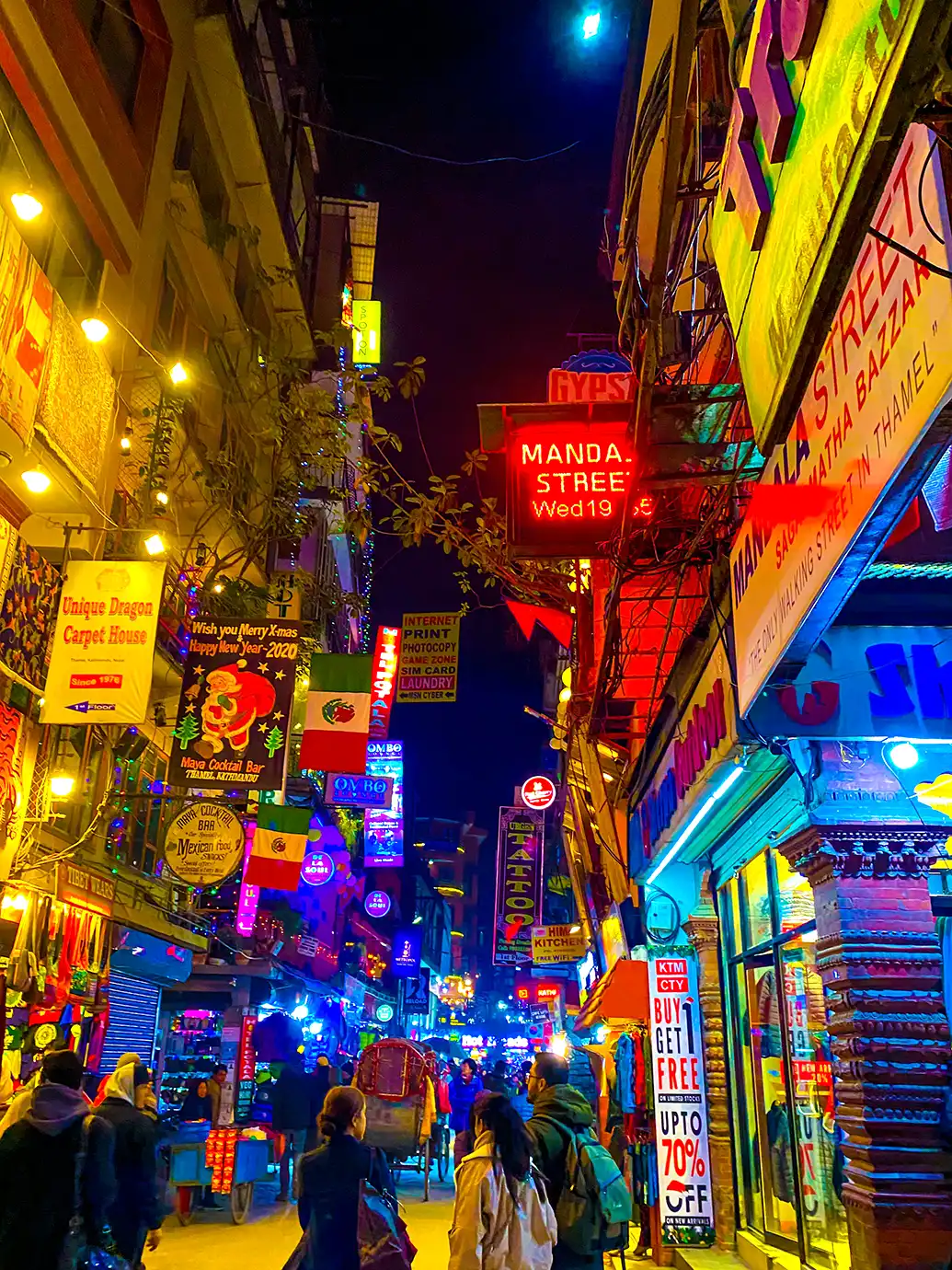
What Thamel Is and Why Most Trips Start Here
Thamel is Kathmandu’s tourist quarter, a dense grid of lanes packed with hotels, restaurants, outdoor shops, bookstores, travel agencies, and bars. Nothing in it is a monument. The appeal lies in convenience and atmosphere, because almost everything a traveler needs sits within a ten-minute walk.
The quarter has no official boundary. Locals treat Tridevi Marg as the southern edge, Chhetrapati as the western limit, and the streets around Saat Ghumti as the northern end. Inside that area, old Newari houses with carved window frames stand beside concrete buildings hung with signboards for rooftop bars, massage rooms, and expedition outfitters.
Thamel works as a base for three kinds of visitors. Trekkers use it to buy kit, meet guides, and sleep off jet lag. Culture travelers use it as a short walk from Durbar Square, Asan, and the Garden of Dreams. Long-stay visitors use it for cheap rooms, fast internet, and company.
How Thamel Became Kathmandu’s Tourist Quarter
One correction is worth making early. The hippies of the 1960s did not gather in Thamel. They gathered in Jhochhen Tole, south of Durbar Square, a lane travelers renamed Freak Street. Thamel took over later, and the shift changed the character of Kathmandu tourism.
Freak Street drew the overland travelers who came down the road from Europe through Iran, Afghanistan, and India. Government-licensed hashish shops operated openly, and cheap lodges filled with young Westerners. Nepal banned cannabis in the early 1970s under international pressure, the shops closed, and the crowd thinned out.
Thamel grew for a different reason. The Kathmandu Guest House opened in a converted Rana mansion in 1967 as the area’s first hotel. Mountaineers and trekkers started using it as a base. As trekking replaced the overland trail as Nepal’s main draw, guesthouses, gear shops, and agencies clustered around it.
The hippie influence survives in the merchandise rather than the crowd. Racks of loose cotton and hemp clothing, tie-dye prints, block-printed cloth, and beaded jewelry still fill the shopfronts. Tibetan and Newari crafts sit alongside all of it, giving Thamel its particular mix.
Finding Your Way Around Thamel
Thamel defeats most maps on a first visit. Street signs are rare, lanes bend and rejoin, and shops look alike after the third turn. Find your way by junctions, called chowks, and by landmark businesses rather than by street names. The layout resolves within a day.
A few anchors help. Thamel Chowk sits near the middle. Chaksibari Marg and Mandala Street run through the core and hold many of the restaurants. JP Road leads south toward Chhetrapati. Saat Ghumti, meaning seven corners, curls through the north with trekking shops and coffee places. Tridevi Marg runs east toward the Garden of Dreams and on to Durbar Marg.
Several central stretches were declared vehicle-free in October 2017, and walking there is far calmer than it once was. Enforcement varies by day and by street, so expect motorbikes to appear on lanes that are meant to be closed. Stay to one side, listen for horns, and let the traffic pass rather than trying to weave through it.
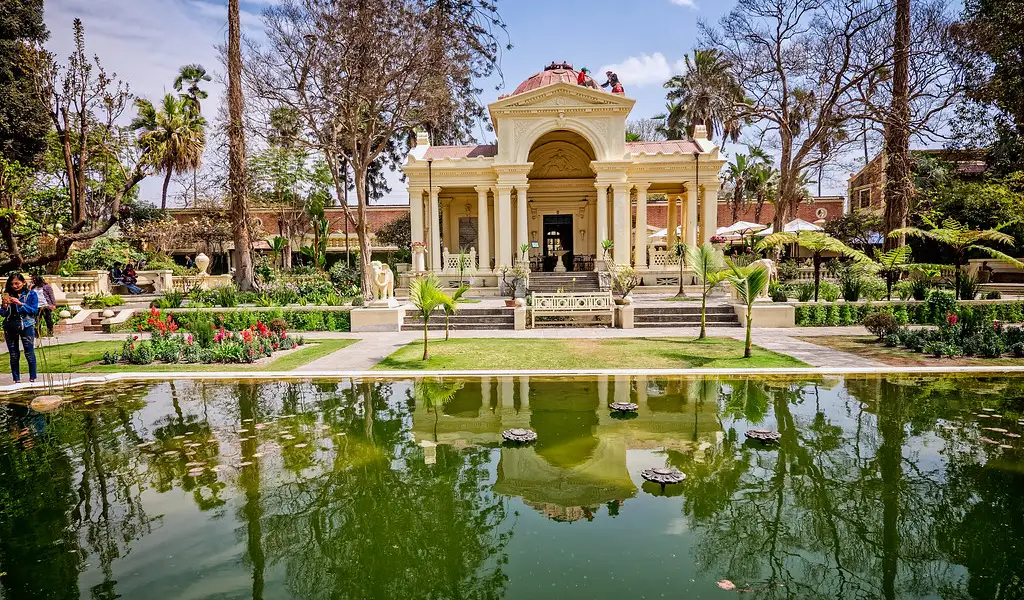
Distances are short. Kathmandu Durbar Square is a fifteen to twenty-minute walk south. The Garden of Dreams sits about five minutes east on Tridevi Marg. Asan, the old trading bazaar, lies ten minutes southeast and shows a working Kathmandu market rather than a tourist one. Swayambhunath takes about 40 minutes on foot or 10 minutes by taxi.
Shopping in Thamel: Gear, Crafts, and What to Check
Thamel sells trekking equipment, pashmina, singing bowls, thangka paintings, khukuri knives, prayer flags, tea, jewelry, and clothing. Quality runs the full range. Knowing which items are usually genuine and which are usually copies saves both money and disappointment on the trail.
Trekking gear. Many shops sell copies made in Kathmandu with familiar logos stitched on. Copies work for items under light stress, such as duffel bags, fleece liners, gloves, and sock liners. Copies fail for items that keep you alive, such as boots, down jackets, and shell layers. Genuine brand outlets exist in Thamel, and their prices are close to Western retail prices.
Rental over purchase. Sleeping bags, down jackets, poles, gaiters, and microspikes all rent by the day near Thamel Chowk. Check zips, loft, and seams before signing. Peregrine lends a duffel, a sleeping bag, and a down jacket on request, so many of our clients rent nothing at all.
Crafts. Singing bowls, thangka paintings, statues, felt goods, lokta paper, and handwoven textiles are genuine Nepali products and make better souvenirs than mass-printed shirts. Ask where a thangka was painted and how long it took; a reputable shop will answer in detail.
Pashmina. Pure pashmina is soft, light, and expensive. Blends with silk are common, honest, and widely sold. A cashmere-priced shawl that feels slippery and heavy is neither.
Export rules. Antiques and genuinely old religious items need certification from the Department of Archaeology before leaving Nepal. Khukuri knives must travel in checked baggage, never in the cabin. Ask any shop for paperwork when an item looks old.
Bargaining and Prices: How It Works
Most Thamel shops price for tourists and expect a negotiation. Genuine brand stores, supermarkets, pharmacies, and restaurants use fixed prices. In the craft and clothing shops, a friendly counteroffer around half to two-thirds of the asking figure usually lands somewhere fair.
Bargaining here is conversation, not conflict. Ask the price, pause, smile, name a lower figure, and let the shopkeeper come back. Buying two or three items together gives both sides room to move. Walking away is an acceptable move, and shopkeepers rarely take it badly.
Judgment matters more than victory. Many Thamel traders run small businesses on thin margins, and rents in the quarter are high. Pushing a vendor down to the last hundred rupees over a hand-felted bag helps nobody. Settle at a price you are happy with and leave it there.
Carry small notes. Many shops struggle to change a large bill early in the day. ATMs are located throughout the quarter, though machines run out of cash during festivals, and a per-transaction fee usually applies.
Where to Eat and Drink in Thamel
Thamel feeds every budget, from dal bhat at a local kitchen to stone-baked pizza and Korean barbecue. The area has fed hungry trekkers for decades, so portions are large, and menus are long. A handful of restaurants have survived for years on repeat custom rather than passing traffic.
Long-standing names include Fire and Ice for Italian and OR2K for Middle Eastern vegetarian food on Mandala Street. Northfield Cafe and Roadhouse Cafe serve casual Western dishes, and New Orleans Cafe, near the Kathmandu Guest House, hosts live evening music. Newari restaurants around Chhetrapati and Asan serve bara, chatamari, and choila to a mostly local crowd.
Rooftop terraces are the quarter’s best feature at the end of a trek. The traffic noise falls away, the Kathmandu skyline opens up, and a plate of momo tastes better than it has any right to. Sam’s Bar and the older pubs near the Kathmandu Guest House draw climbers and guides between expeditions.
Two practical notes. Bars and restaurants usually add service charge and tax to the listed price, so ask before ordering if the menu is silent. Tap water is not safe to drink, and reputable restaurants serve filtered or bottled water.
Books, Music, and the Sound of the Quarter
Thamel has kept its bookshops through the internet era, and it remains one of the better places in Asia to buy Himalayan literature. Music carries the same weight. Shops play Tibetan chant and Nepali folk music into the street, and Gandharva musicians perform live in the lanes.
Pilgrims Book House ranks as a landmark. The original store burned down in May 2013. The rebuilt shop on JP Road carries mountaineering accounts, Buddhist texts, maps, language guides, and Nepali fiction in translation. Summit Bookshop and several secondhand dealers trade paperbacks, which suits anyone finishing a book before a long bus ride.
The Gandharvas, Nepal’s traditional caste of traveling musicians, play the sarangi on Thamel’s corners. The four-stringed instrument is carved from a single block of wood and bowed like a fiddle. Buying one and taking a short lesson from the player costs little and gives you the story behind the sound.
Music students and researchers come to Thamel for the same reason. Folk players who know the sarangi, madal, and bansuri teach informally in the back rooms of instrument shops. Ask at any music shop if you want a lesson rather than a souvenir.
Where to Stay, and When to Look Elsewhere
Thamel holds hundreds of properties, from twelve-dollar guesthouses to boutique hotels in restored courtyards. Staying within the quarter offers convenience, a wider selection of food, and easy access to your trekking office. Staying just outside brings quiet. The right answer depends on the trip.
Stay in Thamel when your trip is short, when you have gear to buy, or when you want to walk to dinner. Rooms facing an inner courtyard are far quieter than those facing a lane. Ask for an upper floor at the back when you book.
Look to Lazimpat, Jhamsikhel, or Boudha when you want calm, when you are traveling with children, or when you are recovering from a long trek. All three sit within a fifteen to twenty-minute taxi ride. Boudha also puts the great stupa on your doorstep, which entirely changes the rhythm of the morning.
Bring earplugs, whatever you choose. Thamel runs late, dogs bark through the night, and construction starts early. Clients on our Luxury Everest Base Camp Trek often take a quieter heritage property for the first two nights. They walk into Thamel only for shopping.
Staying Safe and Sensible in Thamel
Thamel is a safe area by the standards of most capital cities, with visible police and crowded streets late into the evening. The risks are petty rather than violent. Drug offers, aggressive touts, inflated taxi fares, and unlicensed trekking agents make up almost all of the trouble travelers meet.
Drugs. Cannabis and hashish have been illegal in Nepal since the early 1970s. Sellers still approach visitors in the lanes and whisper an offer. Foreign nationals have been arrested and jailed for possession, and your travel insurance covers none of it. A short refusal and a continued walk end the conversation.
Touts and agents. Anyone who approaches you on the street offering a trek, a guide, or a helicopter seat is not a licensed operator. Book through a company registered with the Nepal Tourism Board and TAAN. Check the registration number, and pay into a company account rather than a personal one.
Money. Use ATMs attached to bank branches during daylight. Count cash before leaving the counter and keep your card in sight during payment. Carry a day’s spending in a front pocket and leave the rest in the hotel safe.
Traffic and footing. Motorbikes pass close in lanes that look like pedestrian lanes. Open drains, cables, and uneven stone slabs catch tired feet after dark. A headlamp or phone torch is genuinely useful during a power cut.
Crowds. Pickpocketing happens in the busiest stretches on festival nights. Wear your daypack on your front in a crush, as you would anywhere.
When to Visit Thamel, and at What Hour
October and November bring the year’s busiest streets, clear skies, and full hotels, followed by March through May. The monsoon months empty the quarter and drop room rates sharply. Time of day matters as much as season, because Thamel changes character three times between morning and midnight.
Mornings are calm and practical. Shops open around nine or ten, the light is good for photographs of carved windows, and gear shopping is unhurried. Late afternoon brings the crowds, the touts, and the noise. Evenings belong to the restaurants and the live music, and most places wind down between eleven and midnight.
Festival timing changes everything. Dashain and Tihar in autumn close many shops for several days while families travel home. Indra Jatra brings masked dances and chariot processions to Durbar Square, a short walk away. Ask your hotel which days local businesses will shut.
Frequently Asked Questions About Thamel
The questions below most often come up for travelers about to spend their first night in Kathmandu. They cover safety, how long to stay, buying gear, cannabis laws, the distance to the airport, and what to see in an afternoon.
Is Thamel safe for solo travelers and women?
Yes, with normal city caution. Streets stay busy and policed until late, and solo travelers use Thamel as a base year-round. Avoid empty back lanes after midnight, decline drink invitations from strangers, and use a hotel-called taxi rather than an unmarked car late at night.
How many days should I spend in Thamel?
Most visitors need one or two days at the start of a trip for gear, permits, and jet lag, plus a night at the end. Kathmandu itself deserves two to three days for Durbar Square, Swayambhunath, Boudhanath, Pashupatinath and Patan, none of which are in Thamel.
Can I buy real trekking gear in Thamel?
Yes. Genuine brand outlets operate alongside shops selling local copies. Buy or rent copies for duffels, liners, and gloves. Buy genuine boots, down jackets, and shell layers, or bring those from home and test them before you fly.
Is cannabis legal in Nepal?
No. Nepal banned cannabis and hashish in the early 1970s, and possession carries fines and imprisonment. Street sellers in Thamel still approach visitors, and buying from them puts your trip and your record at risk.
How far is Thamel from the airport?
Tribhuvan International Airport is about six kilometers away, and it takes twenty to forty minutes depending on traffic. Peregrine includes a private airport transfer with every package, and our representative meets you in the arrivals hall holding a nameplate.
What should I not miss in Thamel?
Walk Saat Ghumti in the morning and stop at a rooftop for lunch. Listen to a sarangi player on a corner, browse Pilgrims Book House, then walk five minutes to the Garden of Dreams before dinner.
Is Thamel a good place to stay with children?
It works for a night or two, though the noise and the motorbikes wear families down. Lazimpat and Jhamsikhel offer quieter rooms and gardens within a short taxi ride, and Thamel stays a twenty-minute visit rather than a base.
Planning a trek or a Kathmandu stay? Write to sales@peregrinetreks.com or message us on WhatsApp at +977 985 105 2413. Our team will build an itinerary around the time you want in the city.