

Based on 12 reviews

Nepal and Bhutan Tour
Start a cultural tour of two impressive kingdoms - Nepal and Bhutan.

Duration
12 Days

Meals
- 11 Breakfast
- 06 Lunch
- 06 Dinner

Accommodation
- Aarya Hotel
- Aikawa Hotel
- Mandala Resort etc

Activities
- Sightseeing
- Jungle Safari
- Tiger’s Nest Hike
SAVE
US$ 892Price Starts From
US$ 4460
Overview of Nepal and Bhutan Tour
Few journeys in the world ask you to cross two kingdoms in twelve days and come back changed. The Nepal and Bhutan Tour does exactly that. Peregrine Treks has operated this dual-nation route since 2008, refining the experience to ensure every detail — from lodge placement and seasonal road logistics to the precise timing required for the Tiger’s Nest — is handled with precision.
Nepal opens the expedition. Kathmandu’s Durbar Squares, the dawn ceremonies at Pashupatinath, and the Himalayan panoramas above Pokhara are not simply sights to be seen; they are deep, living traditions. We then shift the pace in Chitwan, where your path takes you from ancient cities into the heart of the jungle. Seven days in Nepal cover altitude, wilderness, and culture in a sequence that feels both logical and immersive.
Bhutan concludes this narrative on different terms. Tourism here is intentionally curated. Every guest supports the Kingdom’s commitment to free education, healthcare, and carbon-negative forestry through the Sustainable Development Fee (USD 100 per person per day). Peregrine manages this entire process as a licensed operator, handling your group visa, guide assignments, and all government-mandated requirements seamlessly. You are not visiting Bhutan as a standard traveler; you are a guest of the Kingdom.
Your itinerary through Bhutan — from the drive over the 3,100-meter Dochula Pass to the riverside serenity of Punakha Dzong — is designed as a cohesive story. The experience culminates in the hike to Taktsang Monastery (Tiger’s Nest).. Perched on a cliff 900 meters above the Paro Valley, this sanctuary is the most profound reward of the trip. The trail gains significant elevation on loose earth — proper hiking boots and trekking poles are not optional.
Climate & Timing
Spring (March–May) and Autumn (September–November) offer the clearest mountain views and most stable flight weather across both nations. While Bhutan’s rain shadow makes the monsoon season manageable, it can impact visibility in Nepal’s Chitwan and Pokhara regions. Winter (December–February) brings crisp, clear skies and quiet trails — perfect for travelers who prefer solitude and don’t mind the brisk mountain air.
Trip Highlights
- The Kathmandu Cultural Circuit: A guided exploration through the spiritual heart of the valley, including Pashupatinath, Boudhanath Stupa, Swayambhunath, and the historic Kathmandu Durbar Square.
- Himalayan Perspective: A scenic mountain flight providing an intimate aerial look at the Everest and Sagarmatha Himalayan range.
- Pokhara Serenity: Sunrises from Sarangkot and the quiet waters of Phewa Lake.
- Chitwan Wilderness: Jeep safari through core jungle zones, canoe on the Rapti River, and an evening Tharu cultural dance performance.
- Thimphu Heritage: A curated exploration of the National Memorial Chorten, local artisan schools, and the cultural landscape of the Bhutanese capital.
- The Dochula Pass: Crossing the 108 Druk Wangyal Chortens with panoramic views of the high Himalayas.
- Punakha Dzong: A visit to the majestic junction of the Pho Chu and Mo Chu rivers, home to the sacred relics of the Kingdom.
- The Tiger’s Nest Pilgrimage: A guided ascent to Paro Taktsang, the cliffside monastery that serves as the spiritual crown of the Bhutanese experience.

Verified on Independent Travel Platforms
5.0
★★★★★
20 verified reviews
Detail Itinerary of Nepal and Bhutan Tour
Day 01: Arrival in Kathmandu
A Peregrine representative meets you at Tribhuvan International Airport and escorts you directly to your hotel. That afternoon, your tour leader holds a group briefing covering the full itinerary, day-by-day schedule, and any last-minute adjustments. Come with questions — this is the right moment to raise them.
Kathmandu is home primarily to the Newari people, whose history stretches back more than a thousand years. That heritage shows up everywhere: in the carved wooden facades of courtyard temples, in the metalwork sold at street-level workshops, and in the food.
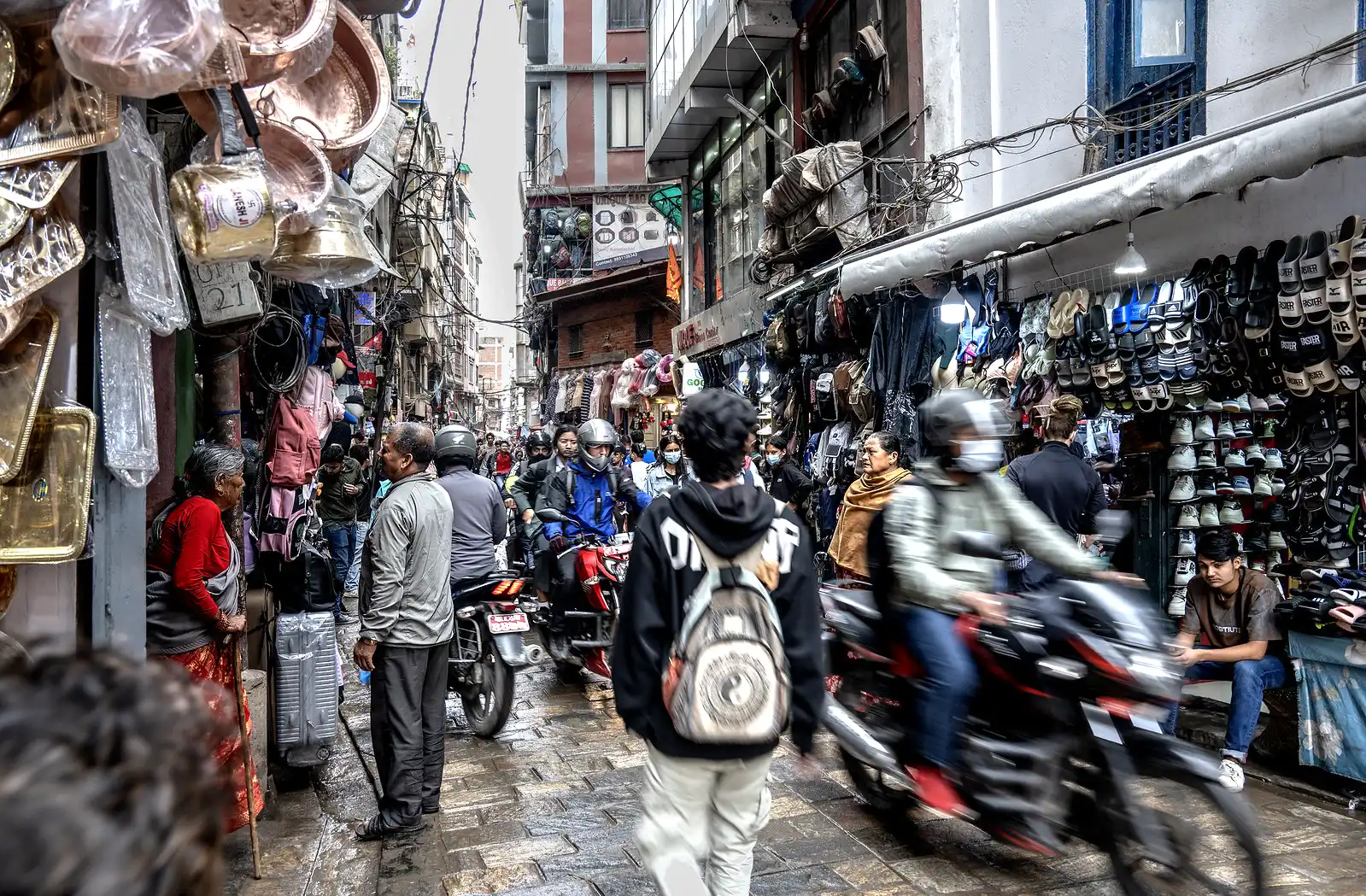
Ason and Indrachowk are the city’s oldest trading bazaars — narrow lanes stacked with spice vendors, thangka painters, and brass temple wares. An evening walk through either takes less than an hour and sets the tone for everything that follows.
Accommodation: Aarya Hotel and Spa – Eternal Heritage or similar
Meals: Not Included
Day 02: Mountain Flight to Mount Everest and Kathmandu return
The day begins before sunrise. Your mountain flight departs early to catch the clearest air, tracing a route along the high Himalayan wall east of Kathmandu. From your window seat, the summit of Mount Everest — 8,849 meters, the highest point on Earth — comes into view alongside Lhotse, Makalu, and the full sweep of Sagarmatha National Park, the first national park in Nepal to be listed as a UNESCO World Heritage Site. Weather is variable by season; Peregrine monitors conditions and will advise if scheduling adjustments are needed.
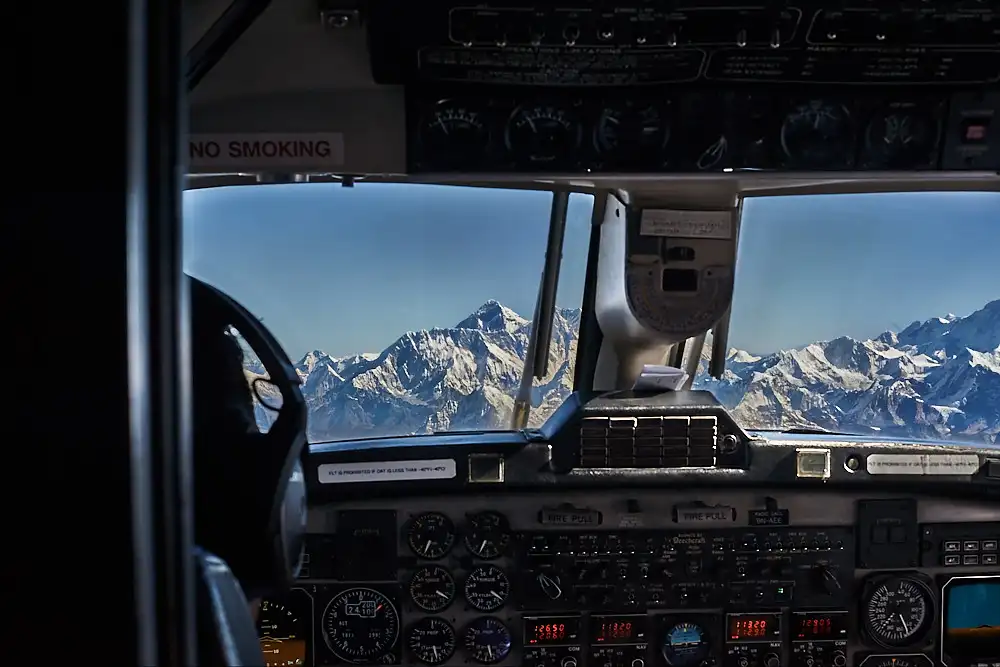
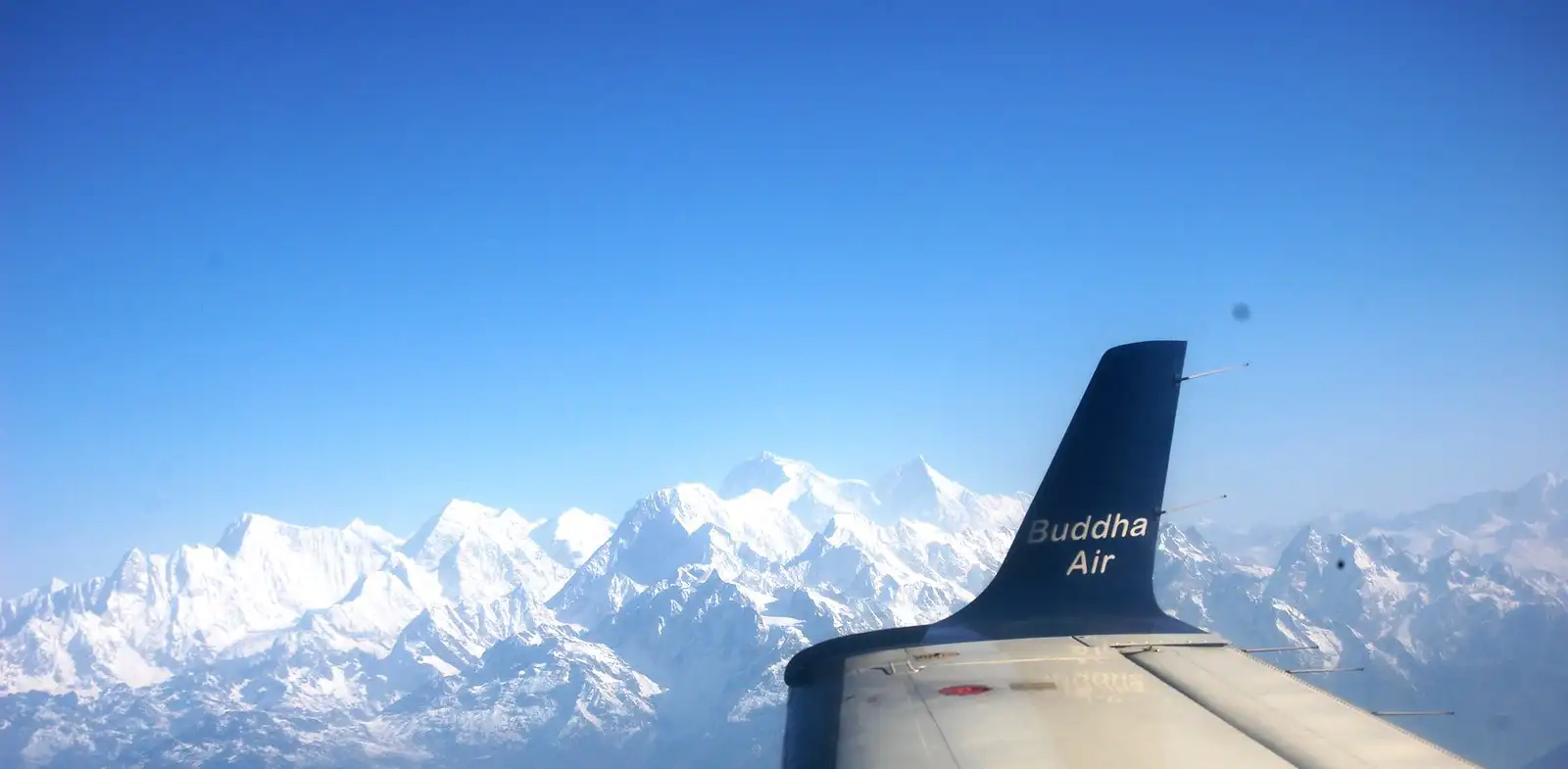
Back in Kathmandu, the afternoon moves through four of the valley’s most significant sites.
Boudhanath Stupa ranks among the largest stupas in Asia, built at the crossroads of the ancient Tibetan trade route into Kathmandu. The whitewashed dome, the watchful painted eyes, and the constant circuit of monks and pilgrims turning prayer wheels make it one of the most alive religious sites in the region — not a museum piece, but a functioning center of Tibetan Buddhist practice.
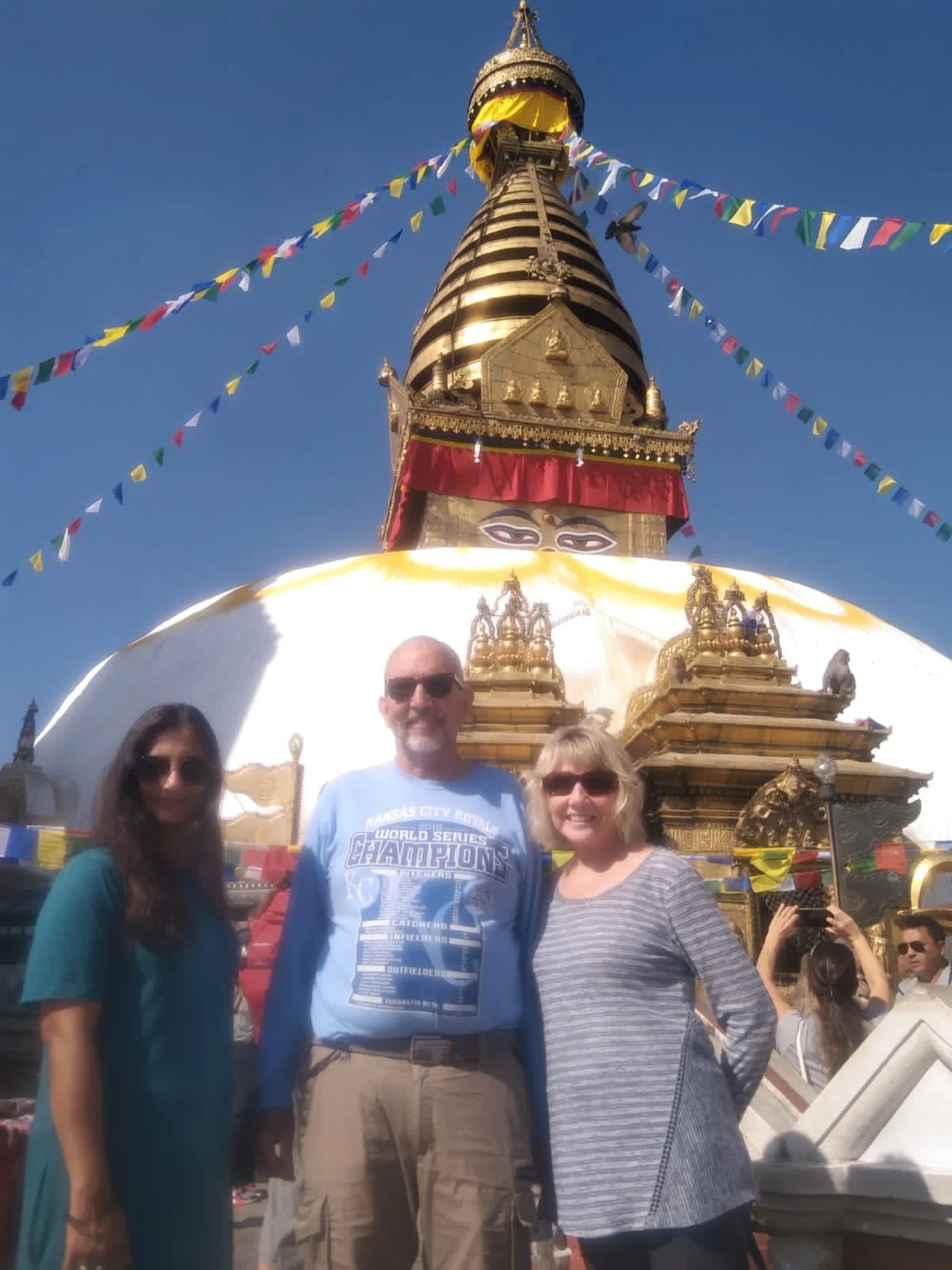
Swayambhunath — known informally as the Monkey Temple — sits on a hillock west of the city and requires a climb of 365 steps to reach the main stupa. The site predates recorded Kathmandu Valley history and offers one of the clearest panoramic views over the city. The resident rhesus macaque population is large and territorial; keep food out of sight.
Pashupatinath Temple dates to the 5th century.. Its complex of shrines and ashrams lines the banks of the Bagmati River, one of the most sacred rivers in Hinduism. Along the ghats, you may witness cremation ceremonies conducted in the open air. This is a living funeral tradition; your guide will prepare you for what to expect and will step back with you if you prefer more distance.
Kathmandu Durbar Square completes the afternoon.. The stonework here dates to the Lichhavi period — third-century architecture still standing in an open plaza, inscribed as a UNESCO World Heritage Site in 1979. The scale of the craftsmanship, built without modern tools or materials, is difficult to absorb in a single visit.
Accommodation: Aarya Hotel and Spa – Eternal Heritage or similar
Meals: Breakfast
Day 03: Fly to Pokhara and Lakeside Exploration
The flight from Kathmandu to Pokhara takes approximately 25 minutes and departs in the late morning. Before you travel, one practical reality is worth understanding: domestic flights in Nepal are among the most weather-dependent in the world. Kathmandu and Pokhara both sit in mountain valleys where visibility, wind, and cloud cover can shift within the hour.
Delays are common across all seasons and are not a reflection of the airline or the operator — they are a function of flying in the Himalayas. Peregrine monitors flight status from the morning of departure and will keep you informed of any changes. Carry a book, download something to watch, and treat any wait at the terminal as the first unhurried moment of the Pokhara leg. The flight itself, when it goes, is 25 minutes of low-altitude mountain scenery that no road journey replicates.
On arrival, the transfer to the hotel takes approximately 20 minutes. The Pokhara Valley sits at a lower elevation than Kathmandu; the air is warmer, and the pace shifts immediately on landing. On a clear day, the Annapurna and Machhapuchhre (Fishtail Peak) ranges are visible from the aircraft window before you touch down.
The afternoon is free for rest and independent exploration of the lakeside. The hotel sits within comfortable walking distance of Phewa Lake — close enough to reach on foot, positioned away from the noise of the busiest part of the Lakeside strip, so that sleeping is not a problem.
Phewa Lake is the natural starting point. The lakeside promenade runs for several kilometers and rewards an unhurried walk — local tea houses, art galleries, gear shops, and open-air cafes line the route, with the lake and the Annapurna range providing the backdrop. The reflection of Machhapuchhre on calm afternoon water is one of the quieter pleasures of Pokhara and requires nothing more than finding a seat with a view.
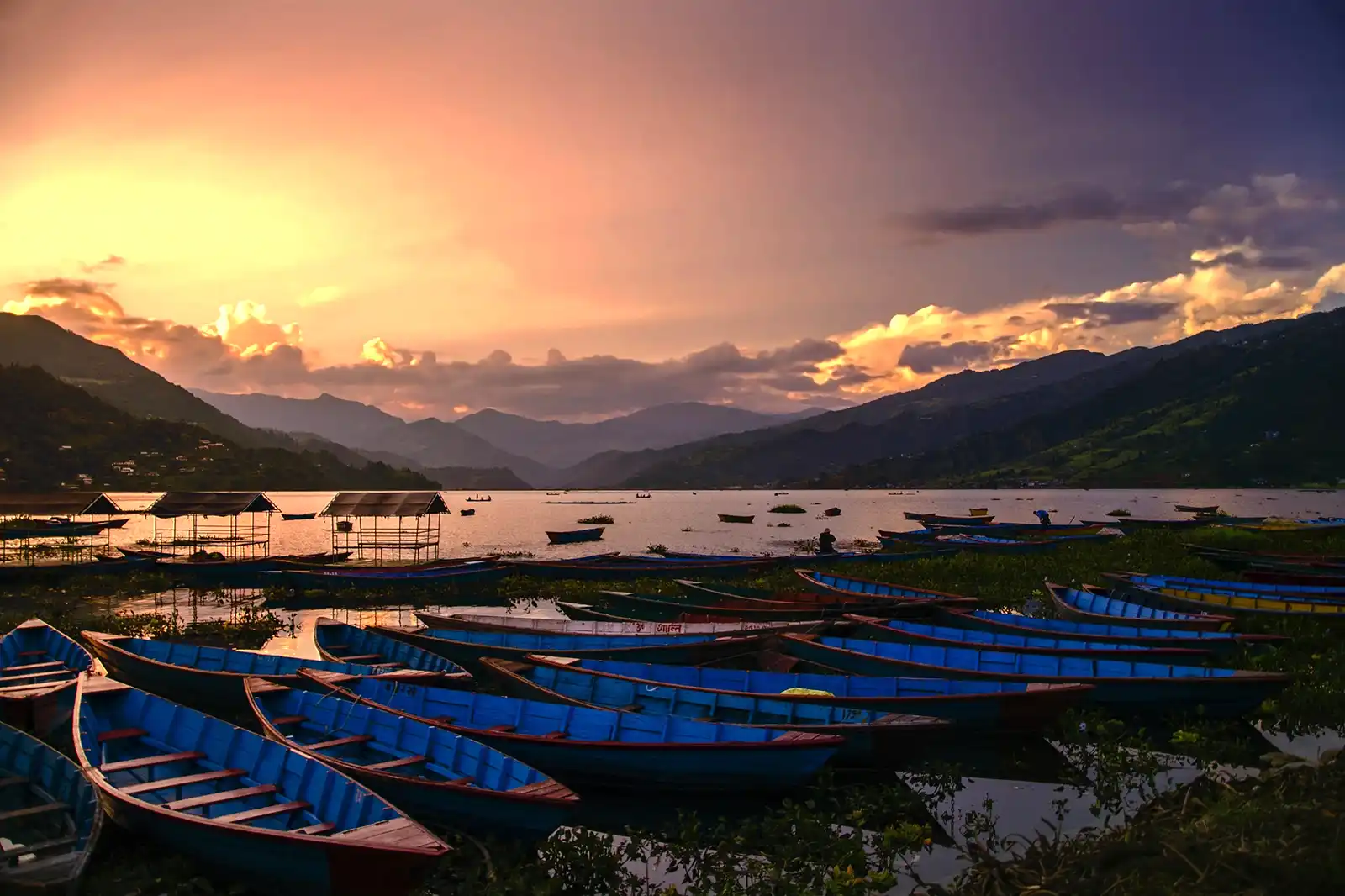
For those with energy after the journey, rental rowing boats are available directly from the lakeside ghats — inexpensive, and they take you away from the shore into open water with an unobstructed mountain panorama. Your guide is available if you prefer a local context for the afternoon, but this is equally well-suited to independent exploration at your own pace.
The evening is free. The lakeside restaurant strip offers everything from Nepali dal bhat to wood-fired pizza — your guide can recommend specific options based on your preference.
Accommodation: Hotel Waterfront or similar
Meals: Breakfast
Day 04: Pokhara — Full Day Exploration
The alarm is early today. Your guide arranges a pre-dawn transfer to Sarangkot, the ridge viewpoint that sits 1,592 meters above sea level on the northern edge of the valley. The drive from the lakeside takes approximately 30 minutes on a winding road through dark forest, arriving before first light to claim a good position at the viewpoint.
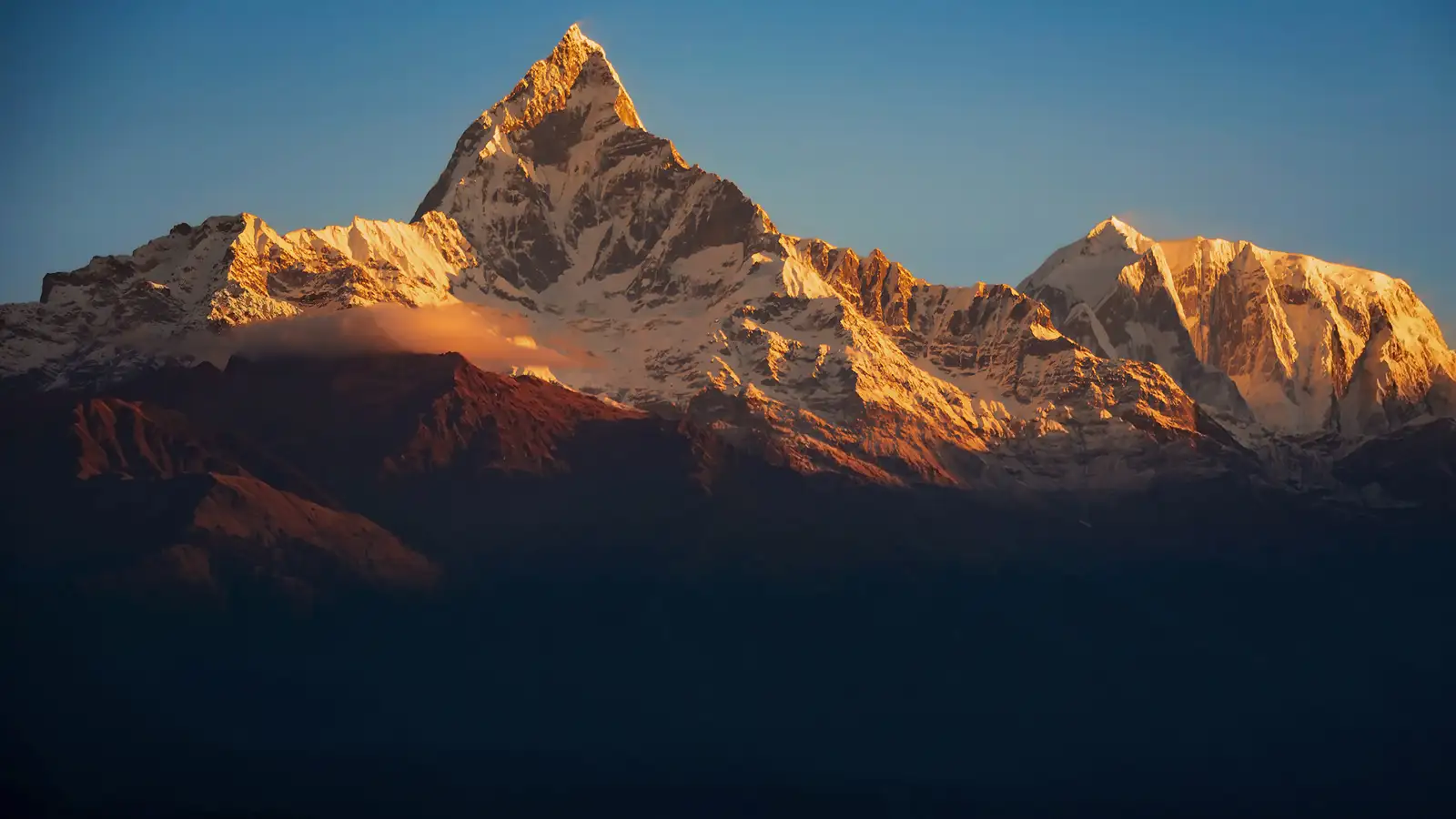
As the sky lightens, the Annapurna range emerges from the darkness in stages: Annapurna South first, then Machhapuchhre’s unmistakable double-summit profile, then Dhaulagiri to the west and Manaslu to the east on a clear morning. The full panorama, when the light catches the snow at the right angle, is the single most memorable view on the Nepal leg of this journey. The return drive is back to the hotel for breakfast.
After breakfast, the day moves at a relaxed pace through Pokhara’s most rewarding stops.
Phewa Lake by boat comes first. A short rowing or paddleboat excursion from the main ghat takes you to the Tal Barahi Temple — a small island shrine in the middle of the lake dedicated to the goddess Barahi and one of the most photographed spots in Pokhara. The boat ride itself, with the Annapurna range reflected on the water on a calm morning, is as worthwhile as the temple visit. The crossing takes less than ten minutes each way.
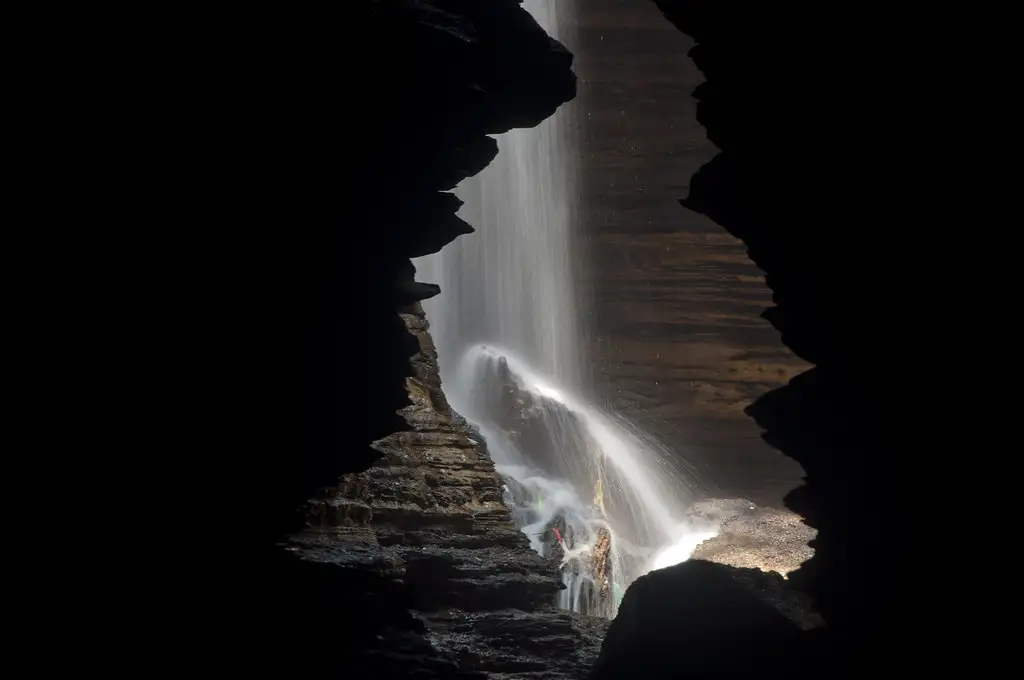
Devi’s Falls— locally known as Patale Chhango — sits on the south side of the city, roughly 20 minutes by taxi. The falls drop through a narrow gorge and disappear underground into a tunnel carved by the water over centuries. Gupteshwor Cave is directly opposite, its entrance decorated with Hindu shrines and stalactite formations, and a lower viewing platform offers a second perspective on the falls from below ground. The two sites together take no more than 45 minutes and are best visited back-to-back.
The Tibetan Refugee Camp at Tashiling, a short distance from Davis Falls, is worth the brief detour. Established in the 1960s, it houses one of the longest-standing Tibetan exile communities in Nepal. The camp’s carpet weaving center and handicraft shop are open to visitors — the hand-knotted carpets produced here follow traditional Tibetan patterns and are made on-site. It is a working community, not a heritage exhibit, and the visit carries more weight for it.
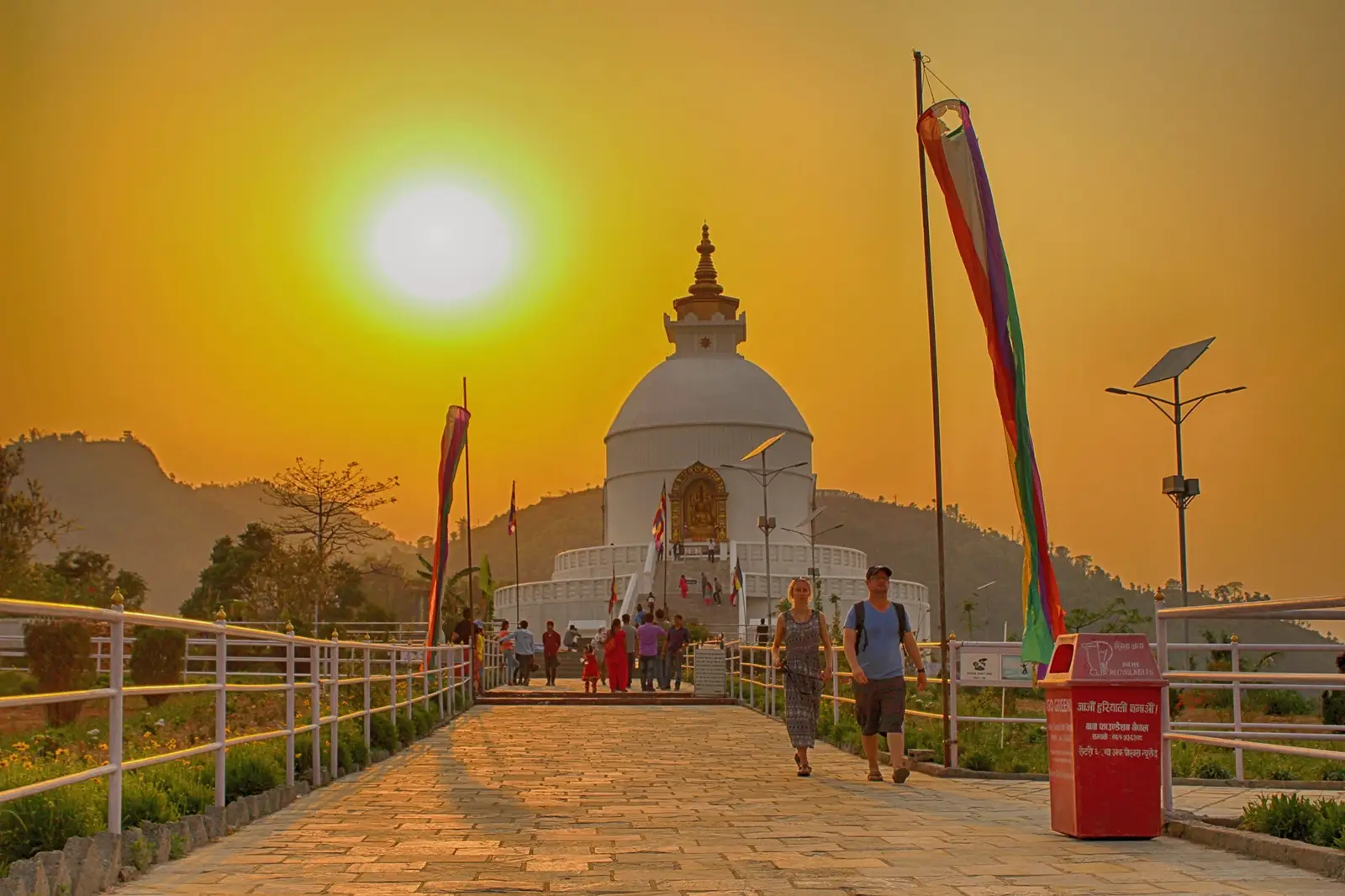
The World Peace Pagoda crowns the ridge on the southern shore of Phewa Lake, roughly 20 minutes by taxi from the lakeside. Nepal has two of the world’s eight Peace Pagodas — one in Lumbini, one here. The views from the pagoda terrace take in the full Annapurna range to the north and the lake and city below. The pagoda can also be reached on foot from the lakeside via a 45-minute forest trail if you prefer the approach on foot.
Pumdikot Hill closes the day. The hilltop is home to a large white Shiva statue and sits on a ridge east of the city with open views across the valley in three directions — the lake to the west, the Annapurna range to the north, and the Pokhara urban spread below. The drive takes approximately 20 minutes from the lakeside. Sunset from Pumdikot, if the timing works, is a strong alternative to Sarangkot for those who want a second viewpoint with fewer crowds.
Lunch and dinner are at your own expense today — your guide can recommend restaurants near the lakeside to suit any budget or preference.
Accommodation: Hotel Waterfront or similar
Meals: Breakfast
Day 05: Drive to Chitwan National Park
The group departs Pokhara by road this morning, heading southeast toward Chitwan National Park — Nepal’s first national park and one of the most biodiverse protected areas in Asia. The drive takes approximately four hours, depending on road conditions, descending from the Pokhara hills into the flat Terai lowlands. The landscape changes completely along the way: rhododendron slopes give way to sal forest, and the air grows heavier and warmer as you drop in elevation.
On arrival in Sauraha, you check in at Hotel Aikawa, a well-located property on the park boundary, built in the Tharu architectural style. The lodge manager introduces the group to your nature guide, who is required for all activities within the national park. The guide covers the activity schedule and what to expect in the jungle.
The late afternoon is yours to use at your own pace. A walk to the riverside at sunset is worth the short distance — the Rapti River at dusk, with the tree line of the park on the far bank, is a good first look at what the next day holds.
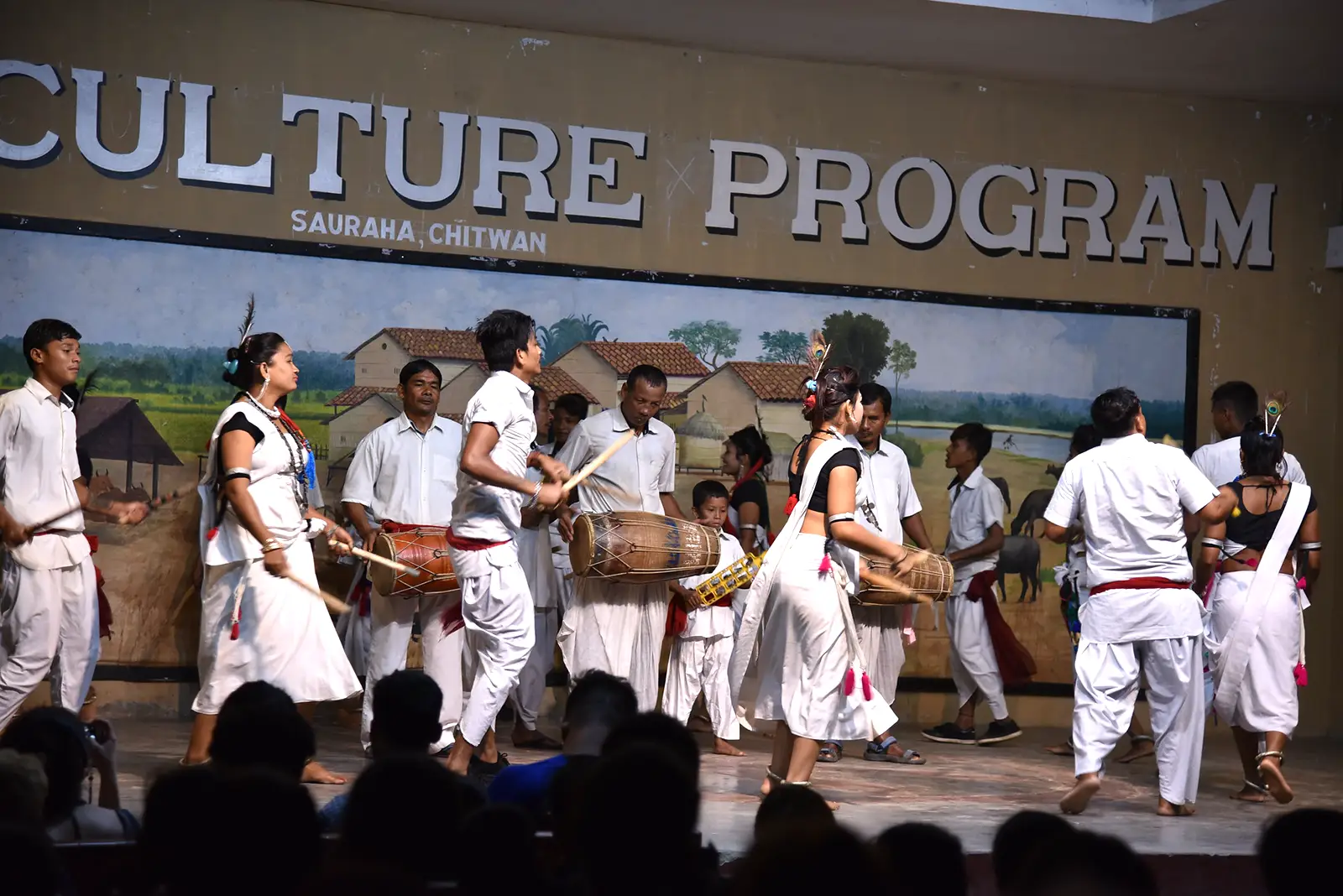
The Tharu people are the original inhabitants of the Chitwan region, with a culture, language, and traditions entirely distinct from those of the hill communities of Nepal. Every evening, a group of Tharu performers presents their cultural dance in the village. Your guide can arrange attendance at the nearest performance — it runs for approximately 1 hour and is one of the more genuine cultural programs available along this route.
Accommodation: Hotel Aikawa or similar
Meals: Breakfast, Lunch, and Dinner
Day 06: Jungle Activities in Chitwan National Park
Peregrine does not offer elephant-back safaris or elephant bathing programs. These activities cause documented harm to captive elephants and are not part of this itinerary. Instead, the morning offers the Elephant Walk — a guided walking tour alongside an Asian captive elephant, observing her natural behavior in a setting that does not involve riding or forced interaction.
It is a more educational and honest encounter. Peregrine continuously reviews its wildlife activity offerings against current animal welfare guidance; if this program changes before your departure, your coordinator will advise on the alternative morning activity.
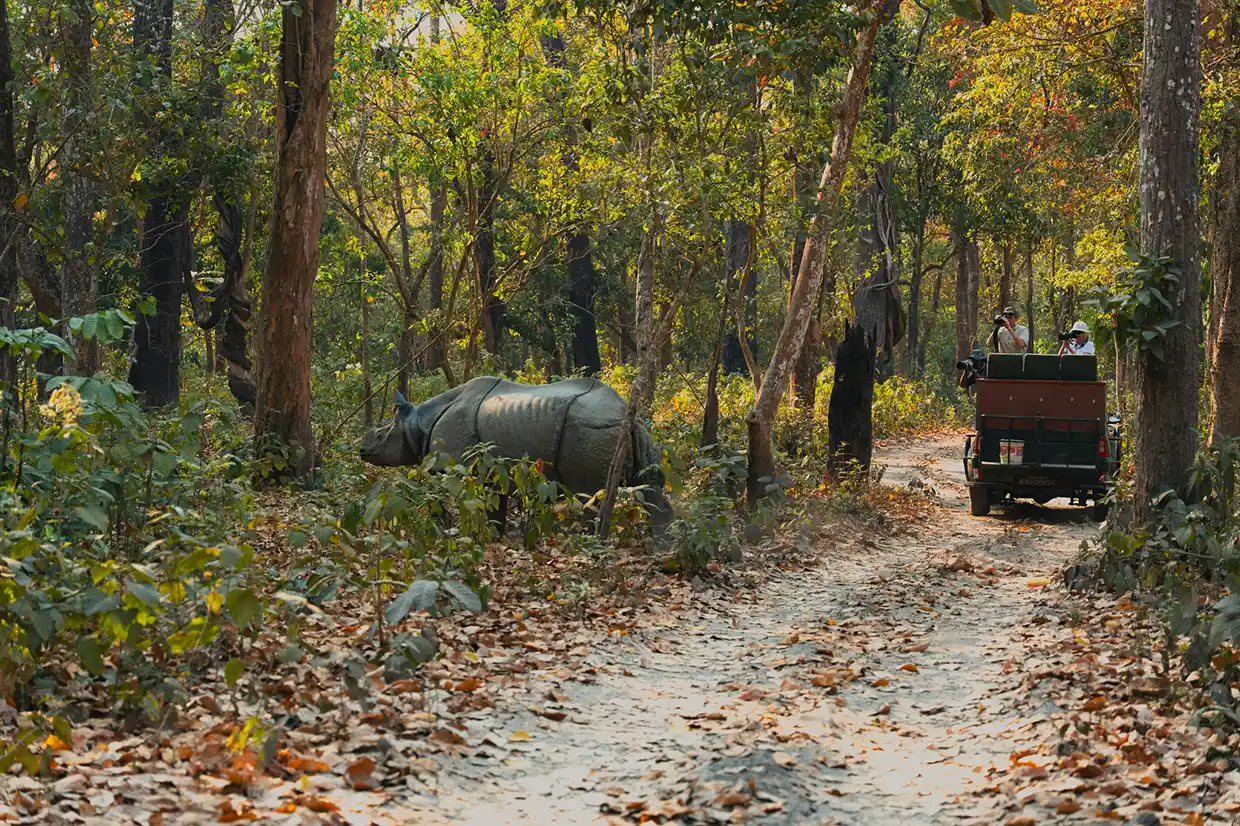
The jeep safari follows. Chitwan’s core zone encompasses dense sal forests, open grasslands, and river channels, and the safari route changes based on where animal activity has been reported. The park holds the second-largest population of the greater one-horned rhinoceros (Rhinoceros unicornis) in the world — sightings are frequent, and close approaches in an open jeep are genuinely striking. Approximately 120 Bengal tigers inhabit the park, though sightings remain rare and should not be expected.
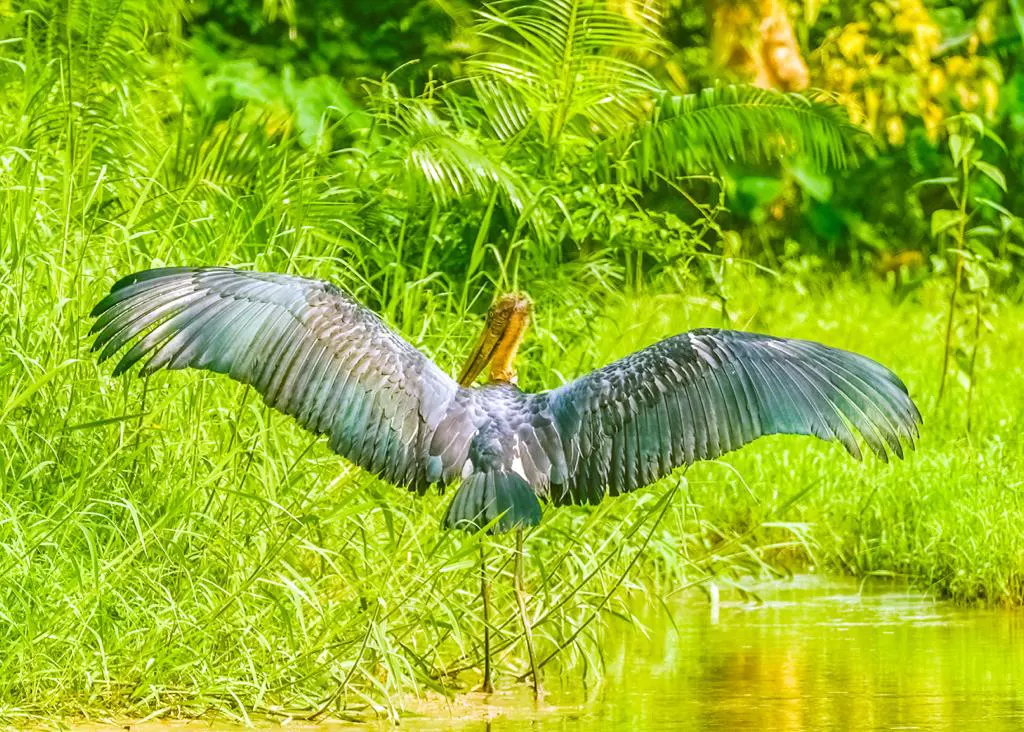
Chitwan records over 500 bird species, making it one of the best birding destinations in South Asia, even without a dedicated birding program. Other common sightings include spotted deer, sambar, wild boar, and langur monkeys.
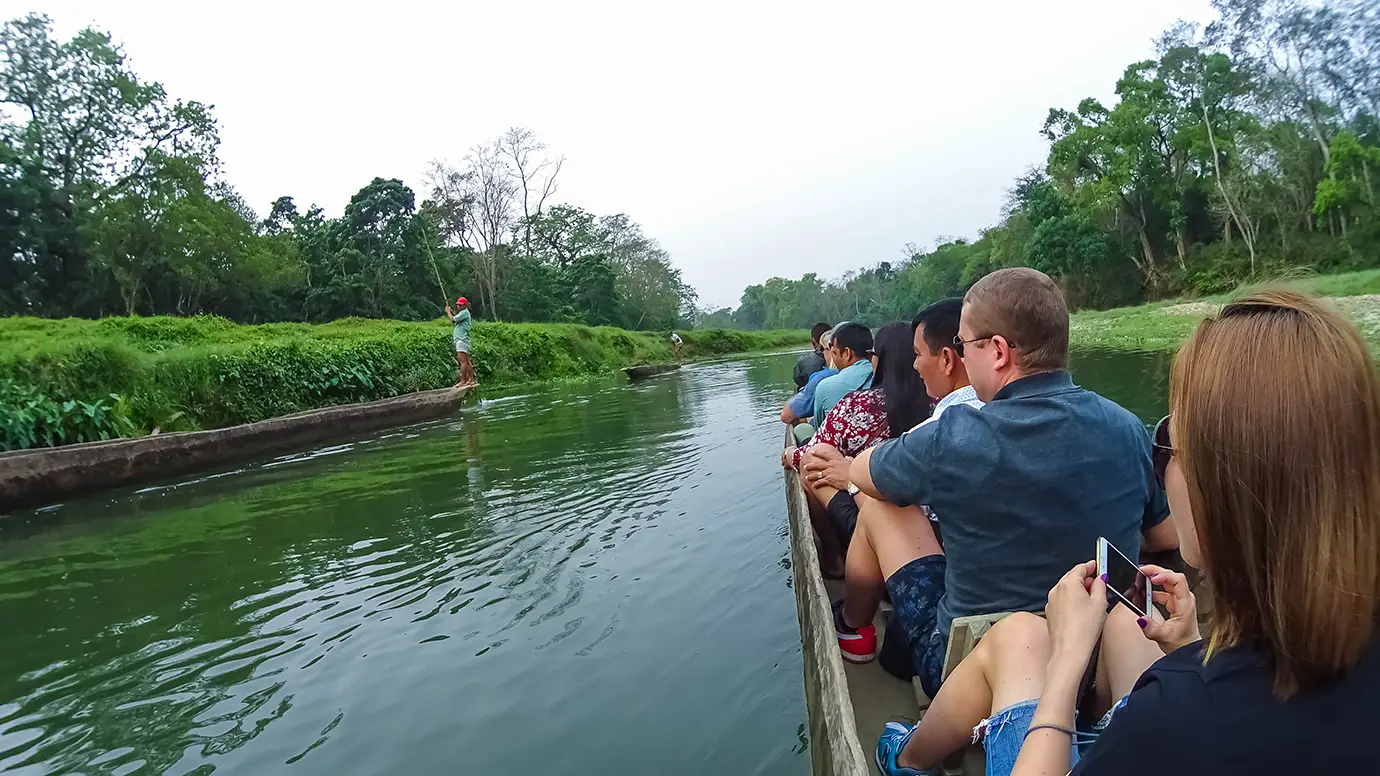
The afternoon canoe ride on the Rapti River closes the day’s activities. The pace drops completely — a dug-out canoe, river noise, and the chance to spot Gharial crocodiles and Marsh Muggers from the water level. The Gharial is endangered; seeing one in the wild, long-snouted and motionless on a sandbank, is a rare encounter. Dinner is at the Tharu Kitchen.
Accommodation: Hotel Aikawa or similar
Meals: Breakfast, Lunch, and Dinner
Day 07: Return to Kathmandu
The day begins with an optional early morning bird-watching walk along the park boundary. The pre-dawn hours are when Chitwan’s forest is most active. Even a 90-minute walk covers significant ground in terms of what becomes visible. Participation is optional but recommended for anyone with an interest in wildlife beyond the jeep safari.
After breakfast, the group flies back to Kathmandu. The afternoon in the city is unscheduled. Use it for any remaining shopping in Thamel, a second visit to a heritage site, or simply to rest before the Bhutan leg of the journey begins.

Your tour leader runs a pre-departure briefing in the evening. This session covers the Bhutan group visa requirements, fixed arrival and departure protocols, what to expect on the Paro flight, and the structure of the days ahead. Attending is important — the entry requirements for Bhutan are more specific than Nepal, and the briefing removes any uncertainty before you land.
Accommodation: Aarya Hotel and Spa – Eternal Heritage or similar
Meals: Breakfast
Day 08: Fly to Paro and Drive to Thimphu
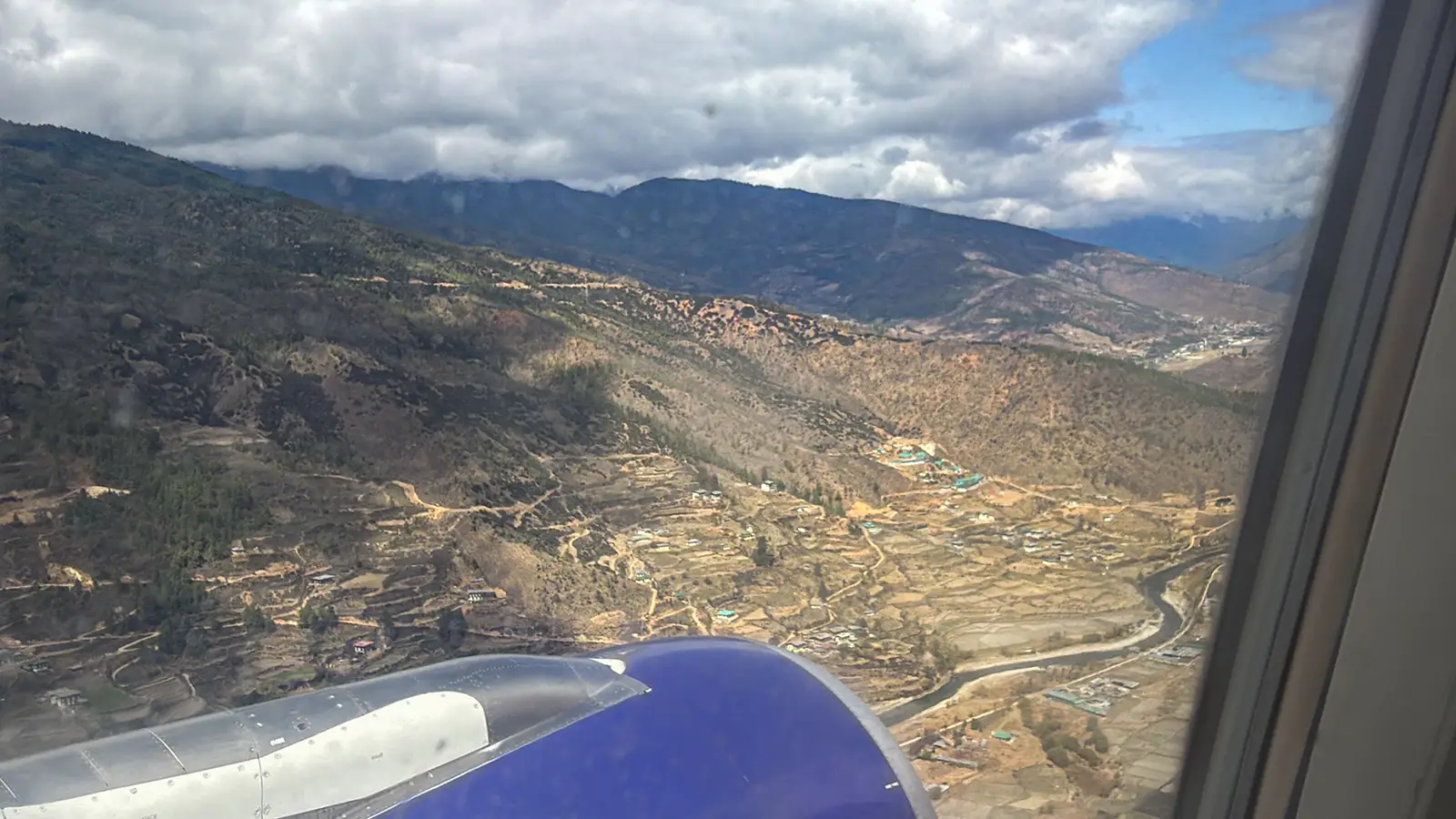
The flight from Tribhuvan International Airport to Paro is one of the most scenic short-haul routes in the world. Request a window seat on the left side of the aircraft. On a clear day, the approach into Paro Valley runs directly alongside the high Himalayan range, with Kanchenjunga, Jomolhari, and the Bhutanese peaks visible at close range before the aircraft descends sharply into the valley floor.
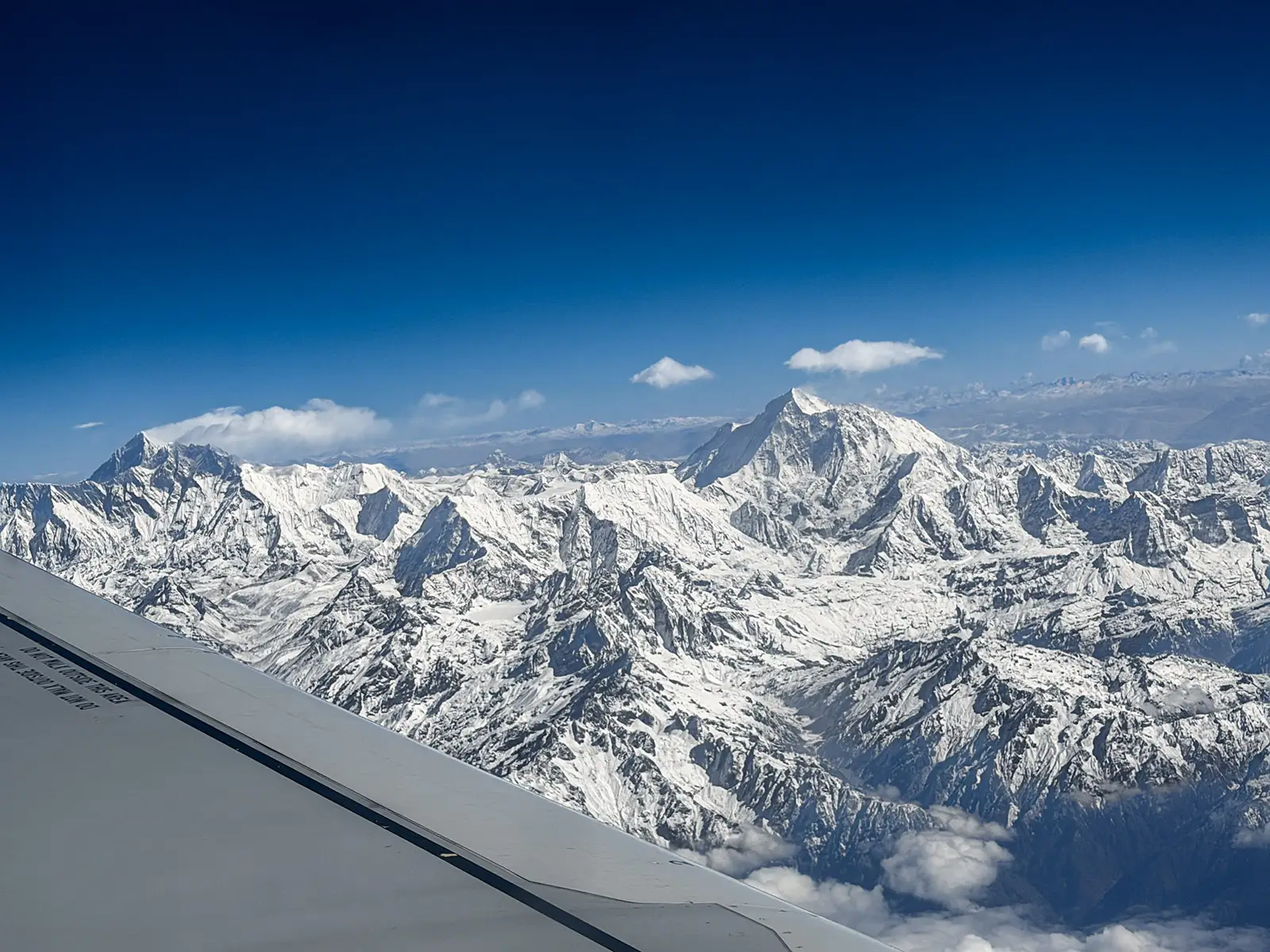
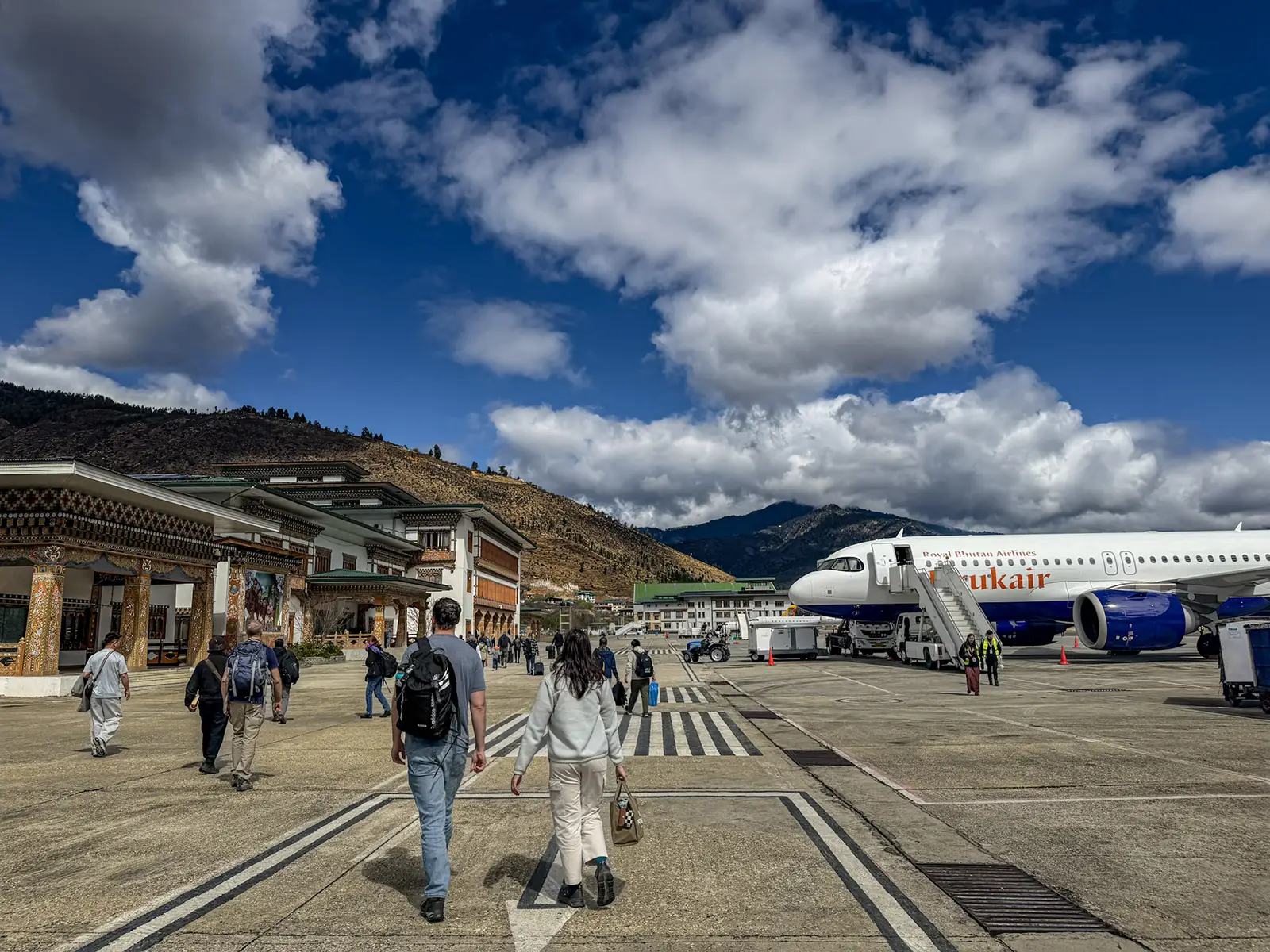
Immigration and customs formalities are completed on arrival. Your licensed Bhutanese guide meets you outside the terminal and transfers the group to Thimphu, Bhutan’s capital city. The drive takes approximately two hours through river valleys, past red rice paddies, whitewashed farmhouses, and dzong architecture that begins appearing almost immediately after leaving the airport.
In Thimphu, the afternoon covers two traditional production sites. Nado Poizokhang is one of Bhutan’s oldest incense factories, producing hand-rolled incense from local juniper, herbs, and aromatic woods using methods unchanged for generations. Gagyel Lhundrup Weaving Center is where you can watch Bhutanese women working on traditional backstrap looms, producing the kira and gho fabrics that all Bhutanese citizens are required to wear in public buildings. Both visits are short but give immediate context for how traditional craft production still functions as a living industry rather than a tourist reconstruction.
The evening includes dinner at the hotel and a group session to discuss the Bhutan itinerary ahead.
Bhutan Entry Requirements
What to Know: Bhutan issues tourist visas linked to a confirmed, pre-paid itinerary. For this itinerary, Peregrine operates on a group visa basis — your visa is processed through our licensed Bhutanese operator relationship, and all travelers in the group must arrive and depart on the fixed dates specified at booking.
The mandatory government fees for 2026 are a one-time visa fee of USD 40 per person and the Sustainable Development Fee (SDF) of USD 100 per person per night — both are included in your Peregrine package. A 5% GST applies to all tour services from January 2026; the SDF and visa fees are exempt from this tax. In the rare event that a flight disruption places you outside the group visa window, Peregrine can arrange alternative accommodation, though this will incur an additional cost. Contact our team immediately if this situation arises.
Accommodation: Hotel Pedling or similar
Meals: Breakfast and Dinner
Day 09: Exploring Thimphu and Drive to Punakha
Thimphu is the only capital city in the world without traffic lights — intersections are managed by white-gloved traffic police in raised booths. The morning begins with a walk through the Tibetan Village on the northern edge of the city, passing agricultural plots, blue pine forest, and traditional farmhouses before reaching the riverside trail.
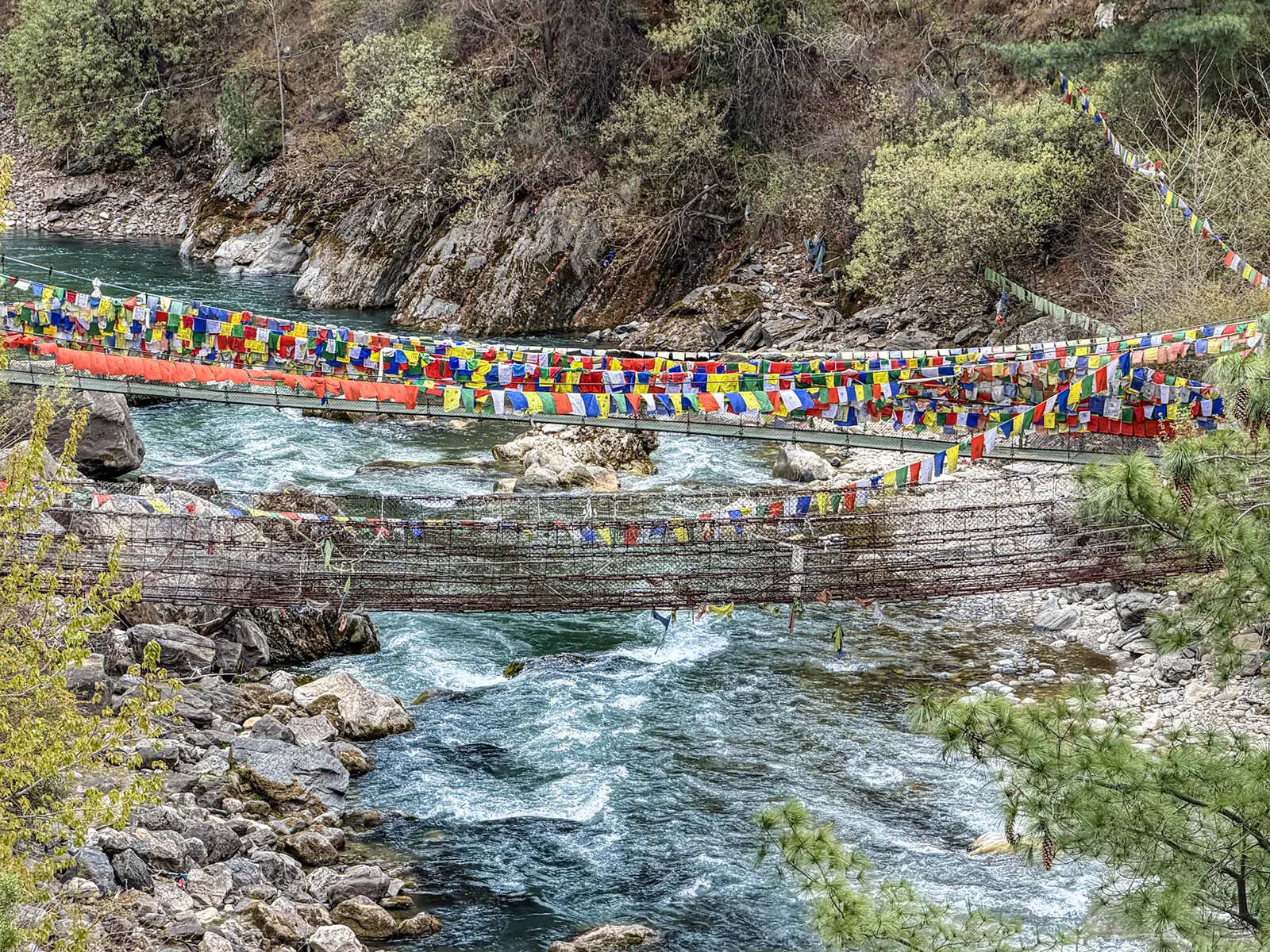
The trail follows the Wang Chhu River north to Pangri Zampa Gompa, a 16th-century monastery complex that now serves as Bhutan’s national center for traditional astrology. Along the route, Tango and Cheri Gompa are visible on the hillsides above — both active monastic institutions, not heritage sites. A picnic lunch on the riverbank marks the midpoint of the morning walk, after which the group returns to the city for the afternoon program.
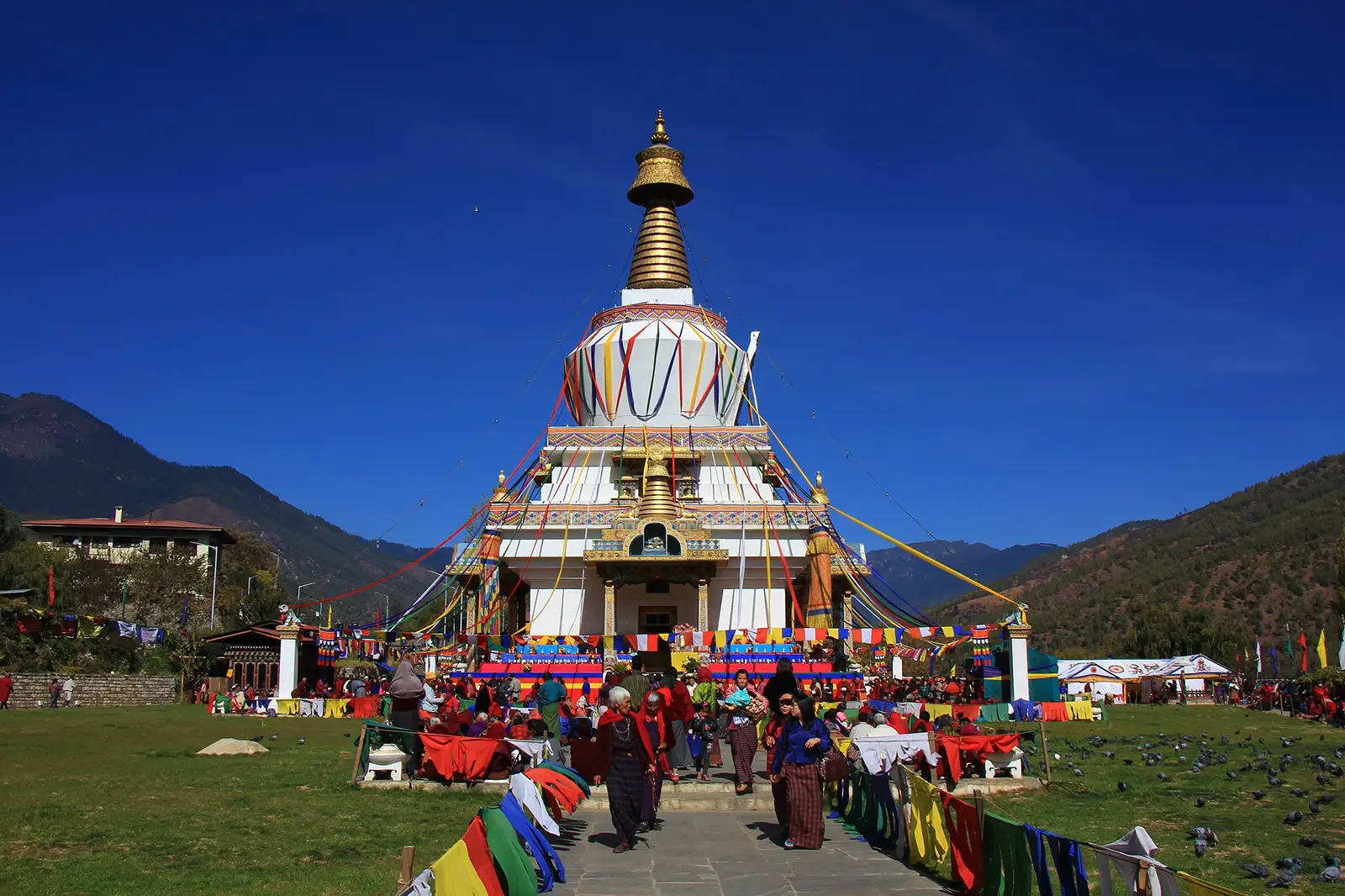
The afternoon tour takes in Thimphu’s most significant landmarks. The National Memorial Chorten was built in 1974 in honor of Bhutan’s third king, Jigme Dorje Wangchuck, and functions as an active site of daily prayer for Thimphu’s residents — elderly Bhutanese circle it continuously throughout the day in a ritual that has nothing to do with tourism. The Zhilukha Nunnery, also known as Drubthob Gomba, houses approximately 60 nuns and is the largest nunnery in Bhutan.
The Choki Traditional Art School teaches the thirteen traditional arts of Bhutan — thangka painting, woodcarving, weaving, and sculpture among them — and visitors can watch work in progress across the studios. The National Textile Museum provides the historical context for Bhutanese textile traditions across centuries and regions. The National Handicrafts Emporium is the most reliable single source for quality traditional products — thangkas, hand-woven textiles, wooden bowls, and bronze statuary, all produced locally.
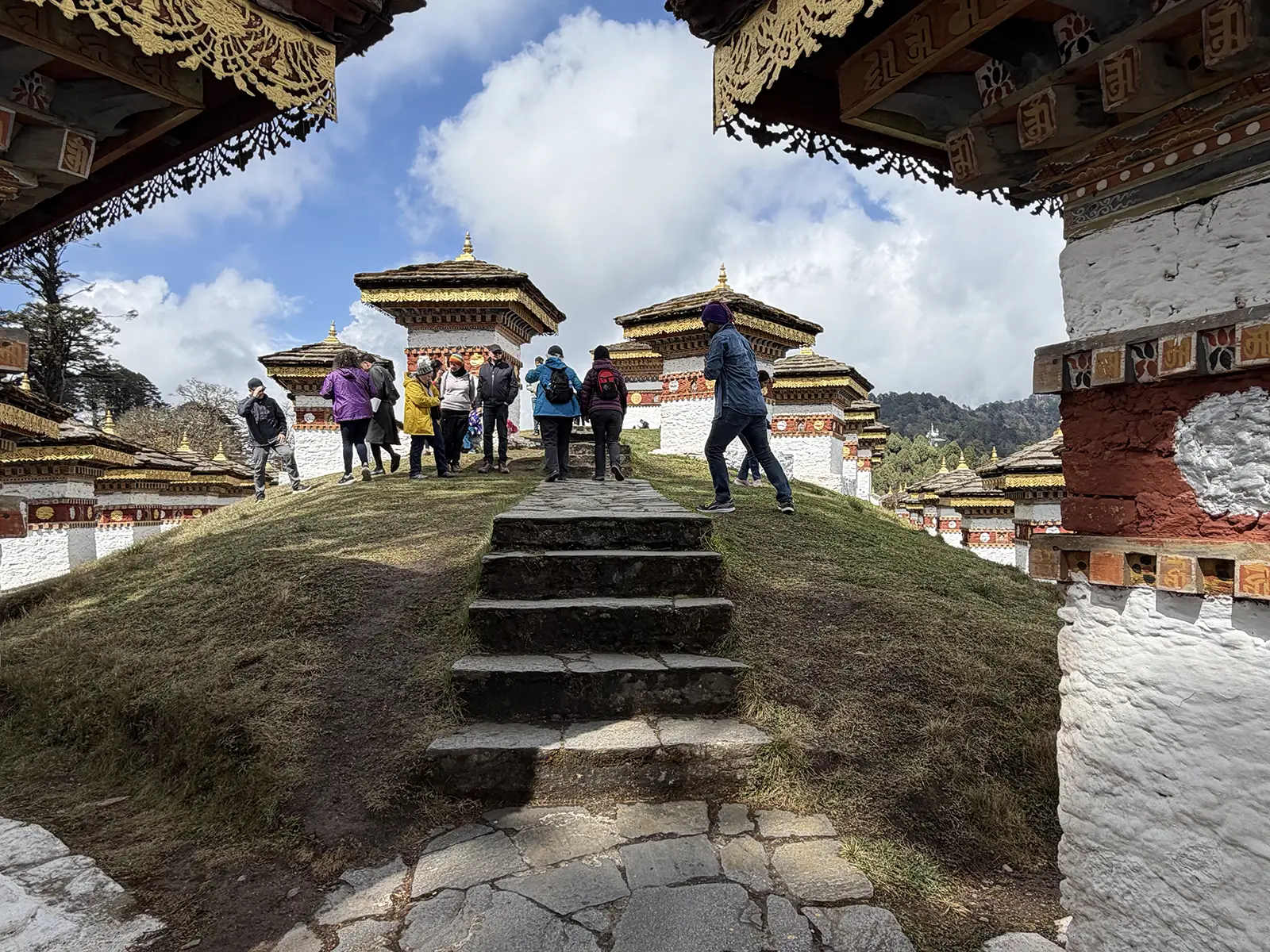
After Thimphu, the drive to Punakha takes approximately four hours via the Dochula Pass at 3,100 meters. Punakha sits at approximately 1,300 meters above sea level — roughly 1,242 meters lower in elevation than Thimphu —, and the temperature difference is immediately noticeable on arrival. The valley is warmer, greener, and has served as Bhutan’s winter capital for centuries. At the pass, the group stops to take in the 108 Druk Wangyal Chortens and, on a clear day, an unobstructed view of Gangkar Punsum — the highest unclimbed peak in the world at 7,570 meters.
Accommodation: Hotel Vara or similar
Meals: Breakfast, Lunch, and Dinner
Day 10: Exploring Punakha and Drive to Paro
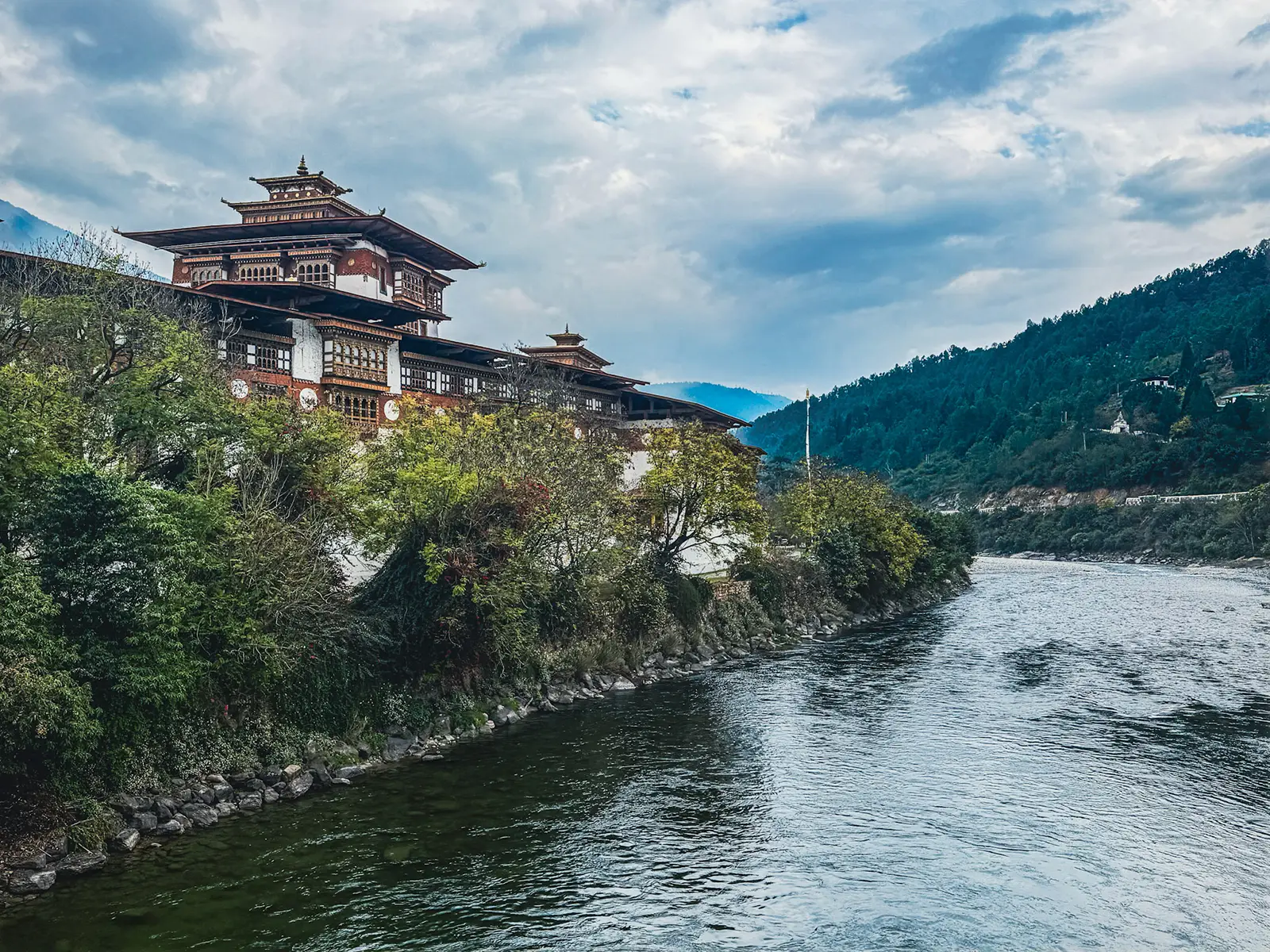
Punakha Dzong is the centerpiece of the morning. Built in 1637 at the exact confluence of the Pho Chu (Father River) and Mo Chu (Mother River), it is the second-largest dzong in Bhutan and one of the most architecturally significant buildings in the country.
The structure holds the sacred remains of Zhabdrung Ngawang Namgyal — the Tibetan lama who unified Bhutan as a nation-state in the 17th century. In spring, jacaranda trees line the entrance bridge in full purple bloom. The interior courtyards, painted assembly halls, and the view back across the river confluence from the far end of the dzong are all worth taking time over.
After lunch, the group hikes from the Mo Chu riverbank to the Khamsum Yulley Namgyal Chorten — a 45-minute climb at 1,800 meters elevation. The trail runs uphill on natural terrain, similar to the surface of the Tiger’s Nest approach the following day, so treat it as useful preparation. At the top, the 360-degree panorama takes in the full length of Punakha Valley: paddy terraces in stepped rows, the Mo Chu winding through the valley floor, and the dzong visible in the distance. The descent returns to the river in under 30 minutes.
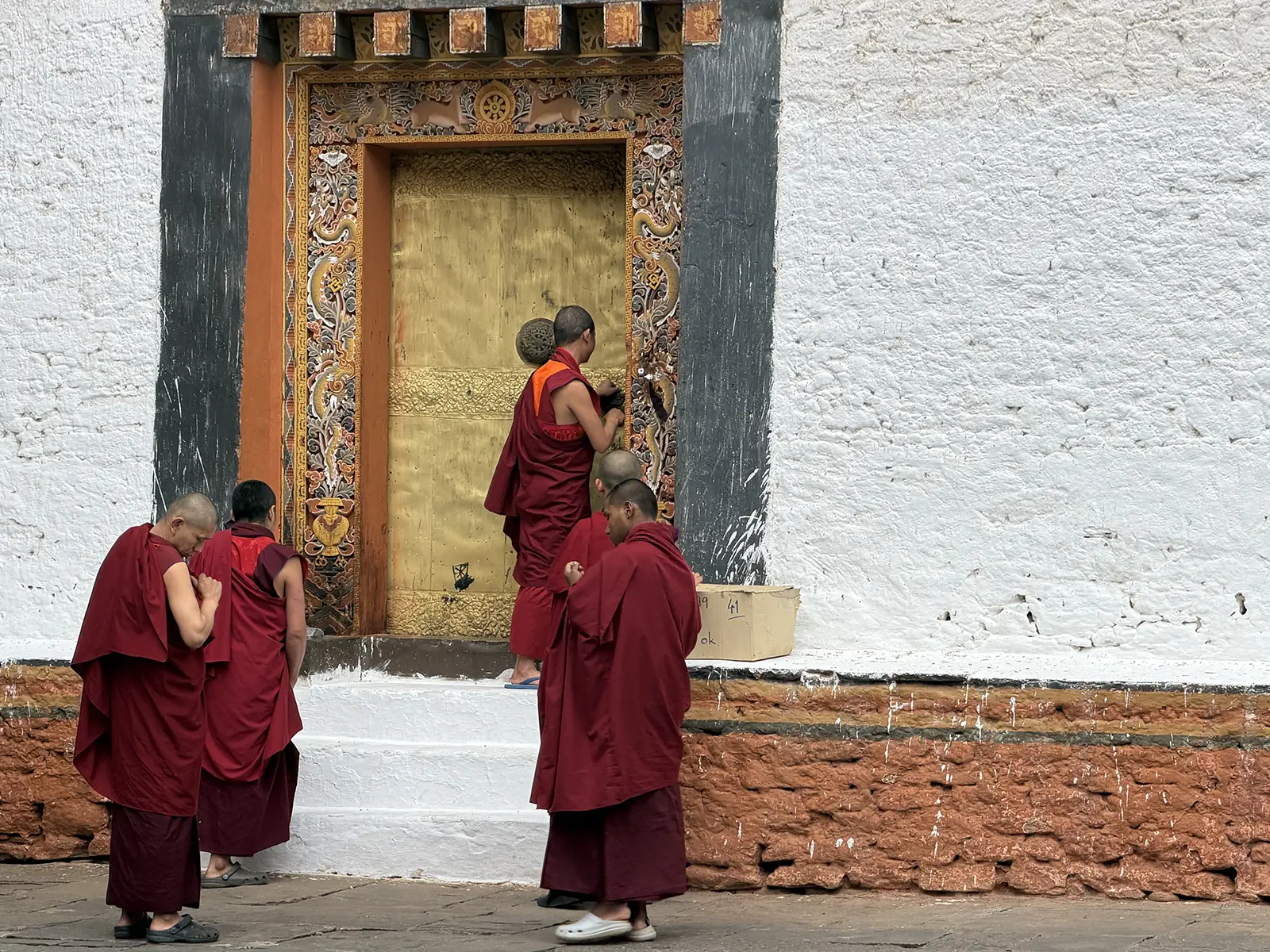
The return drive to Paro crosses the Dochula Pass a second time, offering a different light and perspective on the 108 Druk Wangyal Chortens — built in honor of the Bhutanese soldiers who defended the country in the 2003 conflict against militant groups from Assam, each chorten representing an individual act of service. The morning views across to Gangkar Punsum are often clearer than the afternoon approach from the previous day. The drive from Punakha to Paro takes approximately three to four hours.
Accommodation: Mandala Resort or similar
Meals: Breakfast, Lunch, and Dinner
Day 11: Tiger's Nest Monastery — Paro Taktsang
The drive from the hotel to the trailhead takes about 15 minutes. From the trailhead, the hike to Taktsang Monastery covers four kilometers of ascending trail and takes between two and three hours at a steady pace. The monastery sits on a granite cliff face 900 meters directly above the floor of Paro Valley — visible from the trailhead below, which gives a clear picture of the distance before you start.
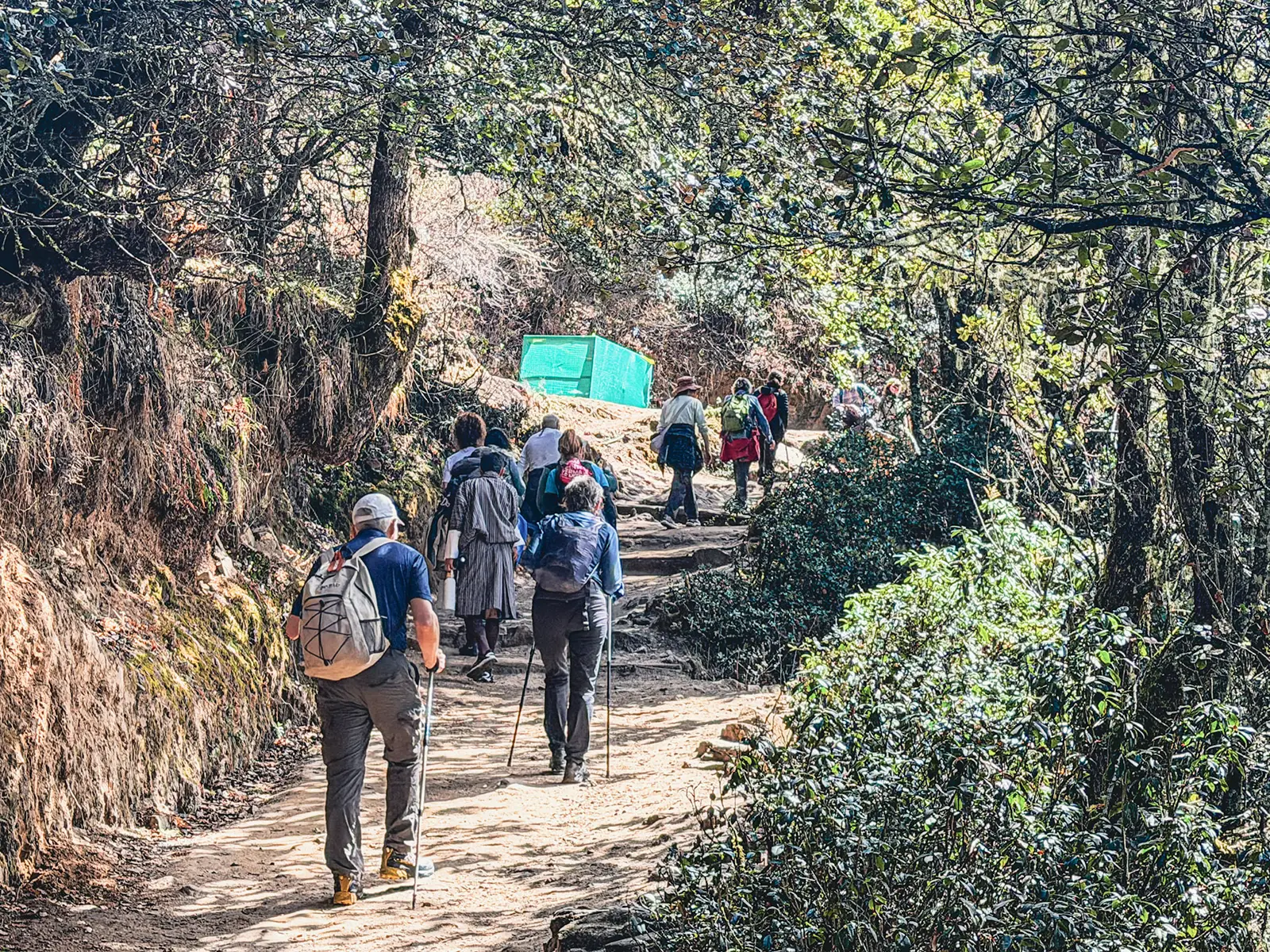
The lower section of the trail is the most gradual, passing through blue pine and rhododendron forest with the monastery appearing and disappearing through the canopy. The middle section steepens considerably. The trail surface is natural earth and compacted stone — proper hiking boots with ankle support and trekking poles make a material difference to both pace and safety. Pony support is available at the trailhead for the lower section if needed. A teahouse and viewpoint sit roughly halfway up; this is the view that appears in most photographs of Taktsang, and it rewards a proper stop.
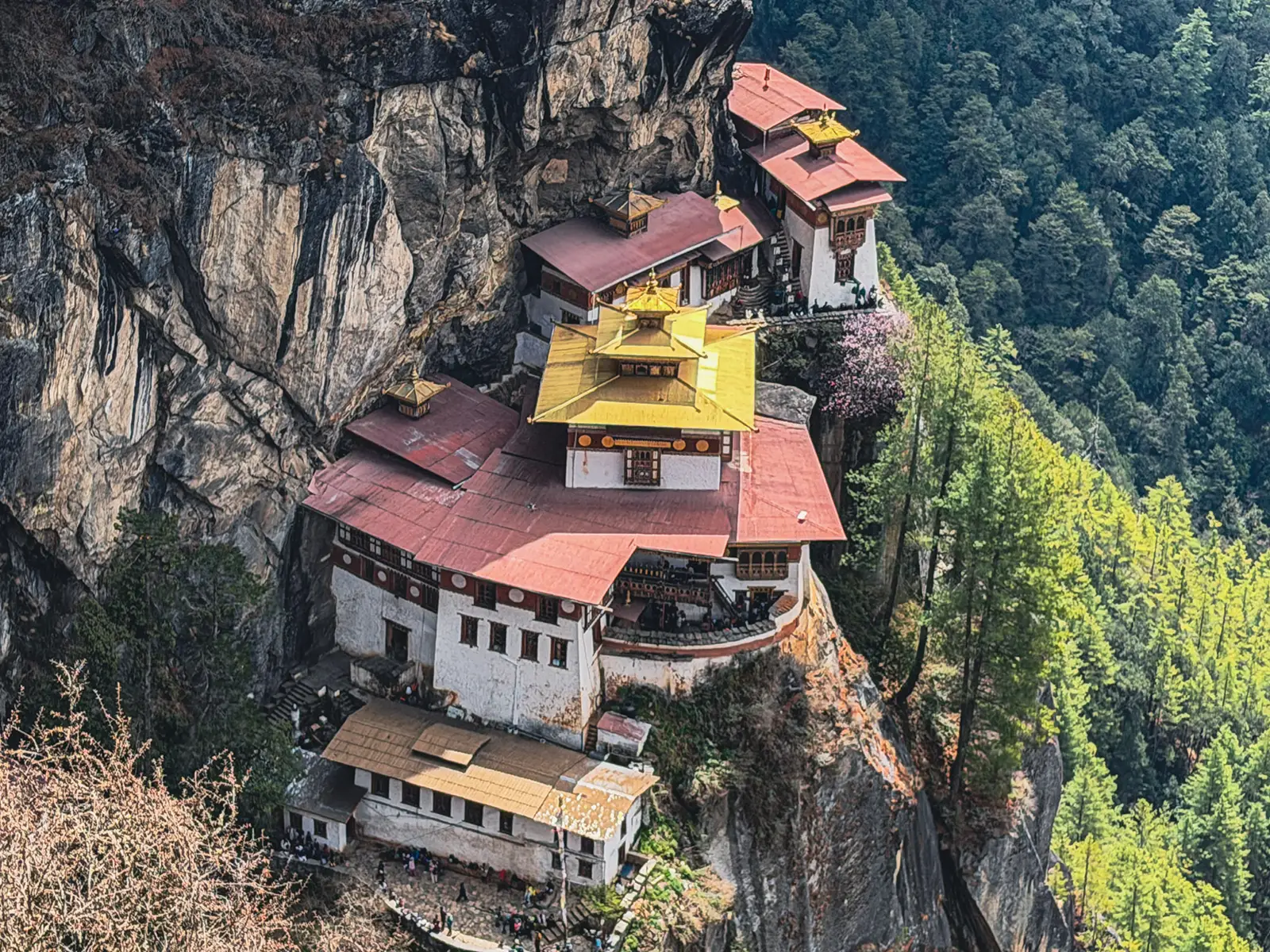
The monastery complex occupies several levels of the rock face, connected by internal staircases and narrow passages. Four main temples are open to visitors, each containing butter lamps, gilded statuary, and murals depicting episodes from the life of Guru Rinpoche (Padmasambhava), who is said to have arrived at this location in the 8th century on the back of a tigress — the origin of the Tiger’s Nest name. Photography is not permitted inside the temples; the time inside is better spent looking than documenting.
The descent takes approximately 90 minutes. The group returns to Paro for the final night of the journey.
Expedition Notes for the Tiger’s Nest Hike:
- Wear hiking boots with ankle support — trail shoes are insufficient with loose upper sections
- Carry at least one liter of water per person; the teahouse halfway up sells drinks, but at limited hours
- Trekking poles reduce knee strain significantly on the descent
- Start early — the trail gets crowded by mid-morning, and the teahouse viewpoint becomes congested
- Dress in layers; the trailhead feels warm, but the upper sections are exposed to wind
- An entry fee is payable at the monastery gate (approximately USD 12 per person — carry cash in Bhutanese Ngultrum or Indian Rupees)
- Shoulders and knees must be covered inside all temple spaces; a light layer or scarf packed in your daypack is sufficient.
- There is no wheelchair access or paved path at any point on the trail
Accommodation: Mandala Resort or similar
Meals: Breakfast, Lunch, and Dinner
Day 12: Farewell from Paro
Breakfast is at the hotel before the transfer to Paro International Airport. All group members are required to depart Bhutan on the same day — this is a condition of the group visa and cannot be adjusted individually. The flight out retraces the approach in reverse: the valley drops away, the Himalayan range comes back into view, and Bhutan recedes behind the peaks.
For any pre-departure questions about this itinerary, contact the Peregrine team at sales@peregrinetreks.com or WhatsApp +9779851052413.
Meals: Breakfast
Customize this trip with help from our local travel specialist that matches your interests.
Includes & Excludes
What is included?
Accommodation
- 3 nights in Kathmandu at Aarya Hotel and Spa – Eternal Heritage or similar
- 2 nights in Pokhara at Hotel Waterfront or similar
- 2 nights in Chitwan at Hotel Aikawa or similar
- 1 night in Thimphu at Hotel Pedling or similar
- 1 night in Punakha at Hotel Vara or similar
- 2 nights in Paro at Mandala Resort or similar
Meals
- 11 breakfasts as per the itinerary
- 6 lunches as per the itinerary
- 6 dinners as per the itinerary
Transportation
- All airport transfers throughout Nepal and Bhutan
- Kathmandu to Pokhara domestic flight (economy class)
- Pokhara to Chitwan by private vehicle
- Chitwan to Kathmandu domestic flight (economy class)
- Kathmandu to Paro international flight (economy class)
- All ground transportation during sightseeing in Nepal and Bhutan by private vehicle
Guided Services
- English-speaking tour leader throughout Nepal
- Licensed Bhutanese guide throughout the Bhutan leg
- Nature guide for all activities in Chitwan National Park
- City guide for Kathmandu and Pokhara sightseeing
Sightseeing and Activities
- Mountain flight over Everest and the Sagarmatha Himalayan range
- All entrance fees for heritage sites in Kathmandu Valley (Boudhanath, Swayambhunath, Pashupatinath, Kathmandu Durbar Square)
- World Peace Pagoda and International Mountain Museum entrance in Pokhara
- Jeep safari (3–4 hours) in Chitwan National Park
- Canoe ride on the Rapti River
- Tharu cultural dance show
- All sightseeing entrance fees in Thimphu, Punakha, and Paro as per the itinerary
- Guided hike to Tiger’s Nest Monastery (Paro Taktsang)
Bhutan Government Fees
- Bhutan group visa fee (USD 40 per person)
- Sustainable Development Fee (SDF) at USD 100 per person per night for the duration of the Bhutan stay
- All Bhutan government permit and documentation fees
Bhutan GST
- 5% Goods and Services Tax applicable on all tourism services in Bhutan from January 2026 (the SDF and visa fee are exempt from this tax)
Other
- All government taxes and service charges
- Farewell dinner on the final evening in Paro
What is excluded?
International Airfare
- International flights to and from Kathmandu (arrival and departure)
- Any airfare not specifically listed under Cost Includes
Nepal Entry
- Nepal visa fee (available on arrival at Tribhuvan International Airport — approximately USD 30 for 15 days or USD 50 for 30 days)
- Nepal visa extension fees if applicable
Meals
- Lunches and dinners in Kathmandu (Days 01, 02, and 07)
- Lunches and dinners in Pokhara (Days 03 and 04)
- Any meals not specified in the day-by-day itinerary
- Alcoholic and non-alcoholic beverages, unless included in set menus
Optional Activities
- Sarangkot sunrise transfer (available on request — included in Day 04 itinerary but chargeable separately if arranged independently)
- Paragliding in Pokhara
- Boating on Phewa Lake (available independently at the lakeside ghat)
- Early morning bird-watching walk in Chitwan (optional as noted in Day 07)
- Pony hire on the Tiger’s Nest trail (approximately USD 20–30 each way)
Travel Insurance
- Comprehensive travel insurance covering medical emergencies, trip cancellation, and evacuation — strongly recommended and not included in the package price
Personal Expenses
- Tips and gratuities for guides, drivers, and hotel staff
- Porter fees if required
- Laundry, telephone calls, and internet charges
- Shopping and personal purchases
- Any additional sightseeing not listed in the itinerary
Health and Medical
- Vaccinations recommended for travel to Nepal and Bhutan
- Any personal medication
- Medical evacuation costs, if not covered by travel insurance
Flight Disruption
In the event of a flight disruption that places any traveler outside the group visa window in Bhutan, individual visa accommodation costs (approximately USD 600) are not included in the package price
Departure Dates
We also operate Private Trips.
Trip Information
Who this tour is best for
This itinerary suits travelers who want the cultural and natural range of two Himalayan countries without committing to high-altitude trekking. It’s a strong fit for first-time visitors to South Asia, couples, families traveling with older children, senior travelers comfortable with two moderately active days, photographers, and anyone drawn to Hindu, Buddhist, Newar, Tharu, and Bhutanese culture in a single trip. Travel is entirely by private vehicle and domestic flight, with no multi-day trekking required.
A note on fit: this tour is built around immersive sightseeing and two single-day hikes rather than extended mountain trekking, so travelers specifically seeking a high-altitude trekking expedition may want a different itinerary from our collection. It’s also worth noting that several days include multi-hour drives between regions, so travelers who prefer to minimize road time should factor that into their decision. In Bhutan, every traveler is accompanied throughout by a licensed Bhutanese guide, which is a feature of how the kingdom protects its monasteries, dzongs, and cultural sites: it means deep, expert-led context at every stop. However, it does mean less unstructured independent wandering than you’d have in Nepal.
Trip Information
Visa and entry documentation
Most nationalities can obtain a Nepal tourist visa on arrival at Tribhuvan International Airport. Standard tiers run 15, 30, or 90 days, with fees scaling accordingly; current rates should be confirmed at the Nepal Immigration Department website before travel, as they are subject to change. Passports must be valid for at least 6 months beyond the date of arrival for both Nepal and Bhutan.
Bhutan is fully handled for you. Your visa is processed entirely by Peregrine as part of your group visa arrangement. You’ll send us a passport copy and photo in advance; we manage the application through our licensed Bhutanese operator relationship and deliver your visa clearance letter well ahead of departure, ready for check-in on the Paro flight.
Travel insurance
Bhutan’s Department of Tourism lifted the mandatory travel insurance requirement in April 2024, so it’s no longer required to process your visa. We still recommend it, given the limited medical infrastructure outside Thimphu and Paro, and the cost of medical evacuation if needed. Look for a policy that explicitly covers medical evacuation and trip disruption for the full duration of travel in both Nepal and Bhutan.
The Bhutanese Public Healthcare System & Your SDF
It is a common question among travelers whether Bhutan’s daily Sustainable Development Fee (SDF) covers medical emergencies. Through the SDF, the Royal Government of Bhutan funds a nationwide universal public healthcare system. For international travelers, this means that basic emergency medical consultations, GP visits, and outpatient care at government hospitals are provided completely free of charge.
If you experience minor illnesses, such as stomach upsets, mild altitude sickness, or minor infections, you can access the local medical network with your passport and receive care without being billed. Our guides are trained to coordinate directly with the primary government facilities in each region:
- Thimphu: Jigme Dorje Wangchuck National Referral Hospital (JDWNRH) — the country’s premier, fully-equipped national referral and trauma center.
- Paro: Paro General Hospital — situated near the valley floor, providing comprehensive local emergency and outpatient care.
- Punakha: Punakha District Hospital — the primary regional medical facility servicing the Punakha valley.
Why Private Travel Insurance is Still Mandatory
While the local public system handles standard medical issues, it is not an insurance policy and will not cover high-cost emergency care.
To protect yourself against the realities of Himalayan travel, your insurance policy must explicitly cover:
- High-Altitude Emergency Medical Evacuation: If a traveler suffers a severe medical emergency (such as severe Acute Mountain Sickness, HAPE, or HACE) while on the trail to Tiger’s Nest or in a remote valley, a private helicopter evacuation is required. These evacuations can easily cost between USD 5,000 and USD 10,000 per flight and are not covered by the Bhutanese government.
- Specialized International Transfers: For complex traumas or advanced critical care, patients must be stabilized and medically flown to comprehensive international hospitals in Bangkok (Thailand) or New Delhi (India).
- Trip Disruption & Repatriation: If an illness forces you to miss your flights, stay past your scheduled visa window, or requires a medical escort to travel home with you, these expenses must be claimed through your personal travel policy.
Note: Before departure, our operations team will collect a copy of your insurance policy details, including the 24/7 international emergency contact number for your provider, to ensure our guides can initiate rapid-response coordination if required.
Your Bhutan guide
Every traveler is accompanied throughout Bhutan by a licensed local guide, included in your package at no extra cost. Beyond fulfilling the kingdom’s cultural preservation requirements, this means you have an expert translator and storyteller with you at every dzong, monastery, and monument, turning each stop into a guided cultural deep-dive rather than a self-led walk-through.
Physical difficulty
Most days on this itinerary are easy: private vehicle transport, short walks, and standard sightseeing. Two days step up the pace. The Khamsum Yulley Namgyal Chorten hike on Day 10 is a 45-minute uphill walk on natural terrain. The Tiger’s Nest hike on Day 11 is the most rewarding physical challenge of the trip: a four-kilometer trail gaining significant elevation over two to three hours each way. No prior trekking experience is required, though a reasonable level of fitness will help you enjoy both days fully.
Altitude
The highest point on this itinerary is Dochula Pass at 3,100 meters, crossed briefly by vehicle on both the outbound and return journeys between Thimphu, Punakha, and Paro. Because no night is spent above 1,800 meters (Khamsum Yulley Namgyal Chorten), the risk of altitude sickness on this specific tour is low compared to high-altitude trekking itineraries in the Everest or Annapurna regions.
Currency and money
Nepal uses the Nepali Rupee; Bhutan uses the Ngultrum, pegged 1:1 to the Indian Rupee, with Indian Rupees widely accepted alongside it. ATMs are reliable in Kathmandu and Pokhara. In Bhutan, ATM access is more limited outside Thimphu and Paro, so we recommend carrying sufficient cash for the Punakha leg. Keep some cash on hand for the optional pony hire and personal purchases.
Packing guidance
Layer for temperature swings: Kathmandu and Chitwan run warm, while Dochula Pass and early mornings in Thimphu and Paro are cold, regardless of season. For Tiger’s Nest, a well-broken-in pair of hiking boots and trekking poles will make a genuine difference to your comfort on the trail. Modest clothing covering shoulders and knees is required inside all temples, dzongs, and monasteries; a light scarf or shawl in your daypack easily covers this. Bhutan uses a mix of plug types depending on the building, most commonly type D and type G, so a universal adapter is the simplest solution. A daypack is handy on the two activity days for water and layers.
Health precautions
Drink only bottled or filtered water throughout the trip. We recommend discussing routine travel vaccinations with a doctor or travel clinic before departure, since the right recommendations depend on your home country and itinerary. All Peregrine-selected accommodations and included meals meet the region’s hygiene standards.
Photography and conduct
Photography isn’t permitted inside any monastery, dzong, or temple interior in either country, including Tiger’s Nest, Punakha Dzong, and the Thimphu sites, though exterior and landscape photography is welcome throughout. Drone use in Bhutan requires separate government permission arranged well in advance; this itinerary doesn’t include drone permits. As a courtesy, ask before photographing local people directly, particularly at religious sites and in Chitwan’s Tharu villages.
Connectivity
Nepal SIM cards are inexpensive and easy to buy at the airport upon arrival, and they offer reliable coverage in Kathmandu, Pokhara, and Chitwan. Bhutan’s network coverage through Tashi Cell and B-Mobile is solid in Thimphu and Paro, with more limited reach in Punakha and along mountain roads. Most hotels on this itinerary offer WiFi.
Trip style
This is a private departure tour, accompanied throughout by a Peregrine tour leader in Nepal and a licensed Bhutanese guide. Your dates are set at booking to suit you; the Bhutan leg, in particular, runs on fixed arrival and departure days as required by the group visa.
Tipping
Gratuities for guides, drivers, and hotel staff aren’t included in the package cost. As a general guide, USD 8 to 12 per traveler per day for your main guide, with smaller amounts for drivers and porters, is standard practice across both countries. This is entirely your call, based on the service you receive.
Festival timing
Nepal and Bhutan both follow lunar calendars for major festivals, including Dashain and Tihar in Nepal and the Paro and Thimphu Tshechus in Bhutan. Dates shift year to year, and a festival can shape your trip in wonderful ways if it aligns with your dates. Let the Peregrine team know if festival timing matters to you when you book, and we’ll confirm what dates fall within your travel window.
If a Bhutan flight is delayed
Paro’s mountain approach is one of the most spectacular and weather-sensitive in the world, and Druk Air and Bhutan Airlines occasionally adjust schedules as a result, particularly outside the clearest months of spring and autumn. This is simply part of flying into the Himalaya, and it’s exactly the kind of thing our team exists to manage on your behalf. If your Kathmandu to Paro or Paro to Kathmandu flight is affected, our operations team handles rebooking directly with the airline. It adjusts your ground arrangements in Bhutan in real time, so you can relax while we handle them. Because Bhutan’s group visa ties your entry and exit to fixed dates, we recommend avoiding very tight onward international connections on your departure day from Bhutan, to give yourself a bit of a buffer.
Planning notes
Bhutan’s single international airport is served by a limited number of carriers connecting through Kathmandu, Delhi, Bangkok, Kolkata, and a few other regional hubs, so we always recommend booking the Bhutan leg early, especially in peak season. Mountain views, the Everest flight on Day 02, and the Paro approach are all weather-dependent; we set honest expectations rather than promise guaranteed clear skies, and we build flexibility into the itinerary wherever we can. Nepal’s road journeys, particularly Pokhara to Chitwan, can run a little longer than the stated estimate depending on traffic, road conditions, or seasonal rain; flight upgrades are available on some sectors if you’d like to minimize road time.
Approximate travel times
| Route | Approximate Time |
|---|---|
| Kathmandu Airport to the hotel | 30–45 minutes |
| Kathmandu to Pokhara (flight) | 25–30 minutes |
| Kathmandu to Pokhara (road, for reference) | 6–8 hours |
| Pokhara to Chitwan (road) | 4–6 hours |
| Chitwan to Kathmandu (flight) | 20 minutes |
| Kathmandu to Paro (flight) | Around 1 hour |
| Paro to Thimphu (road) | 1.5–2 hours |
| Thimphu to Punakha (road) | 3–4 hours |
| Punakha to Paro (road) | 3–4 hours |
Times vary with traffic, road conditions, weather, and photo stops. This itinerary uses flights for Kathmandu–Pokhara and Chitwan–Kathmandu; road times are shown for reference only.
Video Review of the traveler
Related Blog
Things to know before the Bhutan Tour
Top 10 Must-Experience Festivals in Bhutan
Frequently Asked Questions
Spring (March to May) and autumn (September to November) offer the clearest mountain views and most stable flight weather across both countries. Bhutan’s monsoon is manageable thanks to its rain shadow, but it can affect visibility in Nepal’s Chitwan and Pokhara regions. Winter brings cold mornings but clear skies and quieter trails, while June through August suits travelers who prefer greener landscapes and fewer crowds over guaranteed mountain views.
Yes. This itinerary gives seven days in Nepal, covering Kathmandu, Pokhara, and Chitwan, and five days in Bhutan, covering Thimphu, Punakha, and Paro. It is a focused, well-paced introduction to both kingdoms rather than an exhaustive tour of either, which suits travelers who want genuine depth without a longer commitment.
Most days are easy, built around private vehicle transport and standard sightseeing. Two days step up the pace: the Khamsum Yulley Namgyal Chorten hike in Punakha (around 45 minutes uphill) and the Tiger’s Nest hike in Paro (a four-kilometer trail, two to three hours each way). No trekking experience is required, though a reasonable level of fitness makes both days more enjoyable.
Yes, this is one of the better-suited itineraries in our collection for senior travelers, since it avoids multi-day trekking and exposure to high altitude beyond a brief vehicle crossing at Dochula Pass. The two hiking days can be paced flexibly, and ponies are available for part of the Tiger’s Nest trail.
Most nationalities can get a Nepal visa on arrival at Tribhuvan International Airport. For Bhutan, Peregrine handles your visa entirely as part of the group visa arrangement; you simply send a passport copy and photo in advance, and we provide your visa clearance letter ahead of departure.
The SDF is a government fee of USD 100 per person, per night, charged for the duration of your stay in Bhutan. It funds free healthcare, free education, and environmental conservation across the kingdom, and it is included in your Peregrine package cost rather than billed separately.
It is no longer mandatory; Bhutan’s Department of Tourism lifted that requirement in April 2024. We still recommend a policy covering medical evacuation and trip disruption, given the limited medical infrastructure outside Thimphu and Paro.
It is the most physically demanding part of the trip: a 4-kilometer trail that climbs to a monastery perched 900 meters above the Paro Valley floor. The trail surface is natural earth and compacted stone, and proper hiking boots with ankle support make a real difference. A teahouse roughly halfway up offers a rest stop with a clear view of the monastery, and ponies are available for the lower section if needed.
Layers are essential, since Kathmandu and Chitwan are warm, while the Dochula Pass and early mornings in Thimphu and Paro are cold year-round. Broken-in hiking boots and trekking poles are worth bringing for Tiger’s Nest, and modest clothing covering shoulders and knees is required inside all temples, dzongs, and monasteries.
Yes. Every traveler is accompanied throughout Bhutan by a licensed local guide, included in your package at no extra cost. This is part of how Bhutan protects its monasteries and cultural sites, and it means expert context at every stop rather than a self-guided walk-through.
No. Peregrine does not offer elephant-back safaris or elephant bathing activities, as these activities have been documented as causing harm to captive elephants. Instead, the itinerary includes the Elephant Walk, a guided foot excursion alongside an Asian elephant that observes her natural behavior without riding or forced interaction.
Paro’s mountain approach is weather-sensitive, and Druk Air and Bhutan Airlines occasionally adjust their schedules accordingly. If your flight is affected, our operations team handles rebooking directly with the airline and adjusts your ground arrangements in Bhutan accordingly. We recommend avoiding very tight onward international connections on your departure day from Bhutan.
Yes. This package can be adjusted for hotel category, group size, or additional days in either country. Get in touch with the Peregrine team to share your preferred travel month and any specific interests, and we will tailor the itinerary to you.
Your package covers accommodation throughout, 11 breakfasts, 6 lunches, and 6 dinners; all private transportation, including domestic and international flights; all guide and entrance fees; and the full Bhutan government fees, including the SDF and visa. The Bhutan SDF alone costs USD 100 per person per night, a cost that catches many independent travelers off guard; having it folded into a single transparent package price, alongside a licensed guide throughout, is part of what makes this itinerary straightforward to budget for. Full details are in the Cost Includes and Excludes section above.
This runs as a private departure, accompanied throughout by a Peregrine tour leader in Nepal and a licensed Bhutanese guide in Bhutan. There are no fixed group dates to work around; your travel dates are set at booking, with the Bhutan leg locked to fixed arrival and departure days as required by the group visa.
Accommodation runs 3 to 4-star throughout: Aarya Hotel and Spa – Eternal Heritage in Kathmandu, Hotel Waterfront in Pokhara, Hotel Aikawa in Chitwan, Hotel Pedling in Thimphu, Hotel Vara in Punakha, and Mandala Resort in Paro, or similar properties. All are comfortable, well-located choices selected for their proximity to each day’s activities. Hotel upgrades are available on request if you’d like to elevate any part of the trip.
Yes, solo travelers are welcome on this itinerary. As a private departure with no fixed group to join, a single supplement applies to cover the cost of a private room throughout; get in touch with the Peregrine team for the current single supplement rate.
Yes. Nepali and Bhutanese cuisine both offer strong vegetarian options, and our guides and hotel partners are well used to accommodating vegetarian, vegan, and other dietary requirements. Let us know your needs when booking, and we’ll make sure they’re communicated throughout the itinerary, including in Chitwan and Bhutan, where advance notice is most helpful.
This itinerary works well for families with older children who can manage the Tiger’s Nest hike, generally from around age 10 upward, though every child is different and we’re happy to discuss your family’s situation directly. Bhutan’s SDF is charged at half price for children aged 6 to 12, and children under 6 are exempt. There’s no strict upper age limit; the main consideration is comfort with the two more active days on the itinerary.
Nepal and Bhutan share a Himalayan setting but offer genuinely different experiences: Nepal’s open, accessible culture and dramatic variety of landscapes against Bhutan’s deliberately limited, carefully preserved approach to tourism. Visiting both on one trip also makes practical sense, since the Kathmandu to Paro flight is short and the two countries’ high seasons largely overlap. Most travelers find that experiencing the contrast between them, rather than visiting either alone, is what makes this combination memorable.
Reviews on Nepal and Bhutan Tour
5.0
Decadent Cultural and Historical Tour
My experience with the Peregrine team on the Nepal Bhutan Trek was incredible. The entire adventure was distinctive and full of a tranquil mood across two Himalayan nations. First and foremost, thank the tour operator for providing us with a private vehicle for our Kathmandu sightseeing. It was great that the flight ticket cost was also part of the package.
More than that, I adored exploring the Dzongs of Bhutan, and the atmosphere was serene. Through the Bhutan Tour, I was able to witness the Buddhist culture as well as the stunning architecture of Paro and Bhutan. It was one of the most decadent cultural and historical tours I’ve ever experienced.

Stephan Schultheiss
München, GermanyOne of the best tours of my life
With this expedition’s help, I could visit over 50 monasteries and stupas from Nepal to Bhutan. The ancient sites of Pashupatinath, Swoyambhunath, and Boudhanath were magnificent discoveries. I also witnessed the magical view of the Kanchenjunga and the Jomolhari peak on the flight to Bhutan, which was also priceless. My lodging and food while I was in Bhutan were the most crucial aspects of my adventure.
Everything was great, and my fantastic highlight was trekking to the Taktsang monastery. Furthermore, the Dzong or some monasteries in Thimphu were enticing to behold. The tour was enjoyable, and I want to thank Peregrine for providing the opportunity.
Steffen Baumgartner
Ebersberg, GermanyFantastic Nepal and Bhutan Tour
The itinerary was fantastic, and when I asked the tour operator if I could add the Pokhara tour to this adventure, he changed the schedule following my request. The entire Peregrine crew handled things with great class and humility. The local Bhutanese tour guide was also so great that he brought us to every corner of Bhutan.
I tried some native food in Paro, and it was pretty excellent. I had a historic sensation as I visited the Paro Ringpung Dzong and descended to Paro’s city center. Also noteworthy was the Tashicho Dzong and King’s Memorial Chorten in Thimphu, both of which feature stunning architecture. Thanks to Peregrine Treks & Tours for taking me to such beautiful spots in a short amount of time.
Tim Richter
München, GermanyUnforgettable Nepal and Bhutan Tour
My remarkable and unforgettable Nepal and Bhutan Tour was the drive from Kathmandu to Pokhara. The vista of Manaslu, Hiunchuli and the gigantic white face of Annapurna from Pokhara excited me. The paragliding experience in Pokhara was also an enjoyable and noteworthy part of the adventure.
The magnificent Ringpung Dzong in Thimpu also connects me to the cultural and traditional aspects of the native Bhutanese people. The tour guide was modest and helped us learn about numerous monasteries while facilitating communication with the locals. For making this possible, we appreciate Peregrine Treks and Tours.
Steven E. Marmol
United States of AmericaExcellent Tour Package
When one of the guides drove me to a hotel in Bhutan, I experienced a cozy atmosphere. Throughout the Nepal and Bhutan tours, the food and accommodations were excellent. Additionally, the panorama of the entire Punakaha region and the view from the Dochu La pass (3,110m) was thrilling.
Similarly, we practiced mediation at one of the Dzongs, which for some reason, gave me a substantial feel and serenity. The other spectacular sights are the villagers fishing along the Pho Chu and Mo Chuu rivers. Overall, the tour was impressive, and the itinerary was well-planned, so we could see everything in the allotted time.
Ronald A. Day
United StatesImressive Mountain View and Buddhist Culture
I did not anticipate that I would be paddling my boat next to Mount Macchapuchre and Annapurna. The feelings I had from Mahendra Cave to David’s fall were remarkable. The tranquility of Pokhara was on a completely distinct dimension. Also impressive was the view of the magnificent Rupa and Begnas lakes.
The northern Himalayas of Pokhara were visible to us as we proceeded to the Buddha stupa. More than this, the lakeside evening was phenomenal, and the entire tour was first-rate. The exquisite flavor of the local breakfast and coffee I had at the Thimpu still lingers, and I will never forget either. Thanks to Peregrine treks and tours for this excellent Nepal and Bhutan Tour.
Matilda Bindon
AustraliaUltimate Experience of Himalayan Nation
My ultimate experience was discovering Pashupatinath and Boudhanath historical and cultural sites for the first time. The best part was losing me in the incredible ambiance of these spiritual sanctuaries. Likewise, Pokhara’s sightseeing was fantastic. Similarly, visiting Bhutan’s “Simply Museum” gave us insight into the country’s culture and allowed us to admire its beautiful handicrafts and artwork.
The Tashicho Dzong, also known as Thimpu Dzong, is where we eventually entered as we continued toward Thimpu. The entire yard and the inside decorations were stunning. Dzong had a multicolored Dzong with brown paint applied on both sides. The Nepal and Bhutan tour was exciting, and we are grateful to Peregrine for making it so.
Zac Gipps
Australia14 Days Worthy Tour
My surprising part of this tour was the 360-degree panorama of Thimpu from the Buddha Dordenma. The serene atmosphere of the site and the numerous Buddha statues gave an impressive sight. In the same way, I’ll never forget the experience I got on the trek to Taktsang Monastery.
Even though the 3000m trek was a little challenging, it was worth it once I arrived at the monastery. The spectacular panorama was visible from there. More than this, I was glad about the Nepal and Bhutan tour because everything went smoothly thanks to the services of the guides and personnel. For this fantastic journey, I am thankful to Peregrine Treks and Tours.
Elfie van Uum
DenmarkDecadent Cultural and Historical Tour
My experience with the Peregrine team on the Nepal Bhutan Trek was incredible. The entire adventure was distinctive and full of a tranquil mood across two Himalayan nations. First and foremost, thank the tour operator for providing us with a private vehicle for our Kathmandu sightseeing.
It was great that the flight ticket cost was also part of the package. More than that, I adored exploring the Dzongs of Bhutan, and the atmosphere was serene. Through the Bhutan Tour, I was able to witness the Buddhist culture as well as the stunning architecture of Paro and Bhutan. It was one of the most decadent cultural and historical tours I’ve ever experienced.
Sven Neustadt
GermanyEnjoyable Nepal and Bhutan Tour
With this expedition’s help, I could visit over 50 monasteries and stupas from Nepal to Bhutan. The ancient sites of Pashupatinath, Swaymbhunath, and Boudhanath were magnificent discoveries. I also witnessed the magical view of the Kanchenjunga and the Jomolhari peak on the flight to Bhutan, which was also priceless.
My lodging and food while I was in Bhutan were the most crucial aspects of my adventure. Everything was great, and my fantastic highlight was trekking to the Taktsang monastery. Furthermore, the Dzong or some monasteries in Thimphu were enticing to behold. The tour was enjoyable, and I want to thank Peregrine for providing the opportunity.
Bernard Girard
Reine Elisabeth, FranceBeautiful Himalayan Spot
The itinerary was fantastic, and when I asked the tour operator if I could add the Pokhara tour to this adventure, he changed the schedule following my request. The entire Peregrine crew handled things with great class and humility. The local Bhutanese tour guide was also so great that he brought us to every corner of Bhutan.
I tried some native food in Paro, and it was pretty excellent. I had a historic sensation as I visited the Paro Ringpung Dzong and descended to Paro’s city center. Also noteworthy was the Tashicho Dzong and King’s Memorial Chorten in Thimphu, both of which feature stunning architecture. Thanks to Peregrine Treks & Tours for taking me to such beautiful spots in a short amount of time.
Senior Laforest
Isambard, FranceRelated Packages
Destination
Nepal & BhutanDifficulty
EasyNepal and Bhutan Tour
 12 Days
US$ 4460
Destination
Nepal and BhutanDifficulty
ModerateNepal Bhutan Trekking Tour
14 Days
US$ 4650
Destination
Nepal and BhutanDifficulty
EasyNepal Bhutan Luxury Tour
10 Days
US$ 9800