



Based on 12 reviews

Luxury Everest Base Camp Trek with Helicopter Return
Experience the Summit of Comfort: Your Guide to a Luxury Everest Base Camp Trek with Helicopter Return

Duration
13 Days

Meals
- 12 Breakfast
- 8 Lunch
- 8 Dinner

Accommodation
- Kathmandu Marriott Hotel
- Yeti Mountain Home
- Basic Lodge

Activities
- Trekking
- Sightseeing
- Scenic Flight
SAVE
US$ 980Price Starts From
US$ 4900
Overview of Luxury Everest Base Camp Trek with Helicopter Return
4.9
★★★★★
44 verified reviews
The Luxury Everest Base Camp Trek with Helicopter Return is our most-requested premium package — a 13-day private itinerary that gives you the full classic route to Everest Base Camp (5,364 m) and the Kala Patthar viewpoint (5,545 m), then replaces the three-day descent with a 45-minute helicopter flight back to Kathmandu over Ama Dablam, Lhotse, and the Khumbu Icefall.
You stay in heated, en-suite lodges from Lukla through Deboche — Yeti Mountain Home properties, Hotel Everest View at 3,880 m, and Rivendell Lodge — with the best-available teahouses above Dingboche, where luxury infrastructure does not exist. In Kathmandu, you sleep four nights at Kathmandu Marriott Hotel, a 5-star property in Baneshwor. Your guide is Khumbu-born, NATHM-certified, and travels with you at a 1:2 ratio. Twice-daily SpO₂ monitoring above Namche keeps acclimatization on track. Our verified Base Camp success rate across 300+ luxury departures sits at 99%.
The package costs USD 4,900 per person on a private departure. The price includes the shared-charter helicopter return (4-person basis), all luxury accommodation, every meal on trek, Kathmandu–Lukla flights, all permits, an English-speaking lead guide, and porter support at a 1:2 ratio. The total is approximately USD 1,060 above our 16-day Luxury Everest Base Camp Trek — the difference covers the helicopter charter share and the 5-star Kathmandu nights freed up by the shortened itinerary.
Quick Facts
- Duration: 13 days (vs 16 days for the standard luxury trek)
- Max elevation: 5,545 m at Kala Patthar
- Trek grade: Moderate to Strenuous. Suitable for fit beginners with proper acclimatization
- Accommodation: 4 nights 5-star Kathmandu • 7 nights luxury lodges • 2 nights best-available teahouses above Dingboche
- Meals: 12 breakfasts, 8 lunches, 8 dinners on trek
- Helicopter return: Approximately 45-minute flight from Kala Patthar or Gorak Shep to Kathmandu (weather permitting)
- Group size: Private departure, your dates, 2–10 trekkers
- Departure dates: Year-round; best in March–May and September–November
How This Package Differs from Our Other Everest Options
We operate three Everest Base Camp packages. The choice depends on your priorities around comfort, time, and budget:
| Feature | EBC + Heli ($2,890) | Luxury EBC ($3,840) | THIS PACKAGE ($4,900) |
|---|---|---|---|
| Duration | 11 days | 16 days | 13 days |
| Accommodation | Standard teahouse | Luxury lodges + 5-star KTM | Luxury lodges + 5-star KTM |
| Descent method | Helicopter | Trek (3 days) | Helicopter |
| Best for | Time-limited, budget-conscious | Maximum comfort, no time limit | Maximum comfort + saved 3 days |
| Knee-friendly descent | ✓ | ✗ | ✓ |
See our standard luxury EBC trek and the non-luxury helicopter return package for full comparisons.
Who This Package Is Designed For
- Time-pressed professionals who have 2 weeks of leave but want the comfort of a luxury trek and cannot spend 16–18 days away from work
- Travelers over 50 who want to reach Base Camp but prefer to avoid the 3-day knee-impact descent from Gorak Shep to Lukla. If you prefer a shorter route without reaching Base Camp itself, our Everest Panorama Trek offers luxury lodge views of Everest from the Namche-Tengboche corridor in 10 days.
- Couples and small groups who want private departures, premium lodges, and a memorable aerial finish over the Himalayas
- Returning Everest trekkers who have done the standard Everest Base Camp Trek before and want a more comfortable, faster experience this time
- Photographers who want both ground-level views from the route and aerial perspectives of Everest, Lhotse, Ama Dablam, and Pumori from the helicopter return
Comfort That Affects Performance, Not Just Experience
A standard trek and a luxury trek follow the same trail to Everest Base Camp. What changes is what happens between the walking days — and at altitude, recovery quality directly affects how your body handles the next day.
At 4,000 m and above, your body produces fewer red blood cells overnight if you sleep cold or poorly. Standard teahouses at this elevation are unheated, with bedding designed for short stays and shared toilets often located outside the main building. After two or three nights in those conditions, many trekkers arrive at Dingboche dehydrated and under-rested, which is the single biggest contributor to altitude-sickness incidents on the route.
The luxury lodges we use — Yeti Mountain Home Phakding and Namche, Hotel Everest View, Rivendell Lodge in Deboche — have air-conditioned rooms, en-suite bathrooms with hot showers, electric blankets at higher altitudes, and dining rooms with insulated windows. None of this changes the mountain. What it changes is whether you sleep enough to recover. Across 300+ Peregrine luxury departures, we track this directly: trekkers in luxury lodges show better morning SpO₂ readings than trekkers in standard teahouses at the same altitude, by an average of 4–6 percentage points.
The Helicopter Return Saves Time But Does Something Else Too
The most immediate benefit of the helicopter return is the three days you save. A standard 16-day luxury trek descends back through Pheriche, Namche, and Lukla over Days 12–14. This package replaces those three trek days with a single 45-minute flight on Day 11 and a buffer day in Kathmandu before departure.
The descent itself is the second benefit. Coming down from Gorak Shep to Lukla means walking 60+ km on rough stone trails over three days, with a cumulative downhill of 2,500 m. Knees, hips, and feet take a heavier impact on the way down than on the way up. For trekkers over 50, or anyone with existing knee concerns, skipping that descent matters more than the time saving. We have flown clients out who said the helicopter return was the difference between completing the trek and not attempting it at all.
The aerial route from Kala Patthar to Kathmandu offers direct views of Everest, Nuptse, Ama Dablam, Lhotse, and Pumori. On a clear morning, you see the Khumbu Icefall from above. The flight typically departs Kala Patthar between 7:30 and 9:00 AM after the sunrise hike, refuels in Lukla, and lands at Tribhuvan Domestic Terminal in Kathmandu by mid-morning. Total flight time is approximately 45 minutes, excluding the Lukla stop. The aircraft is a 5-seat Airbus AS350 or Bell 407 — the standard high-altitude helicopter for the Everest region.
What This Package Does Not Pretend To Be
Luxury at altitude has limits. Above 4,400 m, no lodge in the Khumbu region has a chef, a spa, or true 5-star infrastructure — the engineering challenges of bringing supplies and water to those altitudes mean that even the best teahouses at Lobuche and Gorak Shep have shared facilities. We tell you this upfront so the package matches expectations: 5-star comfort in Kathmandu, luxury lodges to Deboche, the best available accommodations above that, and a helicopter return that is genuinely the highlight for most clients.
For pricing in your dates, custom group sizes, or a side trip to Pokhara or Chitwan after the trek, contact our team at sales@peregrinetreks.com or WhatsApp +977-9851052413. We respond within 24 hours.
Detail Itinerary of Luxury Everest Base Camp Trek with Helicopter Return
Day 01: Arrival in Kathmandu (1,400 m)
A Peregrine representative meets you at Tribhuvan International Airport on arrival and transfers you to the Kathmandu Marriott Hotel in Naxal by private vehicle. The drive takes around 15 to 25 minutes, depending on traffic conditions in the city.
After hotel check-in, you can rest at the property, swim in the outdoor pool, or step out briefly to explore the nearby upscale neighborhood. If you require any last-minute trekking gear, you can purchase or rent it in Kathmandu today.
Begin your first day in Nepal by choosing familiar meals. Kathmandu’s weather, water, and altitude differ from those in your home country; easing your stomach into local conditions on the first night is the most comfortable option. Once your body adjusts over the next 24 to 48 hours, you can transition into Nepali and Tibetan cuisine without any trouble.
- Altitude: Kathmandu Valley 1,400 m (oxygen approximately 88% of sea level)
- Trekking Distance: 0 km (airport transfer only)
- Travel Duration: 15 to 25 minutes, private vehicle transfer
- Accommodation: Kathmandu Marriott Hotel (5-star, deluxe room)
- Meals: Not included
Day 02: Kathmandu Valley Guided Tour & Trek Briefing
Begin the day with a guided sightseeing tour of Kathmandu Valley’s key UNESCO World Heritage Sites in a private vehicle. For travelers extending their stay, our Nepal Luxury Tour covers these sites in greater depth, including Bhaktapur Durbar Square. Visit Pashupatinath Temple, the sacred Hindu complex along the Bagmati River, where daily rituals take place.
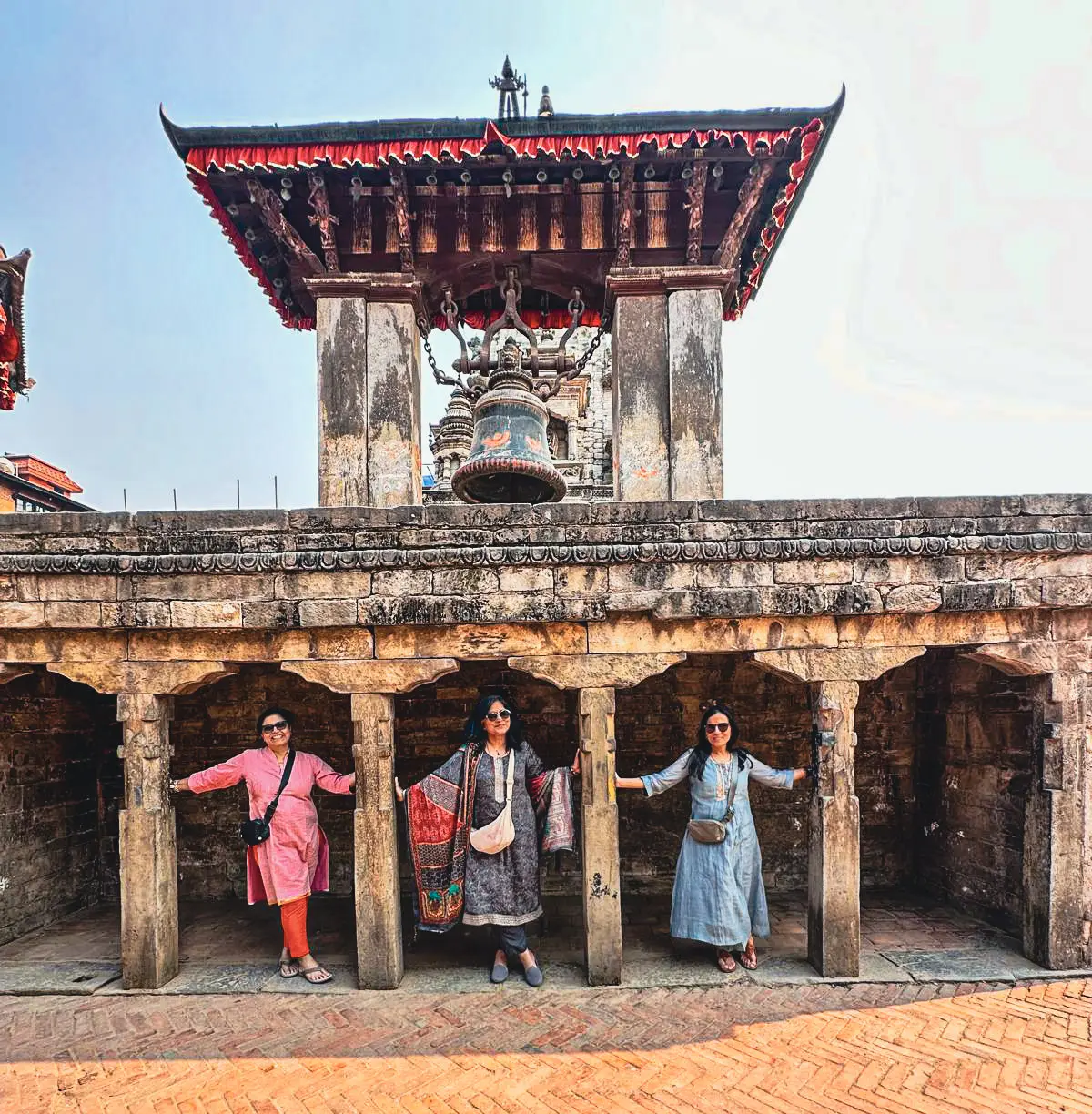
Continue to Boudhanath Stupa, one of the largest stupas in the world, where pilgrims circle the structure in a steady rhythm. Conclude at Swayambhunath (the Monkey Temple), set on a hilltop with sweeping views over the valley.
In the late afternoon, attend a pre-trip briefing at our office with your lead guide. The briefing covers the day-by-day plan, gear inspection, altitude-sickness protocols, helicopter logistics, and any final questions. We also issue your included Peregrine duffel bag, premium down jacket, and -20°C sleeping bag during this session.
- Altitude: Kathmandu 1,400 m (acclimatization-neutral day)
- Activities: Half-day private guided sightseeing and trek briefing
- Sightseeing Duration: 4 to 5 hours
- Accommodation: Kathmandu Marriott Hotel (5-star, deluxe room)
- Meals: Breakfast
Day 03: Helicopter to Lukla (2,840 m) and Trek to Phakding (2,610 m)
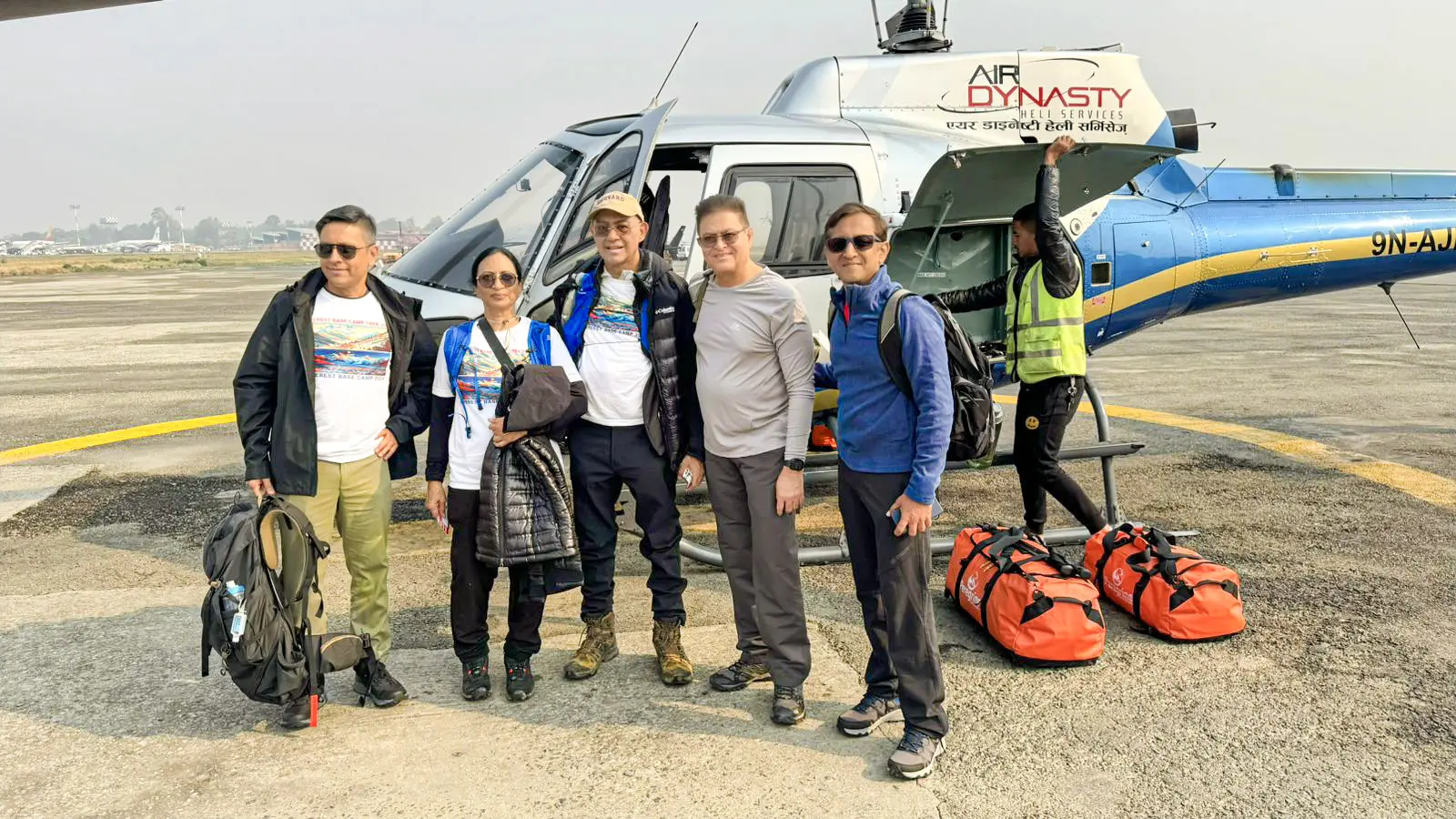
An early morning helicopter flight takes you from Kathmandu to Lukla. This is a 25- to 30-minute direct flight on a 5-seat Airbus AS350 B3e or Bell 407, the standard high-altitude rotorcraft for the Everest region. The route passes through the foothills of the central Himalayas with views of Gauri Shankar on clear mornings. Because your luxury package includes this helicopter, you completely skip the grueling 2 AM road drive to Ramechhap that standard fixed-wing flights require.
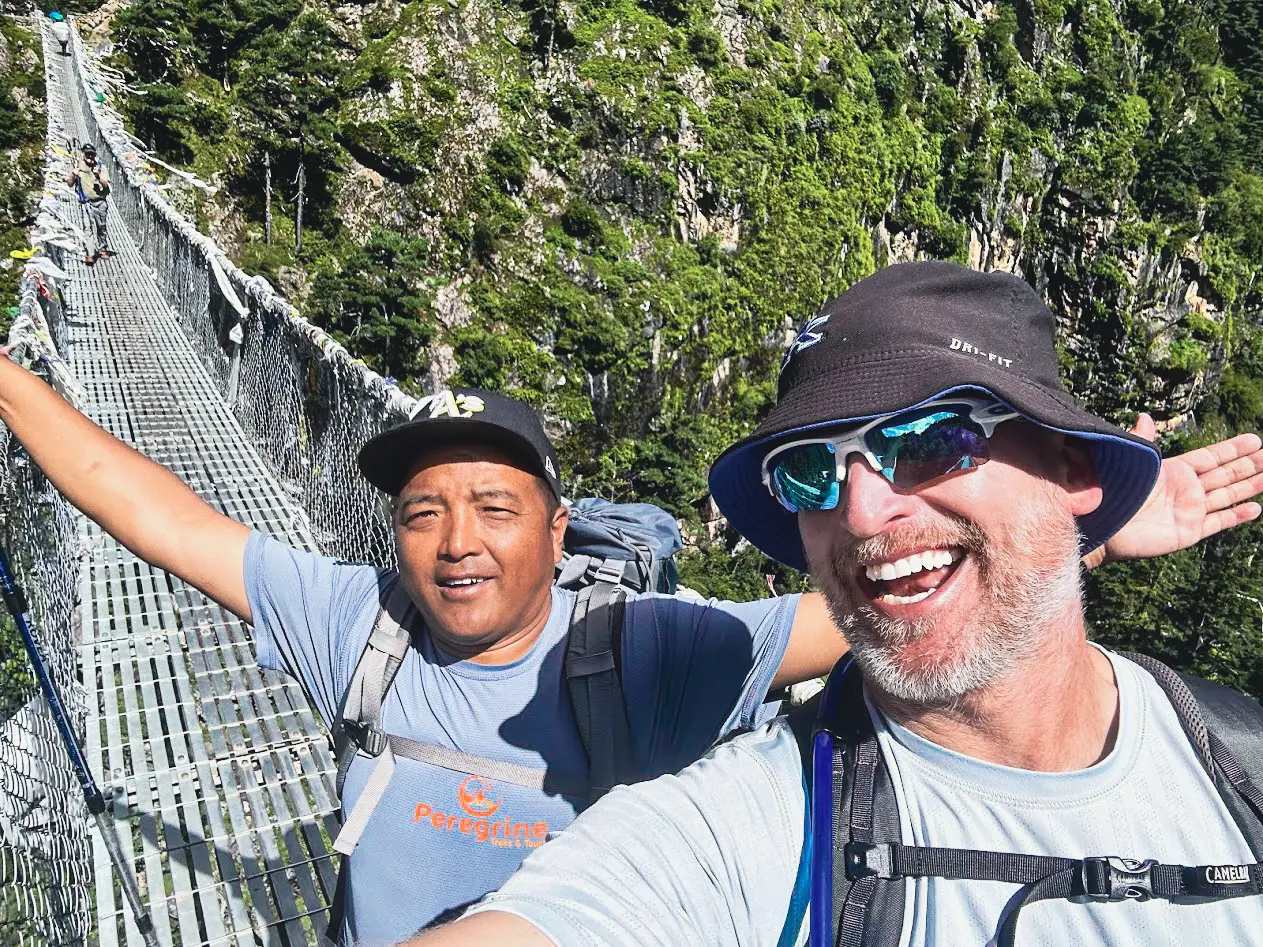
After breakfast in Lukla and a brief gear check, begin your first day of trekking. Walk from Chaurikharka village along the trail leading toward Dudh Koshi Ghat, then move steadily alongside the river until reaching Phakding (2,610 m). The route follows the Dudh Koshi valley with views of Mt. Khumbila (5,761 m), the sacred, unclimbed peak of the Sherpa community. Cross several suspension bridges decorated with prayer flags and pass through small settlements with mani stone walls.
Settle in for the night at The Himalayan Phakding: a newly opened flagship property featuring riverside view cottages, double-glazed insulated rooms, and exceptional Sherpa hospitality.
- Starting Altitude: Kathmandu 1,400 m
- Ending Altitude: Phakding 2,610 m
- Altitude Change: +1,440 m flight; then -230 m net descent to Phakding
- Highest Point: Lukla 2,840 m (oxygen approximately 73% of sea level)
- Trekking Distance: 8 km
- Trekking Duration: 3 to 4 hours (easy pace)
- Trail Route: Lukla to Chaurikharka, Chheplung, Thado Koshi, Ghat, and Phakding
- Accommodation: The Himalayan Phakding (luxury room, en-suite, heated bed / underfloor heating)
- Meals: Breakfast, Lunch, Dinner
Day 04: Trek to Namche Bazaar (3,440 m)
Follow one of the most scenic sections of the trail today as you move along the Dudh Koshi River through forests of rhododendron and pine. Cross a series of suspension bridges lined with prayer flags, including the famous Hillary Bridge, while gradually gaining elevation along the valley floor.
Continue to Monjo, the entry point to Sagarmatha National Park, a UNESCO World Heritage Site that protects the region’s fragile alpine ecosystem. Complete the permit verification process here, then proceed to Jorsalle for a lunch break before the steep climb begins.
Tackle the final ascent of the day with a steady 600-meter climb up Namche Hill. If the weather stays clear, you will catch your first view of Mount Everest during this stretch. Reach Namche Bazaar (3,440 m) by late afternoon and take time to walk through its local shops and bakeries.
- Starting Altitude: Phakding 2,610 m
- Ending Altitude: Namche Bazaar 3,440 m
- Altitude Gain: +830 m net elevation gain
- Highest Point: Namche Bazaar 3,440 m (oxygen approximately 66% of sea level)
- Trekking Distance: 11 km
- Trekking Duration: 6 to 7 hours (including rest stops and lunch)
- Trail Route: Phakding to Benkar, Monjo, Jorsalle, Hillary Bridge, and Namche Bazaar
- Accommodation: Yeti Mountain Home Namche (luxury room, en-suite, heated bed)
- Meals: Breakfast, Lunch, Dinner
First-Hand Note: Our 20 years of operational experience show that trekkers who arrive in Namche by 3 PM and rest for 1 hour before an easy evening walk have measurably better SpO₂ readings the next morning. Our guide, Dorche Sherpa, checks your oxygen saturation at 6 PM and again at 6 AM to shape the day’s pace.
Day 05: Acclimatization and Sleep at Hotel Everest View (3,880 m)
This is a dedicated acclimatization day at the world’s highest-placed hotel. Begin with a steady morning hike from Namche Bazaar to the Syangboche Airstrip, then continue to the Hotel Everest View at 3,880 m. This is a climb of approximately 440 meters over 4 to 5 km of trail.
While standard itineraries require you to return to Namche to sleep, our luxury program books you directly into the Hotel Everest View. This allows you to reap the full physiological benefits of a higher-altitude transition while enjoying premium comfort
On clear days, the hotel’s stone viewing deck offers a direct frontal view of Everest, Lhotse, and Ama Dablam. Spend the afternoon relaxing on the deck or take an optional walk to Khumjung village to visit the local monastery.
- Starting Altitude: Namche Bazaar 3,440 m
- Ending Altitude: Hotel Everest View 3,880 m
- Altitude Gain: +440 m elevation gain
- Highest Point: Hotel Everest View 3,880 m (oxygen approximately 63% of sea level)
- Trekking Distance: 4 to 5 km of hiking
- Trekking Duration: 3 to 4 hours of active hiking
- Accommodation: Hotel Everest View (luxury en-suite room with panoramic views)
- Meals: Breakfast, Lunch, Dinner
Safety Note: Sleeping at 3,880 m is a highly exclusive luxury experience. Because of the rapid elevation gain from Namche, our guides conduct additional pulse oximeter checks throughout the evening to monitor your acclimatization.
Day 06: Trek to Tengboche (3,867 m)
Leave the Hotel Everest View after breakfast and descend through pine and rhododendron forest toward Phunki Tenga (3,250 m) on the Dudh Koshi River, where you cross the suspension bridge and stop for lunch. After lunch, begin the steady 600-meter climb to Tengboche through dense forest.
Reach Tengboche (3,867 m) by mid-afternoon and visit Tengboche Monastery, the spiritual center for the Sherpa community. From the monastery courtyard, Everest, Lhotse, and Ama Dablam appear clearly on the horizon.
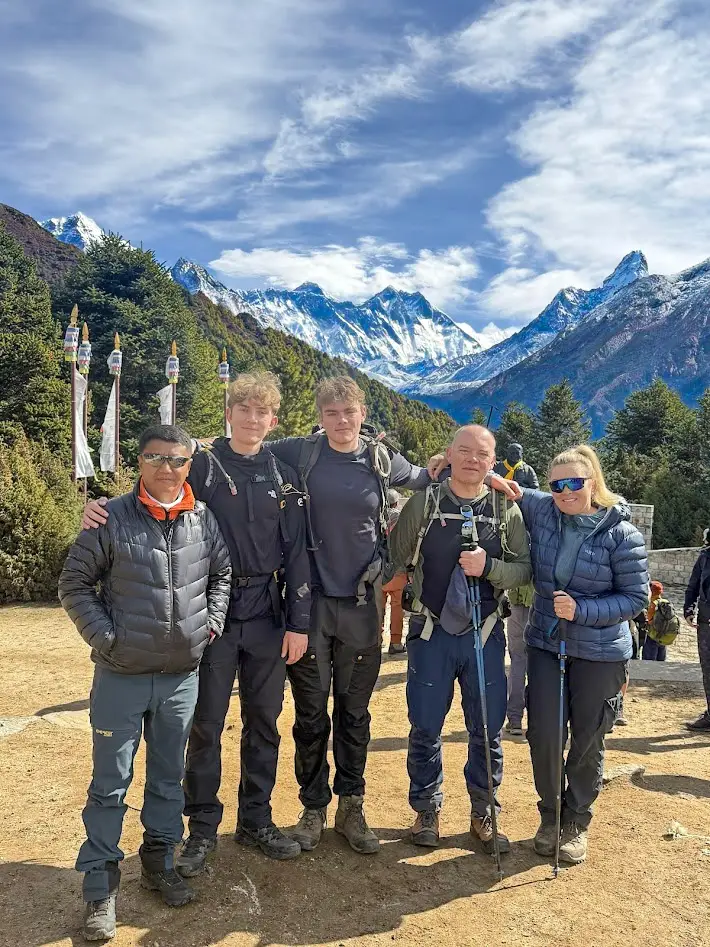
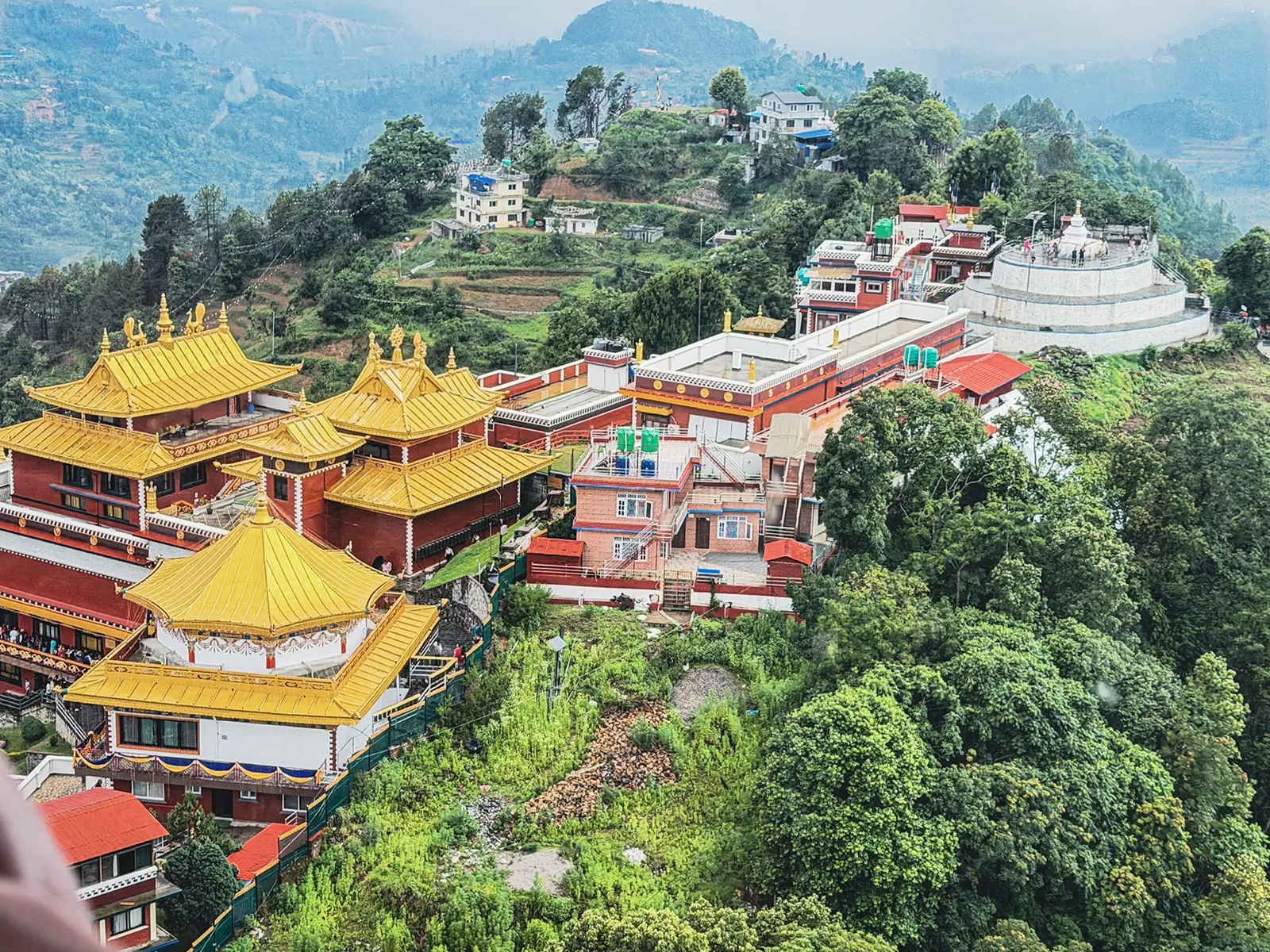
Instead of descending to Deboche as standard agencies require, you will check directly into The Himalayan Tyangboche, located right next to the monastery. Settle in and soothe your muscles in a heated onsen pool at 3,867 m, or experience a restorative treatment from a specialized massage therapist as you watch the sunset over Everest directly from the viewing deck.
- Starting Altitude: Hotel Everest View 3,880 m
- Ending Altitude: Tengboche 3,867 m
- Altitude Change: -13 m net (with intermediate descent to 3,250 m and climb to 3,867 m)
- Highest Point: Hotel Everest View 3,880 m (oxygen approximately 63% of sea level)
- Trekking Distance: 9 km
- Trekking Duration: 5 hours (including monastery visit and lunch)
- Trail Route: Hotel Everest View to Kyangjuma, Sanasa, Phunki Tenga, and Tengboche
- Accommodation: The Himalayan Tyangboche (luxury room, en-suite, underfloor heating, heated onsen pool access)
- Meals: Breakfast, Lunch, Dinner
First-Hand Note: We deliberately time our Day 6 arrival to match the 3 PM monastery prayer ceremony. The chanting of the monks with Ama Dablam framed in the background is one of the most culturally moving experiences on the trail.
Day 07: Trek to Dingboche (4,410 m)
Leave the beautiful ridge of Tengboche after breakfast, descending briefly through rhododendron forests to Deboche, and continue through alpine terrain as the trail moves through forests of conifer and birch. Gradually descend into traditional Sherpa settlements, passing through Pangboche, which hosts one of the oldest monasteries in the entire Khumbu region. Pause for a short visit to the monastery and take in its collection of cultural relics.
Resume the walk and cross the Imja and Lobuche Rivers as the landscape opens into a wide, barren alpine valley. Arrive at Dingboche (4,410 m), a striking village set against a wide Himalayan backdrop of stone-walled fields growing barley, potatoes, and buckwheat.
- Starting Altitude: Tengboche 3,867 m
- Ending Altitude: Dingboche 4,410 m
- Altitude Gain: +543 m net elevation gain
- Highest Point: Dingboche 4,410 m (oxygen approximately 59% of sea level)
- Trekking Distance: 10 km
- Trekking Duration: 5 to 6 hours
- Trail Route: Tengboche to Deboche, Pangboche, Shomare, Orsho, and Dingboche
- Accommodation: Hotel Good Luck Dingboche (private room, attached bath, electric blanket)
- Meals: Breakfast, Lunch, Dinner
Day 08: Acclimatization at Dingboche (Nagarjun Hill Hike)
This is your second built-in acclimatization day. Take a steady hike up the ridge behind Dingboche to gain elevation and support your red blood cell production. The route climbs toward Nagarjun Hill (Nangkartshang Viewpoint) at approximately 5,083 m, a steady 670-meter ascent that gives your body the higher-altitude exposure it needs before tomorrow’s push to Lobuche.
From the ridge, take in sweeping views of Mt. Lhotse (8,516 m), Mt. Makalu (8,485 m), Mt. Cho Oyu (8,201 m), Cholatse, and Taboche. After completing the ridge hike, gradually descend back to Dingboche at a relaxed pace for rest and hydration.
- Sleeping Altitude: Dingboche 4,410 m (no change for overnight)
- Highest Point: Nagarjun Hill Viewpoint 5,083 m (oxygen approximately 54% of sea level)
- Altitude Gain on Hike: +670 m, returning to 4,410 m for sleep
- Trekking Distance: 4 to 5 km round trip
- Trekking Duration: 3 to 4 hours of hiking
- Accommodation: Hotel Good Luck Dingboche (private room, attached bath, electric blanket)
- Meals: Breakfast, Lunch, Dinner
Day 09: Trek to Lobuche (4,940 m)
Begin Day 9 with a nourishing breakfast before setting out on a gradual ascent toward the Pheriche Valley. Follow the northwest trail above the valley floor as it winds through alpine shrub, where wide-open landscapes reveal striking views of Tawoche and Cholatse peaks.
Continue with a steady climb for about two hours to reach Thukla (Dughla), where you stop for a hot lunch. After the break, resume the trek onto the steeper section of the trail leading up to Thukla Pass.
Arrive at the memorial area at Thukla Pass, where stone monuments stand in remembrance of climbers and Sherpas who lost their lives in the Everest region. Take time here to reflect and pay tribute before continuing. Push through the final gradual slope to reach Lobuche by late afternoon.
- Starting Altitude: Dingboche 4,410 m
- Ending Altitude: Lobuche 4,940 m
- Altitude Gain: +530 m net elevation gain
- Highest Point: Lobuche 4,940 m (oxygen approximately 54% of sea level)
- Trekking Distance: 8 to 9 km
- Trekking Duration: 5 to 6 hours
- Trail Route: Dingboche to Dughla (Thukla), Thukla Pass memorial site, and Lobuche
- Accommodation: New EBC Hotel Lobuche (private room, attached bath; best available)
- Meals: Breakfast, Lunch, Dinner
Safety Protocol Note: At Lobuche, our guide Nima Sherpa personally checks each trekker’s SpO₂ readings on arrival and before bed. This protocol has helped us maintain a 99% Base Camp success rate by catching minor symptoms early.
Day 10: Trek to Gorak Shep and Everest Base Camp (5,364 m)
This is the most demanding day of the itinerary. Start from Lobuche after breakfast and move carefully along the trail toward Gorak Shep, following a steady pace as the route climbs along the Khumbu Glacier moraine.
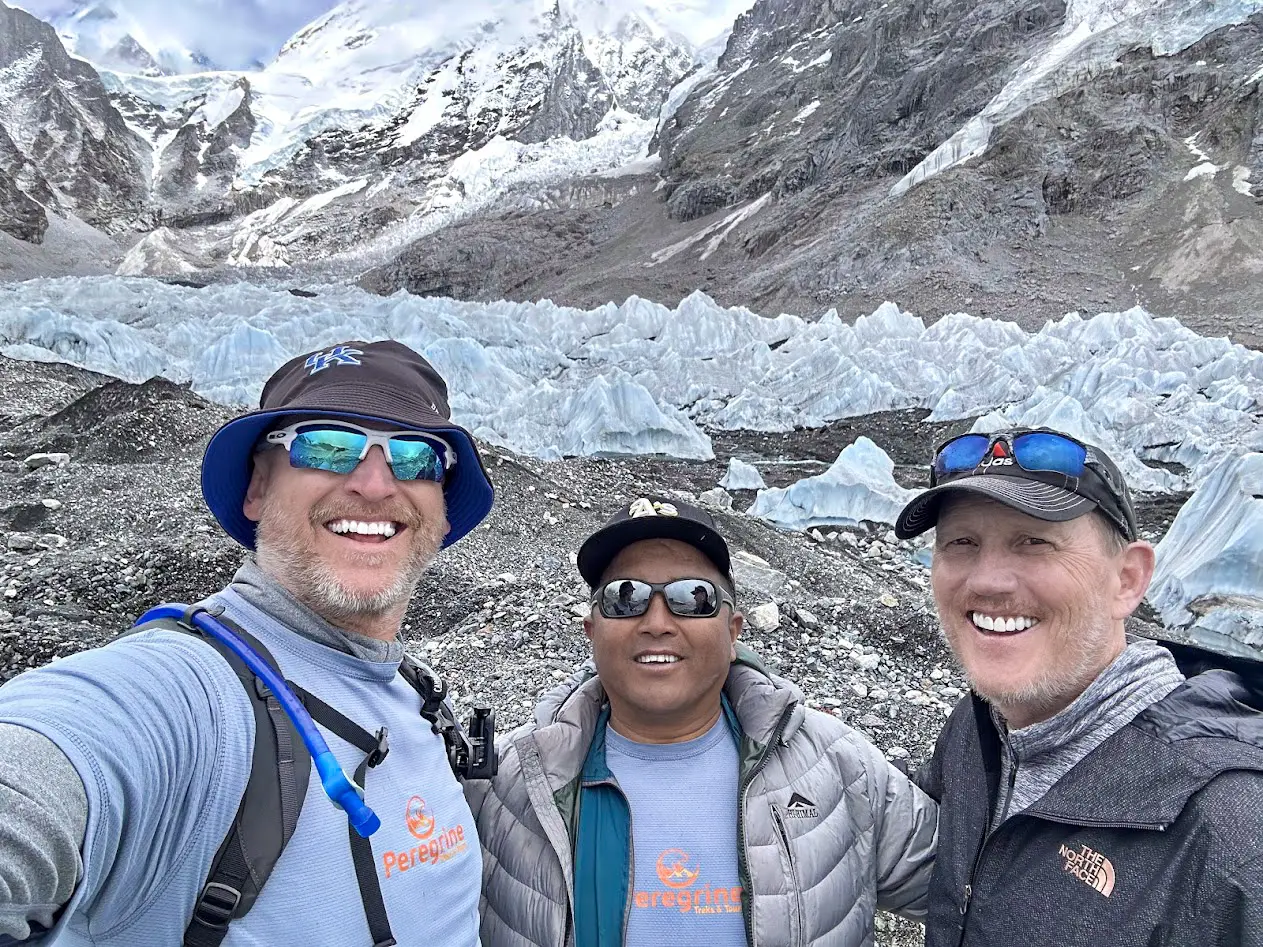
On reaching Gorak Shep, set down your main backpacks at the lodge and switch to your light daypack. Have a hot lunch to regain energy before continuing. Begin the slow, focused ascent to Everest Base Camp, maintaining a steady pace to minimize exertion.
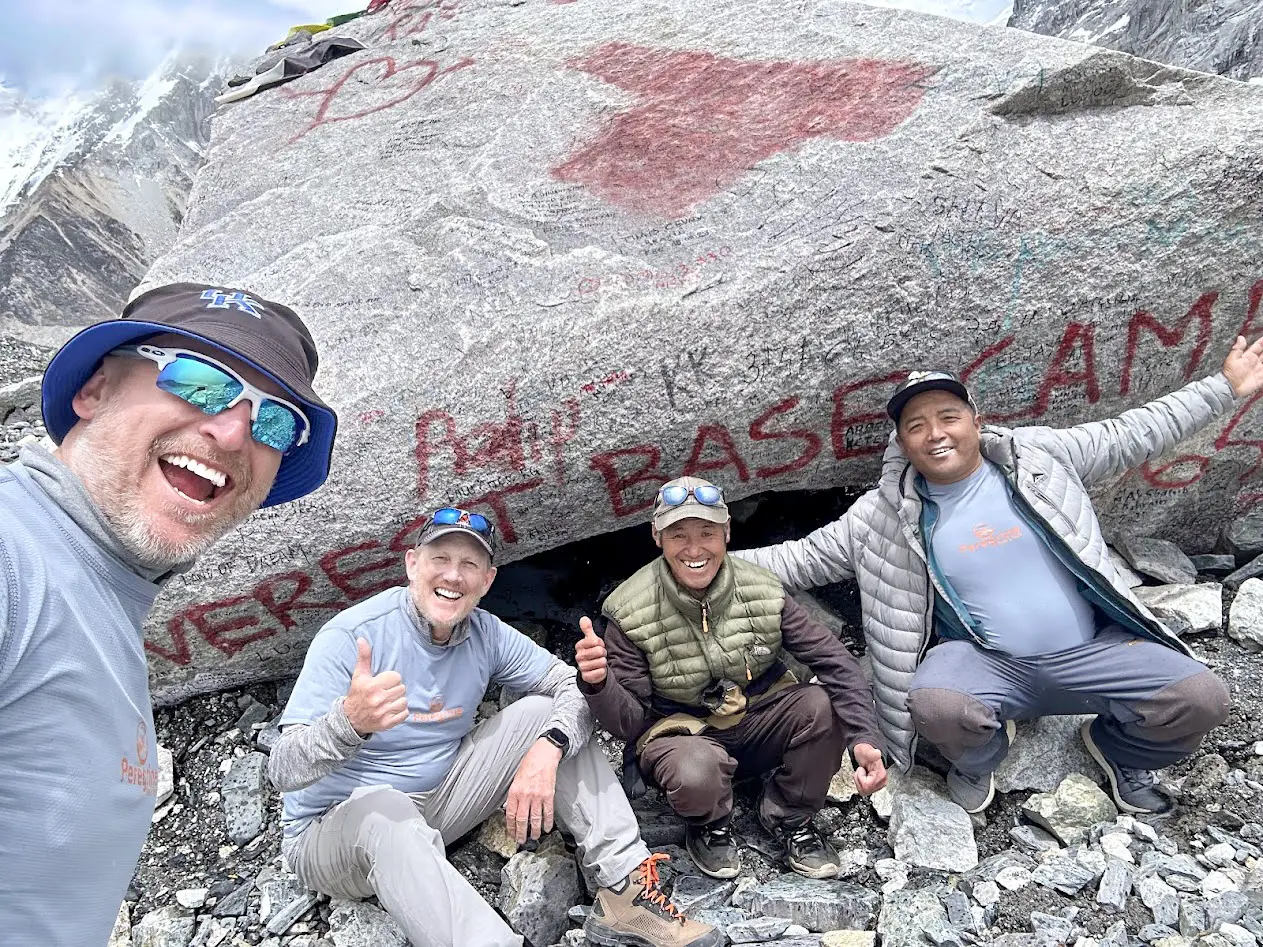
Walk along the rocky ridges of the glacier until the trail opens to reveal the dramatic Khumbu Icefall. Arrive at Everest Base Camp (5,364 m), standing at the foot of the world’s highest mountain. Take time to absorb the surrounding scenery and capture photographs at the iconic rock cairn. After the visit, retrace the route back to Gorak Shep before nightfall.
- Starting Altitude: Lobuche 4,940 m
- Mid-Day Destination: Gorak Shep 5,164 m (lodge)
- Highest Point: Everest Base Camp 5,364 m (oxygen approximately 50% of sea level)
- Altitude Gain: +224 m Lobuche to Gorak Shep; additional +200 m to EBC and back
- Trekking Distance: 4 km (to Gorak Shep) + 7 km (round trip to EBC) = 11 km total
- Trekking Duration: 3 hours (to Gorak Shep) + 5 hours (round trip to EBC) = 8 hours total
- Accommodation: Himalaya Lodge, Gorak Shep (electric blanket)
- Meals: Breakfast, Lunch, Dinner
Day 11: Sunrise at Kala Patthar (5,545 m) and Helicopter to Kathmandu
Begin your pre-dawn hike to Kala Patthar, departing the lodge around 4:30 AM with headlamps. The trail climbs steeply for approximately 1.5 hours from Gorak Shep, gaining 380 meters to the summit ridge at 5,545 m. This is the highest point of your trek.
Reach the viewpoint in time to witness the first rays of sunlight touch the summit of Mount Everest, Nuptse, and Lhotse. From Kala Patthar, you get the closest, unobstructed ground-level view of Everest available to non-climbers.
Descend back to Gorak Shep for breakfast and pack your gear. Your private helicopter departs from the Gorak Shep helipad between 8:30 and 10:00 AM, weather permitting. The aircraft is an Airbus AS350 B3e or a Bell 407. Total flight time to Kathmandu is approximately 45 minutes, excluding a brief refueling stop at Lukla.
Land at the Kathmandu domestic terminal by mid-morning and transfer to the Kathmandu Marriott Hotel by private vehicle. Spend the rest of the day relaxing, enjoying a hot shower, and the modern luxury of your 5-star room.
- Starting Altitude: Gorak Shep 5,164 m
- Sunrise Viewpoint: Kala Patthar 5,545 m (the trek’s highest point)
- Ending Altitude: Kathmandu 1,400 m
- Altitude Change: +381 m climb to Kala Patthar, then -4,145 m descent by helicopter
- Hiking Distance: 4 km round trip (to Kala Patthar and back)
- Hiking Duration: 3 to 4 hours total
- Helicopter Flight Time: 45 minutes flying (Gorak Shep to Lukla to Kathmandu)
- Aerial Views: Everest, Lhotse, Ama Dablam, and the Khumbu Icefall from above
- Accommodation: Kathmandu Marriott Hotel (5-star, deluxe room with mountain views)
- Meals: Breakfast
Helicopter Weather Contingency: Mountain helicopters fly under strict visibility rules. If the weather prevents the Day 11 flight, we will hold the helicopter slot for Day 12 and arrange overnight accommodation at the guesthouse. Note: The rapid descent from 5,164 m to 1,400 m results in a significant change in pressure. We recommend chewing gum or swallowing during the flight to help equalize your ears.
Day 12: Buffer Day in Kathmandu (1,400 m)
This day exists primarily as a weather buffer for the helicopter flight. Mountain weather is unpredictable, and we build Day 12 into every booking so that any flight delays do not affect your international flight home.
If your Day 11 flight ran on schedule, this becomes a free day in Kathmandu. Spend it relaxing at your hotel, visiting the hotel spa, or coordinating a half-day excursion to the historic Durbar Squares of Patan or Bhaktapur with our team.
- Altitude: Kathmandu 1,400 m
- Activities: Free day or optional guided city sightseeing
- Accommodation: Kathmandu Marriott Hotel (5-star, deluxe room with mountain views)
- Meals: Breakfast
Day 13: Departure from Kathmandu
Our team arranges your private vehicle transfer to Tribhuvan International Airport based on your flight schedule. We typically arrive at the airport 3 hours before the international flight departure. We assist you through check-in and bid you farewell at the security gate.
- Altitude: Kathmandu 1,400 m
- Transfer: Private vehicle to Tribhuvan International Airport (15 to 25 minutes)
- Meals: Breakfast
Customize this trip with help from our local travel specialist that matches your interests.
Includes & Excludes
What is included?
Accommodation (12 nights)
- 4 nights at Kathmandu Marriott Hotel, Naxal (5-star, deluxe room)
- 1 night at The Himalayan Phakding (luxury room, en-suite, heated bed, underfloor heating)
- 1 night at Yeti Mountain Home Namche (luxury room, en-suite, heated bed)
- 1 night at Hotel Everest View, 3,880 m (luxury en-suite room with panoramic views)
- 1 night at The Himalayan Tyangboche (luxury room, en-suite, underfloor heating, heated onsen pool access)
- 2 nights at Hotel Good Luck Dingboche (private room, attached bath, electric blanket)
- 1 night at New EBC Hotel Lobuche (private room, attached bath, best available)
- 1 night at Himalaya Lodge Gorak Shep (electric blanket, best available at this altitude)
Meals
- 12 breakfasts, 8 lunches, and 8 dinners as specified in the day-by-day itinerary
- Tea, coffee, and filtered water at lodges during trek days
Flights and Transfers
- Private helicopter charter from Kathmandu to Lukla (Day 3)
- Shared helicopter charter from Gorak Shep or Kala Patthar to Kathmandu (Day 11, 4-person sharing basis)
- All private vehicle airport transfers in Kathmandu
Guide, Porter, and Support Staff
- NATHM-certified English-speaking lead guide (Khumbu-born, minimum 10 Everest-region seasons)
- Porter support at a 1:2 ratio (1 porter per 2 trekkers, carrying up to 12 kg per trekker)
- Twice-daily SpO₂ pulse oximeter monitoring above Namche Bazaar (6 AM and 6 PM)
Gear Provided
- Peregrine-branded duffel bag (yours to keep)
- Premium down jacket rated to -20°C (provided for trek duration)
- Sleeping bag rated to -20°C (provided for trek duration)
Permits and Documentation
- Sagarmatha National Park entry permit
- Khumbu Pasang Lhamu Rural Municipality entry permit
- Trekkers’ Information Management System (TIMS) card
Sightseeing
- Half-day private guided tour of Kathmandu Valley UNESCO World Heritage Sites (Day 2): Pashupatinath Temple, Swayambhunath, and Boudhanath Stupa
Other
- Pre-trek briefing at Peregrine office with your lead guide (Day 2)
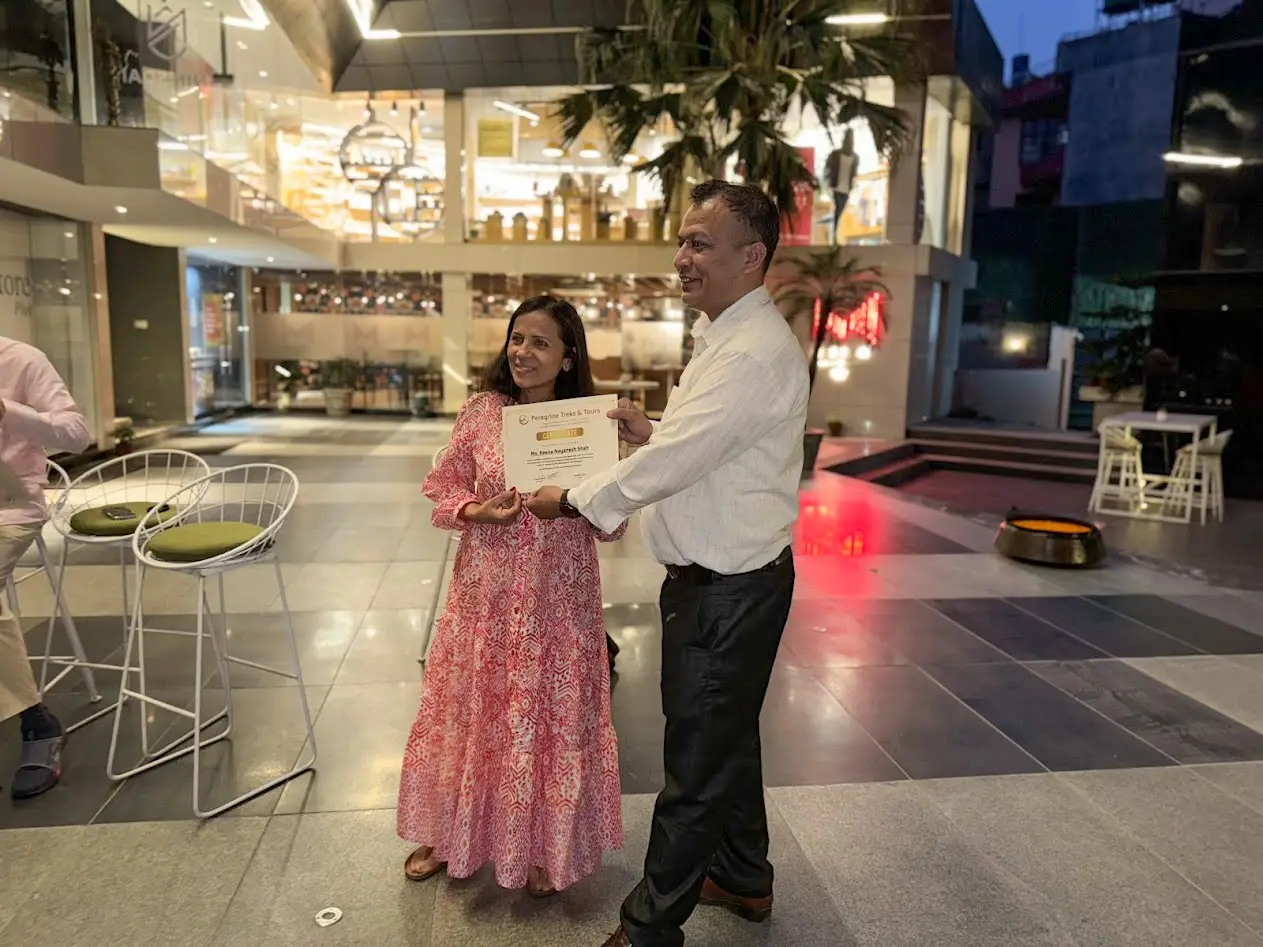
- Peregrine trek completion certificate
- All applicable government taxes
What is excluded?
- International airfare to and from Kathmandu
- Nepal visa fee (USD 30 for 15 days or USD 50 for 30 days, payable on arrival at Tribhuvan International Airport)
- Travel insurance covering high-altitude trekking above 5,000 m and helicopter evacuation (mandatory; we verify your policy before departure)
- Lunch and dinner in Kathmandu on Days 1, 2, 11, 12, and 13
- Alcoholic and bottled beverages on trek
- Hot shower charges at teahouses above Dingboche (where charged separately by the lodge)
- WiFi and device charging fees at lodges above Namche (where charged separately)
- Personal expenses: laundry, phone calls, souvenirs, snacks purchased independently
- Tips for guide, porters, and Kathmandu driver (discretionary; we provide a tipping guideline document before departure)
- Emergency helicopter evacuation (covered by your travel insurance policy)
- Any costs arising from itinerary changes due to weather, natural events, road closures, flight cancellations, or government restrictions beyond our control
- Items not explicitly listed under “What Is Included in the Cost”
Departure Dates
We also operate Private Trips.
Trip Information
What Sets the Luxury Everest Base Camp Trek Apart?
A standard Everest Base Camp trek requires significant sacrifices in comfort, sleep, and privacy. Our luxury itinerary redefines this experience by upgrading the three most critical pillars of your journey: where you sleep, how you fuel your body, and the human infrastructure supporting your climb.
1. Accommodations: Premium Lodges vs. Standard Teahouses
Standard teahouses on the Everest trail are notorious for uninsulated plywood walls, freezing overnight temperatures, and shared communal toilets. Our luxury itinerary bypasses these entirely in the lower and mid-valleys.
Instead of sleeping in a sleeping bag on a hard wooden bed, you will stay in premium properties like Yeti Mountain Home and The Himalayan Lodge.
- The Upgrades: You will experience en-suite bathrooms, hot running water, thermal insulation, and electric-heated beds or underfloor heating.
- The Reality Check: While environmental restrictions mean extreme-altitude settlements (like Lobuche and Gorak Shep) offer simpler facilities, we guarantee the highest tier of private accommodation available on the entire mountain, ensuring you are warm, rested, and ready for the next day’s altitude gain.
2. High-Altitude Nutrition & Hygiene
Fueling your body correctly at altitude is vital. While standard treks offer a repetitive, basic menu of heavy carbohydrates, our luxury package focuses on high-quality, hygienically prepared nutrition designed for altitude recovery.
- The Menu: Expect a diverse daily menu featuring both international and authentic Nepali cuisine, prepared with strict hygiene standards. Rather than instant coffee, mornings begin with freshly brewed coffee and hearty breakfasts.
- Food Safety: We strictly advise against consuming meat at extreme altitudes (as all meat must be carried up the mountain by porters without refrigeration). Instead, our selected premium lodges serve high-protein, plant-based, and safely prepared meals that are easy to digest in the thin air, maximizing your energy for the summit push.
3. Elite Guide Ratios and Personalized Pacing
A luxury trek is ultimately defined by the level of personalized service and safety provided. On budget treks, one guide is often stretched across a massive group of 15 people.
- Dedicated Attention: We enforce a strict 1:5 guide-to-client ratio, ensuring you are never rushed. You can trek at your own biological pace (“pole-pole”), stop for photographs whenever you wish, and ask deep questions about Sherpa culture.
- Ethical Porter Support: We provide a 1:2 porter ratio. Your heavy gear (up to 15kg) is carried safely ahead of you by our fully insured, ethically paid porter team, leaving you to carry only a light daypack.
- Medical Oversight: Because your guide manages a smaller group, they can provide individualized health monitoring, taking the time to carefully track your daily SpO₂ (blood oxygen) readings and adjust your itinerary dynamically if needed.
Preparation and Acclimatization: The Luxury Advantage
Physical Fitness Requirements
While our luxury itinerary maximizes your comfort and recovery, reaching Everest Base Camp remains a demanding physical achievement. You will be walking for multiple days in high-altitude conditions. To ensure you enjoy the journey rather than just endure it, we recommend beginning a targeted fitness regimen at least three months prior to your departure.
Your training should focus heavily on cardiovascular endurance—such as running, swimming, or cycling—to prepare your lungs for the thin mountain air. Additionally, incorporate core strength training and long, multi-hour hikes with a light daypack into your routine. Developing robust stamina ensures you can confidently navigate the daily altitude gains and fully appreciate the spectacular Himalayan scenery around you.
The Luxury Acclimatization Process
Acclimatization is the most critical factor in your trek’s success. On standard budget treks, clients often struggle to recover due to freezing communal tea houses and poor sleep. Our luxury package upgrades this biological process by turning acclimatization into a restorative experience. By sleeping in premium, thermally insulated lodges with heated beds and en-suite bathrooms, your body conserves vital energy that is otherwise lost to fighting the cold.
However, premium comfort does not bypass biology. You must still adhere strictly to altitude safety practices: staying constantly hydrated, ascending at a slow and steady pace, and participating in our scheduled acclimatization hikes.
To guarantee your safety, you are continually monitored by our expert guides. Rather than relying on lodge staff, your Peregrine lead guide—who holds advanced Wilderness First Aid certification—will track your SpO₂ (blood oxygen) levels and resting heart rate twice daily. This provides a clinical level of oversight, allowing you to relax, acclimatize comfortably, and thrive in the high mountains.
Related Article: Everest Base Camp Trek Difficulty
Best Time to Go: Seasons and Weather
The timing of your Luxury Everest Base Camp Trek significantly impacts both your physical comfort and the availability of premium amenities. The Himalayas operate on a strict seasonal rhythm.
- Spring (March to May): This is the premier climbing season. The weather is generally stable, the daytime temperatures are mild, and the lower valleys are alive with blooming rhododendrons. Because this is when expeditions summit Mount Everest, Base Camp itself is a vibrant, bustling tent city.
- Autumn (September to November): This is widely considered the best time for photography and trekking. The monsoon rains have cleared the dust from the atmosphere, leaving crisp, cloudless skies and unparalleled visibility. The weather is the most stable of the year, though temperatures drop significantly toward late November.
The Luxury Inventory Warning: Because true luxury lodges (like Yeti Mountain Home and the Hotel Everest View) have very limited room capacity, they sell out months in advance during these two peak seasons. We strongly advise booking your luxury trek 6 to 8 months in advance to secure the highest-tier accommodations.
Trekking in the Off-Season (Winter and Monsoon)
While standard treks often operate year-round, we do not recommend luxury departures during the Winter (December–February) or the Monsoon (June–August). Winter temperatures plummet to extreme lows that strain even the best heating systems, while the summer monsoon brings heavy rain, zero visibility, and frequent helicopter cancellations, effectively neutralizing the benefits of a premium package.
Trek Experience and Physical Fitness
The Luxury Everest Base Camp Trek with Helicopter Return is not a technical climb, but it is a sustained physical challenge. You will be walking for 5 to 7 hours daily over uneven, rocky terrain, steadily gaining altitude until you reach 5,545 meters (Kala Patthar).
While our luxury itinerary maximizes your comfort and recovery (via heated beds, premium nutrition, and en-suite bathrooms), you must still have the stamina to navigate the daily altitude gains.
- Cardiovascular Endurance: We recommend beginning a targeted fitness regimen at least three months prior to your departure. Focus heavily on cardiovascular exercises—such as running, swimming, or cycling—three to four times a week to prepare your lungs for the thin mountain air.
- Strength and Stamina: Incorporate core strength training and long, multi-hour hikes with a light daypack into your routine. The trek is a marathon, not a sprint. Developing robust stamina ensures you can confidently maintain a slow, steady biological pace (“pole-pole”) and fully appreciate the spectacular Himalayan scenery.
Why Choose Peregrine for This Trek?
A luxury trek is ultimately defined by the human infrastructure supporting it. Peregrine specializes in creating bespoke Himalayan experiences that combine raw adventure with uncompromising safety and comfort.
If you are looking for the cheapest possible price, Peregrine is not the right fit. We do not cut corners on safety. We are known for our expert, summit-proven Sherpa guides who provide clinical-level health monitoring (twice-daily SpO₂ checks) and deep insights into local culture. Peregrine handles every logistical detail—from securing the best luxury lodge rooms to orchestrating your private helicopter return—ensuring you can focus entirely on the majesty of Everest.
Comprehensive Safety and Medical Protocols
Safety is the foundation of every Peregrine expedition. On a luxury trek to Everest Base Camp, our goal is to provide peace of mind through proactive monitoring and rapid response capabilities.
Proactive Medical Monitoring
We do not wait for symptoms to appear. Our high-altitude medical protocols are built into your daily routine:
- Twice-Daily Monitoring: Your lead guide will measure your blood oxygen saturation (SpO₂) and resting heart rate every morning and evening. This allows us to track your acclimatization baseline and detect subtle physiological shifts long before they become an issue.
- Wilderness First Aid Standards: Your lead guide is certified in advanced Wilderness First Aid and carries a full medical kit, including emergency oxygen cylinders and, on group departures, a Portable Altitude Chamber (PAC bag).
- Expertise: All Peregrine guides are summit-proven professionals with extensive experience in the Khumbu region. They know when to adjust the daily pace to ensure you remain comfortable and acclimatized.
Helicopter Evacuation Standards
Our itinerary includes a dedicated helicopter return, but the aircraft also serves as our primary emergency asset.
- Rapid Response: We maintain 24/7 coordination between our field guides and our Kathmandu operations office.
- Operational Limits: In the event of a medical emergency, we are equipped to coordinate helicopter evacuations up to 6,000 meters, which covers the entire EBC trekking route, including Kala Patthar.
Mandatory Travel Insurance
To ensure you are fully protected, comprehensive travel insurance is a non-negotiable requirement for all trekkers. Your policy must be verified before your departure and must include the following:
- High-Altitude Coverage: Your plan must explicitly cover helicopter search and rescue operations up to 6,000 meters.
- Medical Expenses: Coverage for emergency medical treatment and repatriation.
- Trip Cancellation: We recommend coverage for trip interruption, as mountain weather can occasionally necessitate itinerary adjustments.
Note: Please ensure you carry a hard copy of your insurance policy details, including the emergency contact number for your provider, during your trek.
Related Article: Nepal Trekking Insurance
Elevating Your Expedition: Additional Luxury Options
Private Helicopter Experiences
The helicopter return is more than just a logistical convenience—it is a perspective-shifting experience. Soaring over the Khumbu Icefall, the deep glacial valleys, and the soaring 8,000-meter peaks offers a vantage point rarely seen by even the most seasoned mountaineers. For travelers who wish to maximize their time or secure exclusive aerial photography access, we can arrange private, chartered helicopter flights that offer a truly majestic end to your Everest journey.
The Reality of “Luxury at Base Camp”
While the trek remains a raw, authentic Himalayan experience, our “luxury” focus is about optimizing your comfort at every possible stage of the ascent.
- Altitude Recovery: We prioritize dining in premium lodges where our staff ensures a high-protein, altitude-friendly menu, avoiding the common pitfalls of standard teahouse food.
- Exclusive Access: Rather than communal public areas, we organize private, quiet spaces for our groups in the higher lodges, allowing for restorative rest away from the noise of large, unmanaged trekking groups.
- Personalized Briefings: We host private evening briefings with your lead guide, where you can discuss the next day’s terrain, delve into local Sherpa history, or receive personal coaching for the final summit push.
Responsible Luxury & Stewardship
Environmental Stewardship
True luxury in the Himalayas means leaving the mountains exactly as you found them. We operate with a “Leave No Trace” philosophy that goes beyond standard regulations. Our logistics team ensures that all waste is carried out of the Khumbu region, and we prioritize partnerships with lodges that utilize solar energy, maintain high-efficiency water filtration systems, and minimize the use of single-use plastics.
Ethical Porter and Guide Support
We believe that luxury service must be built on a foundation of ethical treatment. Peregrine Treks ensures that every member of our porter and guide team receives fair, living wages, full insurance coverage, and professional-grade high-altitude gear. When you trek with us, you are not just a client; you are a patron of a sustainable Himalayan economy. This ensures that the people who carry your gear are proud, well-treated members of our team, which directly translates to a safer, more attentive experience for you.
Beyond the Trek: Nepalese Luxury Extensions
Your Everest journey is often just the beginning. We can seamlessly extend your trip to include the most exclusive experiences in Nepal and beyond:
- Heritage Luxury in Kathmandu: Extend your stay at the Dwarika’s Hotel—a living museum of hand-carved Newari architecture—with a private cultural chauffeur to guide you through the city’s secret courtyards and ancient artisan workshops.
- Pokhara & Annapurna Retreats: Take a private flight to Pokhara to enjoy the serenity of the Phewa Lake waterfront, staying at premium spa resorts that offer yoga, meditation, and panoramic Annapurna views.
- Maldives Extension: The perfect finale. We can arrange a seamless connection from Kathmandu to the Maldives, where you can spend 5 nights in an overwater villa, trading the high-altitude air of Everest for the turquoise waters of the Indian Ocean.
What to Expect Upon Return
Post-Trek Experience in Kathmandu
After completing your luxury Everest Base Camp trek with a helicopter return, your adventure is still ongoing. Kathmandu offers a fitting environment to relax and reflect on your journey. You might unwind at one of the city’s high-end hotels, where spa services and fine dining can help you transition back to daily life. If you’re interested in souvenirs, Kathmandu has exclusive boutiques where you can find premium local crafts that serve as a lasting reminder of your trip.
Sharing Your Luxury Trek Experience
Sharing your travel stories brings a unique joy, and a luxury trek to Everest Base Camp provides ample material. Whether posting breathtaking photos on social media or writing a detailed travel blog, sharing your experience serves two purposes. First, it enables you to revisit those special moments. Second, it provides valuable insights for others contemplating a similar adventure.
Return from a luxury Everest Base Camp trek with a helicopter return offers opportunities for both relaxation and reflection. Kathmandu’s luxury offerings serve as a soft landing after the rigorous trek, while sharing your experience extends the journey’s emotional impact. Your adventure may be over, but its legacy can continue in the stories you share and the memories you cherish.
1. Helicopter and Domestic Flight Luggage Limits
Weight management is strictly enforced by aviation authorities for both the fixed-wing flight to Lukla and your helicopter return from the mountains.
- Total Weight Allowance: You are permitted a strict total of 20 kg per person.
- Main Duffel Bag (Carried by Porter): Maximum 15 kg.
- Personal Daypack (Carried by You): Maximum 5 kg.
- Why the limit? Small Twin Otter aircraft and high-altitude helicopters have critical payload restrictions. If your gear exceeds 20 kg, it will be offloaded and left in Kathmandu. We provide a 65L soft-sided Peregrine duffel bag during your briefing to help you pack efficiently.
- Helicopter Shuttle Protocol (Above 4,400m): For your helicopter return from Gorak Shep (5,164 m) or Kala Patthar (5,545 m), the air density severely restricts lift capacity. The maximum payload per flight above 4,400 meters is 240 kg. If your group exceeds this (typically groups of 4 or 5), the helicopter will perform a “shuttle run.” It will fly two passengers down to Pheriche (4,371 m), return to grab the remaining passengers, and then fly the entire group together back to Kathmandu.
2. High-Altitude Connectivity and Power
While our luxury package includes comfortable lodges, the reality of high-altitude infrastructure means that power and internet are limited resources.
| Location | Altitude | Internet Availability | Charging Facilities |
|---|---|---|---|
| Namche Bazaar | 3,440 m | Good 4G (Ncell/NTC); Lodge Wi-Fi | Free in-room charging at Yeti Mountain Home |
| Tengboche/Deboche | 3,867 m | Spotty 4G; Everest Link Wi-Fi | Free in-room charging at The Himalayan Lodge |
| Dingboche | 4,410 m | Everest Link Wi-Fi (0.5–2 Mbps) | Shared lodge charging (Approx. USD 5–10 per device) |
| Gorak Shep | 5,164 m | Everest Link Wi-Fi (Weak/Slow) | Shared lodge charging (Approx. USD 10–15 per device) |
- Everest Link Wi-Fi: Above Namche, mobile networks fail. Lodges sell Everest Link scratch cards (approx. USD 25 for 10GB). Expect speeds capable of WhatsApp messaging, but voice calls and video uploads are generally unreliable above 4,000 meters.
- Power Banks: We strongly recommend bringing a high-capacity power bank (20,000mAh) to keep your devices charged during the final push to Base Camp, as cold batteries drain quickly.
3. Medical Protocols and High-Altitude Safety
Your safety is our absolute priority. A luxury trek is defined by the level of medical support provided. Our lead guides hold advanced Wilderness First Aid certifications and manage your health using the following protocols:
- Daily SpO₂ Monitoring: Your guide will measure your blood oxygen saturation (SpO₂) and resting heart rate twice daily (morning and evening) using a medical-grade pulse oximeter. At sea level, normal SpO₂ is 95-100%. At Everest Base Camp, a healthy SpO₂ can drop to 70-80%. Our guides monitor your specific baseline to detect early signs of Acute Mountain Sickness (AMS) before symptoms become severe.
- Portable Altitude Chamber (PAC Bag): On our group departures, we carry an inflatable Portable Altitude Chamber. In the event of severe AMS, HAPE, or HACE, placing a trekker inside the PAC bag and inflating it simulates a rapid descent of approximately 1,500 meters, stabilizing the patient until a helicopter arrives.
- Emergency Oxygen: Every Peregrine luxury trek carries dedicated emergency oxygen cylinders. This is strictly for medical intervention, not for climbing assistance.
- Helicopter Evacuation: If your health requires it, we maintain 24/7 contact with our Kathmandu office to dispatch a rescue helicopter up to 6,000 meters. (This is why comprehensive travel insurance covering helicopter evacuation is mandatory).
Related Articles
Frequently Asked Questions
A: A luxury trek is defined by the quality of your recovery and the level of service. While standard treks utilize communal tea houses with plywood walls, we book the finest available lodges (such as Yeti Mountain Home and The Himalayan). You gain access to en-suite bathrooms, electric-heated beds, and high-protein, hygienically prepared meals. Furthermore, we maintain a 1:5 guide-to-client ratio, ensuring you are never rushed and receive personalized daily health monitoring.
A: Mountain aviation is always subject to weather conditions. While our itinerary is designed to maximize your chances of a smooth flight, safety is the final authority. If mountain weather prevents a flight on Day 11, we hold a scheduled buffer day (Day 12) in Kathmandu, ensuring you have time to accommodate any necessary adjustments without impacting your international flight home. We prioritize safety above all else, ensuring that if you cannot fly, we manage the logistics for your safe return.
A: No, but you do need to be a consistent walker. The EBC trek is a long-distance endurance challenge, not a technical climb. We recommend a 3-month cardiovascular training regimen (running, cycling, or swimming) to prepare your lungs for high-altitude conditions. Our “pole-pole” (slow, slow) pacing strategy allows for steady acclimatization, making the journey accessible for anyone in good physical health.
A: We view altitude acclimatization as a medical and logistical priority. We utilize two mandatory acclimatization days (Namche and Dingboche) to follow the “climb high, sleep low” principle. Your lead guide, who holds advanced Wilderness First Aid certification, performs mandatory twice-daily blood oxygen (SpO₂) and heart rate monitoring. This proactive approach allows us to detect subtle physiological changes days before they become a risk, letting us adjust the pace or provide supplemental oxygen as needed.
A: Luxury travel values privacy above all. Our package is based on double occupancy, but we offer a single supplement for any traveler who prefers their own space. As a solo traveler, if you select the single supplement, we will secure a private, en-suite room for you in every lodge and hotel throughout the entire journey.
A: Power access is a limited resource at extreme altitudes. We ensure you have priority access to charging in all luxury lodges up to Deboche. However, at higher settlements like Lobuche and Gorak Shep, power is shared. We recommend bringing a high-capacity power bank (20,000mAh) to ensure you can keep your devices charged for the final push to Base Camp without relying on lodge availability.
A: Our menu is designed for altitude recovery. While traditional teahouses rely heavily on basic carbohydrates, we provide a diverse, high-protein menu featuring both international and Nepali-Tibetan cuisine. We strictly enforce a no-meat policy above Namche Bazaar to ensure maximum food safety and hygiene, focusing instead on digestible, energy-dense, and ethically sourced plant-based ingredients.
A: Comprehensive travel insurance is a mandatory requirement. Your policy must explicitly cover high-altitude trekking up to 6,000 meters and include a specific provision for emergency helicopter search and rescue. We review your policy documents before departure to ensure you are fully protected in the unlikely event of an evacuation.
A: Tipping is at your discretion, but we understand that luxury travelers prefer guidance to avoid awkwardness. Upon booking, we provide a detailed, voluntary tipping guideline based on industry standards, ensuring your support team is rewarded fairly for their exceptional work without you having to second-guess the amount.
A: Yes. Unlike fixed-departure group treks, our Luxury EBC package is fully bespoke. If you prefer to stay an extra night at Hotel Everest View to focus on photography, or if you want to skip a specific section of the trail, we can adjust the itinerary to match your pace and interests.
A: Your safety and comfort are paramount. In the event of illness, our guides have the authority to initiate an immediate descent. Because your trek is private, we do not need to wait for a group. We will coordinate a rescue helicopter evacuation directly from the trail to Kathmandu, and our 24/7 operations team will manage all hospital logistics and hotel arrangements upon your arrival in the city.
A: Absolutely. Once your trek is confirmed, we send you a curated luxury packing guide. It distinguishes between what you need to bring from home (personal layers, cameras) and what we provide (Peregrine-branded down jackets, high-altitude sleeping bags, and 65L duffel bags). We also offer a complimentary gear check in Kathmandu on Day 2 to ensure you have exactly what is needed—and nothing more.
You do not need mountaineering experience, but you do need a solid cardiovascular base. We recommend at least 8 to 12 weeks of preparation before departure. Focus on sustained uphill walking with a loaded daypack (8 to 10 kg), stair climbing, and at least 3 cardio sessions per week. You should be able to walk uphill for 5 to 6 hours at a steady pace without exhaustion. The most demanding day is Day 10 (Gorak Shep to Everest Base Camp and back), which covers 11 km over 8 hours at altitudes above 5,100 m. Our guide Dorche Sherpa sets the pace based on your fitness and SpO₂ readings, and can adjust the schedule to add rest breaks without affecting the overall itinerary.
Mountain helicopters operate under strict visual flight rules and cannot fly in low visibility, heavy cloud cover, or strong crosswinds. We build Day 12 into every booking specifically as a weather buffer. If the Day 11 flight is grounded, we hold the helicopter slot for Day 12 and arrange overnight accommodation at Gorak Shep. If Day 12 is also grounded, we arrange a third attempt on Day 13 and adjust your departure accordingly at no additional helicopter cost. In the rare event that three consecutive days are unflyable, we arrange a walking descent (3 additional days) with accommodation and meals covered by Peregrine. In 300+ luxury departures, we have never had a client miss their helicopter return entirely.
Yes. We operate private departures for solo trekkers at the same per-person price. Your lead guide, porter, and the full luxury lodge booking are dedicated to you. Solo trekkers follow the same itinerary and receive the same service level as groups. Many of our solo clients are professionals with limited leave who cannot coordinate travel dates with others.
The two peak seasons are spring (March to May) and autumn (September to November). Autumn offers the clearest skies, the lowest chance of precipitation, and the most stable helicopter flying conditions. Spring brings rhododendron blooms along the lower trail sections and warmer daytime temperatures. We operate year-round, but we advise against December through February for this luxury package because snowfall above Dingboche can close the trail and ground helicopter flights for multiple days. June through August is monsoon season with heavy rain, reduced visibility, and leech activity on the lower trail.
Our acclimatization protocol follows Wilderness Medical Society guidelines: gain no more than 500 m of sleeping altitude per day above 3,000 m, with a rest day every 1,000 m gained. The itinerary builds in two dedicated acclimatization days: Day 5 at Hotel Everest View (3,880 m) and Day 8 at Dingboche (4,410 m). Your guide carries a pulse oximeter and checks your SpO₂ and heart rate twice daily above Namche Bazaar. If your SpO₂ drops below 75% at rest or you show symptoms (persistent headache, nausea, loss of coordination), the guide will hold you at the current altitude for an extra day or arrange an immediate helicopter evacuation covered by your travel insurance. We also carry supplementary oxygen as a precaution above Lobuche.
Luxury lodges from Phakding through Tengboche serve multi-course meals: dal bhat, pasta, soups, fried rice, momos, pancakes, and fresh vegetables. Yeti Mountain Home properties have trained kitchen staff and menus that include baked goods, eggs cooked to order, and hot beverages throughout the day. Above Dingboche, menus narrow to dal bhat, noodle soups, fried potatoes, and simple carbohydrate-heavy dishes. The calorie density matters more than variety at these altitudes. We carry extra snacks (energy bars, dried fruits, and high-protein nuts) from Kathmandu. Our guides carry extra snacks (energy bars, dried fruit, chocolate) from Kathmandu for the high-altitude days. If you have dietary restrictions (vegetarian, vegan, gluten-free, halal), inform us at booking so we can coordinate with the lodges in advance.
WiFi is available at the Kathmandu Marriott Hotel (complimentary) and at luxury lodges from Phakding through Tengboche (free or NPR 500 to 800 per session). Above Dingboche, WiFi is unreliable and often unavailable. Mobile data works on Ncell and NTC networks up to Namche Bazaar (3,440 m) and intermittently to Dingboche (4,410 m). Above Dingboche, expect no connectivity until the helicopter returns you to Kathmandu. We recommend downloading offline maps, notifying family of the expected communication blackout above Dingboche, and carrying a portable battery pack (20,000 mAh minimum) since charging above Dingboche costs NPR 300 to 500 per device per charge.
Yes. Many clients add a post-trek extension. The most popular options are a Kathmandu Pokhara Chitwan tour (5 to 7 additional days covering Pokhara lakeside, Chitwan National Park safari, and the Annapurna mountain panorama) or a day trip to Patan and Bhaktapur Durbar Squares. We also arrange connecting trips to Bhutan (5 to 8 days) and Tibet (7 to 10 days) departing directly from Kathmandu. Tell us your interest at booking so we can build the extension into your itinerary and handle all permits, flights, and accommodation as a single package.
We recommend booking 3 to 6 months ahead for peak season (October, November, March, April). Luxury lodges in the Khumbu have limited room inventory (Yeti Mountain Home properties and Hotel Everest View often sell out 2 to 3 months before peak season dates). Helicopter charter slots also fill during October and November. For off-peak months (May, September, December), 4 to 6 weeks advance booking is usually sufficient. We require a 30% deposit at booking with the balance due 30 days before departure.
Reviews on Luxury Everest Base Camp Trek with Helicopter Return
5.0
Comfortable and memorable Trip
Recently, we did the Luxury Everest Base Camp Trek with a helicopter return with Peregrine Treks, and it was an unforgettable experience. We chose this company based on recommendations from their previous clients, and we are so glad we did. Although we faced a slight delay due to weather conditions and couldn’t fly to Lukla on Day 3, the team managed everything smoothly, and we were able to fly on the fourth day.
The rest of our journey was incredible. Our guide, Nima, was knowledgeable and attentive, making sure we were comfortable at every step. Dawa, our porter, was equally supportive and friendly. One of the highlights was the stunning view from Kala Patthar—it was truly breathtaking. Unfortunately, a few members of our group missed this opportunity as they decided to stay at Gorakshep, but those who made it had the experience of a lifetime.
The first-class service from Peregrine Treks added a touch of luxury to the adventure. From accommodations to meals, everything was well-organized, ensuring our trek was both comfortable and memorable. We highly recommend Peregrine Treks for anyone considering the Everest Base Camp trek!

Brandon Bishop
1340 Rainy Day Drive Woburn, MAWorth Every Penny for the Comfort and Safety
After checking out several companies, we chose Peregrine for our Everest vacation, and they delivered an awesome experience. Trekking at high altitudes is no joke, but sleeping in heated beds at Yeti Mountain Home made a huge difference in our physical recovery. Our guide checked our SpO2 levels twice a day, which made us feel incredibly safe. Bypassing the grueling hike back with a private helicopter ride to Kathmandu was spectacular. If you want five-star organization, clinical safety protocols, and cozy lodge accommodations, this is the trip to book.
David Miller
Boston, Massachusetts, USAAn Outstanding and Highly Professional Trek
The level of professionalism demonstrated by Peregrine was absolutely exemplary throughout the holiday. The acclimatisation programme was perfectly paced: stopping at the Hotel Everest View for our overnight stay at 3,880 metres was a brilliant decision that helped us adjust comfortably. Our Sherpa guide was deeply knowledgeable, explaining the local history and Buddhist customs with real passion. The quality of the food at high altitudes was excellent, and the cosy, en-suite rooms provided a welcome refuge at the end of each day. The final helicopter flight past the majestic peaks back to Kathmandu was a truly unforgettable highlight.
Alistair Vance
Edinburgh, Scotland, UKCrackin' Experience with Top-Tier Logistics
What a brilliant trip. We did the luxury trek because we wanted the comfort of hot showers and private rooms, and we were not disappointed. Our lead guide was an absolute legend, keeping us in high spirits and checking our medical baselines every single day. Seeing the ethical way Peregrine treats their porters under KPAP guidelines made us proud to trek with them. The walk up Namche Hill was a challenge, but the helicopter ride back from Gorak Shep saved us days of hard descent. It was a flawless trip from start to finish.
Lachlan Harris
Sydney, New South Wales, AustraliaUltimate Warmth and Comfort in the High Mountains
Coming from Canada, I am used to cold weather, but sleeping at high altitudes is a completely different story. Staying at properties with heated beds and en-suite bathrooms made our nightly recovery so much easier. The food prepared by the chefs was fresh, delicious, and customized easily to my vegetarian diet. Our guide, Dorche, was exceptionally professional and tracked our acclimatization with a medical oximeter every morning. Returning by helicopter was the ultimate luxury, saving us from knee strain while offering stunning views of the Khumbu Glacier. I highly recommend this boutique package.
Sarah Tremblay
Vancouver, British Columbia, CanadaPerfectly Organized High-Altitude Expedition
From the initial airport transfer to the final flight home, the logistics of this trip were flawless. The safety protocols strictly followed the Wilderness Medical Society guidelines, which was my main reason for booking with Peregrine. Our guide monitored our heart rate and blood oxygen twice daily, which gave our group total confidence. The room reservations at the luxury lodges were secured perfectly, and we enjoyed excellent multi-course meals every evening. Skipping the long descent with a scenic helicopter flight was efficient and highly spectacular. A premium trip that I recommend to everyone.
Lukas Weber
Munich, Bavaria, GermanyBypassed the Knee Strain with the Helicopter Return
This trek was a bucket-list dream for us. While we wanted the challenge of hiking to Base Camp, we did not want the joint pain of walking all the way back down. This luxury itinerary was the perfect solution. The rooms at Yeti Mountain Home were beautiful and cozy, featuring heated beds that made the cold nights comfortable. Our guide was incredibly attentive, ensuring we maintained a slow, safe pace to avoid altitude sickness. Flying back over the glacier in a private helicopter was an unbelievable experience. The Kathmandu Marriott was a great five-star finish.
Amanda Vance-Steward
Seattle, Washington, USAExceptional Service at the Roof of the World
This package is worth every pound. The luxury properties in the lower valleys were stunning, offering cooked-to-order breakfasts and exceptional hygiene standards. The guide carried a comprehensive medical kit and checked our SpO2 levels twice daily, which made us feel entirely looked after. Even at the highest lodges where facilities are simpler, Peregrine secured the absolute best private rooms with electric blankets. The helicopter flight was breathtaking, letting us admire the immense scale of the mountains we had just climbed. It was a truly seamless, premium travel experience.
Charlotte Kingsley
London, England, UKUnbelievable Service and Ethical Porter Policy
I booked this as a solo traveler and appreciated having a completely private departure dedicated to my schedule. My guide and porter were fantastic company, pacing the daily climbs perfectly to match my comfort level. The heated beds and hot showers in Phakding and Namche made the physical effort much more manageable. I was also incredibly impressed by Peregrine’s fair-wage and insurance policy for their local staff. The scenic helicopter flight back from Kala Patthar was the icing on the cake. I will definitely be recommending this company to my friends back home.
Kylie Jenkins
Melbourne, Victoria, AustraliaMasterfully Planned with Premium Comforts
This trip exceeded all our expectations. The physical preparation advice we received from the office prior to departure was spot-on, helping us build the cardio needed for the higher sections. The acclimatization strategy was excellent: staying at the Hotel Everest View at 3,880 meters was a major highlight. We had warm en-suite rooms and excellent food throughout the valleys, which kept our energy levels high. Flying back to Kathmandu by helicopter saved us days of walking and provided unparalleled photos of Mount Everest. A truly outstanding, professional tour operator.
Robert MacDonald
Calgary, Alberta, CanadaMajestic Landscapes and Exceptional Local Hospitality
A magnificent adventure organized with absolute precision. Our Sherpa guide was highly experienced and checked our blood oxygen levels daily to ensure our safety. The luxury lodges like Yeti Mountain Home were charming, with comfortable, warm beds and excellent service. We loved visiting the Tengboche Monastery and experiencing the local culture without feeling rushed. Bypassing the long descent with a private helicopter charter was a beautiful, relaxing experience that capped off our mountain journey perfectly. Thank you to the entire Peregrine team for making our dream come true in such comfort.
Sophie Laurent
Lyon, Auvergne-Rhone-Alpes, FranceRelated Packages
Destination
NepalDifficulty
ModerateLuxury Everest Base Camp Trek
 16 Days
US$ 3840
Destination
NepalDifficulty
Moderate to ChallengingEverest Base Camp Trek with Helicopter Return
11 Days
US$ 2890
Destination
NepalDifficulty
ModerateEverest Base Camp Trek for Beginners
16 Days
US$ 2450