

Based on 746 reviews

Annapurna IV Expedition
Conquer the 7,525m peak with expert guides and full base camp support

Duration
29 Days

Meals
- 28 Breakfast
- 25 Lunch
- 25 Dinner

Accommodation
- Radisson Hotel
- Teahouse
- Tented Camp

Activities
- Expedition
- Trekking
SAVE
US$ 6300Price Starts From
US$ 31500
Overview of Annapurna IV Expedition
The Annapurna IV Expedition climbs to 7,525 meters in the Annapurna Massif of Manang, north-central Nepal. Peregrine Treks runs the ascent over 29 days, fully guided from Kathmandu. Our route follows the Northwest Ridge from the Manang side.
Records credit a German team with the first ascent on 30 May 1955. Heinz Steinmetz leads Harald Biller and Jürgen Wellenkamp to the summit. Seventy years on, the same Northwest Ridge remains the standard line.
Annapurna IV sits between Annapurna II (7,937 m) and Annapurna III (7,555 m). The peak rises directly above the airstrip village of Humde. Climbers see the summit from many points along the Annapurna Circuit.
Trip Highlights
- Summit a technical 7,525 m Himalayan peak in the Annapurna Massif.
- Qualify for Nepal 8,000-meter permits under Tourism Bill 2081’s 7,000 m rule.
- Climb the historic 1955 Northwest Ridge, first opened by the Steinmetz–Biller–Wellenkamp party.
- Approach through the Marshyangdi Gorge, Chame pines, and the dry Manang plateau.
- See Annapurna II, III, Gangapurnaa, and Manaslu (8,163 m) from Base Camp.
- Get one-to-one climbing Sherpa support with oxygen-ready summit logistics.
- Set up your progression toward Annapurna I, Dhaulagiri, Everest, or K2.
Our 29-day plan builds slow, conservative acclimatization. Climbers drive from Kathmandu to Besisahar, then Chame, then trek to Humde at 3,353 meters. An active acclimatization day at 3,540 meters precedes the walk to Sabej Kholagaon. Base Camp sits at 4,800 meters above the Sabej Khola glacier.
Sixteen climbing days cover camp rotations, rope fixing, and a weather-window summit push. Peregrine assigns one two-time-summit-climbing Sherpa per climber. Base Camp includes a heated dining tent, solar and generator power, and an HRA-linked medical kit. Seattle-sourced daily forecasts guide the summit window. Bottled oxygen stays on standby for the summit push.
Annapurna IV suits experienced climbers only. Ideal candidates have previously summited a 6,000-meter technical summit, such as Ama Dablam, Lobuche East, or Island Peak. A 7,000-meter climb, such as Himlung Himal, Baruntse, or Pumori, adds strength to the resume.
Alpine grade runs from PD++ to TD+, depending on snow conditions. Short sections between Camp I and Camp II steepen to 60–80° on rock and hard ice. The corniced summit ridge stays fully exposed to Himalayan winds.
Nepal’s proposed Tourism Bill 2081 requires a 7,000-meter Nepal summit before any Everest permit. Annapurna IV meets that rule at a fraction of typical qualifier costs. Peregrine positions the peak as the most cost-efficient Everest qualifier in our portfolio.
Detail Itinerary of Annapurna IV Expedition
Day 1 — Arrive in Kathmandu
Airport pickup and hotel transfer.
Your Annapurna IV Expedition starts at Tribhuvan International Airport. Our driver meets you outside arrivals with a Peregrine Treks name board. The transfer to the hotel takes 30 to 45 minutes, depending on Kathmandu traffic. We book you into a 4-star property near Thamel or Boudha — the Yak & Yeti, Hotel Shanker, or Shangri-La.
Check in, rest, reset your body clock.
Kathmandu sits at 1,350 meters — mild altitude, but you may feel drained from the international flight. Drink 2 liters of water on the day of arrival. Skip alcohol. Sleep long.
Welcome dinner and orientation.
Peregrine hosts a welcome dinner at Krishnarpan (Dwarika’s) or Bhojan Griha, a restored Rana palace in Dilli Bazaar. Our expedition leader joins the table. The menu covers Newari dal-bhat, sekuwa lamb, and momo—vegetarian, vegan, and halal options are available upon request. Dinner cost sits inside your package.
Paperwork check.
Bring your passport (six-month validity), four passport photos, and a printed insurance certificate to tomorrow’s briefing. Also, bring your climbing CV — summit dates and route names — for the Department of Tourism file.
Elevation: 1350m
Day 2 — Kathmandu preparation, briefing and permits
Department of Tourism briefing.
Your morning starts with an official briefing at the Department of Tourism in Bhrikuti Mandap. The Liaison Officer meets the team. Officials verify passports, permits, and insurance. Bring your climbing CV. The full session runs about ninety minutes.
Gear check with the expedition leader.
Back at the hotel, our lead Sherpa inspects each climber’s kit. Any missing item goes on a shopping list for Thamel that afternoon. Priority items include summit boots, down suit rating, harness age, and helmet certification. Our team rejects any gear over eight years old for critical hardware.
Thamel shopping run.
Peregrine sends a staff member to help you shop. Best rental shops sit around Chhetrapati Chowk — Shona’s Alpine and Everest Rental Point stock genuine La Sportiva Olympus Mons and Marmot 8000 down suits. Bargain firmly. Cash gets a better rate than a card.
Team dinner at Yeti Sherpa Kitchen.
Try the yak steak with rakshi (local rice spirit) — one shot only. Early night before tomorrow’s drive to Besisahar.
Packing plan.
Split the kit into three duffels — mountain bag (goes to Base Camp with the porter), lodge bag (with you on the trek), Kathmandu bag (stored at the hotel until return). Peregrine tags every duffel.
Elevation: 1350m
Day 3 — Drive Kathmandu to Besisahar
Early departure via the Prithvi Highway.
Your vehicle leaves the hotel at 06:30 sharp. Peregrine uses a private Toyota Hiace or Coaster for the group. The Prithvi Highway runs west along the Trishuli River gorge. Roadwork sections between Naubise and Malekhu often add an hour to travel time.
Lunch stop at Kurintar.
Around noon, we stop for lunch at Riverside Springs Resort in Kurintar. The buffet covers Nepali thali plus continental options. Wi-Fi and clean toilets work as an easy rest break. Your driver refuels here.
Afternoon leg to Dumre and Besisahar.
Past Mugling, the road climbs north from Dumre to Besisahar (823 meters). Mountain views open on the right — Manaslu peeks out on clear days. The final 40 km takes about two hours. Arrival lands around 15:00 to 16:00.
Lodge night at Besisahar.
We book you into Hotel Tukuche Peak or Hotel Manaslu, both with hot showers, Western toilets, and Wi-Fi. Dinner covers dal-bhat, thukpa, and pasta. Local Gorkha Khukri Rum warms the evening.
Prep for tomorrow.
Charge everything. Download offline maps for Manang. From here, network coverage drops sharply.
Elevation: 823m
Day 4 — Drive Besisahar to Chame
Off-road transfer into the Marshyangdi Valley.
Your ride switches from bus to 4WD Mahindra jeeps at Besisahar. The road climbs steeply along the Marshyangdi River gorge. Expect bumpy, dusty conditions. Wear a buff and sunglasses.
Halts at Jagat and Tal.
Morning brings a tea stop at Jagat (1,300 m). By noon, we reach Tal (1,700 m) for lunch — a wide sandy river bend with strong Gurung influence. Try the buckwheat pancake with local honey.
Climb through Dharapani and Timang.
Post-lunch, the road tunnels through pine and rhododendron forest. Waterfalls drop from cliffs on both sides. At Timang, the first clear view of Manaslu (8,163 m) opens to the east. Photo stop.
Arrival at Chame (2,670 m).
We reach Chame — the headquarters of Manang District — by 16:00. Lodge options include Hotel New Tibet Lodge and Hotel Marshyangdi. Both run on solar plus micro-hydro power. Hot showers cost extra (NPR 300).
Altitude notes.
Chame sits at 2,670 meters. Some climbers feel a mild headache. Drink 3 liters today. Start Diamox at 125 mg twice daily if your doctor approves. Sleep with the window cracked open for airflow.
Elevation: 2670m
Day 5 — Trek Chame to Humde
First day on foot.
Your trekking phase begins here. The trail follows the north bank of the Marshyangdi through Bhratang village and the famous Paungda Danda cliff face. Total distance is 15 km. Gain is 683 meters.
Pisang Peak and Chulu views.
Mid-morning, the trail climbs into the upper Manang plateau. Pisang Peak (6,091 m) rises on the right. Chulu East and West stand behind you. The forest thins to juniper and dwarf birch.
Lunch at Lower Pisang.
Lower Pisang (3,240 m) sits on the river. Order the vegetable thukpa or the Tibetan bread with honey. Try apricot juice — local orchards run through October. Refill water bottles here.
Afternoon walk to Humde.
The path stays flat and easy past Ongre village. Humde (3,353 m) sits on a windswept flat with a short-take-off airstrip — active for STOL flights from Pokhara during peak season. Arrival lands around 15:00.
Lodge night at Humde.
Hotel Airport and Humde Guest House both stock hot showers, solid meals, and dorm-plus-private rooms. The signal comes through Ncell, but the data speed stays slow. Order momos with tomato pickle.
Altitude gain today.
You add 683 meters of sleeping altitude. Watch for headache, poor appetite, or trouble sleeping. Notify your leader early.
Elevation: 3351m
Day 6 — Acclimatization at Manang
Climb-high, sleep-low principle.
Today follows a classic acclimatization pattern. Trek high, return to Humde to sleep. Total moving time is 4 to 5 hours across 12 km with 200 meters of gain.
Morning walk to Braga Gompa.
The trail heads north-west along the river flat, past the airstrip. Braga village (3,450 m) sits beneath a red-sandstone amphitheater. The gompa — the oldest in the region — holds 500-year-old thangkas and a stunning statue library. Entry is NPR 150.
Continue to Manang village.
Manang (3,540 m) sits 30 minutes further. Grab coffee at Yakru Café or Café Shangrila — real espresso, apple pie, Wi-Fi. Visit the Himalayan Rescue Association clinic. HRA runs a free 15:00 altitude lecture every day in season. Attend it.
Optional side hike.
Strong climbers can add the round trip to Gangapurna Lake (3,540 m) — 45 minutes each way. Views of the Gangapurna icefall pull the eye. Do not push if you have a headache.
Return to Humde.
Walk back the same route in the afternoon. Total sleeping altitude stays at 3,353 meters. Hydration target: four liters. Second Diamox dose at 18:00 if used.
Evening menu.
Try the yak cheese pizza at Humde Guest House — it works better than it sounds.
Elevation: 3540m
Day 7 — Trek Humde to Sabej Kholagaon
Leave the Annapurna Circuit trail.
Today marks a real turning point. Your team leaves the classic Circuit trail and turns south into the Sabej Khola side valley. Foot traffic drops to zero from here. You may see no other trekkers.
Morning route through the Sabej Khola gorge.
The path drops briefly to cross the Marshyangdi, then climbs steeply into pine and juniper forest. Small streams cross the trail. Wear gaiters — brush stays wet with dew until 10:00.
Meeting the porter train.
Around mid-morning, our porter and mule team catch up. Base Camp equipment goes forward from here. Personal duffels ride mules to Sabej Kholagaon. You carry only your day pack.
Lunch in the meadow.
The team stops for lunch at a wide alpine meadow around 3,600 meters. The kitchen crew serves hot tea, a tuna sandwich, boiled eggs, and fruit. First cooked lunch off the lodge grid. Tastes better than it sounds.
Afternoon push to Sabej Kholagaon.
The final two hours of the climb pass through short juniper scrub to a moraine bench at 3,900 meters. The camp goes up on flat ground beside a stream. First tented night. Twin-share expedition tents with foam mats plus your own pad on top.
Evening at camp.
Dinner runs in the dining tent — pasta, dal-bhat, or fried rice. Temperatures drop to −5 °C at night.
Elevation: 3900m
Day 8 — Trek Sabej Kholagaon to Base Camp
Long climbing day on the moraine.
Today is short in kilometers — 8 km — but the climb pushes to 900 meters of vertical. Start early to reach Base Camp before the afternoon cloud.
Morning through the upper Sabej Khola.
The trail climbs steadily over grass benches, then onto rocky moraine. Small tarns dot the route. Views of Gangapurna and Annapurna III open through the mist. Total gain in the first three hours is 500 meters.
Break in the last spring.
Around 4,400 meters, the team stops at the last reliable water source before Base Camp. Refill bottles. Kitchen crew serves black tea and biscuits. From here, the terrain becomes pure moraine.
Final push to Base Camp.
The last 90 minutes cross large moraine blocks. Move slowly. Breathe deep. Base Camp (4,800 m) sits in an alpine bowl above the Sabej Khola glacier snout. Annapurna II, III, and IV form the western wall.
Base Camp layout.
Our advance team has already set up camp. Individual sleeping tents stand in a semi-circle. The heated dining tent, kitchen tent, communications tent, toilet tents, and shower tent sit at the center. Solar arrays and generator power run the site.
First night at 4,800 meters.
Expect a light headache and broken sleep. Take a second Diamox dose. Drink hot fluids. Skip sleeping pills.
Elevation: 4800m
Day 9 — Base Camp rest and puja ceremony
Full rest day for acclimatization.
Your body needs 24 hours to catch up with the fast altitude gain from Kathmandu. Today runs slowly. Sleep in. Eat well. Move a little.
The puja ceremony.
Around 09:00, our lama arrives from Manang for the puja — the Buddhist blessing ritual for climbers, Sherpas, and the mountain. The team builds a stone altar (chorten) at the edge of camp. Prayer flags run in five colors. The lama chants for two hours. Every climber places an ice axe, harness, or helmet on the altar. Rice and juniper burn as offerings. No climbing gear leaves camp before the puja completes.
Fixed-line and route briefing.
After lunch, your climbing leader briefs the team on the route above Base Camp. Camp positions, rope-fix schedule, radio protocols, weather calls, and emergency plans all get covered.
Personal admin.
Wash socks. Check batteries. Test your headlamp. Charge phones and cameras. Recheck personal first-aid kit — Diamox, Ibuprofen, ORS, blister care.
Menu at Base Camp.
Peregrine’s BC chef cooks three meals a day. Standard rotation: porridge, pancakes, or eggs for breakfast. Fried rice, momos, pasta, or dal-bhat for lunch. Soup, meat curry, vegetables, and rice for dinner. Fresh fruit every third day (mule delivery).
Sleep and hydration.
Aim for 8 hours in the tent. Drink 4 liters of water. Skip alcohol until below 3,500 meters on descent.
Elevation: 4800m
Day 10 — Climb training on lower fixed lines
Technical refresh above Base Camp.
Today runs as a half-day training session. The team walks 90 minutes above camp to a rock buttress at around 5,000 meters. Fixed lines go up 60 meters.
Skills covered.
Your Sherpa lead reviews jumar technique on a fixed line, correct rappel with a figure-of-eight or ATC, changeover at anchor points, rest-step footwork on steep snow, self-arrest with an ice axe, and short-rope movement on exposed terrain. Every climber practices each drill twice.
Assessment by the lead Sherpa.
Your lead runs a quiet skill assessment. Any climber weak on jumar-and-rappel gets an extra afternoon session. No one moves higher without a clean session. Safety comes first.
Lunch at the practice site.
Kitchen crew delivers a hot lunch — noodles, meat, and tea. Eat well. Rest 30 minutes.
Return to Base Camp.
Descend to camp by 15:00. Debrief with the leader. Any equipment issue — dull crampons, worn ice axe pick, iffy harness buckle — gets fixed by the BC gear kit today.
Rest of the day.
Nap. Read. Journal. Message family via satellite phone (USD 3 per minute). Base Camp Wi-Fi runs at Ncell 4G speed only on clear afternoons — do not depend on it for work calls.
Weather briefing at 18:00.
Your climbing leader reads out the Seattle-sourced forecast. Wind, snow, and freezing level go up on the whiteboard.
Elevation: 5000m
Day 11 — Load-carry rotation to Camp I, return to BC
First rotation begins.
Today marks the start of the classic climb-high, sleep-low rotation cycle. You climb to Camp I with a light load, drop it, and descend back to Base Camp for the night.
Route to Camp I.
The line leaves BC on moraine, then joins a snow slope on the north face flank. For the final 100 meters to Camp I, I climb a rocky spur on a fixed rope. Steepness peaks at 60–80° on sharp rock blocks. Ascender skill matters here.
Camp I location.
Camp I (5,500 m) perches on a modest snow platform above the Annapurna IV glacial lake. Two to three tents fit on the platform. Your Sherpa carries a stove and one high-camp tent for today’s drop.
Time budget.
Climb time from BC: 3 to 4 hours. Cache load: about 15 minutes. Descent to BC: 2 hours. Total on-mountain time: 6 hours.
Physical load.
You carry 8-10 kg—sleeping bag, dry food, personal gear. Your Sherpa carries a heavier tent and shared kit. Move at a maximum of 300 vertical meters per hour.
Return to BC.
Descend by mid-afternoon. The kitchen serves hot soup, tea, and biscuits on arrival. Eat properly at dinner. Sleep low, at 4,800 meters. Body adapts to 5,500 meters without spending a night there — the safest form of acclimatization.
Elevation: 5500m
Day 12 — Rest at Base Camp
Full rest for recovery and physio.
Your body worked hard yesterday. Today runs entirely on rest. Sleep in. Eat three cooked meals. Walk no more than 100 meters from your tent.
Physio checks.
Peregrine’s expedition medic — a Kathmandu-trained ER doctor on autumn dates — runs a morning health check. Pulse oximeter reads SpO₂ (blood oxygen saturation) and pulse. Normal at BC: SpO₂ 80–88 percent, pulse 70–90 bpm. Anyone below 75 percent gets an extension on their rest day.
Fluids and food.
Drink 4 to 5 liters. Eat carbs — rice, potatoes, pasta. Skip red meat if your appetite drops. Add electrolyte tablets to two water bottles. Ginger tea helps with mild nausea.
Reading and rest.
The dining tent stocks a small library of mountain literature and Nepalese history. Popular titles include Ed Douglas’s Himalaya, Bernadette McDonald’s Alpine Warriors, and Maurice Herzog’s original Annapurna account.
Weather update.
At 18:00, the leader reads out the seven-day forecast from Seattle. Look for the first summit window in days 22 to 23.
Kit maintenance.
Check crampon straps, ice-axe pick sharpness, sunglass lens integrity, and headlamp battery status. Swap batteries for the summit push (cold drains cells fast). Repack summit day snacks — dark chocolate, salted nuts, energy gels, hard cheese.
Sleep long tonight.
Aim for 9 hours. The room temperature in your down bag should stay warm. Boil water for a bottle in the bag if it drops too low.
Elevation: 4800m
Day 13 — Climb BC to Camp I, overnight
First night at altitude on the mountain.
Today begins the second rotation. You climb to Camp I and sleep there. Total time on the mountain: 4 to 5 hours climbing.
Early breakfast.
The kitchen serves breakfast at 05:30 — porridge, eggs, toast, tea, and coffee. Fill your thermos with hot water. Depart camp at 06:30. The sun hits the north face by 08:00.
Route from BC to C1.
The line runs the same as your Day 11 carry — moraine crossing, snow slope, rocky spur, fixed rope, and arrival at C1 platform. You move faster today with acclimatized legs.
Camp I set up.
Your Sherpa pitches the tent. Melt snow for water — plan on 3 liters per climber for the afternoon and morning. Eat freeze-dried dinner or dry meal packs. Peregrine stocks Real Turmat and Mountain House flavors.
Sleep at 5,500 meters.
Expect broken sleep. Cheyne-Stokes breathing (with irregular pauses) affects some climbers here. Not dangerous, but strange. Diamox helps. Warm bag temperature matters — wear dry base layers, tuck a hot bottle at your feet.
Morning wake at C1.
You wake at 05:00 for the next stage. Melt snow for the first liter of water — takes 20 minutes with a hanging stove.
Emergency plan.
If anyone develops a severe headache, ataxia (poor balance), or coughing, the group descends immediately to BC.
Elevation: 5500m
Day 14 — Climb Camp I to Camp II, fixed ropes on the technical band
The hardest single climbing day so far.
Today crosses the mountain’s core technical section. You gain 1,000 meters of altitude on fixed rope through the rock-and-ice band.
Depart Camp I.
Leave the tent standing — you return through here on descent. Depart at 06:00. Move light — harness, jumar, ATC, four carabiners, ice axe, water thermos, snack food, emergency down parka.
The rock band.
The line above C1 kicks up sharply. Rock steps mix with hard ice. Steepness ranges from 45° to 60° with short 70° sections. Fixed rope runs the full length. Jumar technique matters — smooth up-clip motion, no jerking. Rest at anchors, not on the rope.
Snow slope to Camp II.
Above the rock, a broad snow slope of 40 to 45° runs up to a level shoulder at 6,500 meters. Wind exposure grows. Face mask on. Goggles down.
Arrival at Camp II.
Camp II (6,500 m) sits on a broad snow platform. Advance Sherpas already have tents up. Views west show the wall of Annapurna II. East shows Manaslu (8,163 m) on the horizon.
Sleep at 6,500 meters.
Your first sleep above 6,000 meters. Hydrate. Eat what you can. Melt the snow through the night for the morning.
Time budget.
Climb C1 to C2: 6 to 8 hours, depending on rope congestion.
Elevation: 6500m
Day 15 — Climb Camp II to Camp III, establish high camp
Short but demanding day.
Today, I gain only 300 meters, but every step at this altitude runs slowly. Total climb time: 3 to 5 hours.
Depart Camp II.
Leave at 07:00. Sun hits the shoulder by 08:30. Move light — sleeping bag, high-altitude food, personal safety gear.
Route to Camp III.
The line climbs the northwest ridge on moderate snow. Steepness stays at 30° to 45°. Fixed rope runs the exposed sections. Watch for wind slab — your Sherpa probes the surface with an axe on every step.
Camp III position.
Camp III (6,800 m) sits on a small, exposed platform below the summit slopes. Room for two tents only. Anchor everything — a rogue gust can shred a loose fly. Your Sherpa builds snow walls on the windward side.
Set-up time.
Tent pitch and anchor: 45 minutes. Snow-wall build: 30 minutes. Water melt for dinner: one hour.
Rest and hydrate.
Eat what you can — appetite drops sharply above 6,500 meters. Sip 500 ml of warm juice every hour. Nibble dark chocolate and salted nuts.
Weather check.
Radio call to BC at 15:00 and 18:00. If tomorrow’s window looks poor, the team descends to BC. If it looks strong, the rotation ends with a descent tomorrow — the summit push comes on the second cycle.
Sleep at 6,800 meters.
Sleep will be broken. Cheyne-Stokes breathing intensifies. Keep hydrating overnight.
Elevation: 6800m
Day 16 — Descend to Base Camp for recovery
Long descent day.
Today drops from Camp III (6,800 m) to Base Camp (4,800 m) — 2,000 vertical meters. Your body earns the biggest recovery boost of the trip.
Depart Camp III.
Leave at 07:00 after breakfast and snow-melt water. Pack sleeping bag, personal gear, and food into your climbing pack.
Descent through C2 and C1.
Rappel or arm-rappel the fixed ropes down the ridge and rock band. Speed matters — hands and feet stay warm as long as you move. Stop 10 minutes at Camp II for water. Stop 20 minutes at Camp I to pack the tent for the cache.
Watch for descent errors.
Most mountain accidents happen on descent. Concentration slips. Muscles ache. Keep three points of contact on rock steps. Clip and unclip carabiners in the correct order at every anchor.
Cross the moraine to BC.
The last hour crosses moraine to Base Camp. The kitchen sees you coming and prepares hot lemon-garlic soup and dal-bhat. Arrive by mid-afternoon.
Rest and refuel.
You have completed a full rotation to 6,800 meters and back. The body will now build red cells at an accelerated rate. Eat everything on the table. Drink 4 liters. Wash off dirt and sunscreen if the sun keeps the shower tent warm.
Sleep long tonight.
The next two days are rest and weather-window watch. Sleep 9 to 10 hours if your body allows.
Elevation: 4800m
Day 17 — Rest and resupply at Base Camp
Deep recovery day one.
Today runs entirely on rest. Sleep late. Eat three cooked meals. Walk only inside the camp.
Physio checks.
Our medic re-tests SpO₂ and pulse for every climber. Compare to Day 12 numbers. Improvement of 3 to 5 percent is typical. Anyone below 82 percent gets an extra rest day.
Kit reset.
Dry all wet gear on solar racks. Wash socks and base layers if the sun holds. Recharge headlamp, phone, satellite phone, InReach, camera, and altimeter watch. The battery bank draws from solar and the generator.
Food and hydration.
Kitchen serves easy-to-digest meals — mashed potatoes, boiled eggs, chicken curry, and fresh chapati. Peregrine sends a resupply mule train from Humde on Day 17 mornings — fresh fruit, vegetables, and eggs arrive.
Social hour.
Team members trade stories, cards, and backgammon. Small chats keep morale strong. Some climbers write in a journal — the mind clears at 4,800 meters.
Communication.
Call home once via satellite phone (USD 3 per minute) or InReach text (unlimited on our unit). Keep messages calm and short. Anxiety at home slows recovery here.
Weather planning.
At 18:00, the leader reads out the forecast for days 19 to 25. The summit push commonly falls on day 22, with day 23 as the backup. Weather calls determine the exact push day.
Elevation: 4800m
Day 18 — Weather window assessment and pre-summit planning
Second recovery day.
A second rest day drops HR further and boosts red-cell count. Your body prepares for the summit push. Sleep. Eat. Rest.
Summit strategy briefing.
At 10:00, the climbing leader runs a 90-minute summit strategy session. Topics covered — departure time from C3 (usually 01:00 to 02:00), pace targets (250 vertical meters per hour), rest schedule, turnaround time (typically 12:00 to 13:00 at the latest), descent plan, and radio call schedule.
Gear preparation for the summit push.
Repack your summit pack — down suit or heavy down jacket plus pants, spare gloves, mittens, goggles, thermos with hot juice, 1 liter water bottle, snack food (700 to 900 kcal for the push), sunscreen, lip balm, headlamp with fresh batteries.
Oxygen prep, if used.
Peregrine stocks bottled oxygen for the summit push on request. Cost quoted at load. Sherpas test masks and regulators. The flow rate for an Annapurna IV summit push is typically 1 to 2 liters per minute — lower than the 8,000-meter norm.
Final meal choices.
Kitchen serves a carb-heavy dinner — pasta, potatoes, garlic bread, rice. Eat slowly. Digest before sleep.
Early bed.
Aim to sleep by 21:00. Set an alarm for 04:30 on Day 19.
Weather confirmation.
The leader calls the summit window at 20:00 based on the day’s forecast. Green light means the push starts on Day 19.
Elevation: 4800m
Day 19 — Base Camp to Camp I, second rotation begins
Summit rotation starts.
Today launches the summit push cycle. You climb BC to C1 with a light body, strong red-cell count, and mental focus.
Depart at 06:30.
Breakfast at 05:30. Depart at 06:30 with a headlamp on until sunrise. Moon and stars still show on the moraine.
Route to Camp I.
Same line as your first rotation — moraine, snow slope, fixed rope on the rocky spur. You feel stronger and faster than in the first cycle. Time budget: 3 hours.
Camp I stop.
Reach C1 by mid-morning. Melt snow for water. Hot lunch — noodle soup, meat patty, biscuits. Rest for 90 minutes.
Skip Camp II push?
Standard plan holds C1 for the night. If the weather looks tight, some teams push straight to C2 today — the leader calls it based on the forecast and your team’s condition. Peregrine’s default — sleep at C1, save legs for the summit push.
Afternoon at Camp I.
Nap. Sip warm tea. Chat with your Sherpa about tomorrow’s climb. Prepare gear for a 05:30 departure.
Weather radio check.
Radio to BC at 15:00 and 18:00. Confirm summit window on Day 22.
Sleep at 5,500 meters.
Sleep is easier this rotation — your body knows the altitude. Aim for 8 hours. Set an alarm for 05:00.
Elevation: 5500m
Day 20 — Climb Camp I to Camp II
Second lift through the technical band.
Today runs the same route as Day 14. Time budget: 5-7 hours.
Depart at 06:00.
Wake at 05:00. Breakfast on freeze-dried oats, dried fruit, and hot tea. Depart Camp I at 06:00. The sun hits the rock band by 08:00.
The rock and ice band.
You know the fixed rope now. Move efficiently. Jumar clean, no jerking. Rest at anchors. Watch footing on the mixed rock steps.
Snow slope to C2.
Above the band, the 40-45° snow slope leads to the C2 shoulder. Sink hips into the pack straps to stay balanced. Kick-step in the tracks the Sherpa cuts.
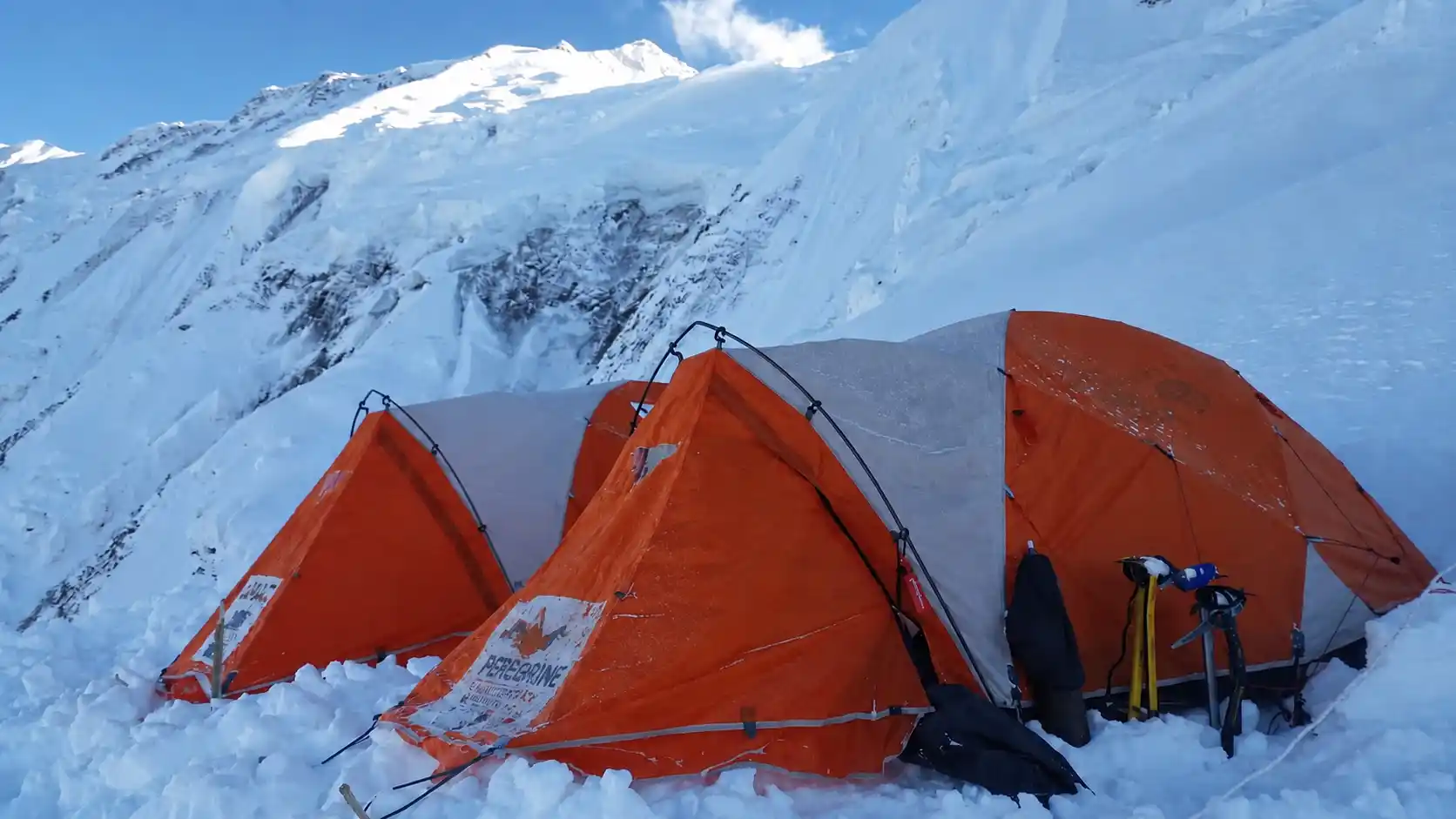
Camp II arrival.
Reach C2 by early afternoon. Tents from the first rotation stayed cached — set-up runs in 15 minutes. Melt snow. Eat what you can — appetite runs low above 6,000 meters.
Views.
Late-afternoon clouds burn off. The wall of Annapurna II fills the western sky. Manaslu casts a shadow on the eastern horizon. Take five photos. Then rest.
Sleep at 6,500 meters.
Sleep is broken, but doable at the second rotation. Cheyne-Stokes breathing continues. Diamox helps.
Wake early tomorrow.
Alarm at 04:30 for the push to Camp III.
Elevation: 6497m
Day 21 — Climb Camp II to Camp III, prepare for summit push
Short climb, big preparation day.
Today gains only 300 meters, but the day matters most for summit prep.
Depart Camp II.
Wake at 04:30. Breakfast on high-carb food — porridge, banana chips, hot tea. Depart at 06:00 in cold, dry air. Wind speed matters — the leader checks the anemometer reading.
Route to Camp III.
Same 30-45° snow ridge as on Day 15. Fixed rope on exposed sections. Slow, steady movement. Time budget: 3-4 hours.
Camp III setup.
Tents from Day 15 rotation cache in a snow pit. Dig them out. Reset the snow walls. Pitch on the cleanest, flattest snow. Anchor with pickets, ice screws, and buried dead-men.
Rest and hydrate.
Move slowly inside the tent. Melt snow through the afternoon. Drink 3 liters before dinner. Add electrolyte tablets. Snack every 90 minutes on chocolate, cheese, and nuts.
Summit gear layout.
Lay out summit gear before dark — down suit on top of sleeping bag, crampons on boots inside the tent porch, harness and hardware on the front of the tent, headlamp on your chest strap.
Final weather call.
Leader radios BC at 17:00 to confirm the summit window. Wind, freezing level, and precipitation are all read out. Green light means a summit push from 01:00 to 02:00.
Sleep lightly or nap.
Sleep runs light or non-existent at 6,800 meters. Rest quietly. Alarm at 00:30.
Elevation: 6800m
Day 22 — Summit day: Camp III to the summit of Annapurna IV, descend
The defining day of your expedition.
Today’s run is 9 to 13 hours from Camp III to the summit and back down. Weather, snow, and wind decide the schedule. The leader turns you around if conditions cross the safety line.
Wake at 00:30.
Melt snow for water. Eat hot porridge or an energy bar. Boot up. Harness on. Headlamp on. Depart Camp III at 01:30 to 02:00.
Fixed-line push to the northwest shoulder.
The first two hours climb 45 to 55° snow slopes on a fixed rope. Move steadily, breathe through the nose, and avoid stopping in exposed sections. Wind chill can drop to −40 °C. Every ounce of your down suit matters.
Traverse the corniced summit ridge.
Above the shoulder, the summit ridge runs exposed and corniced. Stay on the safe side of the cornice line — your Sherpa leads. Pace drops to 200 vertical meters per hour.
Summit at 7,525 meters.
Reach the summit by 09:00 to 11:00 in a strong window. Photos take 15 minutes. Radio call to BC. Prayer flags tied to the anchor. Total time on summit: 20 minutes maximum.
Descent to Camp II or III.
Descend the fixed lines with focus. Most accidents happen here. Rappel or arm-rappel. Sleep at Camp II if strong or Camp III if not.
Elevation: 7525m
Day 23 — Reserve summit day, weather buffer
Contingency day is baked into the plan.
Peregrine builds one full reserve summit day into the itinerary. Weather in the Himalayas rarely runs to plan. Today runs one of three ways.
Option 1 — Weather held, summit hit Day 22.
You already submitted. Today runs as a full descent day. From Camp II or Camp III, drop through the technical band to Camp I, then continue to Base Camp—long, tiring day. The kitchen serves hot food on arrival.
Option 2 — Weather delayed, summit push runs today.
If the Day 22 forecast crashes, the team stays at C3 or drops one camp to C2 and pushes today. Route and timing mirror Day 22 exactly — 00:30 wake, 02:00 depart, 09:00 to 11:00 summit, descend the same afternoon.
Option 3 — Second weather delay.
Rare. Peregrine’s plan builds enough buffer that the case is unusual. If it does happen, the leader consults with the team on whether to push for Day 24 or make a safe descent.
Communication on the day.
Radio traffic runs BC to the summit team every 90 minutes. InReach messages go home from your Sherpa’s device. Family knows the outcome within one hour of the summit or turnaround.
Rest for the descent.
Whichever option runs, the mountain wins for weather. The team accepts what the sky offers.
Day 24 — Descend to Base Camp, pack up
Full descent to Base Camp.
Today drops from the high camps to BC and packs up the base for departure. Long day, but downhill.
Depart from the high camp early.
Wake at 05:30. Breakfast on hot cereal, dried fruit, and tea. Depart by 07:00.
Descent line.
From C3 or C2, drop the fixed lines through the technical band. Move slowly. Watch anchor changeovers. From C1, the moraine descent takes 2 hours to reach BC.
Sherpa clean-up.
Peregrine’s Sherpa team retrieves all high-camp gear, ropes, tents, and rubbish. Nepal’s garbage deposit rule requires every kilogram brought up to come down. No exceptions. Peregrine holds a zero-litter record in the Annapurna Conservation Area.
Arrival at Base Camp.
Reach BC by 13:00 to 15:00. Kitchen serves hot soup, dal-bhat, garlic bread, and apple juice. Eat everything. Drink 3 liters.
Base Camp breakdown.
Kitchen and porter crew break down the site. Sleeping tents come down last — you sleep in yours one more night. Solar arrays get packed. Everything loads onto mules for tomorrow’s descent.
Celebration dinner.
Peregrine hosts a Base Camp celebration dinner — extra momos, apple pie, rakshi (optional, small pour only). Song and dance from the Sherpa team. Photos with the crew.
Sleep at 4,800 meters for the last time.
Sleep long. Your body starts flushing altitude fatigue tonight.
Day 25 — Trek Base Camp to Sabej Kholagaon
Descent day one from the mountain.
Today drops 900 meters from Base Camp to Sabej Kholagaon. Terrain is moraine, grass, and juniper scrub. Total time on foot: 4 to 5 hours.
Depart at 08:00.
Breakfast in the kitchen tent at 07:00 — pancakes, eggs, coffee, and tea. Depart Base Camp at 08:00. Take a group photo at the entry chorten.
Descent through moraine.
The first two hours are spent crossing the boulder field. Move carefully — descent injuries hit knees and ankles hardest. Use trekking poles. Wear ankle-support boots.
Cross the last spring.
At 4,400 meters, refill water at the last high spring. Kitchen crew serves black tea and biscuits.
Descend to the grass benches.
Below 4,200 meters, the terrain softens to grass and moss. Take deep breaths — oxygen returns. Notice small mountain flowers if late-season. Views open back toward Gangapurna and Annapurna III.
Arrive Sabej Kholagaon.
Camp goes up on the same flat as Day 7. Twin-share tents. Foam mats plus your pad. Kitchen serves a full lunch on arrival.
Rest of the afternoon.
Rest legs. Wash if the sun keeps the water warm. Change into fresh base layers — you carried them clean in your day pack, ready for the moment.
Evening menu.
Fresh vegetables, dal-bhat, chicken curry, rice. Eat everything.
Sleep at 3,900 meters.
Sleep runs deep and long. First real sleep after weeks of altitude.
Elevation: 3900m
Day 26 — Trek Sabej Kholagaon to Humde, drive to Besisahar
Long day out of the mountains.
Today combines a morning trek with an afternoon jeep transfer. Total moving time: 8 to 10 hours.
Morning trek to Humde.
Depart camp at 07:30. The trail drops through juniper and pine forest to the Marshyangdi River, then climbs briefly to Humde (3,353 m). Time: 4 hours.
Lunch at Humde.
Order what you want. Momos with tomato pickle, yak cheese pizza, and apple pie with cream. Wi-Fi works — text home to say you are down.
Jeep transfer to Besisahar.
Peregrine’s 4WD jeep leaves at 13:00. The road drops fast through Chame, Timang, Tal, Jagat, and Ngadi. Bumpy road, dusty conditions. Total drive time: 5 to 6 hours.
Views on the way down.
Watch the country change — dry Manang gives way to pine forest, then rhododendron, then sub-tropical banana and mango orchards near Besisahar.
Arrival at Besisahar.
Reach Besisahar (823 m) by 18:00 to 19:00. Lodge night at Hotel Manaslu or Tukuche Peak. Hot shower — a real one, with unlimited water.
Dinner.
Order Nepali dal-bhat, sizzler with buff steak, and Everest beer. Toast the summit team.
Sleep at a low altitude.
Deep sleep at last. Oxygen fills every breath. Your body races to catch up on missed rest.
Elevation: 823m
Day 27 — Drive Besisahar to Kathmandu
The road back to Kathmandu.
Today, it runs a 7-hour drive by Toyota Hiace or Coaster along the Prithvi Highway. Terrain drops steadily from Besisahar to the Kathmandu Valley.
Early morning departure.
Depart at 07:00 after breakfast. Traffic on the Prithvi Highway builds after 09:00, so an early start beats congestion.
Lunch stop at Kurintar.
Same lunch stop as on the way up — Riverside Springs Resort. Buffet of Nepali and continental cuisine: Wi-Fi and clean toilets. Refuel here.
Afternoon in Kathmandu.
The road climbs from Malekhu to Naubise, then descends into Kathmandu Valley. Traffic thickens after Thankot. Total time to the hotel: 3-4 hours from Kurintar.
Arrival at the hotel.
Peregrine drops you off at the Yak & Yeti or Shangri-La between 16:00 and 17:00. Long hot shower. Check email. Message family.
Optional evening.
Rest, or step out to Thamel for shopping — cashmere shawls, Tibetan singing bowls, prayer flags, mountain art prints. Peregrine’s expert guide walks you to genuine sellers on request.
Dinner at leisure.
Try Roadhouse Café in Thamel for wood-fired pizza—or Fire and Ice for Italian classics. Or Rum Doodle for the classic climbers’ menu — every 8,000-meter summiteer signs the Yeti footprint here.
Sleep at 1,350 meters.
Long, deep sleep. Full oxygen. Real bed.
Elevation: 1350m
Day 28 — Free day in Kathmandu, farewell dinner
Rest and cultural time.
Today runs on your schedule. Sleep in. Eat a slow breakfast. Explore the Valley on your own or with a Peregrine city guide (on request, no extra charge).
Morning sightseeing options.
Best options include the Boudhanath Stupa — the largest stupa in Nepal — and a kora walk with local devotees at sunrise. Or Pashupatinath — the sacred Hindu temple complex on the Bagmati River. Or Patan Durbar Square — the Newari medieval city with the finest palace craft in South Asia.
Lunch tips.
Try Krishnarpan at Dwarika’s — Nepali royal cuisine in nine courses. Or Bricks Café in Patan for the Newari thakali set meal. Or Momo Star in Boudha for the best steamed buff momo in the city.
Afternoon massage and shopping.
Book a therapeutic massage at Dwarika’s Spa or the Shangri-La — 60 minutes fixes tight legs and shoulders. Then shop in Thamel or Patan for cashmere, silver, thangka paintings, coffee-table Himalaya books, or Sherpa yak-wool blankets.
Farewell dinner at Bhojan Griha.
Peregrine hosts the farewell dinner at Bhojan Griha — a 150-year-old restored Rana mansion. The menu features Newari, Thakali, and Sherpa dishes, along with cultural dance. Wear something warm — the courtyard runs cool.
Certificates and photos.
The expedition leader presents your summit certificate and expedition photo album. Group photo before dessert.
Pack tonight.
Prepare bags for the airport. Peregrine confirms your departure pickup time.
Day 29 — Final departure from Kathmandu
Airport transfer and farewell.
Today closes the Annapurna IV Expedition. Peregrine transfers you to Tribhuvan International Airport 3 hours before your international flight.
Early breakfast at the hotel.
Buffet breakfast opens at 06:30. Order the American breakfast — eggs, sausage, hash browns, and real coffee. Refuel for the flight.
Airport transfer.
Peregrine’s driver meets you in the lobby at the confirmed pickup time. The transfer to the airport runs 45 to 60 minutes, depending on traffic. Bring extra time for the morning peak.
Check-in and security.
Kathmandu international departures work slowly. Plan on 2 hours of queuing between check-in and security. Bring water, snacks, and a book. VIP fast-track is available on request — Peregrine can arrange it for USD 60 per person.
Duty-free options.
The airport stocks Nepali gift items — tea, coffee, honey, rakshi, and mountain-themed T-shirts. Prices run higher than in Thamel. Buy your souvenirs in the city instead.
Departure.
Peregrine’s ground team stays reachable by phone until wheels-up. Any last-minute issues — luggage, tickets, currency — get resolved.
Stay in touch.
Peregrine adds you to our climbers’ alumni network. Discount vouchers apply to your next expedition — Ama Dablam, Himlung Himal, Baruntse, or an 8,000-meter climb.
Safe travels home.
Post-expedition recovery runs 2 weeks. Rest fully. Eat well. Book a physio session on arrival. Book your next mountain when the fire returns.
Customize this trip with help from our local travel specialist that matches your interests.
Includes & Excludes
What is included?
Core logistics
- All Kathmandu-to-Humde ground transport for climbers, Sherpas, LO, and kitchen staff.
- 4 nights hotel in Kathmandu on B&B (5-star hotel)
- Welcome dinner in Kathmandu on Day 1.
- Farewell dinner with a cultural program on Day 28.
- Lodge accommodation from Besisahar to Humde on trek days.
- Full camping infrastructure from Sabej Kholagaon onwards.
- Individual sleeping tent per climber at Advanced Base Camp.
- Shared tents at Camp I, Camp II, and Camp III.
Permits and paperwork
- Annapurna IV climbing permit and royalty.
- Annapurna Conservation Area Permit (ACAP).
- Garbage-management deposit.
- Government Liaison Officer wages and insurance.
Climbing team
- One-time summit climbing Sherpa per member for the full climbing period.
- Sherpa wages, gear, meals, medical, and accident insurance.
- Base Camp chef and kitchen crew.
- Porter and mule support for expedition cargo.
Food and BC infrastructure
- Three cooked meals per day throughout the expedition.
- Fresh fruit and vegetable resupply from Humde every 5 to 7 days.
- Heated dining tent, kitchen tent, communications tent.
- Toilet tent and shower tent (solar-heated water).
- Solar arrays and generator backup for lighting and charging.
- Table, chairs, and cooking utensils.
Climbing hardware and safety
- Group climbing gear — fixed and dynamic ropes, ice screws, ice bars, snow bars, snow pickets.
- Emergency oxygen system and Gamow bag at Base Camp.
- HRA-linked medical consultation at Base Camp.
- First-aid kit for the group and staff.
Communications
- Satellite phone with the expedition leader (USD 3 per minute usage).
- Walkie-talkies for Sherpa and group coordination.
- Garmin InReach tracker.
- Daily point weather forecasts from a Seattle-based service.
Baggage and personal items
- 40 kg porter and mule allowance from Kathmandu to Base Camp and return.
- Free cargo clearance assistance.
- Peregrine duffle bag, T-shirt, and scarf.
- Summit certificate on successful ascent.
What is excluded?
- International airfare to and from Kathmandu.
- Nepal on-arrival visa fees.
- Lunch and dinner in Kathmandu, except for welcome and farewell dinners.
- Personal climbing gear, clothing,g and duffel bags.
- Personal travel, medical, and helicopter-rescue insurance (mandatory).
- Personal supplemental oxygen bottles, mask,k and regulator (rental available).
- Summit bonus for climbing Sherpa — minimum USD 1,000 on summit, USD 500 non-summit.
- Base Camp staff tips — recommended USD 300 per member, collected by the team leader.
- Filming, drone,ne or commercial photography permits.
- Any expense from natural disasters, political disturbance,nc,e or force majeure.
- Personal snacks, alcoholic drinks, and mineral water beyond scheduled meals.
- Laundry, souvenirs, phone bills, and internet beyond package inclusions.
Departure Dates
We also operate Private Trips.
Trip Information
Physical Preparation Requirements
Base fitness benchmark. Peregrine expects 4 to 6 months of dedicated training before your Annapurna IV Expedition.
Aerobic training. Run 4 to 6 aerobic sessions per week — long uphill hikes, stair climbs, or running. Each session runs 60 to 120 minutes. Add a 15-20 kg pack for pack-carry sessions.
Strength training. Add 2-3 strength sessions per week—legs, core, and posterior chain. Squats, deadlifts, lunges, weighted step-ups, and hanging leg raises form the core lifts.
High-altitude simulation. Book a Himalayan trek above 5,000 meters in the 2 to 3 months before your climb — Everest Base Camp, Gokyo Ri, or Kang Yatse Base Camp. Or use a hypoxic training mask.
Technical prep. Refresh crampon, ice axe, and fixed-line skills on a technical peak in the year before Annapurna IV. Ama Dablam, Lobuche East, or Island Peak all work.
Best Season and Weather Guidance
Autumn — primary season. September to November. Cool, dry, stable post-monsoon skies. Best summit statistics. Peregrine’s flagship October departure sits inside the autumn window.
Spring — secondary season—April to May. Warmer daytime temperatures. Longer daylight. Higher summit-day winds are possible. Peregrine runs a mid-April departure most years.
Summer — no operation. June to August. Monsoon rain, avalanche risk, poor visibility. Peregrine does not run Annapurna IV in summer.
Winter — no operation. December to February. Extreme cold and jet-stream winds. Not commercially operated.
Temperature ranges. Base Camp nights run −5 °C to −15 °C. High-camp nights run −20 °C to −35 °C. Summit-day wind chill can reach −45 °C.
Trust Components and Booking Pathway
Why book Annapurna IV with Peregrine Treks
22 years of Nepal expedition operations. Peregrine Treks has run mountain expeditions from Kathmandu since 2002. Our Chairman, Pradip Karki, personally scouts every new route before we sell it.
Registered and certified. Peregrine holds TAAN, NMA, and NTB registrations. We operate under Nepal’s Office of the Company Registrar. The Kathmandu head office and the Muscat regional office serve international clients.
Sherpa team you can trust. Every summit push carries a two-time-summiter Sherpa per member. Our Sherpas hold IFMGA-standard training. All staff carry helicopter-rescue insurance.
Small-team ethic. Peregrine caps group size at 10 climbers. Private departures for 2 to 4 climbers are available on request. Small teams mean better safety margins and Sherpa attention.
Zero-litter operation. Our garbage deposit refund is 100% every season. Every kilogram of gear that goes up comes back down.
How to book
Step 1 — Initial inquiry. Send your climbing CV, target dates, and questions via our booking form or WhatsApp. Response time runs 24 hours or less on business days.
Step 2 — Proposal call. Book a video call with the expedition leader. We review your CV, discuss your goals, and confirm you meet the Annapurna IV Expedition experience baseline.
Step 3 — Reservation deposit. Confirm your slot with a 30 percent deposit via bank wire or major credit card. Peregrine issues a booking confirmation with departure code PT-EXP-A4.
Step 4 — Final payment and paperwork. The remaining 70 percent falls due 60 days before departure. Peregrine issues a detailed pre-departure pack — kit list, insurance guidance, and permit paperwork.
Step 5 — Arrival in Kathmandu. Meet our driver at the airport. Your Annapurna IV Expedition begins.
Cancellation and flexibility
Cancellation policy.
- More than 90 days out — full refund minus a USD 500 admin fee.
- 61 to 90 days out — 70 percent refund.
- 31 to 60 days out — 50 percent refund.
- 15 to 30 days out — 25 percent refund.
- 14 days or fewer — no refund, credit toward a future Peregrine expedition within 24 months.
Weather and force majeure. If Peregrine cancels a departure due to weather, a natural disaster, or a political disturbance, we refund all prepaid mountain services and offer a full rebooking for the next season.
Insurance requirement. Personal travel and helicopter evacuation insurance up to 7,600 meters are mandatory. Peregrine can recommend Global Rescue, Ripcord, and Austrian Alpine Club policies that meet the requirements.
Book your 2027 or 2028 expedition.
Ready to climb Annapurna IV? Send your climbing CV and target season to our booking team. Peregrine confirms availability within 24 hours. Autumn 2026 slots fill fast — early October departures often sell out by April.
Frequently Asked Questions
Annapurna IV rises to 7,525 meters (24,688 feet) in the Annapurna Massif of Manang District, north-central Nepal. The peak sits between Annapurna II (7,937 m) and Annapurna III (7,555 m) on the same connecting ridge.
Annapurna IV climbs at Alpine grade PD++ to TD+ — technically harder than Cho Oyu or Manaslu at a lower altitude. The route runs sustained 45 to 55° snow, short 60 to 80° rock and ice sections between Camp I and Camp II, plus an exposed corniced summit ridge.
Peregrine expects at least one prior 6,000-meter technical summit — Ama Dablam, Lobuche East, or Island Peak. A prior 7,000-meter climb, such as Himlung Himal, Baruntse, or Pumori, adds strength. Comfort on a jumar-and-rappel on a fixed rope is essential.
Peregrine’s Full-Board Expedition starts at USD 14,500 per climber on twin-share. All permits, one-to-one Sherpa support, Base Camp infrastructure, and oxygen-ready logistics are included in the price. A Base-Camp-Service tier for independent teams starts at USD 7,500.
Yes. Nepal’s proposed Tourism Bill 2081 requires a Nepal 7,000-meter summit before any Everest permit. Annapurna IV at 7,525 m meets the rule cleanly. Peregrine positions the peak as the most cost-efficient qualifier climb in our portfolio.
Autumn (September to November) runs as the primary season — dry, stable, post-monsoon skies. Spring (April to May) runs as the secondary window with warmer days but higher summit-day winds. Peregrine’s flagship October departure sits inside the autumn window.
Reviews on Annapurna IV Expedition
5.0