


Old Muscat Forts include two strong stone forts, Al Jalali and Al Mirani, safeguarding Muscat’s old port city for centuries. They sit on rocky hills on either side of the harbor and remain some of Oman’s most famous historical sites. A smaller fort, Mutrah, stands nearby around the curve of the harbor. Together, these three forts show Muscat’s history during the Portuguese era.
Walking around them, or even just looking out from the harbor, gives a clear sense of the city’s strategic importance and the style of its military buildings from the 16th and 17th centuries. Today, the forts stay quiet, and the cannons no longer fire, but it is easy to imagine soldiers keeping watch and guarding the city long ago.
Historical Background: The Portuguese Era and Oman’s Fight for Freedom
To understand these forts, you have to look back at a time of colonial competition. In the early 1500s, the Portuguese came to the Arabian Peninsula to control trade routes across the Indian Ocean. They captured Muscat in 1507 and held the city, on and off, for over a hundred years. To protect the harbor, they built strong forts. Al Jalali and Al Mirani rose on older Persian foundations in the late 16th century, probably around 1586.
The Portuguese named them Fort São João (St. John, later Jalali) and Fort São Tiago (St. James, later Mirani). The forts stood at the narrow entrance to Muscat’s Bay, making it almost impossible for enemy ships to attack without facing cannon fire from both sides.
By 1650, the Omanis decided they would no longer accept foreign rule. Imam Sultan bin Saif of the Yaruba dynasty led Omani forces in a siege of Muscat. Soldiers climbed the cliffs in a daring attack and captured the forts, finally forcing the Portuguese out on 23 January 1650.
This victory made Oman one of the first Arab nations in the region to remove European colonizers and marked the start of Oman’s naval and regional power. Afterward, Omanis repaired and strengthened the forts in Muscat. They continued to defend Muscat through decades of tribal conflicts and foreign threats.




Al Jalali Fort: The Eastern Fortress Above Old Muscat
Al Jalali, sometimes called “Jalali” or “Ash Sharqiya Fort” (Eastern Fort), stands as the larger of Muscat’s two harbor forts. It perches on a rocky hill on the eastern side of the cove, overlooking the old harbor and the Sultan’s Al Alam Palace below. Over the years, people have used Jalali for many purposes. In the 20th century, it served as a prison. After restoration in the 1980s, Omanis converted it into a private museum to showcase the country’s culture and history to state visitors.
Tourists cannot usually go inside, but visitors can climb partway up the staircase and walk around the outside, enjoying the views and imagining what life was like inside the walls. The fort has strong crenelated walls, two main towers at each end, and a gate with a drawbridge that now serves as a permanent bridge. People say the fort conceals an old freshwater well, underground chambers, and possibly even a secret tunnel that once connected to the palace or a nearby fort. Stories like these add mystery and intrigue.
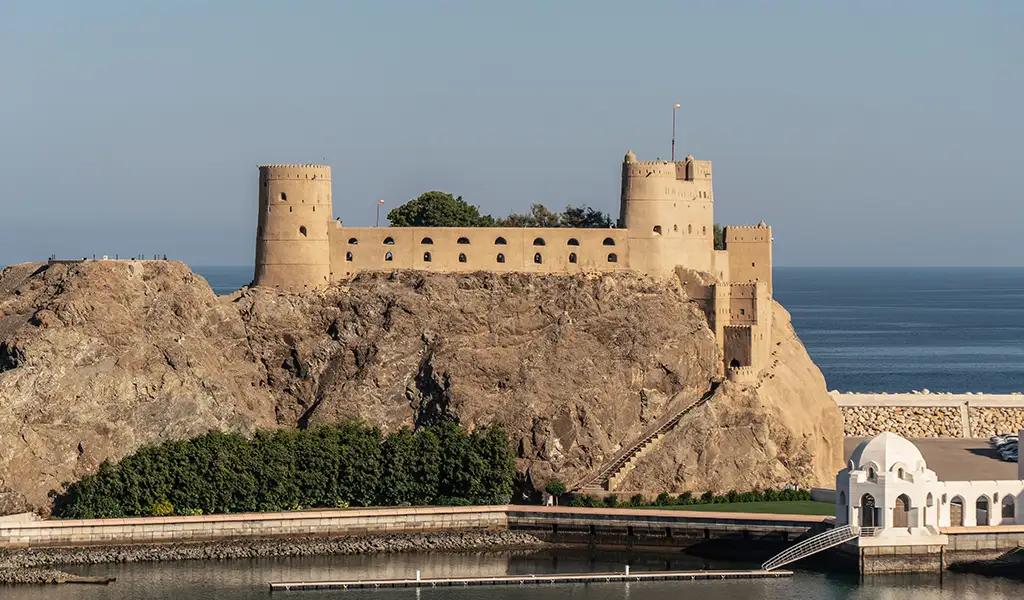
After the restoration process, the fort’s exterior now features decorative white Omani patterns on its walls and battlements, added during Sultan Qaboos’ renovations to enhance the fort’s cultural presence. The Jalali Fort glows in golden colors against the dark, making it a favorite subject for photographers.
Al Mirani Fort: The Western Stronghold Guarding the Harbor
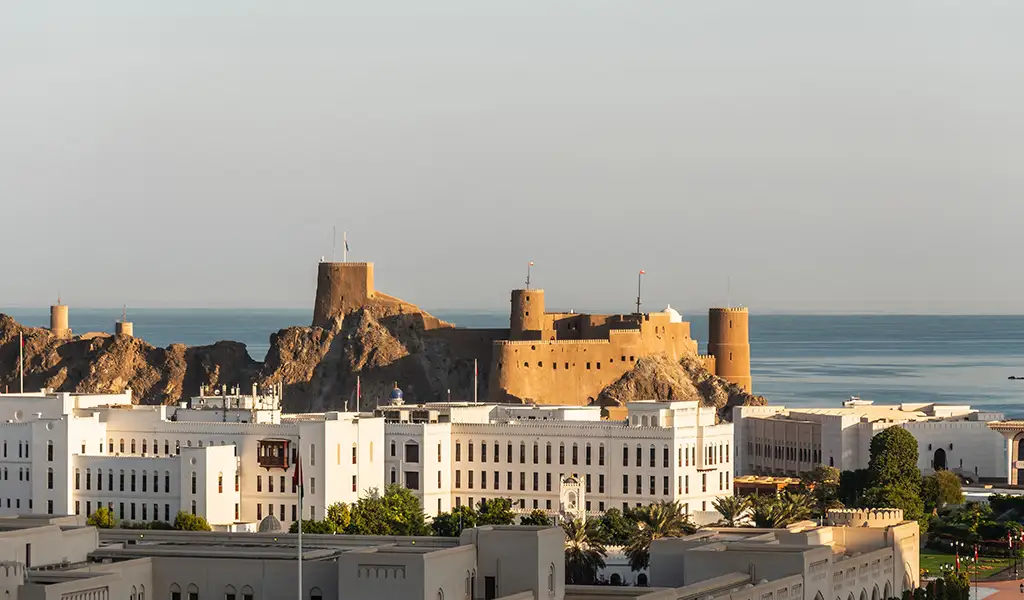
On the western side of Muscat’s harbor stands Al Mirani, sometimes called the Western Fort. Compared to Jalali, Mirani sits closer to the ground on the town side, allowing visitors to approach its gates near the palace. Its side facing the sea still drops sharply to the water.
The fort features two round towers and thick walls that connect them. It guarded the western approach to Muscat and protected the back of the palace. After the Portuguese left, Omanis kept Mirani as a defensive stronghold. Local stories claim that soldiers once lived inside and also guarded the city walls.
Mirani Fort remains closed to visitors because it is under the Ministry of Defense’s management. Some areas might still serve military or ceremonial purposes. Even from the base, you can feel its size. Look up at the heavy wooden doors and the plaque with calligraphy, and you get a sense of the fort’s presence.
Portuguese design is clearly evident in Mirani, just as in Jalali, with rounded turrets built to withstand cannon fire and positions that cover the harbor with overlapping fields of fire. Controlling the forts often meant controlling Muscat, even during later conflicts in the 18th century.
Stories from history bring the forts to life. In the late 17th century, when Imam Ahmed bin Said started the Al Bu Said dynasty, and later when Persian forces attacked under Nadir Shah in the 1740s, both forts played key roles. In some sieges, defenders held the forts even when the town fell, thanks to the strong walls and stored supplies serving as the city’s final line of defense.

Mutrah Fort and City Walls: Defending Muscat’s Trade Port
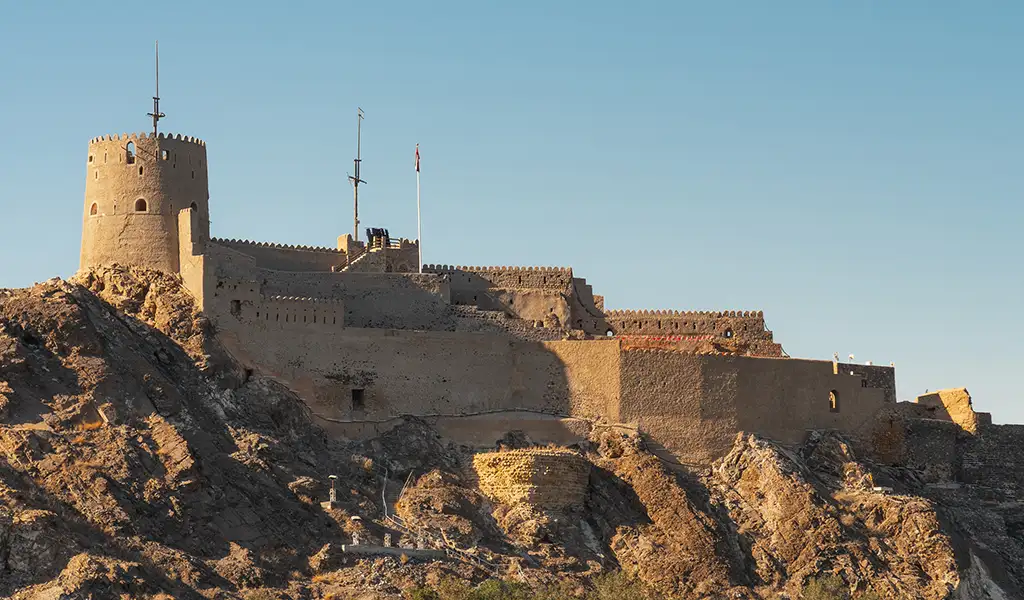
While Jalali and Mirani guarded Muscat’s royal harbor, the nearby port of Mutrah had its own fort. Mutrah Fort sits on a hill at the end of the Mutrah Corniche, overlooking the old Mutrah souq and the fishing harbor. The Portuguese built it around the 1560s to protect the western approach to Muscat and its busy commercial port. The fort has three round towers and several terraces. It is now possible to visit the Mutrah fort, unlike the two forts, Jalali and Mirani.
Climbing its steps rewards you with expansive views of the waterfront, the mountains, and the harbor. Inside, small exhibits and information panels tell the fort’s story. Visitors can touch the thick walls and stand behind cannon openings looking out to sea, making it a hands-on experience for anyone interested in history.
Muscat’s old town, including the area around the palace and stretching to the Mutrah gate, once had city walls. Big gates, like the Muscat Gate, closed at night to keep intruders out. Some walls remain, and one gate now houses the Muscat Gate Museum. The museum is small but interesting, showcasing how the city developed and how its walls and gates defended it.
Walking through Old Muscat today, you can trace the line of the old walls and see how the forts and natural mountains formed a complete defense network. The rugged mountains served as natural barriers, and the forts filled the gaps where valleys opened up toward the sea or inland.
Modern Context: The Forts as Heritage Icons Today
Today, the old forts of Oman stand as treasured symbols of Oman’s history and heritage. Even if visitors cannot enter Jalali or Mirani freely, the forts still dominate the skyline and give a strong sense of Muscat’s past. People use them as backdrops for official ceremonies and national day celebrations, where lights and flags highlight their dramatic positions on the cliffs.
Visiting Al Alam Palace offers one of the best experiences: you stand in the open plaza with the palace before you and see Jalali and Mirani rising proudly on either side. The combination of the elegant palace and the imposing forts perfectly shows Muscat’s character, blending royal sophistication with historical strength and protection.
Photographers and history lovers alike find plenty to admire. To capture both Jalali and Mirani in a single frame, try taking a boat ride from the harbor or head to elevated points, such as the hill near the National Museum or along the old town waterfront. You will find that the best place to photograph the Mutrah Fort is from along the Mutrah Corniche, especially in the late afternoon when the sun illuminates the fort walls and highlights the textures of the stone.
Walking around these viewpoints, you can feel the forts’ commanding presence and imagine how they once guarded the harbor against invaders. They remind visitors not only of Muscat’s strategic importance in the past but also of the care Oman takes today to preserve its history while allowing people to connect with it visually and emotionally.
Preservation: How Oman Protects Its Historic Muscat Forts
Oman has carefully taken various precautions to maintain the condition of its historic Muscat forts. During Sultan Qaboos’ time, restorations strengthened the buildings while preserving their original look. Artisans used traditional materials whenever possible and avoided modern changes that would alter the historic charm of their work. At Mutrah Fort, you can see the added steps and railings for visitors, but the main structure still retains its authentic feel. Jalali and Mirani stand mainly as historic sites.
Even without going inside, you can picture soldiers walking the walls, climbing towers, and guarding the harbor. These forts demonstrate how Muscat relied on robust construction and strategic planning to protect the city, and today they allow people to connect with Oman’s history while enjoying the views.
Conclusion: Why the Old Muscat Forts Still Matter
The old forts of Jalali and Mirani, along with Mutrah Fort, tell the story of Oman’s past without words. They show a time of foreign intrusion, Omani courage, and a city built for defense. Walking through Muscat’s old town or along the Corniche, you cannot miss them. Their strong walls and high positions remind you of the city’s long history of protection. Even without going inside, you notice their lines, towers, and the way they overlook the harbor, giving a sense of strength and stability that lasted for centuries.
If you enjoy history or architecture, visiting the forts is essential. Walk along the ramps and terraces at Mutrah Fort, and pause near Jalali and Mirani to take in their presence. As you walk around the walls and imagine the soldiers on duty, the battles they fought, and the ways they kept Muscat safe, you will develop a more profound respect for the Omani people. The forts show Oman’s courage, pride, and careful planning. Being there in person brings history to life and helps you truly feel the city’s story.