

Based on 16 reviews

Luxury Everest Base Camp & Gokyo Lakes Trek
18-Day Khumbu Circuit via Cho La Pass, Kala Patthar and Everest Base Camp

Duration
18 days

Meals
- 17 Breakfast
- 13 Lunch
- 14 Dinner

Accommodation
- Radisson Hotel
- Yeti Mountain Home
- Normal Lodges

Activities
- Trekking
- Sightseeing
- Scenic Flight
SAVE
US$ 980Price Starts From
US$ 4900
Overview of Luxury Everest Base Camp & Gokyo Lakes Trek
The Luxury Everest Base Camp & Gokyo Lakes Trek covers every major highlight of Nepal’s Khumbu region. You complete the full circuit in 18 days. Gokyo Lakes, Gokyo Ri, Cho La Pass, Everest Base Camp, and Kala Patthar all sit on the same route. Radisson Hotel Kathmandu, Yeti Mountain Home lodges, Hotel Everest View, and The Edelweiss Pheriche anchor the accommodation.
Luxury on the Khumbu means the best available rooms at every stop. Above 4,700m, it means expert guiding, porter support, daily pulse oximeter checks, a Certec hyperbaric chamber, and satellite communication. Good service replaces good bathrooms at the high camps.
The Luxury Everest & Gokyo Trek is a premium 18-day circuit of the Khumbu. You complete Gokyo Lakes, Gokyo Ri, Cho La Pass, Everest Base Camp, and Kala Patthar on the same route. Accommodation ranges from Radisson Hotel Kathmandu to Yeti Mountain Home lodges, Hotel Everest View, and The Edelweiss Pheriche.
Quick Facts
| Feature | Details |
|---|---|
| Package name | Luxury Everest Base Camp & Gokyo Lakes Trek |
| Secondary name | Luxury Everest & Gokyo Trek |
| Duration | 18 days / 17 nights |
| Highest point | Kala Patthar, 5,545m / 18,192ft |
| Cho La Pass | 5,368m / 17,612ft — crampons required |
| Everest Base Camp | 5,364m / 17,598ft |
| Gokyo Ri | 5,357m / 17,575ft |
| Hotel Everest View overnight | 3,880m — Guinness World Records’ highest hotel |
| Kathmandu hotel | Radisson Hotel or similar 5-star |
| Lower Khumbu lodges | Yeti Mountain Home — Phakding, Namche, Lukla |
| Descent lodge | The Edelweiss Pheriche, 4,240m |
| Difficulty | Strenuous |
| Best season | March–May and September–November |
| Active trekking days | 14 days |
| Start and end | Kathmandu, Nepal |
Why Choose the Luxury Everest Base Camp & Gokyo Lakes Trek
Most Everest packages follow the direct trail: Namche, Tengboche, Lobuche, Base Camp. At Namche, this route turns west into the quieter Gokyo Valley instead. You cross Cho La Pass at 5,368m and rejoin the main EBC trail at Lobuche. The circuit visits three landmark destinations in one trip. You see the Five Gokyo Lakes, summit Gokyo Ri for views of four 8,000m peaks, and reach Everest Base Camp. No backtracking. One continuous loop.
Day 5 includes an overnight at Hotel Everest View at 3,880m. Most packages stop for coffee and leave. You stay, eat fillet mignon, and watch the sunrise over Everest through floor-to-ceiling glass. Every item used to build this hotel arrived by porter or helicopter in 1971.
Why Gokyo Comes Before Everest Base Camp
The Gokyo route delivers three specific advantages over the direct EBC trail.
- First, sleeping at Dole (4,200m), Machhermo (4,470m), and Gokyo (4,790m) before crossing Cho La gives your body gradual altitude gains. You arrive at Lobuche and Gorakshep already well-adapted.
- Second, the Gokyo Valley carries far fewer trekkers than the main EBC trail. Alpine meadows, turquoise lakes, and glacier views mark the path.
- Third, Cho La Pass connects Gokyo directly to Lobuche. The circuit flows in a natural loop. You see new terrain every day.
Who This Trek Suits Best
The best-fit trekker on this route comes with prior hiking experience and strong cardiovascular fitness. You should walk comfortably for five to eight hours on steep, uneven mountain terrain.
Best-Fit Traveler Profiles
- Experienced trekkers who want the complete Khumbu experience in one trip
- Couples or private groups who prefer dedicated guide service and flexible pacing
- Photographers seeking four distinct high-altitude viewpoints
- Active travelers aged 35 to 65 with strong fitness
- Luxury travelers who accept remote Himalayan realities above 4,700m
Consider a Shorter Package If You
- Have never trekked at high altitude before
- Expect fully en-suite bathrooms at every overnight stop
- Walk fewer than five hours per day on mountain terrain
- Feel uncomfortable on glaciated, icy surfaces
- Travel without insurance covering helicopter evacuation to 6,000m
Detail Itinerary of Luxury Everest Base Camp & Gokyo Lakes Trek
Day 1: Arrival in Kathmandu — The Soft Landing
The moment you clear customs at Tribhuvan International Airport, Kathmandu’s noise retreats. A uniformed chauffeur holds a placard — your name printed below the words Luxury Everest Base Camp & Gokyo Lakes Trek. Chilled oshibori towels and Himalayan mineral water wait in the back of a climate-controlled vehicle. The 20-minute drive to Radisson Hotel Kathmandu passes brick pagoda roofs and marigold garlands. The city feels pleasantly distant.
At the Radisson, your suite combines polished teak and crisp white linen. The marble bathroom runs deep enough for a long soak. French doors open onto a private balcony. Unpack slowly. The outdoor pool glimmers amid tropical gardens. The spa offers a jet-lag-crushing Himalayan salt scrub.
As dusk falls, your Lead Guide welcomes you in the hotel’s private dining room. He is a Khumbu-born Sherpa with decades of high-altitude experience. Orchids float in brass bowls on a table set for two. A three-course dinner balances Nepali spices with Continental finesse. Over coffee, your guide walks you through the 18-day circuit with a hand-drawn map. The warmth in the room feels like being welcomed into a family. He checks your boots, your down jacket, and your gloves.
Insurance details get confirmed. An emergency contact card slips into a slim leather sleeve. You sleep knowing every detail is already held.
Elevation: 1400m
Accommodation: Radisson Hotel Kathmandu (5★)
Meal: Welcome dinner
Day 2: Kathmandu — The Art of Preparation
Morning begins with a la carte breakfast in the Radisson’s garden courtyard. Order the masala omelet with Gruyère or a bowl of house-made granola with buffalo yogurt. Then, in a quiet corner of the hotel, the Peregrine representative leads a private 90-minute briefing over French press coffee.
He explains acclimatization and what happens to your blood above 4,000 meters. A fingertip pulse oximeter — a small white device — clips onto your finger. Your baseline reads 98%. You learn the rhythm that will carry you safely: climb high, sleep low, monitor twice daily. He talks about Cho La Pass with the calm of someone who has crossed it forty times. The glacier section, the fixed ropes, and the pre-dawn satellite check. His safety decision is final and non-negotiable. You leave the room feeling prepared, not alarmed.
The afternoon stays yours to shape. A private cultural guide and chauffeur can take you to Swayambhunath’s stupa or the courtyards of Patan Durbar Square. Or you may prefer the Radisson spa and a quiet walk through Thamel to pick up a pashmina. The evening is free — dinner on your own terms, perhaps at a rooftop restaurant with valley views.
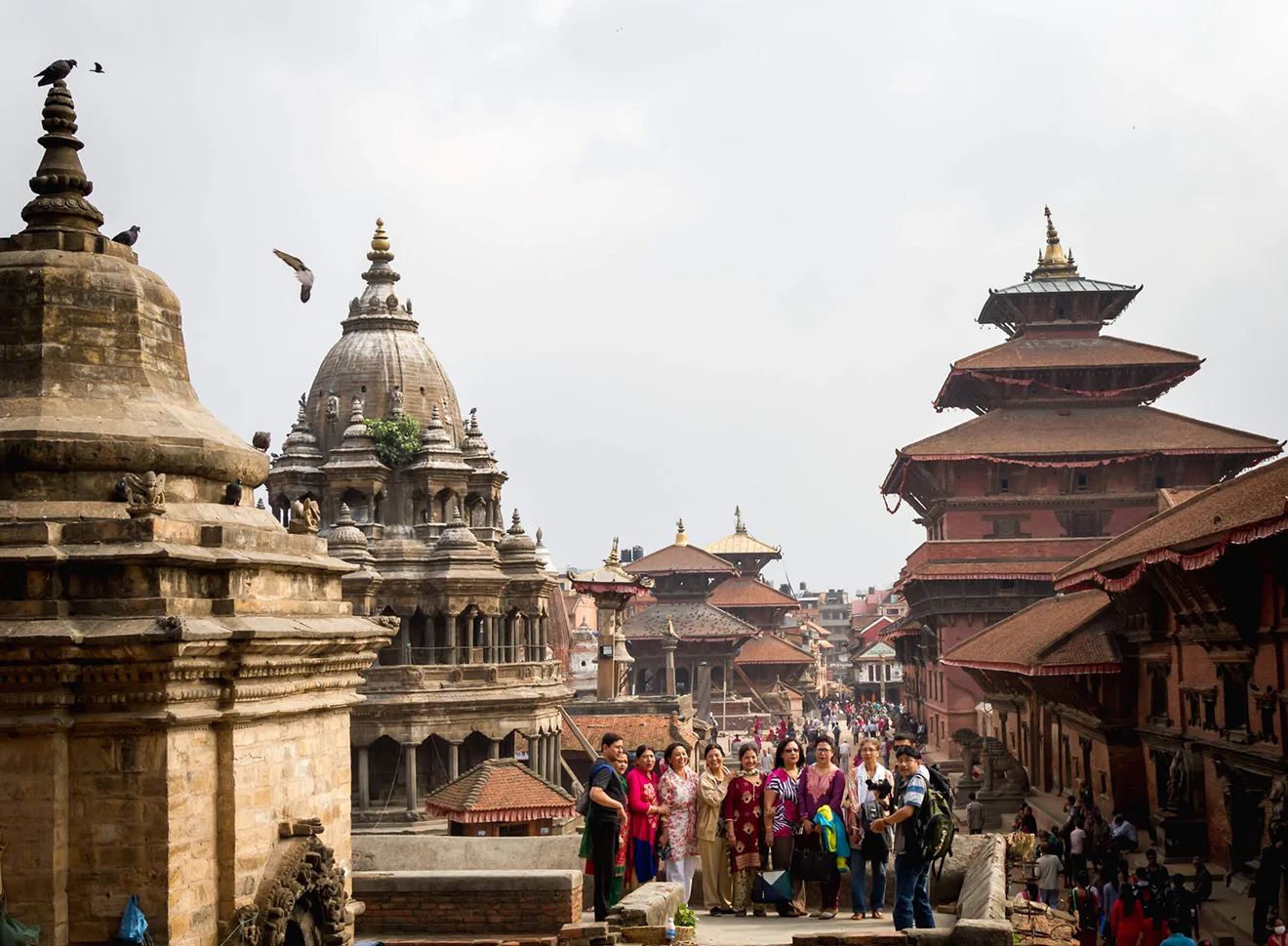
Elevation: 1400m
Accommodation: Radisson Hotel Kathmandu (5★)
Meal: Breakfast
Day 3: Fly to Lukla — The First Footsteps
A private car delivers you to the domestic terminal before dawn. At check-in, your guide hands you a small leather pouch. Inside: a hand-drawn route map and a local honey candy for the flight. The Twin Otter lifts above terraced fields, and the Himalaya fills the left-hand window. Then the runway at Tenzing-Hillary appears. A tilted strip of asphalt cut into a mountainside, it ends at a stone wall. The landing is swift and sure.
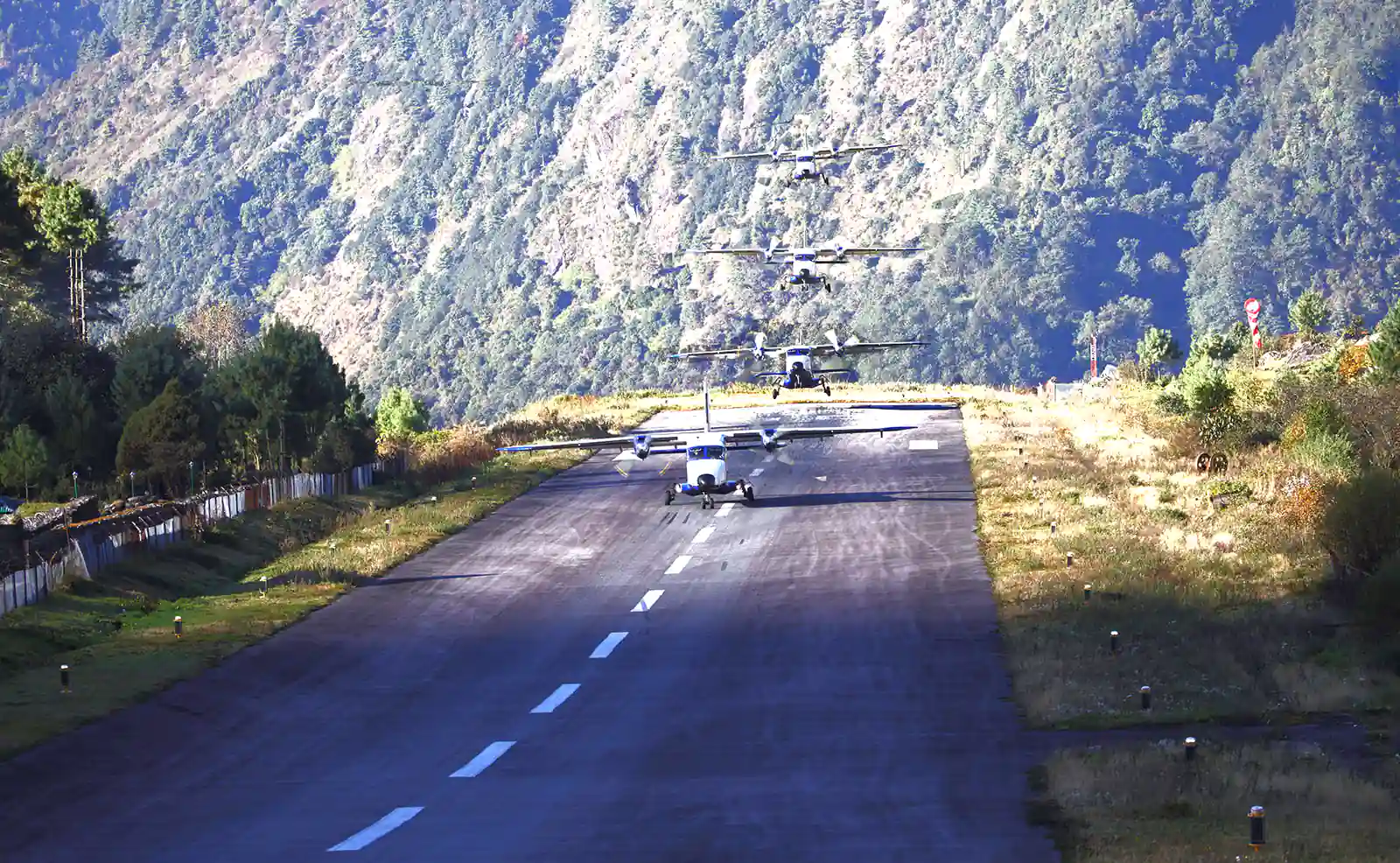
Cool, sharp air greets you at 2,860 meters. Porters in matching jackets collect your duffel. You carry only a daypack. The trail slips south through Chaurikharka, past mani stones and potato fields, then descends into the Dudh Koshi gorge. Three suspension bridges draped in prayer flags sway beneath your weight. Pine needles soften the path. The river’s roar is constant, milky grey, and alive.
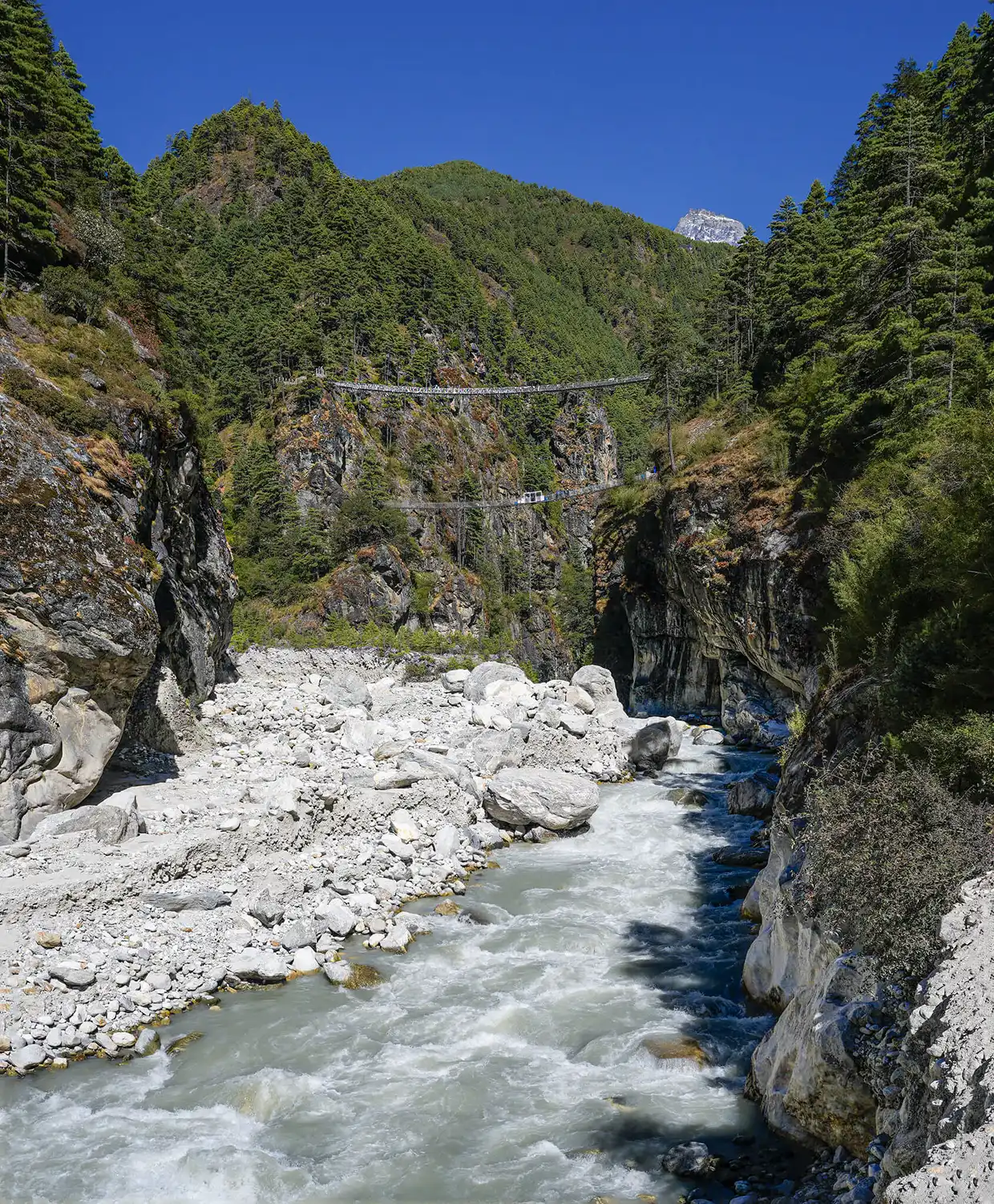
By early afternoon, Yeti Mountain Home Phakding appears on the riverbank. A staff member welcomes you with a chilled mint-and-lime drink in a sunroom spilling over with fresh flowers. Your ensuite room, paneled in warm wood, looks onto the water. An electric blanket is already warming the bed. As dusk settles, the beamed ceiling dining room serves organic vegetables from the lodge’s own garden. You fall asleep to the sound of the river, the mountains already closer.
Distance: 8km | Walking time: 3 hours
Elevation: 2652m
Accommodation: Yeti Mountain Home Phakding
Meal: Breakfast, Lunch, Dinner
Day 4: Phakding to Namche Bazaar — The Sherpa Capital
Breakfast at Yeti Mountain Home Phakding is a quiet affair. Fresh eggs, home-baked bread, and strong coffee come out on the sunroom terrace. The Dudh Koshi rushes below. Your porter team loads the duffels, and you set out with just a daypack.
The trail climbs gently through blue pine forest to the Sagarmatha National Park checkpoint at Monjo. Your guide handles the permits while you stamp the dust off your boots. Beyond the gate, the valley narrows, and the Hillary Suspension Bridge appears — a long span high above the churning river. Cross it slowly. On clear mornings, a white triangle of Everest peeks between Nuptse’s shoulders, your first real sight of the peak.
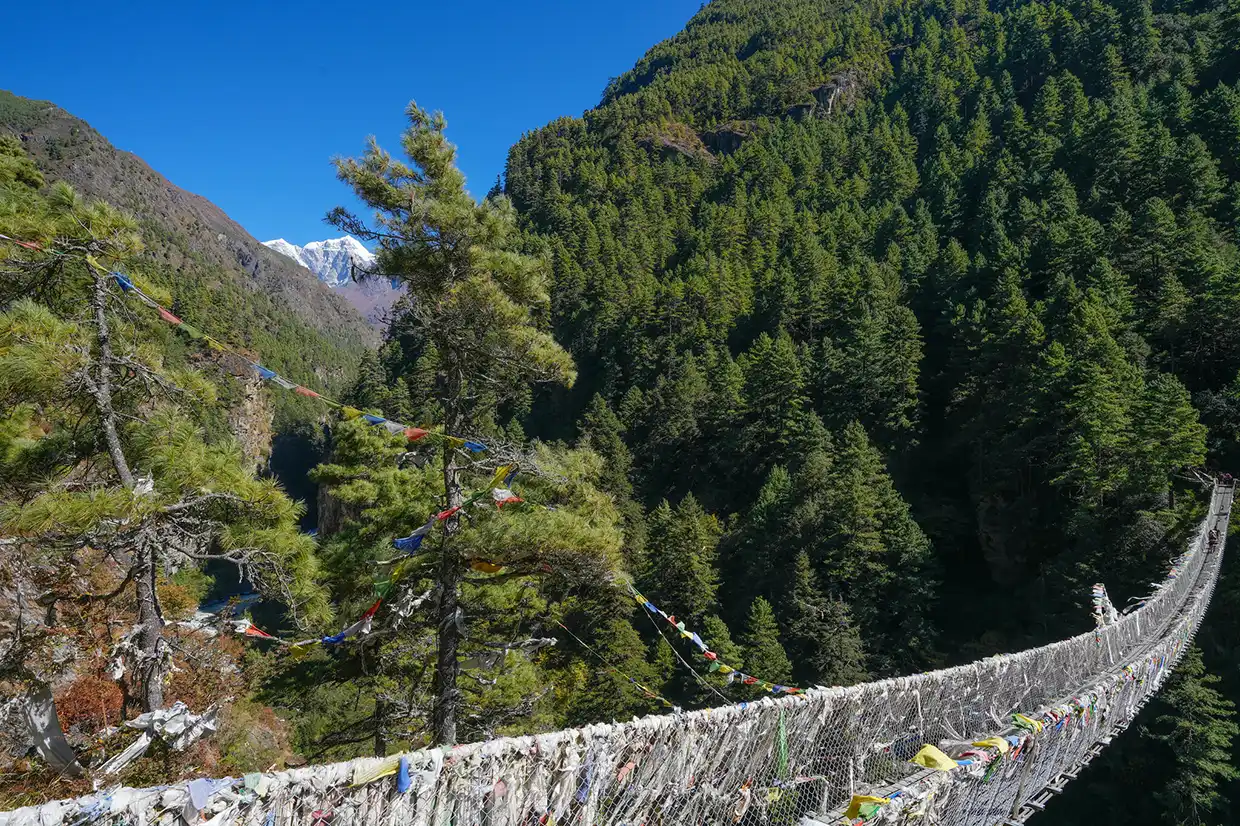
After the bridge, the real work begins. The final 600-meter ascent to Namche Bazaar winds up a steep forested ridge on a stone staircase. You stop often — to sip water, to catch your breath, to let a yak train pass. Your guide sets a mercifully slow, steady pace. The altitude makes itself known.
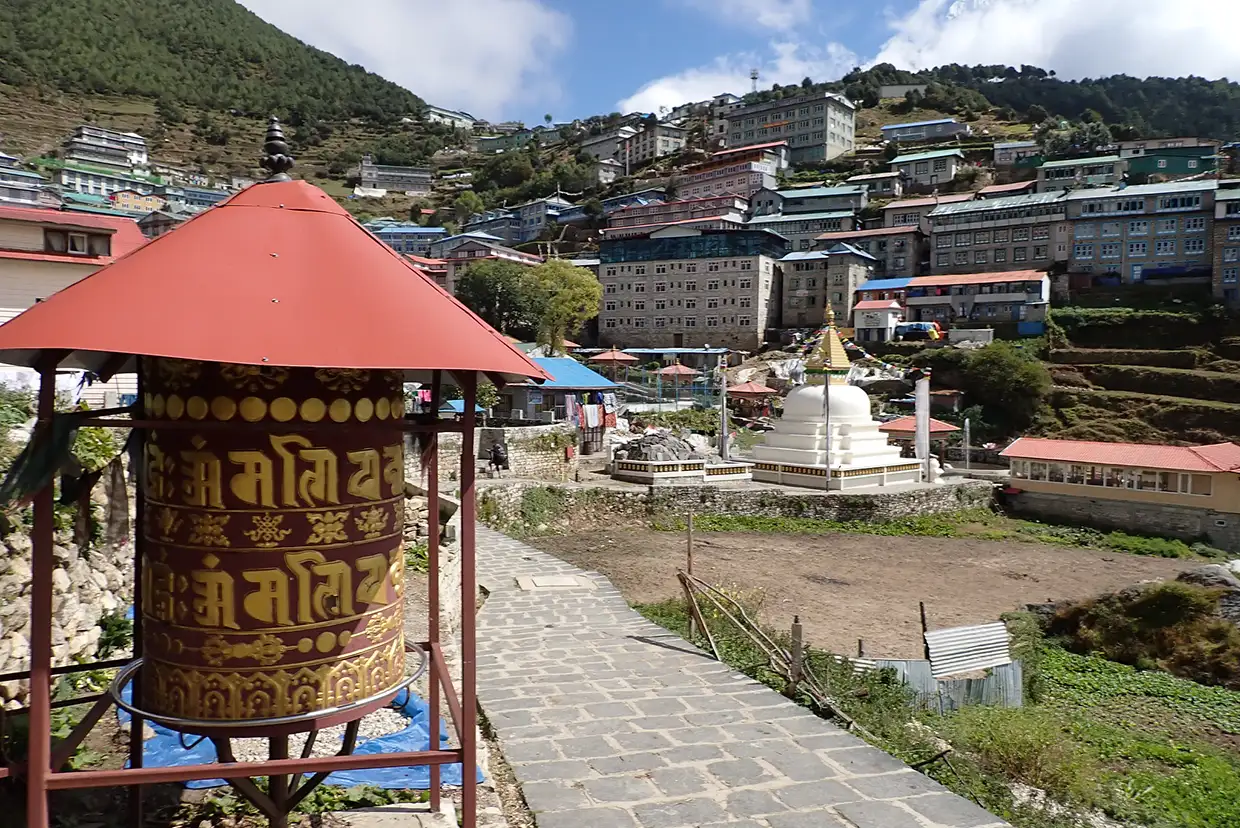
Then the ridge breaks open. Namche Bazaar unfolds in a horseshoe of whitewashed lodges, bakeries, and gear shops carved into the mountainside. Prayer flags flutter across the valley. You arrive at Yeti Mountain Home Namche by early afternoon. A thermos of hot, boiled water and an electric warmed bed wait in your wood-paneled room. The sealed-chimney dining room serves organic greenhouse vegetables and offers a view straight across the valley to Kongde Ri. After dinner, your guide records your first high altitude SpO₂ reading. The mountains have you now, and Namche is the perfect place to pause.
Distance: 10–12km | Walking time: 6 hours
Elevation: 3440m
Accommodation: Yeti Mountain Home Namche
Meal: Breakfast, Lunch, Dinner
Day 5: Acclimatisation at Hotel Everest View — The Highest Hotel on Earth
Today is an act of deliberate luxury. Instead of a demanding trek, you take a gentle 440-meter climb through juniper and rhododendron to Syangboche ridge. The path is quiet, the pace unhurried. Your guide points out Himalayan monal pheasants darting through the undergrowth.
By late morning, Hotel Everest View appears on a grassy knoll at 3,880 meters. Japanese architect Yoshinobu Kumagaya built it in 1971. Every piece — timber, glass, the kitchen sink — arrived on a porter’s back or by helicopter. The Guinness Book of Records lists it as the world’s highest placed hotel.
Your room is a sanctuary. Floor-to-ceiling sliding glass doors frame Everest, Lhotse, and Ama Dablam in a single panoramic sweep. Oxygen wall outlets with disposable nasal cannulas sit ready beside the bed. Heated blankets and a room heater soften the thin air. In the dining room, an ancient boulder forms one wall, with a Tibetan Buddhist inscription carved into it. Dinner is unexpectedly fine: fillet mignon, Japanese oyakodon, or a continental plate. The chef was trained in Kathmandu’s top kitchens.
After the meal, your guide runs a 30-minute saturation clinic. SpO₂, heart rate, and feeling notes — every reading goes into your Daily Saturation Log. Below 85% triggers oxygen and a revised pace plan. Tonight, you sleep with the mountain right outside your window, silent and enormous under the stars.
Walking time: 2–3 hours
Elevation: 3880m
Accommodation: Hotel Everest View
Meal: Breakfast, Lunch, Dinner
Day 6: Hotel Everest View to Dole — The Road Diverges
You wake to dawn light on Everest’s summit pyramid. Only guests who stay overnight see it from this angle. After breakfast with that same panorama, you descend through juniper back to Namche. You pick up the Gokyo trail heading west at Kyangjuma. At Kyangjuma, the Gokyo circuit separates from the standard EBC highway. Instantly, the foot traffic thins. You hear only birdsong and the distant rumble of the Dudh Koshi.
The path drops steeply to Phortse Thanga at 3,680 meters, a tiny settlement at the river’s edge. You cross a bridge and begin climbing again — a sustained, heart-pumping ascent through birch and rhododendron forest. Thamserku, Kangtega, and Cholatse dominate the eastern skyline, ridge after snowy ridge. Keep an eye out for musk deer and the brilliant flash of a Himalayan monal.
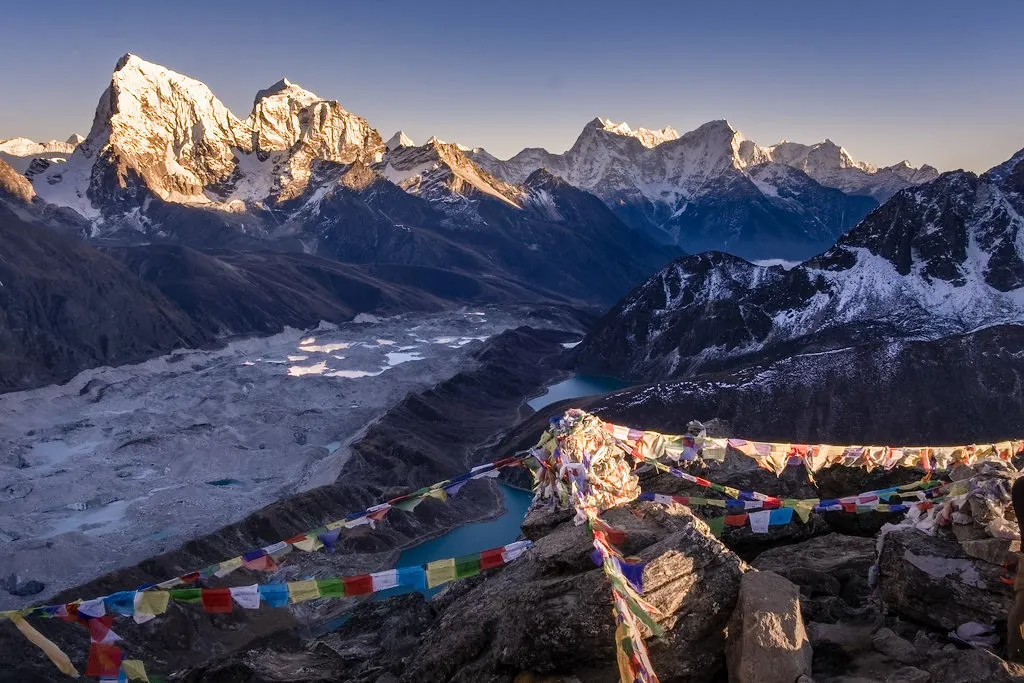
Dole, at 4,200 meters, is a cluster of stone lodges perched on an open hillside. No luxury-branded property operates here, but Peregrine reserves the best available rooms months in advance. The lodge is simple, the welcome warm. Hot tea arrives within minutes of your arrival. As the temperature drops and the first stars prick the dark, your guide takes the evening SpO₂ reading. The Gokyo Valley proper begins tomorrow, and the air is already thinner.
Distance: 11–12km | Walking time: 5 hours
Elevation: 4200m
Accommodation: Best available lodge in Dole
Meal: Breakfast, Lunch, Dinner
Day 7: Dole to Machhermo — Into the Thin Air
A shorter walking day supports your body’s quiet adjustment above 4,000 meters. After breakfast in the stone dining room at Dole, the trail climbs through scrub juniper and dwarf rhododendron. Lhabarma and Luza pass as stone hamlets barely marked on maps. The air feels noticeably thinner now, and your guide keeps the pace deliberately gentle. You breathe in rhythm with your steps.
Machhermo appears by mid-morning, a small settlement tucked beneath rocky slopes at 4,470 meters. A seasonal Himalayan Rescue Hospital operates here, a reminder that altitude demands respect. Your guide may point to a nearby ridge. In 1974, a Sherpa woman reportedly fought off a Yeti that killed three yaks. The incident ranks as the most documented sighting in Khumbu history.
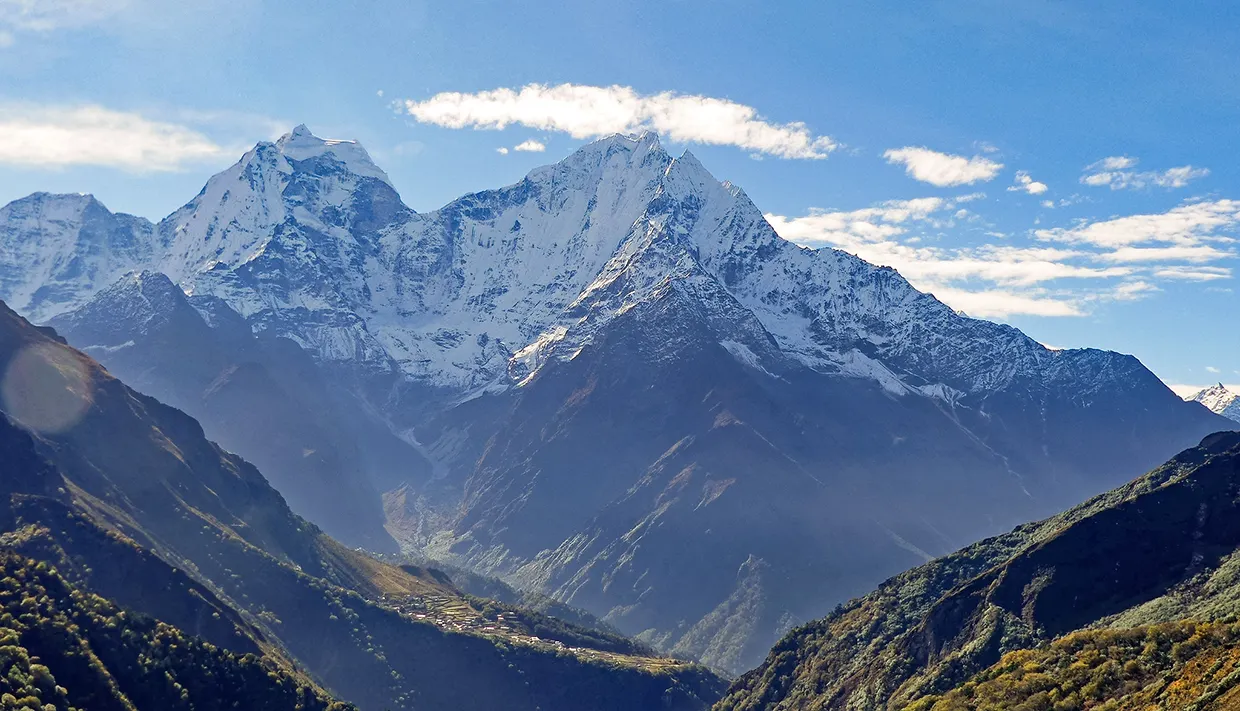
Namgyal Lodge welcomes you with hot tea and a family-run warmth. Peregrine reserves the five ensuite rooms months beforehand for October and April departures. After lunch, you rest. In the evening, your guide clips the pulse oximeter to your finger and logs the reading. The number is lower now, but steady. You sleep early, the silence of high altitude pressing against the window.
Distance: 6km | Walking time: 3–4 hours
Elevation: 4470m
Accommodation: Namgyal Lodge Machhermo or similar
Meal: Breakfast, Lunch, Dinner
Day 8: Machhermo to Gokyo Lake — The Turquoise Necklace
The trail climbs a ridge above Machhermo, and the world opens. Cho Oyu, the sixth-highest mountain on Earth, rises to the north, its massive flank dominating the skyline. At Phangkha, you pass a stone memorial for forty people lost in a 1995 avalanche. The path then mounts the terminal moraine of the Ngozumpa Glacier — Nepal’s longest river of ice, stretching 36 kilometers.
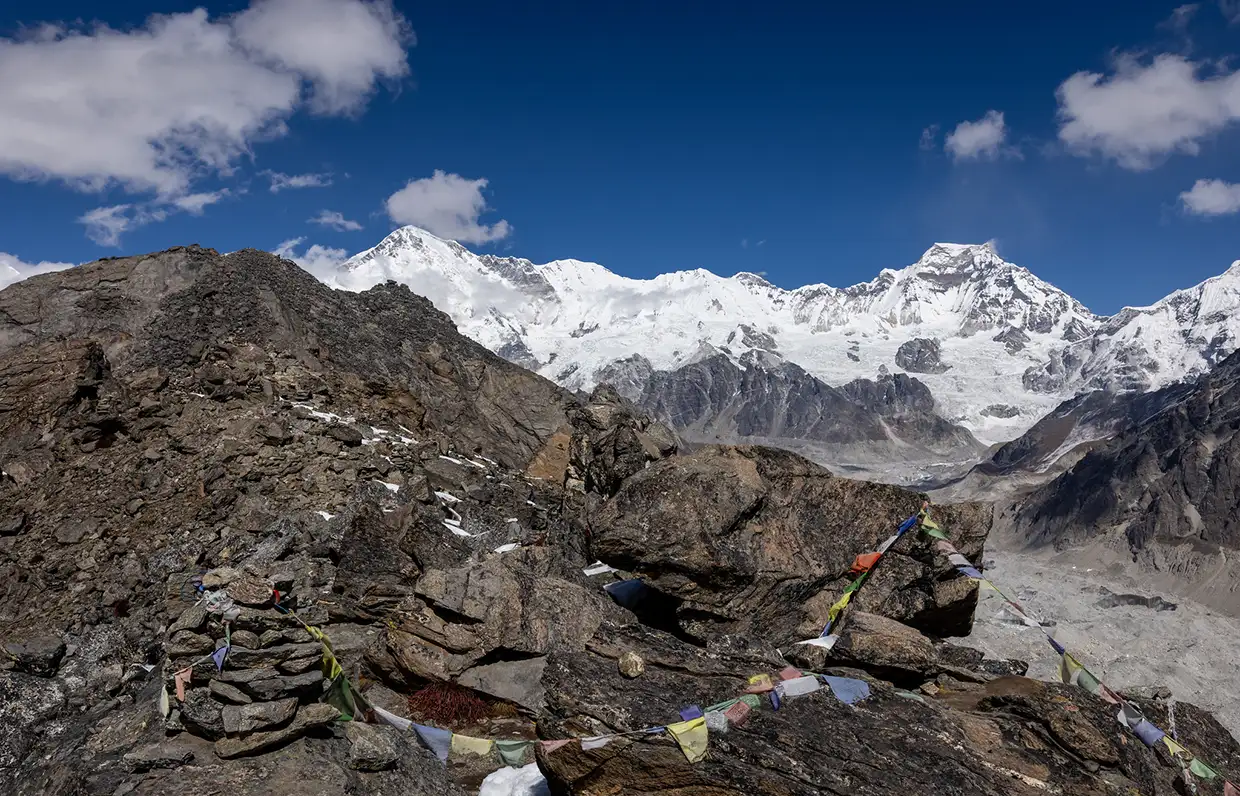
Then you see the first lake. Longpongo, at 4,690 meters, gleams a shade of turquoise that seems almost artificial. A second lake and a third follow in quick succession as the valley curls south. The color shifts from electric blue-green in sunlight to deep jade under clouds. Glacial minerals suspended in the water drive the change. These five lakes hold Ramsar Convention status as internationally important wetlands — one of the highest freshwater ecosystems in the world.
Gokyo village clusters beside the third lake, Dudh Pokhari. Your guesthouse, the best available, is simple but chosen with care. A warm dining room looks straight across the water to the glacier. As the sun sets behind Cho Oyu, the peaks turn rose gold. You understand why people call this the loveliest valley in the Khumbu.
Distance: 6.8km | Walking time: 4–5 hours
Elevation: 4790m
Accommodation: Best available guesthouse at Gokyo
Meal: Breakfast, Lunch, Dinner
Day 9: Gokyo Ri Sunrise, Fifth Lake, and Trek to Thangna — The Summit of Four Giants
You wake at 4:00 AM, pull on your warmest layers, and begin the climb to Gokyo Ri in darkness. Your headlamp cuts a narrow path up the steep switchbacks. At 5,357 meters, the summit is cold and wind-lashed, but then the sun rises. Four of the world’s five highest peaks stand in a single panoramic sweep: Everest, Lhotse, Cho Oyu, and Makalu. Below, the five turquoise lakes string north like a necklace dropped on the valley floor. The Ngozumpa Glacier grinds silently beneath it all.
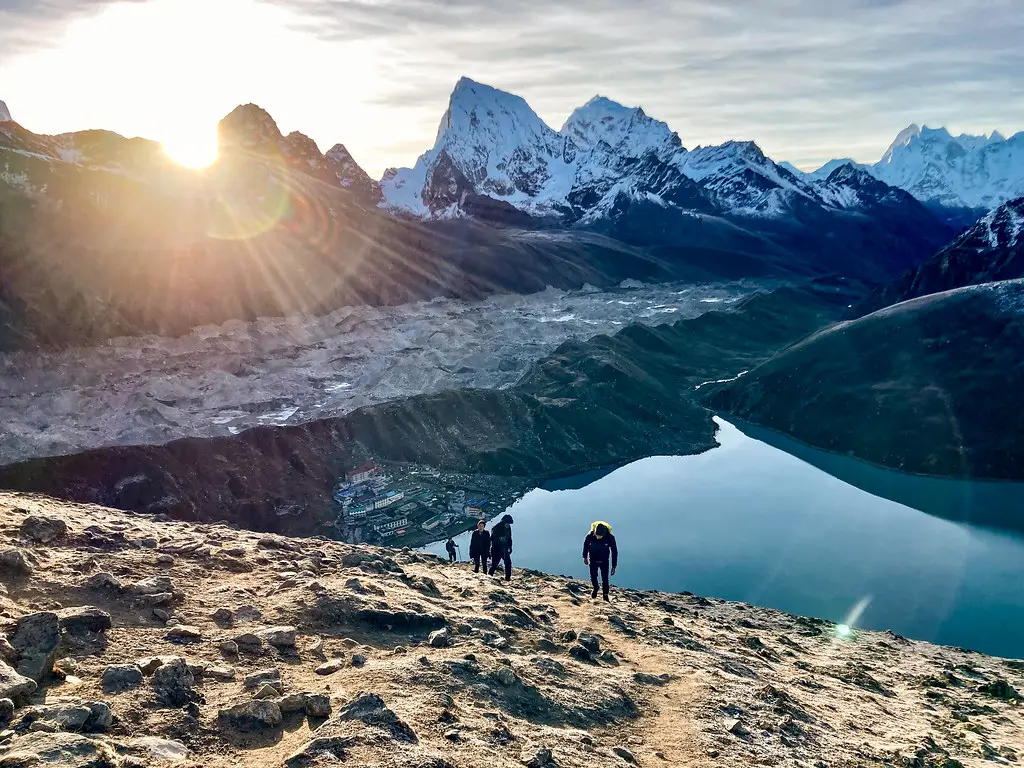
Back at the lodge, a warm breakfast restores you. Then you have a choice. Rest and soak in the lakeside quiet, or hike north to the fourth and fifth Gokyo Lakes. The fifth lake, Ngozumpa Tsho, sits at roughly 4,990 meters. It rewards the extra effort with a face of Everest that very few trekkers ever see.

In the afternoon, you trek southeast to Thangna, the base camp for tomorrow’s Cho La crossing. The walk across the glacier moraine takes two to three hours. The lodge is basic. Your guide briefs you immediately on the morning operation: crampons, fixed ropes, and satellite weather check. His safety decision is final. Dinner is simple and hot. You sleep early, the pass waiting in the dark.
Distance: ~14km total | Walking time: 7–8 hours
Elevation: 5357m
Accommodation: Local lodge Thangna
Meal: Breakfast, Lunch, Dinner
Day 10: Cross Cho La Pass — The Glacier Gate
Departure is at 4:30 AM. Your guide has already checked the satellite weather report. If wind or visibility fail to meet his threshold, the crossing waits — no argument, no pressure. Today, the mountains give permission.
Headlamps pick out the rocky valley beyond Thangna. The trail steepens, and soon the glacier section appears: a tilted sheet of ice and rock roughly 300 meters across. A dedicated Sherpa team placed fixed ropes before dawn. Your guide fits each guest’s crampons personally and holds a 1:2 ratio on the ice. You move one step at a time, the rope cold and sure in your glove.
At the summit cairn — 5,368 meters — prayer flags snap in the thin wind. A support porter appears with a thermos of hot ginger lemon tea. You drink it standing among the flags. Then the descent begins, steeply down loose rock on the eastern side, before the valley floor opens toward Dzongla. The full crossing takes seven to nine hours. In Dzongla, a simple stone-walled lodge welcomes you with a hot meal and deep quiet. A Certec hyperbaric chamber sits on standby throughout the day. You sleep with the gratitude of having crossed.
Distance: 8km | Walking time: 7–9 hours
Elevation: 5368m
Accommodation: Local lodge Dzongla
Meal: Breakfast, Lunch, Dinner
Day 11: Dzongla to Lobuche — The Valley of Remembrance
A short, gentle recovery day follows the pass. The trail from Dzongla crosses the Khumbu Valley and joins the familiar path of the standard Everest Base Camp route. Sunlight warms the moraine ridges, and the pace feels mercifully slow after yesterday’s effort.
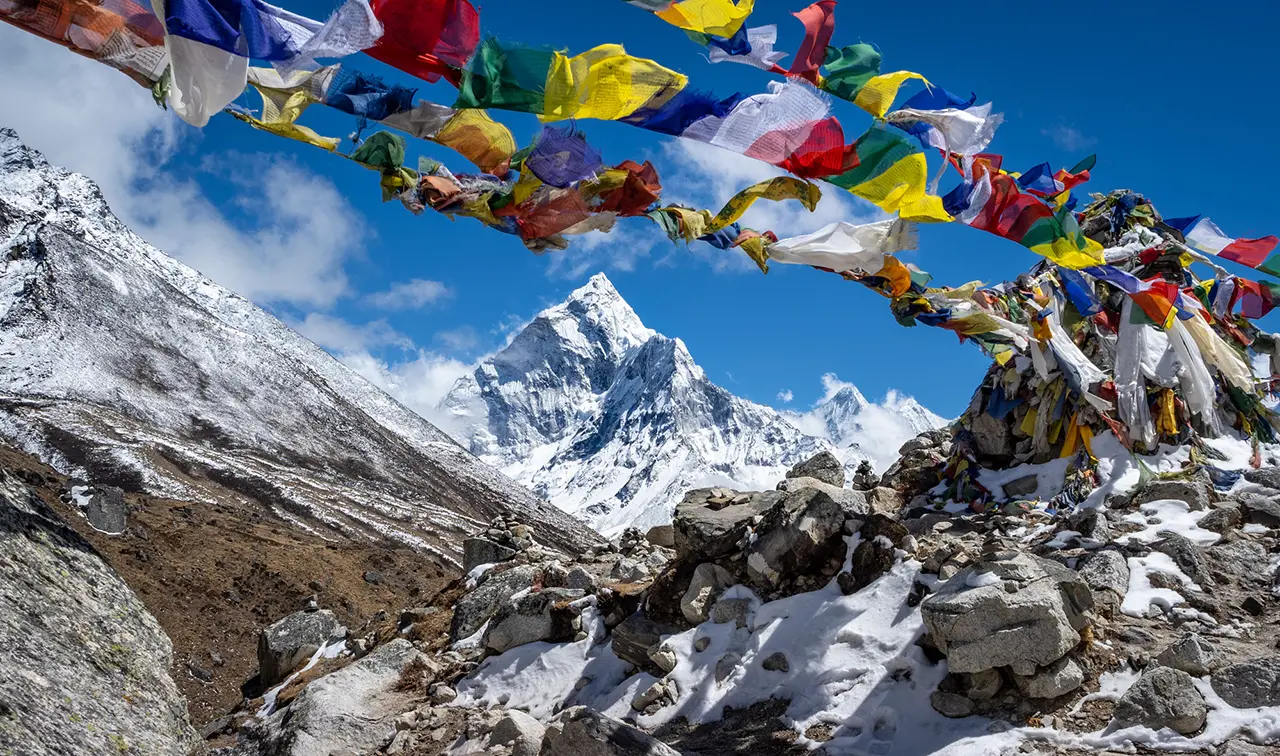
At Thukla Pass, you come upon a cluster of stone chortens and prayer flags. These memorialize climbers who never returned from Everest: Scott Fischer, Rob Hall, Babu Chhiri Sherpa, and many others. Your guide pauses and shares their stories with quiet respect. The site is somber, deeply moving, and an essential moment on every Khumbu circuit.
You reach Lobuche by early afternoon. The New EBC Hotel offers the best accommodation at this altitude — simple, cold, and functional, but managed with care. Hot food arrives promptly, and your guide records the evening SpO₂ reading. Lobuche sits at 4,940 meters, and the air contains only half the oxygen as at sea level. You rest knowing that Everest Base Camp lies just one day ahead.
Distance: 4–5km | Walking time: 3–4 hours
Elevation: 4940m
Accommodation: New EBC Hotel Lobuche
Meal: Breakfast, Lunch, Dinner
Day 12: Gorakshep and Everest Base Camp — At the Foot of the World
You leave Lobuche early, walking the lateral moraine of the Khumbu Glacier. The terrain shifts to a moonscape of grey rock, frozen meltwater, and ice. After three hours, Gorakshep appears at 5,170 meters. A handful of lodges cling to the edge of the glacier.
At the Himalaya Hotel, you drop your heavy pack, sip hot tea, and catch your breath. Then, with only water and a camera, you set out for Everest Base Camp. The trail crosses the glacier surface to a sprawling area of boulders and ice. During the spring climbing season, expedition tents paint the camp yellow and orange. Outside those months, the Icefall alone commands attention — a frozen cascade of seracs groaning and cracking directly above you.
Everest stays hidden behind Nuptse from Base Camp. Standing at the exact point where every summit attempt begins, you feel the mountain’s full gravity. Spend 45 minutes, take photographs, then listen. The glacier speaks. Return to Gorakshep before dusk. Request the Everest-facing room, and let the high altitude silence hold you through the night.
Distance: 13km round trip | Walking time: 7–8 hours
Elevation: 5364m
Accommodation: Himalaya Hotel Gorakshep
Meal: Breakfast, Lunch, Dinner
Day 13: Kala Patthar Sunrise — The Golden Hour — Descent to Pheriche
Your guide wakes you at 4:30 AM with a gentle knock and a thermos of hot tea. Outside, the cold bites. You pull on your down jacket, switch on your headlamp, and begin the steady climb from Gorakshep to Kala Patthar. The darkness mutes everything but the crunch of your boots and the steady rhythm of your breath.
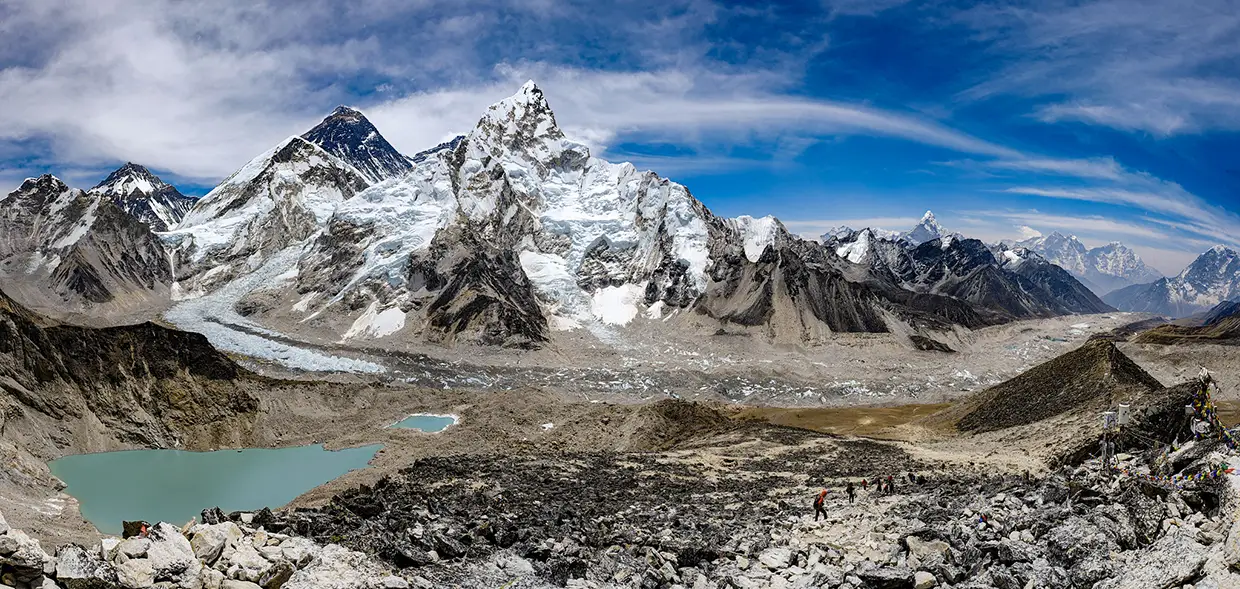
After 45 minutes, the summit ridge appears. At 5,545 meters, you stand at the highest point of the entire journey. Then the sun rises. It touches Everest’s summit pyramid first — a slash of gold on charcoal rock. Slowly, the light spills down the South Col, across the West Ridge, and onto the glacier below. Nuptse, Changtse, Pumori, Lingtren — every peak catches fire in sequence. You forget the cold. You forget the thin air. You just watch.
Back at Gorakshep, a full warm breakfast restores you. Then the long descent begins. You retrace the moraine past Lobuche and Thukla, dropping steadily out of the alpine zone. The air thickens with every step. By late afternoon, Pheriche appears in a wide, grassy valley at 4,240 meters.
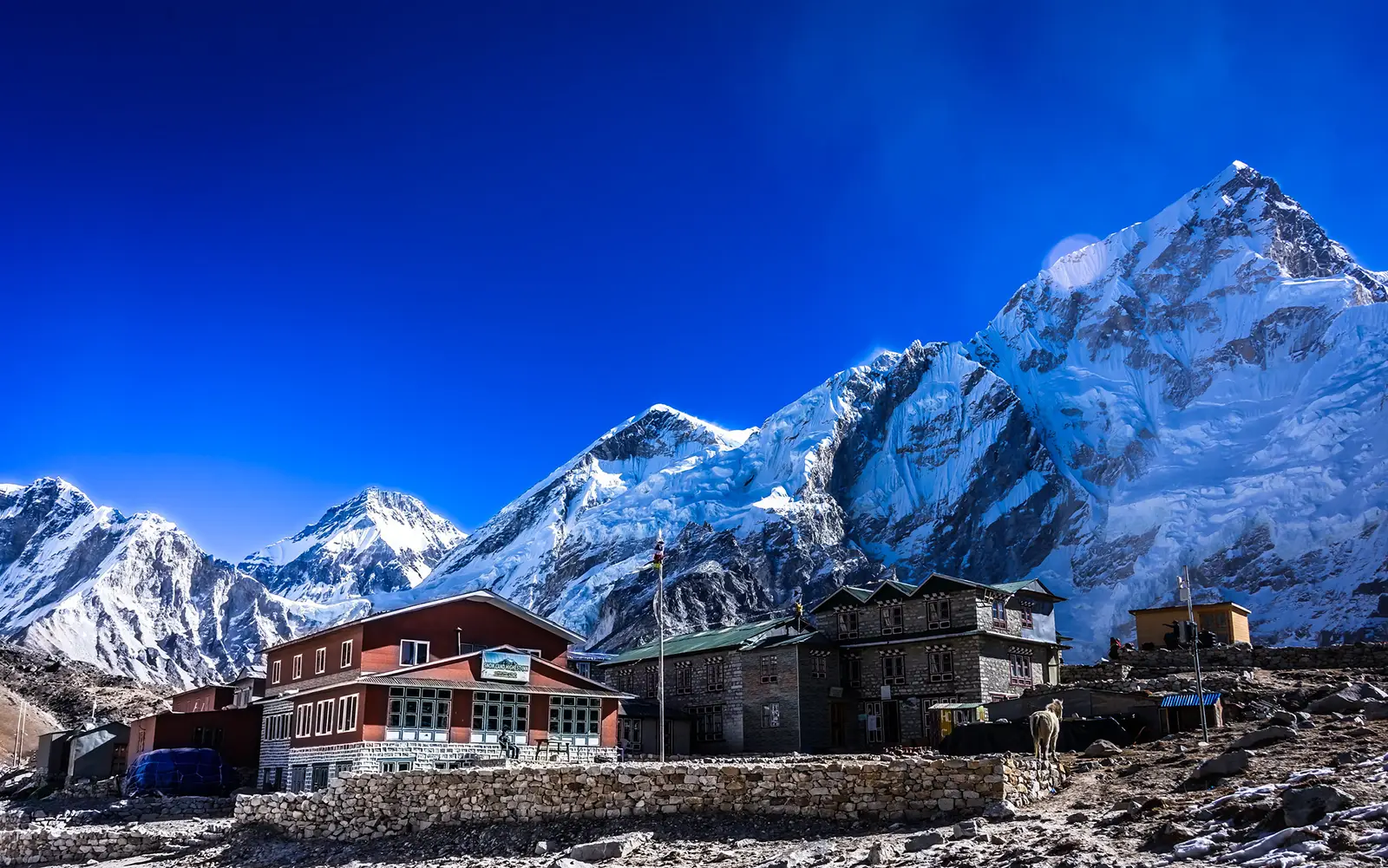
The Edelweiss Pheriche feels like a sanctuary. Double-glazed windows seal out the chill. Your room, designed with Sherpa antiques and local artwork, has an attached bathroom and 24-hour hot water. After a gas-fired shower, you settle into the dining room for sea buckthorn tea and American-style coffee. The meal is superb — locally sourced, carefully prepared. Tonight, your body rests deeply, grateful for the oxygen.
Distance: ~18km | Walking time: 7–8 hours
Elevation: 5545m
Accommodation: The Edelweiss Pheriche
Meal: Breakfast, Lunch, Dinner
Day 14: Pheriche to Namche Bazaar — The Return to Green
The descent south feels like rewinding a film. Pale rock gives way to scrub juniper, then to pine and rhododendron forest. Every breath draws in thicker, warmer air. Birdsong returns. The Dudh Koshi River grows louder as you drop alongside it.
You pass through Pangboche, where Ama Dablam still dominates the sky, then climb gently toward Tengboche. If the timing aligns, your guide pauses at Tengboche Monastery for the afternoon puja ceremony. Deep, resonant chanting fills the ancient hall. The days you already spent in these mountains make the experience richer.
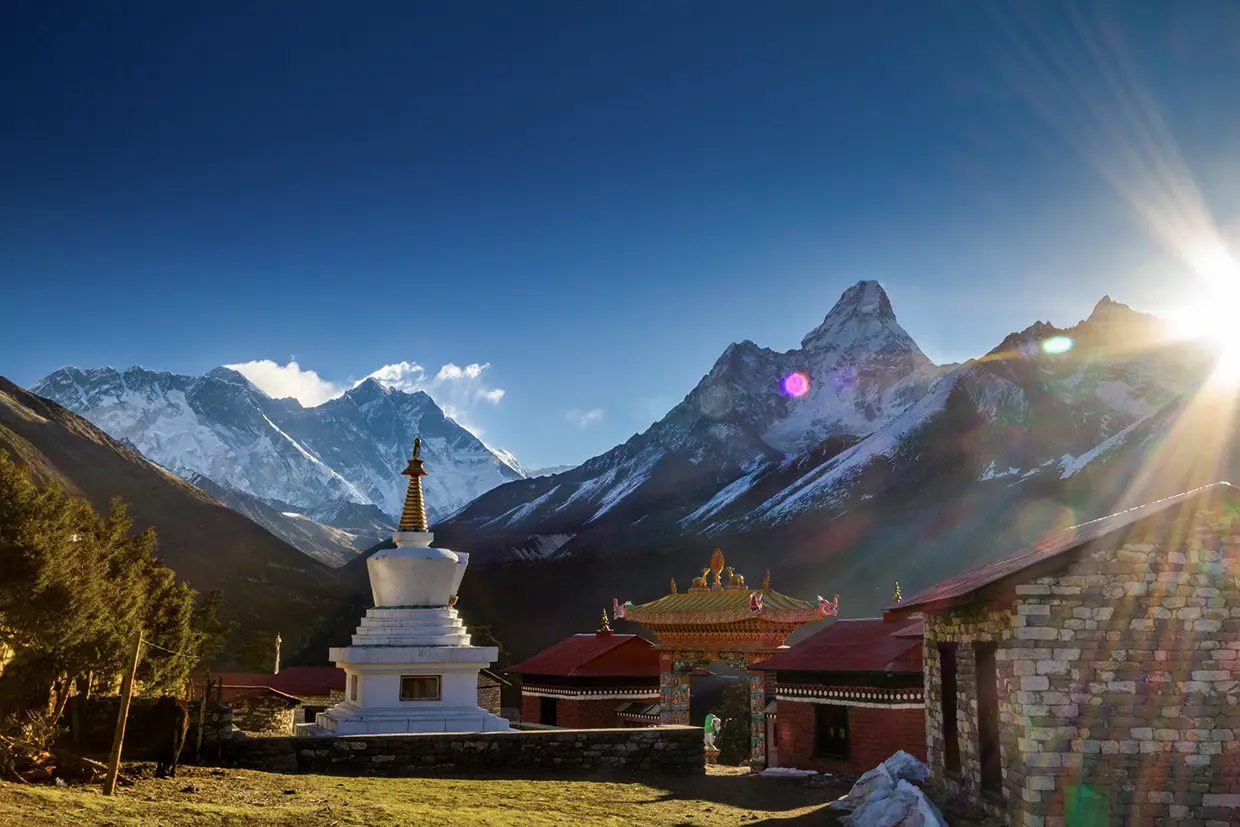
By late afternoon, the familiar horseshoe of Namche Bazaar opens before you. You check in at Yeti Mountain Home in Namche. A thermos of hot water and an electric blanket feel like the warmest welcome. After a long shower, you walk into town. Namche’s bakeries are legendary among Khumbu veterans: order warm apple pie or a cinnamon roll still dusted with sugar. Dinner back at the lodge brings greenhouse cuisine and a quiet satisfaction that the hardest miles lie behind you.
Distance: 19km | Walking time: 6–7 hours
Elevation: 3440m
Accommodation: Yeti Mountain Home Namche
Meal: Breakfast, Lunch, Dinner
Day 15: Namche Bazaar to Lukla — The Final Footsteps
Your last day on the trail arrives with soft light and a gentle ache of accomplishment. After breakfast, you leave Namche and cross the Hillary Suspension Bridge one final time. The route south retraces familiar ground: Monjo, then the pine forests above the Dudh Koshi, then the three suspension bridges over the grey river. You exit Sagarmatha National Park at Monjo.
The oxygen-rich air makes every kilometer feel quicker, easier. By Phakding, the trail levels along the riverbank. A few short climbs lead to the final stretch into Lukla. The sight of Tenzing-Hillary Airport’s sloping runway marks the end of the walk.
Yeti Mountain Home Lukla is the most beautifully decorated lodge in the chain. Buddhist monastery paintings cover the interior walls, and the library invites quiet reflection. In the evening, your guide and porter team join you for a celebration dinner. Tips wrapped in prayer scarves change hands. Glasses raise. The 12-day trial is complete.
Distance: 18km | Walking time: 6 hours
Elevation: 2860m
Accommodation: Yeti Mountain Home Lukla
Meal: Breakfast, Lunch, Dinner
Day 16: Fly to Kathmandu — The Return to the Valley
Morning light fills the painted rooms of Yeti Mountain Home, Lukla. Over breakfast, you watch the airstrip wake — porters loading, prayer flags flapping, the first Twin Otter growling down the runway. Then it is your turn. The flight lifts you out of the Khumbu in thirty-five minutes, the white peaks shrinking into cloud and memory.
At Kathmandu’s domestic terminal, your private chauffeur waits with a sign and a smile. Cool towels and chilled water reappear. The drive to Radisson Hotel Kathmandu feels shorter now. The pagoda roofs and marigolds look familiar. You first passed them eighteen days ago. Your suite is ready, crisp and quiet.
The afternoon is deliberately empty. Swim in the garden pool. Book a deep-tissue massage at the spa. Order room service and eat on your private balcony. You walked from Lukla to Gokyo, crossed a glacier pass, stood at Everest Base Camp, and watched the sunrise from Kala Patthar. The body deserves stillness. Tonight, the hotel hums softly. You sleep without an early wake-up call for the first time in two weeks.
Elevation: 1400m
Accommodation: Radisson Hotel Kathmandu (5★)
Meal: Breakfast
Day 17: Kathmandu Reflection Day — The Gift of Time
Day 17 exists for one reason: Lukla’s weather is unpredictable. Roughly one in three October departures is delayed. Without this buffer, a fog-closed morning could cost you your international flight. Day 17 absorbs that uncertainty at no extra cost. If all has gone smoothly, it becomes a day of pure leisure.
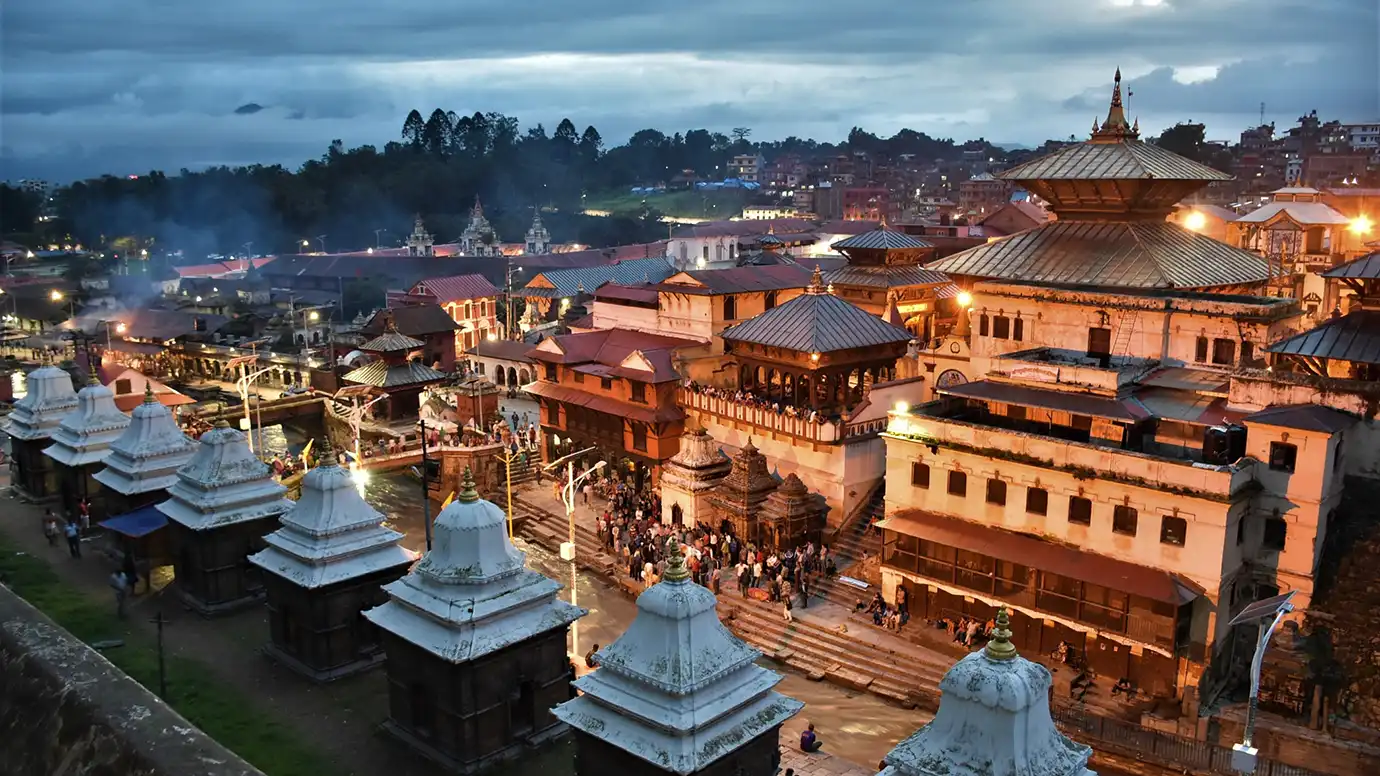
Linger over a late breakfast. The Radisson’s garden restaurant serves fresh papaya, warm croissants, and strong Nepali coffee. Then shape the hours as you wish. A private guide and car can take you to Pashupatinath for morning aarti, or to the quieter courtyards of Bhaktapur. Thamel’s alleys offer pashmina, singing bowls, and final gifts for the flight home. The hotel spa remains an indoor haven if your legs still hum from the trail.
As dusk settles, your guide hosts a farewell dinner. White linen, candlelight, and a menu that fuses Himalayan ingredients with European technique. Your guide arrives in formal attire to present your trek completion certificate. A thick paper document carries your name and the route you walked. A post-trip photo summary arrives within 48 hours. The evening closes with a toast. Not to ending, but to everything you carried back with you.
Elevation: 1400m
Accommodation: Radisson Hotel Kathmandu (5★)
Meal: Breakfast, Farewell dinner
Day 18: Departure from Kathmandu — The Long Farewell
A final breakfast. A last cup of masala tea. When the time comes, your chauffeur collects you from the Radisson. The drive to Tribhuvan International Airport takes roughly thirty minutes. The drive takes roughly thirty minutes. Your guide insists on seeing you all the way to the terminal gate.
Elevation: 1400m
Meal: Breakfast
Customize this trip with help from our local travel specialist that matches your interests.
Includes & Excludes
What is included?
Airport Transfers
A private, climate-controlled vehicle picks you up from Tribhuvan International Airport on arrival day. The same service drops you off on the morning of your final departure. Your name appears on the driver’s placard at arrivals.
Kathmandu Accommodation
Three nights at Radisson Hotel Kathmandu or an equivalent five-star property. Rates cover a deluxe room with daily breakfast. The hotel features a heated outdoor pool, a full-service spa, and multiple dining restaurants.
Domestic Flights
Return flights on the Kathmandu–Lukla–Kathmandu sector. Your guide coordinates check-in and baggage handling for both legs. The package includes buffer days for Lukla weather delays, which are common in the shoulder season.
All Trek Accommodation
Best available lodges at every overnight stop along the route. At Phakding and Namche, this means Yeti Mountain Home. At Syangboche, this means Hotel Everest View. At Pheriche on the descent, this means the Edelweiss. Above 4,700m, the standard shifts to the best available private room at each location.
Meals
- 17 breakfasts — all locations, including Kathmandu
- 13 lunches — all active trekking days
- 14 dinners — all trek nights including welcome and farewell
Kathmandu meals include the welcome dinner at Radisson and breakfast each morning. On the trek, your guide selects the best available option from each lodge menu.
Guides and Porters
One senior Sherpa guide per group throughout all 18 days. Your guide is Khumbu-born, certified in wilderness first aid, and carries a satellite phone and pulse oximeter at all times.
Porter allocation: one porter per trekker, maximum 15kg duffel per porter. Porters carry luggage between lodges. You carry your own daypack on the trail.
Safety Equipment
- Fingertip pulse oximeters with daily SpO₂ readings logged
- Emergency supplemental oxygen from Day 6 onward
- Crampons and ice axe for Cho La Pass crossing (if necessary)
Permits and Government Fees
- Sagarmatha National Park entry permit
- Khumbu Pasang Lhamu Rural Municipality fee
- TIMS (Trekkers’ Information Management System) card
Pre-Trek Briefing
Private 90-minute acclimatization and safety briefing in Kathmandu with your lead guide. The session covers altitude physiology, SpO₂ monitoring, Cho La Pass preparation, emergency procedures, and daily pacing targets.
Farewell Dinner
Three-course farewell dinner at Radisson Hotel Kathmandu on your final full evening. Wine and beverages are at your own cost.
What is excluded?
International Flights
Airfare to and from Kathmandu is not included. Book your international flight to Tribhuvan International Airport (KTM), Kathmandu, Nepal.
Nepal Entry Visa
Nepal issues tourist visas on arrival at Kathmandu airport. Current fees: USD 30 for 15 days, USD 50 for 30 days, USD 125 for 90 days. Bring two passport photos and USD cash for faster processing.
Travel Insurance
Mandatory personal travel insurance is not included in the package price. Your policy must cover helicopter evacuation to an altitude of 6,000 m. See the Travel Insurance section below for guidance on providers and minimum coverage requirements.
Personal Trekking Gear
Trekking boots, clothing layers, poles, a sleeping bag liner, and personal items are your responsibility. Our Nepal Trekking Gear List covers everything you need for this specific route.
Meals Not in the Plan
Lunches in Kathmandu on non-included days, any restaurant meals outside the plan, and beverages beyond complimentary service are at your own cost.
Tips and Gratuities
Tips for your guide, porters, and lodge staff are customary and appreciated. Suggested daily rates: Guide USD 15–20, Porter USD 8–10, Lodge staff USD 2–3 per night.
Personal Expenses at Lodges
Hot showers, device charging, laundry, WiFi, and any items purchased at tea houses or the Namche market are extra costs paid directly at each location.
Helicopter Evacuation Costs
If medical evacuation becomes necessary, your insurer covers the cost directly. Peregrine Treks & Tours coordinates the logistics. Your policy must confirm this coverage in writing before your departure date.
Departure Dates
We also operate Private Trips.
Good To Know
Your safety kit meets expedition-grade standards. The full equipment list travels with your guide team throughout the 18 days.
| Equipment | Specification |
| Portable oxygen | 2 x 1,200L portable oxygen cylinders |
| Hyperbaric chamber | Certec portable chamber (Gamow bag) — simulates descent of 1,000–2,000m altitude |
| Pulse oximeters | Two fingertip units — SpO2 and heart rate logged twice daily from Day 5 |
| Satellite communicator | Garmin inReach — two-way satellite messaging and 24-hour SOS |
| First-aid kit | Senior wilderness first-aid kit for guide team |
| Crampons | Provided for all guests for the Cho La Pass glacier crossing |
| Altitude medication | Diamox is available under guided advisement |
Your guide maintains a Daily Saturation Log starting on Day 5. Every guest receives SpO2 and heart rate readings twice a day. Any guest with SpO2 below 85% at altitude receives supplemental oxygen and a revised pacing plan. Descent takes priority over schedule.
Two main windows suit the full circuit: March to May and September to November. Both offer stable weather, clear skies, and passable Cho La conditions. Each season has a distinct character. Knowing the difference helps you choose the departure that matches your priorities.
Spring Season: March to May
Spring is the most popular window for the Luxury Everest Base Camp & Gokyo Lakes Trek. Rhododendron forests below Namche bloom from March through April. Days warm quickly, skies remain clear into early afternoon, and the Gokyo Valley shows its best colors.
April is the single best month on the route. Temperatures at Namche (3,440m) sit around 5°C to 12°C during the day. At Gokyo (4,790m), expect 0°C to 7°C in the afternoon and -5°C to -10°C overnight. Cho La Pass conditions are close to perfect through late April.
May remains viable, but pre-monsoon haze builds by the third week. Book May departures in the first two weeks of the month. Trail crowds peak in April and early May, especially through Namche and along the main EBC corridor.
| Month | Daytime Temp at Namche | Trail Condition | Crowd Level |
| March | 3°C – 10°C | Good, possible snow above 5,000m | Moderate |
| April | 5°C – 12°C | Excellent — optimal window | High |
| May (early) | 7°C – 14°C | Good, pre-monsoon haze begins | High |
| May (late) | 8°C – 15°C | Acceptable, instability building | Moderate |
Autumn Season: September to November
Autumn delivers the cleanest air of the year on this route. The monsoon washes the atmosphere through July and August. September opens the post-monsoon season with extraordinary clarity. Peaks look sharper and closer than in spring.
October is the premium autumn month. Days are bright and cold. Nights above 4,500m drop sharply. Every high viewpoint — Gokyo Ri, Kala Patthar, Cho La col — delivers unobstructed panoramas. Cho La crossings through October are close to ideal.
November remains viable in the first two weeks. Snowfall becomes more frequent after mid-November, and conditions at Cho La become less predictable. Late November departures carry a higher risk of rerouting. Book early November if you want autumn without the April crowds.
| Month | Daytime Temp at Namche | Trail Condition | Crowd Level |
| September (late) | 8°C – 15°C | Good, trail dries after the monsoon | Moderate |
| October | 4°C – 12°C | Excellent — optimal window | High |
| November (early) | 0°C – 8°C | Good, cold nights above 4,500m | Moderate |
| November (late) | -2°C – 6°C | Acceptable, early-season snow risk | Low |
Seasons to Avoid
Monsoon (June–August):
Heavy rainfall, leeches below 3,000m, trail erosion, landslide risk below Namche, and Cho La Pass closure make this window unsuitable for the full circuit.
Winter (December–February):
Cho La Pass often carries prohibitive snow depth. Temperatures at Gorakshep drop to -20°C at night. The route is feasible for experienced winter mountaineers with modified equipment, but the luxury experience framework does not apply in this window.
This trek is rated strenuous. You walk five to eight hours per day on steep, rocky, high-altitude terrain for 14 consecutive active days. Fitness is not optional — it directly shapes how much you enjoy every hour above 4,000m.
What the Trek Physically Demands
Daily elevation gain:
The hardest days — Phakding to Namche, Machhermo to Gokyo, and the Cho La crossing — involve 600m to 900m of sustained ascent. Descents on rocky and glaciated trails place significant stress on knees and ankles.
Altitude effect:
Above 4,000m, your body operates at 60 to 70 percent of its sea-level oxygen capacity. Physical effort feels harder than at home. Recovery slows. The pace must drop to match your body’s reduced efficiency.
Cumulative fatigue:
Fourteen active trekking days with only two acclimatization rest stops build cumulative fatigue. Fitness built up in the months before departure protects you during the final three days on the route, when tiredness peaks.
Recommended 12-Week Training Plan
Weeks 1–4: Cardiovascular Base
Walk or hike three to four times per week. Each session should last 60 to 90 minutes. Include hills wherever possible. Build to 15 to 20km per week total distance by the end of Week 4.
Weeks 5–8: Loaded Pack Training
Add a 7-10kg loaded daypack to your hikes. This mirrors the weight you carry daily on the trek. Increase session length to three to four hours. Complete at least one full-day hike (six to eight hours) per week.
Weeks 9–12: Altitude Simulation (Optional)
If you live near mountains, complete at least two hikes above 3,000m. If you don’t, maintain the loaded pack schedule. Consult your doctor about Diamox (acetazolamide) for preventing altitude sickness.
Throughout: Knee and Ankle Strengthening
Single-leg squats, step-downs, and calf raises reduce the risk of injury on steep descents. Add these exercises two to three times per week from Week 1.
Fitness by Age
Age is not a barrier on this route. The oldest trekkers to complete the EBC and Gokyo circuit have been in their late 70s. What matters is cardiovascular conditioning, honest pacing, and a willingness to adjust to your body’s altitude response. Peregrine Treks has guided clients successfully across every decade from their 20s to their 70s on this exact route.
Medical Considerations Before Booking
Consult your doctor before booking if you have any of the following:
- History of heart or lung conditions
- High blood pressure (treated or untreated)
- Prior episodes of altitude sickness above 3,000m
- Joint replacements or chronic knee and ankle problems
Diamox (acetazolamide) is effective for preventing altitude sickness but can cause side effects, including frequent urination and mild tingling. The decision to use it is yours and your doctor’s. Your guide is not a medical professional and cannot prescribe or advise on medication.
Contact Peregrine Treks to discuss your travel dates, group size, and comfort expectations. Our Everest coordinators respond within 12 hours, every day of the year. Reserve your Hotel Everest View room at least four months before departure. The property holds only 12 rooms and fills in October. The ensuite rooms at Edelweiss Pheriche require advance booking during peak season. Peregrine handles both reservations as part of your package. Request your private proposal with preferred departure dates and group size. Peregrine confirms Radisson Hotel Kathmandu, Yeti Mountain Home stays, Hotel Everest View overnight, and a custom Cho La Pass safety plan.
Trip Information
Complete Accommodation Plan — All 18 Nights
The accommodation on the Luxury Everest Base Camp & Gokyo Lakes Trek follows a deliberate hierarchy. Kathmandu and lower-Khumbu nights use certified five-star and premium lodge properties. Above 4,700m, the terrain and supply chain dictate the standard.
| Night | Location | Accommodation |
|---|---|---|
| 1–2 | Kathmandu | Radisson Hotel Kathmandu (5★) |
| 3 | Phakding | Yeti Mountain Home Phakding |
| 4 | Namche Bazaar | Yeti Mountain Home Namche |
| 5 | Syangboche | Hotel Everest View |
| 6 | Namche Bazaar | Yeti Mountain Home Namche |
| 7 | Dole | Best available lodge |
| 8 | Machhermo | Best available lodge |
| 9–10 | Gokyo | Best available lodge |
| 11 | Thagnak | Best available lodge |
| 12 | Lobuche | Best available lodge |
| 13 | Gorakshep | Best available lodge |
| 14 | Pheriche | The Edelweiss Pheriche |
| 15 | Namche Bazaar | Yeti Mountain Home Namche |
| 16 | Lukla | Best available lodge |
| 17–18 | Kathmandu | Radisson Hotel Kathmandu (5★) |
Radisson Hotel Kathmandu
The Radisson anchors both ends of your trip. It sits in the Lazimpat diplomatic quarter, close to Thamel but removed from the street noise. Rooms offer marble bathrooms, private balconies, and blackout curtains. The outdoor pool, full-service spa, and multi-cuisine dining room make it the right base before and after the mountains.
Yeti Mountain Home — Phakding, Namche, Lukla
Yeti Mountain Home operates four properties in the Khumbu, and three sit directly on this route. Each lodge uses locally sourced wood paneling, electric blankets, and sealed-chimney dining rooms. Organic gardens supply vegetables for the kitchen. The Namche property is situated on a ridge with unobstructed views across to Kongde Ri (6,187m).
Hotel Everest View — Syangboche (3,880m)
Hotel Everest View holds the Guinness World Record as the world’s highest placed hotel. Japanese architect Yoshinobu Kumagaya built it in 1971 entirely from materials carried by porters and delivered by helicopter. Floor-to-ceiling glass in each room frames Everest, Lhotse, and Ama Dablam simultaneously. Rooms come with oxygen wall outlets, electric blankets, and individual heaters. The kitchen produces fillet mignon and a full Western breakfast — a genuine anomaly at 3,880m.
The Edelweiss Pheriche (4,240m)
The Edelweiss sits at Pheriche on the descent leg, one day below Everest Base Camp. It is the highest-quality permanent lodge on the main EBC trail. The dining room runs a wood-fired stove and delivers a menu well above the Khumbu average. After crossing Cho La Pass and reaching Base Camp, a night at the Edelweiss feels genuinely restorative.
Above 4,700m — Managing Expectations
Above Machhermo, lodge quality becomes consistent rather than premium. Rooms at Gokyo, Thagnak, Lobuche, and Gorakshep are clean double rooms with foam mattresses and adequate blankets. Shared toilet facilities are standard. Hot showers exist at most locations for a small fee. Your guide selects the best available room at each stop—good acclimatization and good guiding matter more than good bathrooms at this altitude.
Crossing Cho La Pass — Complete Guide
Cho La Pass sits at 5,368m and connects the Gokyo Valley to the Lobuche plain. It is the most technically demanding section of the Luxury Everest Base Camp & Gokyo Lakes Trek and requires careful preparation. This section covers exactly what to expect, what equipment is provided, and how your guide manages safety on crossing day.
What to Expect on Crossing Day
The crossing takes four to six hours, depending on conditions. Your group departs Thagnak (4,700m) before dawn, typically at 5:30 am. Early starts reduce the risk of afternoon snow softening and deteriorating ice conditions.
The trail climbs steeply from Thagnak to the base of the Cho La glacier. Below the ice, the terrain is loose rock and a boulder field. Above the glacier base, the route follows fixed ropes up a glaciated headwall to the col. This section is 200–300m of sustained steep climbing on compacted snow and ice.
The pass itself is a narrow col at 5,368m. On clear days, Cholatse (6,440m) and Taboche (6,367m) rise directly overhead. The descent toward Lobuche drops steeply over loose scree and frozen ground before rejoining the main EBC trail at Dzongla (4,830m).
Equipment Provided by Peregrine
Peregrine Treks & Tours provides crampons and an ice axe for every trekker on Cho La crossing day (if necessary). Your guide fits and checks crampons at Thagnak before departure. No prior crampon experience is required. You must follow your guide’s instructions precisely throughout the crossing.
Safety Protocol
Your guide makes the final go/no-go decision each morning. If overnight snowfall exceeds 10cm, visibility drops below 50m, or wind speed makes the headwall unsafe, your guide will delay or reroute. This decision is non-negotiable.
The bypass route eliminates the Cho La crossing. You descend from Gokyo to Phortse via the valley floor, then climb east to Lobuche via Dingboche. This adds one day to the itinerary and removes all technical terrain. Your guide communicates conditions via satellite phone with Peregrine’s Kathmandu operations team each morning from Gokyo onward.
Cho La Pass Conditions by Season
| Season | Conditions | Viability |
|---|---|---|
| March | Cold, possible fresh snow, firm ice | Yes — crampons essential |
| April | Stable, best freeze-thaw cycle | Yes — optimal window |
| May (early) | Warmer, ice softens by midday | Yes — early start critical |
| May (late) | Pre-monsoon instability building | Marginal — guide decision |
| June–August | Monsoon snow, avalanche risk, trail erosion | Closed — not attempted |
| September | Stable, post-monsoon clearing | Yes — reopens mid-month |
| October | Cold, firm ice, best visibility of the year | Yes — optimal window |
| November (early) | Cold with potential early snowfall | Yes — viable window |
| November (late) | Snowfall is more frequent, and conditions are unpredictable | Risk of reroute |
| December–February | Deep snow, closed headwall | Generally closed |
Who Can Cross Cho La Pass
You do not need mountaineering experience. You need solid cardiovascular fitness, a confident step on steep terrain, and the ability to follow rope protocols calmly under mild stress. Trekkers who feel anxious on open, exposed ridges at altitude should discuss the Cho La section with their guide before departure. The Dzongla bypass is a legitimate and safe alternative that adds one extra day.
What You Eat on the Route
Yeti Mountain Home lodges grow organic produce in on-site greenhouses. Phakding’s riverside garden and Namche’s high-altitude greenhouse supply the kitchen with fresh seasonal vegetables.
For premium guests, Peregrine arranges a weekly cold-chain resupply by helicopter. Fresh salad greens, citrus, and eggs are delivered to the Gokyo and Lobuche lodges each week. You eat fresh produce at 4,800m.
All produce receives a potassium permanganate wash before preparation — standard expedition hygiene. Kitchens follow an open-kitchen policy. You observe food preparation on request.
Sample Dinner at Yeti Mountain Home, Namche
| Course | Dish |
|---|---|
| Starter | Roasted pumpkin soup with yak cheese croutons |
| Main | Seared trout with garlic potato mash and Himalayan morel sauce |
| Dessert | Warm apple crumble with brandy custard |
| Drinks | Single-origin Nepali coffee, ginger-lemon tea, and herbal infusions |
Dietary requirements receive planning. Vegetarian, vegan, gluten-free, halal, and nut-free meals are available with notice before departure. Peregrine communicates all dietary needs in writing to every lodge on the route.
The Five Gokyo Lakes
The Gokyo Lakes system holds Ramsar Convention status as an internationally important wetland. Five glacial lakes sit above 4,690m in the Gokyo Valley.
The turquoise color comes from glacial meltwater carrying fine mineral particles in suspension. The shade shifts from electric blue-green in direct sun to deep jade in cloud cover. Ngozumpa Glacier above Gokyo extends approximately 36km — Nepal’s longest.
| Lake | Altitude | Name |
|---|---|---|
| First | 4,690m | Longpongo — the smallest of the five |
| Second | 4,700m | Taboche Tsho |
| Third | 4,750m | Dudh Pokhari — Gokyo village stands here |
| Fourth | 4,840m | Thonak Tsho |
| Fifth | 4,990m | Ngozumpa Tsho — unique Everest view angle |
Gokyo Ri vs. Kala Patthar: Two Viewpoints, One Trek
The Luxury Everest & Gokyo Trek includes both high-altitude viewpoints. Each reveals something the other cannot.
| Feature | Gokyo Ri — 5,357m | Kala Patthar — 5,545m |
|---|---|---|
| Best for | Wide panorama: lakes, glaciers, Cho Oyu range | Closest to the Everest south face view |
| Mountains | Everest, Lhotse, Cho Oyu, and Makalu simultaneously | Everest, Nuptse, Lhotse, Changtse |
| Lakes visible | Yes — all five below | No |
| Altitude | 5,357m | 5,545m — highest point of the trip |
| Best timing | Sunrise or afternoon light | Sunrise only |
| Photography | Turquoise lakes in the foreground | Everest South Face at dawn |
Luxury vs. Standard: Why the Premium Matters on This Route
The Luxury Everest Base Camp & Gokyo Lakes Trek costs roughly three times as much as a standard EBC package. Here is exactly what that difference delivers, point by point.
| Feature | Standard EBC Trek | Luxury EBC & Gokyo Trek |
|---|---|---|
| Kathmandu hotel | 3-star guesthouse | Radisson Hotel (5-star) |
| Guide ratio | 1 guide per 6–10 trekkers | 1 private guide per group |
| Gokyo Lakes | Not included | Included — all five lakes accessible |
| Cho La Pass | Not included | Full crossing with equipment provided |
| Acclimatization night | No premium overnight | Hotel Everest View (3,880m) |
| Safety equipment | None standard | Certec chamber, daily SpO₂ logs, satellite phone |
| Porter allocation | Shared porter system | Dedicated porter per trekker |
| Pacing | Fixed group schedule | Flexible — adjusted daily to your acclimatization |
| Emergency protocol | Verbal guide advice | Satellite comms + hyperbaric chamber + evacuation plan |
| Route | Standard EBC trail only | Full Khumbu circuit — new terrain every day |
| Duration | 12–14 days | 18 days |
| Price range | USD 1,200–1,800 | From USD 4,900 |
The core difference is private guiding and safety infrastructure. A 1:4 guide ratio means your acclimatization symptoms get identified and addressed early. The Certec hyperbaric chamber means a pressure emergency can be treated on the trail before helicopter evacuation becomes the only option.
The Gokyo valley adds three days of terrain that the direct EBC trail never reaches. Most trekkers who have completed both routes describe Gokyo Ri as their most powerful visual memory from the Khumbu region.
Travel Insurance for the Luxury Everest Base Camp & Gokyo Lakes Trek
Travel insurance is mandatory on this trip. Your guide will confirm policy details before the trek begins. A policy without confirmed helicopter evacuation coverage to 6,000m will not be accepted. This requirement protects you, not us.
Minimum Coverage Requirements
| Coverage Type | Minimum Required |
|---|---|
| Medical treatment abroad | USD 100,000 |
| Helicopter evacuation | To 6,000m altitude — confirmed in writing by insurer |
| Emergency repatriation | USD 100,000 |
| Trek cancellation | Recommended — covers Lukla flight delays and illness |
| Baggage and equipment | USD 2,000–3,000 |
How Evacuation Works in Practice
Your guide assesses your condition daily via pulse oximeter. If your SpO₂ drops below 70% and does not respond to hyperbaric chamber treatment, your guide initiates helicopter evacuation to Peregrine’s Kathmandu dispatch team. Most helicopters access the Khumbu from Lukla, Pheriche, or Gorakshep. Response time in clear weather runs 90 minutes to three hours.
Peregrine coordinates the evacuation logistics. Your insurer reimburses the cost. Average helicopter evacuation from Gorakshep costs USD 5,000 to 8,000. Without insurance, this amount is due before boarding.
Optional Add-Ons and Extensions
The Luxury Everest Base Camp & Gokyo Lakes Trek works as a complete 18-day itinerary. The extensions below enhance it without repeating any section of the route.
Pre-Trek: Kathmandu Cultural Extension — 2 Days
Arrive two days early for a private cultural day in Kathmandu before your trek preparation begins. Your private cultural guide and chauffeur can take you to:
- Pashupatinath Temple — Nepal’s most sacred Hindu site on the Bagmati River
- Boudhanath Stupa — one of the world’s largest Buddhist stupas and a UNESCO World Heritage Site
- Patan Durbar Square — a 17th-century royal courtyard with Newari architecture
- Sunrise drive to Nagarkot for a panoramic Himalayan horizon view
This extension removes any pressure from arrival day logistics and adds genuine cultural depth to the Kathmandu portion of your trip.
Post-Trek: Island Peak Climbing — 6 Days
Island Peak (Imja Tse, 6,189m) is the most popular trekking peak in Nepal and the natural extension of this route. The peak sits one day above Dingboche, which your circuit passes on the return leg from EBC. An Island Peak extension adds six days and a Nepal trekking peak permit (approximately USD 250 per person).
No prior mountaineering experience is required. The crampon and fixed rope skills you develop on Cho La Pass apply directly to the summit push on Island Peak. Peregrine provides all climbing equipment and a dedicated climbing guide for the summit attempt.
Post-Trek: Helicopter Return from Gorakshep
Replace the two-day trail descent from Gorakshep to Lukla with a 45-minute helicopter flight. The helicopter lands directly at Lukla or, on request, at Kathmandu’s domestic terminal. This option suits trekkers with tight international departure schedules or those who prefer to close the circuit on the high of Everest Base Camp rather than the long walk out.
Additional cost: USD 1000 per person. Available as an add-on at the time of booking or confirmed from the trail if space permits.
Post-Trek: Chitwan National Park — 3 Days
Chitwan sits at 150m above sea level in Nepal’s southern Terai lowlands. After 14 days above 3,000m, the warmth, bird calls, and flat ground feel surreal. A three-day Chitwan extension includes jungle safari on foot and by jeep, rhino and elephant sightings, a Tharu cultural evening program, and accommodation at a premium jungle lodge.
Post-Trek: Pokhara Relaxation — 3 Days
Pokhara offers panoramic views of the Annapurna range, spa treatments, and the quietest skyline in Nepal. A sunrise drive to Sarangkot, a rowing session on Phewa Lake, and two full rest days complete a natural wind-down from the expedition. Peregrine’s Pokhara partners include lakeside resort properties with mountain-view rooms.
Frequently Asked Questions
The trek covers five major destinations on one 18-day premium circuit. You complete Gokyo Lakes, Gokyo Ri, Cho La Pass, Everest Base Camp, and Kala Patthar. Accommodation includes Radisson Hotel Kathmandu, Yeti Mountain Home lodges, Hotel Everest View overnight, and The Edelweiss Pheriche.
The premium circuit refers to the same 18-day route. It combines the Everest Base Camp trail with the quieter Gokyo Valley and Cho La Pass crossing. The service, safety standards, and accommodation portfolio remain identical.
The trek rates as strenuous. You reach 5,545m at Kala Patthar and 5,368m at Cho La Pass. The pass crosses a glaciated surface requiring crampons. You walk on mountain terrain for 14 consecutive days. Expert guide support and porter service reduce fatigue. They do not reduce altitude.
Yes. Day 5 features a full overnight stay at Hotel Everest View at 3,880m. The hotel holds the Guinness World Records listing (2004) as the world’s highest-placed hotel. All 12 rooms face Everest through floor-to-ceiling glass. In-room oxygen outlets and electric blankets are standard.
No. YMH lodges, Hotel Everest View, and The Edelweiss Pheriche are premium properties. Above 4,700m at Dole, Machhermo, Gokyo, Thangna, Dzongla, Lobuche, and Gorakshep, Peregrine uses the best available lodge. Luxury value at remote stops comes from expert service, safety equipment, and quality meals — not room category.
Cho La Pass sits at 5,368m on a glaciated surface. Crampons are required on the ice section. A dedicated Sherpa team pre-places fixed ropes before your arrival. Your guide holds a 1:2 ratio on the glacier traverse. A Certec hyperbaric chamber and Garmin inReach satellite communicator remain on standby. The guide holds at Thangna for up to 24 hours if conditions fail the safety check.
The Edelweiss Pheriche sits at 4,240m in Pheriche village. Owner Mr. Lhakpa Sherpa built the property after the 2015 earthquake. The lodge holds 11 rooms with attached bathrooms and 24-hour hot water. Double-glazed windows make it the only fully insulated lodge at this altitude. Rooms feature artistic Sherpa heritage design. Sea buckthorn tea is the lodge specialty.
Your policy must cover medical treatment in Nepal and helicopter evacuation to 6,000m. Technical trekking, trip cancellation, and flight delays also need coverage. Verify that your policy names altitude trekking and technical terrain before you depart.
October and November give the most stable weather and clearest views. Post-monsoon air eliminates haze. April and May suit spring travelers who prefer rhododendron blooms in the lower Khumbu. Spring also brings warmer daytime temperatures on the high trail.
The standard luxury package starts at USD 4900 per person on a twin-share basis. The ultra-premium private package starts at USD 7,500. Single supplement adds USD 700. A helicopter return from Gorakshep or Lobuche costs approximately USD 1300 per person.
Lukla weather delays affect approximately 30 to 40 percent of October departures. Without Day 17, one fogged-out morning means you miss your international flight home. The buffer day absorbs exactly one Lukla delay at no additional cost to you.
Yes. A helicopter from Gorakshep or Lobuche to Kathmandu saves four days of descent trekking. The addition suits guests with limited time or knee fatigue after Kala Patthar. Contact your booking coordinator at registration to add this option.
Prior high-altitude experience is not mandatory, but it helps significantly. If you have trekked to 3,500m before without symptoms, this route is within reach provided your fitness is strong. If you have never been above 2,500m, share your fitness history with us before booking. The acclimatization schedule on this trip — including the Hotel Everest View overnight and the gradual Gokyo valley ascent — is designed to reduce altitude sickness risk for first-time high-altitude trekkers.
Your guide records daily SpO₂ and heart rate readings from Day 5 onward. If readings fall below safe thresholds, or if you report persistent headache, nausea, loss of coordination, or confusion, your guide responds in this order: rest and hydration, descent to a lower elevation, Certec hyperbaric chamber treatment, and — if none of the above resolves the situation — helicopter evacuation to Kathmandu. Your guide’s safety decision is final. Altitude sickness is manageable when caught early and dangerous when delayed.
Yes, with proper guidance. Cho La is a glaciated pass that requires crampons and an ice axe. It is not a technical mountaineering objective. Thousands of trekkers cross it each season. Your guide provides and fits all equipment, leads the rope section, and makes the go or no-go call each morning based on current snow and ice conditions. If conditions are unsafe, your guide reroutes the group via Dzongla without penalty.
Clean, heated, and functional. Rooms above 3800m have foam mattresses, sufficient blankets, and shared toilet facilities. Hot showers are available at most lodges for a small fee. Device charging is available in dining rooms. WiFi exists at Lobuche and Gorakshep but runs slowly. The standard above this elevation is honest mountain hospitality rather than hotel comfort — and this is normal on any Khumbu route, including the most expensive packages available worldwide.
Lukla is one of the most weather-affected airports in the world. Flight cancellations occur, particularly in early spring and late autumn. Your 18-day itinerary includes a buffer day in Lukla and a buffer day in Kathmandu. If delays extend beyond two days, you have two options: pay a supplement for a direct helicopter transfer from Lukla to Kathmandu, or extend your Kathmandu hotel stay at the group rate. Peregrine’s team monitors weather forecasts from Day 14 onward and advises on options before problems develop.
This package runs as a private trip. You travel with your own dedicated guide and your own porter. There is no fixed group departure date and no strangers in your group. Your daily pacing, rest stops, and schedule adjust to your condition. If you prefer a group experience for social reasons, contact us — we can occasionally match solo travelers with compatible departures.
We recommend a minimum age of 16 for the full 18-day circuit including Cho La Pass. Participants under 16 require parental accompaniment and prior documented high-altitude experience. There is no upper age limit. Peregrine has guided clients in their 70s to Everest Base Camp on this exact route.
Yes. Island Peak (6,189m) is the natural extension of this circuit. The peak sits above Dingboche, which your route passes on the return leg. Adding Island Peak requires six additional days, a Nepal mountaineering permit (approximately USD 250), and a dedicated climbing guide. Peregrine coordinates all permits and equipment. Inform us at booking so the extension integrates smoothly into your itinerary.
Full refund for cancellations more than 60 days before departure. 50% refund for cancellations 30 to 60 days before departure. No refund within 30 days of departure. Domestic flight supplements and Hotel Everest View and Yeti Mountain Home deposits are non-refundable within 30 days due to supplier terms. Travel insurance covering trip cancellation is strongly recommended for all bookings on this route.
Peregrine Treks & Tours is registered in Kathmandu and operates directly in the Khumbu without subcontracting to a third party. Western operators add a 30 to 50 percent margin and route your booking through a Kathmandu partner agency anyway. Booking directly with us removes that layer. You work with the same Khumbu-born guides, the same lodges, and the same safety infrastructure — at prices that reflect actual Nepal operating costs, not London or New York office overheads.
Reviews on Luxury Everest Base Camp & Gokyo Lakes Trek
5.0
Worth Every Dollar — The Safety Setup Alone Justifies the Price
I’ve done guided treks in Patagonia and Peru, and nothing came close to the level of organization Peregrine brought to this 18-day circuit. The daily pulse oximeter checks starting at Namche genuinely caught my early AMS symptoms before they became a problem. The Certec hyperbaric chamber never got used — because we never needed it. That’s the point. The Radisson welcome dinner set the tone perfectly.

James Patterson
Boston, Massachusetts, USARather Magnificent — Quite the Finest Trek I've Ever Done
One doesn’t ordinarily expect fillet mignon at 3,880 metres, but Hotel Everest View delivered precisely that. The overnight there — watching Everest turn pink at sunrise through floor-to-ceiling glass — was rather extraordinary. Our Sherpa guide, Dorje, was absolutely brilliant. Unfailingly calm on Cho La Pass and genuinely wonderful company throughout. Would recommend Peregrine without a moment’s hesitation.
Sophie Harrington
Kensington, London, EnglandThe Best Guided Trek Experience in Asia — No Question
I’ve backpacked the Rockies extensively and done guided trips across Southeast Asia, so I had high expectations. Peregrine exceeded them. The Gokyo Valley loop before Everest Base Camp was a genius routing decision — quieter trails, better acclimatization, and Gokyo Ri genuinely floored me. Our guide’s pacing judgment was exceptional. Super well-organized from Kathmandu to the final farewell dinner.
Liam O'Brien
Toronto, Ontario, CanadaBloody Brilliant — Peregrine Absolutely Nailed It
Straight up, this is the best money I’ve ever spent on a trip. The Cho La Pass crossing had me a bit nervous beforehand, but our guide fitted the crampons, clipped us onto the rope, and just made it happen. No drama, no fuss. Gokyo Lakes are proper stunning — nothing like the photos. Heaps better than any standard EBC package. Do not hesitate.
Emma Whitfield
Bondi Beach, Sydney, NSW, AustraliaOutstanding Organisation — Safety Standards Exceed Expectations
As an engineer, I appreciate precise planning. Peregrine delivered exactly this. The 90-minute pre-trek safety briefing covered altitude physiology in clinical detail. SpO2 readings were recorded systematically every day. The satellite phone check at Gokyo each morning confirmed weather conditions before decisions were made. The itinerary structure — Gokyo Valley first, then Cho La, then Base Camp — is logistically optimal.
Hans Müller
Munich, Bavaria, GermanyUne Expérience Inoubliable — A Journey for All the Senses
The cuisine at Hotel Everest View surprised me completely. Continental cooking at 3,880 metres, and it was genuinely good. But it was the Gokyo Lakes that touched my heart — five glacial lakes, each a different shade of turquoise, with Cho Oyu reflected in the stillest water I have ever seen. The Sherpa culture, the prayer flags, the silence — this trip gives you something no hotel in Paris can.
Isabelle Fontaine
Lyon, Auvergne-Rhône-Alpes, FranceThe Price Is Justified — Let Me Explain Exactly Why
I researched twelve operators before booking Peregrine. Dutch people like clear value. Here it is: private guide, Certec hyperbaric chamber, Yeti Mountain Home quality, Hotel Everest View overnight, and Cho La Pass equipment included — all at $4,900. Western operators charge $6,500 and subcontract to Kathmandu agencies anyway. Booking direct with Peregrine cuts the middleman. The quality I received was completely honest.
Marco van den Berg
Amsterdam, North Holland, NetherlandsSolo Female Traveler — I Felt Completely Safe and Supported
I traveled this alone and had real concerns about safety at altitude as a solo woman. Peregrine addressed every worry before it formed. My guide checked my oxygen twice daily, knew my medical history from the Day 2 briefing, and made every decision with my wellbeing as the first consideration. Kala Patthar at sunrise was the most powerful moment of my life. Worth every bit of the trek.
Sarah Mitchell
Denver, Colorado, USAGokyo Ri at Dawn — Four 8,000m Peaks and Not a Soul in Sight
I’m a landscape photographer who’s worked in Iceland, Svalbard, and Ladakh. Gokyo Ri at 5,357 metres gave me the finest mountain light I have ever photographed. Everest, Lhotse, Makalu, and Cho Oyu — four eight-thousanders in one frame at golden hour. The Gokyo Valley trail is blissfully quiet compared to the main EBC route. Peregrine’s pacing gave me time to actually stop and shoot. Brilliant routing.
Alistair Drummond
Edinburgh, Scotland, UKThe Gokyo Valley Is Unlike Anything I Have Seen in Scandinavia
Sweden has beautiful nature but nothing prepares you for the Gokyo Valley. The path is silent, the lakes are the colour of glacial water in late light, and the scale of everything is impossible to understand until you stand there. Our guide chose the campsites and rest stops thoughtfully. The whole 18-day loop felt peaceful and intentional, never rushed. A deeply restorative experience.
Lars Eriksson
Stockholm, Stockholms Län, SwedenThis Trek Did Not Just Challenge My Body — It Changed My Perspective
I came expecting mountains and physical challenge. I was not prepared for what the Khumbu gives you emotionally. The Sherpa villages, the prayer wheels, the monastery at Tengboche lit by butter lamps at dusk — every day held something that stayed with me. Crossing Cho La Pass at sunrise, with Cholatse rising directly above, I understood for the first time how small I am. Magnificent.
Valentina Romano
Milan, Lombardy, ItalyZero Altitude Sickness — Peregrine's Acclimatization Schedule Is the Reason
My previous Nepal trip with a budget operator ended at Namche with severe headache and forced descent. With Peregrine, I reached Kala Patthar at 5,545 metres without a single symptom. The Gokyo-first routing builds altitude gradually and intelligently. Daily SpO2 monitoring caught any early dips immediately. The Hotel Everest View acclimatization night at 3,880m was genuinely smart — sleep there before pushing higher.
Michael Chen
Vancouver, British Columbia, CanadaOur Sherpa Guide Turned an Adventure Into a Life Experience
In Spain we say that the company makes the journey. Pemba, our guide from Phortse village, made this trek something I will never forget. He shared stories of his family, his mountains, and his life with complete generosity. When I struggled on day twelve above Lobuche, he simply walked beside me and talked quietly until the summit appeared. This is what private guiding should always feel like.
Carlos Menéndez
Barcelona, Catalonia, SpainCompleted This at 54 — Proof That Age Is No Barrier
People told me I was mad attempting Cho La Pass at my age. I trained hard for six months, booked Peregrine for the safety infrastructure, and did every single meter of this route. Kala Patthar at 5,545m, Gokyo Ri, Everest Base Camp — the full circuit. Peregrine’s 1:1 porter ratio let us pace exactly to my body. At 54, this was the most proud I have ever been of myself.
Rebecca Thornton
St Kilda, Melbourne, Victoria, AustraliaThe Hyperbaric Chamber Changed My Confidence Completely
I have hiked in the Alps extensively but had never been above 4,500 metres. Knowing Peregrine carried a Certec hyperbaric chamber the entire route gave me confidence I would not have had otherwise. I used the supplemental oxygen briefly at Gorakshep — no drama, no evacuation, just a sensible adjustment. That calm, professional response to my symptoms is exactly why I will book Peregrine again for Island Peak.
Thomas Fischer
Zürich, Canton of Zürich, Switzerland