


Sri Lanka is small on the map, but its weather changes fast by coast, region, and altitude. The south coast can be dry and bright, while the east coast sits under heavy cloud. The hill country can feel cool and misty, while Colombo is hot and humid.
The best time to visit Sri Lanka depends on where you go, not just when. Two separate monsoon systems split the island into zones, so there is almost always a good place to visit in any given month. The trick is to match your route to the season rather than chase one “perfect” date.
The guide below breaks the year down month by month, coast by coast, and activity by activity. Use it to pick the right window for your trip and build a route that works with the weather, not against it.
Quick Answer: When Is the Best Time to Visit Sri Lanka?
The best time to visit Sri Lanka is December to March for south coast beaches and cultural ruins, or May to September for east coast bays and surf breaks. February and March are the strongest overall months, with drier weather across Colombo, Sigiriya, Kandy, Ella, Galle, and the south coast.
For the east coast, including Trincomalee, Pasikudah, and Arugam Bay, the better window is May to September. October and November are the trickiest months. Inter-monsoon rain can hit both coasts, so flexible planning matters more than usual.
Sri Lanka has two monsoon systems, not one. Rain does not shut down the entire island at once. A well-planned route can work in almost every month of the year.
Sri Lanka Weather at a Glance
Sri Lanka sits just north of the equator, so temperatures stay warm year-round. Coastal areas hover between 27 and 32 degrees Celsius. The hill country around Ella and Nuwara Eliya drops to 1- 20 degrees. Humidity is high near the coast and lower in the hills.
The real question is not temperature but rainfall, and rainfall depends on the coast and the season.
| Travel Goal | Best Time | Best Places |
|---|---|---|
| First-time Sri Lanka trip | February to March | Colombo, Sigiriya, Kandy, Ella, Galle |
| South and west coast beaches | December to April | Galle, Mirissa, Bentota, Weligama |
| East coast beaches | May to September | Trincomalee, Pasikudah, Arugam Bay |
| Hill country | January to April | Kandy, Ella, Nuwara Eliya |
| Wildlife safari | Varies by park | Yala, Wilpattu, Udawalawe, Minneriya |
| Honeymoon | December to March | South coast, hill country, Maldives extension |
| Surfing | Varies by coast | Arugam Bay (May to Sep), Weligama (Nov to Apr) |
| Lower crowds and value | May, June, September | East coast and cultural sites |
Best Overall Months
February and March deliver the widest range of good conditions across the most popular regions. The south and west coasts are dry, the Cultural Triangle is warm but manageable, and the hill country is at its clearest.
Best Time for the South and West Coast
December to April. Galle, Mirissa, Weligama, Bentota, Hikkaduwa, and Unawatuna all run best in these months. The sea is calmer, swimming is safer, and whale-watching boats leave from Mirissa.
Best Time for the East Coast
May to September. Trincomalee, Pasikudah, Nilaveli, and Arugam Bay take over when the south and west go wet. The East Coast is less developed and quieter, which suits travelers who prefer empty sand.
Best Time for Hill Country
January to April is the most reliable window for Kandy, Ella, and Nuwara Eliya. Rain can fall in the hills at any time of year, so a light jacket and a flexible attitude help more than a rigid plan.
Best Time for Wildlife Safaris
Safari timing depends on the park. Yala’s dry season runs roughly from February to July. Wilpattu peaks in a similar window. The Minneriya elephant gathering takes place from July to October. Whale watching off Mirissa runs from December to April, then shifts to the east coast off Trincomalee from roughly May to September.
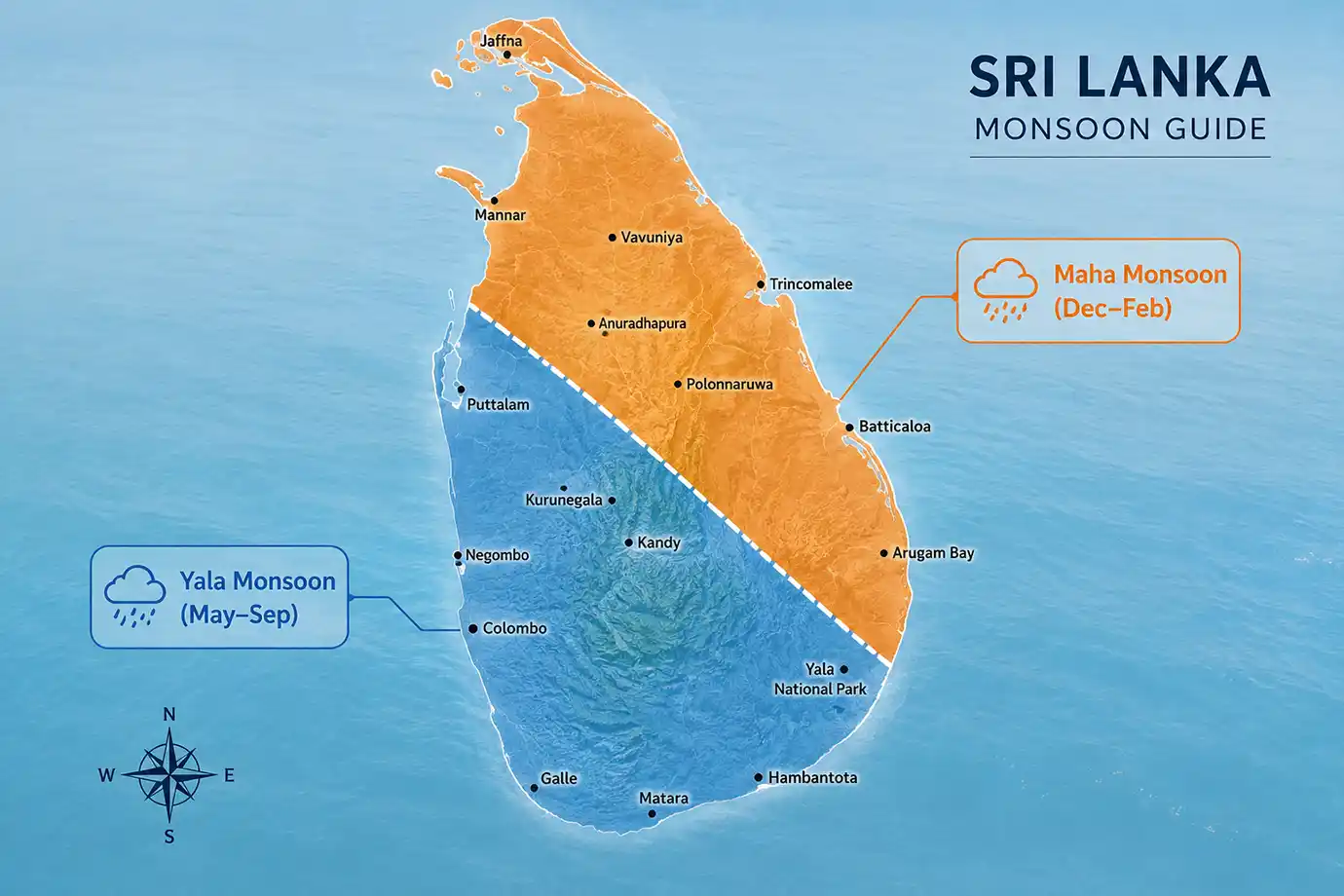
Understanding Sri Lanka’s Monsoon Seasons
Sri Lanka has two monsoons, not one. Each affects a different part of the island at a different time. Understanding the pattern is the single most useful thing you can learn before booking flights.
Southwest Monsoon (Yala)
The southwest monsoon usually runs from May to September. It brings rain, clouds, and rougher seas to the south and west coasts and the western slopes of the hill country.
Colombo, Galle, Bentota, Mirissa, and Weligama all sit in the path of the Yala monsoon. During these months, the East Coast is usually the better bet for beaches.
Rain does not fall all day. Monsoon often means a heavy afternoon downpour followed by clearing skies, or a stretch of cloud and humidity with dry spells between. A well-timed route can still work. Mornings are often the best hours, so plan outdoor sightseeing early and keep afternoons flexible.
Northeast Monsoon (Maha)
The northeast monsoon usually runs from December to February. It brings rain to the north, the east coast, and parts of the northern hill slopes.
Trincomalee, Pasikudah, Batticaloa, and Jaffna are most affected. During these months, the south and west coasts are usually at their best, which is why December to March is the classic season.
First Inter-Monsoon (March to April)
The gap between the two monsoons brings warm, humid conditions across much of the island. Afternoon or evening thunderstorms are possible, but mornings are often clear. March is one of the best months overall. April gets hotter in the lowlands and can coincide with the Sinhala and Tamil New Year holiday, shifting domestic travel patterns.
Second Inter-Monsoon (October to November)
The second inter-monsoon is the least predictable window. Rain can hit both coasts, and heavy downpours are more common island-wide. October is often the wettest single month. November usually improves, especially later in the month as the south coast begins to dry out.
Does Rain Ruin a Sri Lanka Trip?
No. Rain in Sri Lanka is rarely a full-day washout. A typical monsoon day brings a heavy shower in the afternoon, warm sunshine in the morning, and a dramatic sky at sunset. The tea country looks its greenest after rain, and the crowds thin out.
The real concern is sea conditions, not rainfall. Rough seas can cancel whale-watching boats, make swimming dangerous, and close dive sites. Sea state matters more than sky state for coastal plans.
A flexible route, a quality hotel with a good wet-weather setting, and realistic expectations make rain months entirely workable. Some travelers prefer the monsoon months for the quieter roads, the greener hills, and the dramatic afternoon skies that clear to golden sunsets. A rigid beach-only plan in the wrong season does not.
Best Time to Visit Sri Lanka Month by Month
| Month | Best For | Rain Risk | Crowd Level |
|---|---|---|---|
| January | South coast, culture, hill country | Low to medium | High |
| February | Classic route, honeymoon, wildlife | Low | High |
| March | Culture, beaches, hill country | Low to medium | Medium-high |
| April | Culture, beach, festivals | Medium | Medium |
| May | East coast, cultural sites | Medium-high | Low-medium |
| June | East coast, fewer crowds | Medium | Low |
| July | East coast, elephants, families | Medium | Medium |
| August | East coast, Kandy festival | Medium | Medium-high |
| September | East coast, value travel | Medium | Low-medium |
| October | Flexible travel only | High | Low |
| November | Shoulder season | Medium-high | Low-medium |
| December | South coast, honeymoon, luxury | Low-medium | High |
Sri Lanka in January
January is one of the safest times to take a classic Sri Lanka route. Adam’s Peak pilgrimage season is underway, and the trail of headlamps up the mountain at night makes for one of the island’s most memorable scenes. The south and west coasts are dry and warm, Galle Fort glows in the afternoon light, and the hill country around Ella and Kandy is at its clearest.
Expect peak-season hotel prices and busy attractions. Sigiriya and the Cultural Triangle work well, and wildlife parks are in strong form. The East Coast can still be wet from the tail of the northeast monsoon.
Honeymooners, families, first-time visitors, and luxury travelers all find January a strong and reliable choice.
Sri Lanka in February
February is one of the best overall months for a first visit. The weather is dry across most of the classic route, from Colombo to Sigiriya, Kandy, Ella, and Galle. Whale watching from Mirissa is in season, and Yala’s dry months are underway.
Demand is high, so book hotels early. February is also a strong month for Yala leopard drives, as dry conditions concentrate animals at the waterholes. Photographers get clean light and green tea hills, and the warm evenings suit slow dinners on the Galle ramparts.
Good for: Everyone. February is the closest Sri Lanka gets to a “best for all” month.
Sri Lanka in March
March offers excellent conditions across popular regions, with slightly fewer crowds than in January and February. The south coast is warm and dry, the Cultural Triangle is hot but manageable with early starts, and the hill country is clear.
Heat builds in the lowlands through the month: Plan Sigiriya and Polonnaruwa for the first hours of the day. March is also one of the strongest months for whale watching off Mirissa and for Yala leopard drives.
Culture lovers, beach seekers, wildlife watchers, photographers, and couples all get excellent conditions in March.
Sri Lanka in April
April is hot in the lowlands and warm in the hills. The Sinhala and Tamil New Year falls around April 13 to 14, and domestic travel surges for a week. Hotels in popular areas can fill early, and some services slow down during the holiday.
Afternoon thunderstorms start to build as the first inter-monsoon approaches. Mornings are usually still dry and bright. Beach trips to the south coast can work, but the shoulder is turning.
April rewards travelers who handle heat well and want fewer international crowds at the major sites.
Sri Lanka in May
May marks the start of the southwest monsoon. The south and west coasts become less reliable, with rain, cloud, and rougher seas. Colombo gets wetter, and Mirissa whale-watching boats wrap up their season.
The East Coast wakes up. Trincomalee and Pasikudah start to turn dry and calm, and Arugam Bay begins its surf season. The Cultural Triangle still works with an umbrella and early starts. Hotel prices drop in many areas.
The month suits east coast beach plans, budget-conscious travelers, and surfers heading to Arugam Bay.
Sri Lanka in June
June is a strong East Coast month. Trincomalee’s waters turn turquoise, Pasikudah’s long shallow bay is warm and calm, and Arugam Bay’s point break builds. The south and west coasts sit under the monsoon, with wet days and rough seas.
The Cultural Triangle, Kandy, and Ella can still work, though rain is possible in the hills. Crowds are low, and hotels that charge premium rates in February offer better value now.
Couples who want quiet beaches and flexible cultural days find June a rewarding, uncrowded window.
Sri Lanka in July
July is one of the best months for an East Coast route. Combine Trincomalee or Pasikudah with the Cultural Triangle and a stop in Kandy for a strong 10-day plan.
The elephant gathering at Minneriya or Kaudulla starts to build as the dry-zone tanks shrink. Families traveling during school holidays find good options on the East Coast and in the Cultural Triangle. The south coast remains less predictable.
Good for: Families, East Coast beach lovers, elephant safari, and surfers.
Sri Lanka in August
August stays strong on the East Coast and adds a cultural highlight: the Kandy Esala Perahera, a festival of drumming, dancers, and decorated elephants that fills the city for ten nights. Dates shift with the lunar calendar, so check the year’s schedule early.
Hotel demand in Kandy spikes during the festival, and the east coast stays busy with summer travelers. The elephant gathering near Minneriya or Kaudulla can be at its strongest now.
Good for: Festival lovers, families, East Coast beach, elephant safari, and photographers.
Sri Lanka in September
September is an underrated month. The East Coast still holds good weather, crowds drop after the summer holidays, and hotel prices soften. Arugam Bay can still deliver waves, and Trincomalee stays calm.
The season starts to turn later in the month as the second inter-monsoon approaches. Flexible travelers who book the right route get strong value and quiet beaches.
Value seekers, late-season East Coast planners, and flexible couples get the best of September.
Sri Lanka in October
October is often the trickiest month. The second inter-monsoon can bring heavy, widespread rain to both coasts. Fixed beach plans are risky, and outdoor activities may face interruptions.
Traveling in October is not impossible, but the route must stay flexible. Choose quality hotels with good indoor settings, keep the itinerary loose, and accept that some days will be wet. Rates can be low, and the island feels genuinely quiet.
Good for: Flexible travelers with realistic expectations, wellness retreats, and cultural stays.
Sri Lanka in November
November is a transition month. Early November can still feel like the inter-monsoon, with scattered rain and unpredictable days. Late November usually improves, especially on the south and west coasts, as the new dry season begins to settle in.
Travelers who arrive in the second half of November often find improving weather, low crowds, and shoulder-season rates before the December rush starts. A wellness retreat or a slow cultural route suits the mood.
Shoulder-season value hunters and wellness travelers do well in November, especially in the second half.
Sri Lanka in December
December opens the prime season on the south and west coasts. Galle, Mirissa, Weligama, and Bentota are warm and dry, and the hill country looks its best. Whale watching off Mirissa starts up again, and Yala and Wilpattu enter good form.
Christmas and New Year push hotel prices to their highest point. Book months ahead for top properties. The east coast can be wet due to the northeast monsoon, so classic routes stay on the west and south sides of the island.
Good for: Honeymooners, luxury travelers, families, festive-season visitors.

Best Time to Visit Sri Lanka by Region
Colombo and Negombo
Colomboserves as a year-round hub for arrivals and departures. The most comfortable months are December to March, when heat and humidity ease slightly. May to September brings more rain and stickier air, but a day or two in the city still works in any month.
Galle and the South Coast
December to April. Galle Fort, Mirissa, Weligama, Tangalle, Hiriketiya, and Unawatuna all peak in these months. The monsoon season from May to September brings rougher seas and wetter days, though slow-travel stays in a heritage hotel can still work.
Mirissa, Weligama, and Whale Watching
Whale-watching boats from Mirissa run roughly from December to April, when the seas are calmest and blue whales pass through the deep water offshore. Weligama’s surf suits beginners well. From May to September, the coast turns rougher, and the whales shift to the east coast off Trincomalee.
Trincomalee and the East Coast
May to September. The East Coast is a mirror image of the South. When Mirissa is wet, Trincomalee is dry. Pasikudah, Nilaveli, and Arugam Bay all peak in these months, with calm seas, warm water, and far fewer crowds.
Kandy, Ella, and Hill Country
January to April is the most reliable stretch, but the hills receive rain at any time. Pack a light rain layer and keep mornings free for the scenic train and for Horton Plains, where mist rolls in by mid-morning. The hill country is cooler than the coast, so a light jacket earns its place in the bag.
Sigiriya and the Cultural Triangle
The Cultural Triangle operates year-round. Sigiriya, Dambulla, Anuradhapura, and Polonnaruwa sit in the dry zone, where rainfall is lower than on either coast. The dry zone stays warm, and rain is less common than on the coast. March and April can be very hot, so start at Sigiriya, Dambulla, Anuradhapura, and Polonnaruwa early in the day. Combine the Cultural Triangle with the south coast from December to April, or with the east coast from May to September.
Yala, Wilpattu, and Safari Parks
Safari seasons vary by park. Yala’s dry season runs roughly from February to July, when receding water concentrates leopards, elephants, and sloth bears around the remaining pools. Wilpattu follows a similar window, with the best tracking conditions in the driest months. The Minneriya elephant gathering peaks from August to September as the tanks shrink. Udawalawe offers year-round elephant viewing, with herds drawn to the reservoir’s edges.

Best Time to Visit Sri Lanka by Travel Style
- Beach holidays: Relax on the south and west coasts from December to April, or switch to east coast bays from May to September.
- Cultural tours: Explore Sigiriya, Kandy, and ancient ruins from December to March, or during the late-summer festival window from July to September.
- Wildlife safaris: Track leopards and bears in Yala or Wilpattu from February to July, or witness the elephant gathering at Minneriya from August to September.
- Honeymoons: Secure premium beach and hill-country stays from December to March, and pair your trip with an overwater villa extension in the Maldives.
- Surfing: Ride the point breaks at Arugam Bay from May to September, or learn on the beginner-friendly beach breaks at Weligama from November to April.
- Ayurveda and wellness: Book a retreat year-round. Monsoon months bring rain on the roof, green surroundings, and lower rates.
- Family holidays in January, July, August, and December align with most school holiday calendars and offer reliable conditions on the right coast.
- Photography: February and March give the cleanest light. August adds the Kandy Perahera and the elephant gathering. Monsoon months bring dramatic skies.
Best Time for a Sri Lanka Honeymoon
December to March is the strongest honeymoon window. The south coast is warm, Galle is romantic, the tea country is green and cool, and a Maldives extension adds a beach finish. An East Coast honeymoon works from June to September for couples who prefer a quieter, less-developed coastline.
Best Time for Beaches
South and west coast beaches run from December to April. East coast beaches run from May to September. October and November are the weakest months for beach plans on either coast.
| Season | Best Coast | Plan Carefully |
|---|---|---|
| December to April | South and west coast | The East Coast may be wet |
| May to September | East coast | The South and West Coast may be wet |
| October to November | Flexible route | Fixed beach plans are risky |
Best Time for Wildlife
Yala’s dry season (roughly February to July) concentrates animals around waterholes and makes leopard sightings more likely. The Minneriya gathering peaks from August to September. Whale watching off Mirissa runs from December to April, then shifts to Trincomalee from roughly May to September. Udawalawe offers elephant viewing year-round.
Best Time for Surfing
Arugam Bay on the east coast runs from May to September, with the strongest swells around June to August. Weligama and the south coast suit beginners from November to April. Hikkaduwa also catches good waves in the south-coast season.
Best Time for Ayurveda and Wellness
Ayurveda retreats work year-round. A week of doctor-led treatments, yoga, and quiet does not need perfect beach weather. Monsoon months can actually be ideal for a retreat, with rain on the roof, green surroundings, and lower rates. Choose the retreat location based on your travel month.
Best Time for Family Travel
January, July, August, and December line up with most school holiday calendars. January and December suit the south coast. July and August suit the East Coast and the Cultural Triangle. Book early during holiday windows, because family-friendly hotels fill fast.
Best Time for Photography
February and March give the cleanest light and the widest range of open routes. August adds the Kandy Perahera festival and the elephant gathering. Monsoon months bring dramatic skies, mist in the tea country, and lush green, which suit photographers who want mood over clarity.
Best and Worst Months to Visit Sri Lanka
| Category | Months |
|---|---|
| Best for first-time visitors | February, March |
| Cheapest months | May, June, September, October |
| Busiest months | December, January, February, August |
| Rainiest / riskiest | October, early November |
| Most underrated | June, September, late November |
Best Months for First-Time Visitors
February and March. Both months deliver dry weather across the most popular route (Colombo, Sigiriya, Kandy, Ella, Galle, south coast) without the peak-holiday prices of December and January.
Cheapest Months
May, June, September, and October offer the lowest hotel rates in many regions. Weather can be more unpredictable, but travelers who design a route around the right coast can save significantly.
Most Underrated Months
June and September both deliver strong East Coast conditions with low crowds and good hotel rates. Late November often catches the first days of the new south coast season before the December rush, making it a smart window for travelers who want quality without the peak-season premium.
Suggested Sri Lanka Itineraries by Season
December to March: Classic Route
Colombo to Sigiriya to Kandy to Ella to Yala to Galle to Mirissa to Colombo. The full loop covers culture, hill country, safari, heritage, and beach in 10 to 14 days. Add a Maldives extension at the end for a 12- to 16-day twin-center trip that finishes with reef, sand, and stillness.
May to September: East Coast Route
Colombo to Sigiriya to Kandy to Trincomalee or Pasikudah, with an optional Arugam Bay extension. Culture, hill country, and east coast beach in 10 to 12 days.
April: Shoulder Season Route
Colombo to Sigiriya (early start) to Kandy to Ella to Galle. Avoid heavy midday sightseeing in the lowlands. Mornings are still dry and bright.
October to November: Flexible Route
A cultural route through the Cultural Triangle and Kandy, paired with a wellness retreat in the hills or on the coast. Keep the itinerary loose, skip a fixed beach plan, and let the weather guide the pace. A wellness retreat in the hills or an Ayurveda program on the coast suits the quieter mood of these months.
Practical Tips for Planning Around Sri Lanka’s Weather
Pack for Heat, Rain, and Temples
Bring light cotton clothing, a good rain jacket, sun protection, comfortable walking shoes, and a set of temple-appropriate clothes that cover shoulders and knees. A light layer for the hill country saves you on cool train rides and misty mornings at Horton Plains.
Book Early for Peak Season Hotels in Galle, Mirissa, Ella, and Yala for December to March, months in advance. Luxury properties and small boutique hotels sell out first. The Kandy Perahera in August also spikes local demand.
Keep Flexible Plans in Monsoon Months
A monsoon-season trip works well when the route aligns with the right coast, and the itinerary has breathing room. Avoid cramming six destinations into seven days during a wetter month. Two nights in each place beats a one-night sprint. A slower pace also means the occasional rainy afternoon becomes a rest day rather than a ruined plan.
Choose the Right Coast
The single most important planning decision is coast. South and west from December to April. East from May to September. October and November need a flexible inland or wellness route rather than a fixed beach commitment.
Check Local Festival Dates
Poya (full-moon) days are public holidays in Sri Lanka, and alcohol sales may stop at hotels and restaurants. The Sinhala and Tamil New Year in April and the Kandy Perahera in July or August shift domestic travel patterns and hotel availability. Check the dates for your year before you book.
Frequently Asked Questions About the Best Time to Visit Sri Lanka
What is the best month to visit Sri Lanka?
February and March are the best overall months for first-time visitors. The weather is usually dry across the classic route through Colombo, Sigiriya, Kandy, Ella, and Galle.
What is the rainy season in Sri Lanka?
Sri Lanka has two rainy seasons. The southwest monsoon runs roughly from May to September and affects the south and west coasts. The northeast monsoon runs roughly from December to February and affects the north and east. October and November can bring wider inter-monsoon rain.
Is Sri Lanka good to visit year-round?
Yes. Sri Lanka operates year-round when the route aligns with the season. The south and west coasts peak from December to April—the East Coast peaks from May to September. Cultural sites and hill country work across most months.
What is the best time to visit Sri Lanka’s beaches?
The best beaches on the south and west coasts are from December to April. East coast beaches are best from May to September. October and November are the weakest months for beach plans on either coast.
What is the best time for a Sri Lanka honeymoon?
December to March is the strongest honeymoon window for classic routes along the south coast, through tea country, and to Galle. Add a Maldives extension to complete the twin-center.
Is October a good time to visit Sri Lanka?
October is often the wettest and least predictable month. Traveling is possible, but the itinerary must stay flexible, and a fixed beach-only plan is risky.
Is July a good time to visit Sri Lanka?
Yes, if the route focuses on the East Coast, the Cultural Triangle, and selected wildlife parks. July is less reliable for a south coast beach holiday.
When is the best time for whale watching in Sri Lanka?
Mirissa whale watching runs roughly from December to April, when the seas are calm and blue whales pass offshore. Trincomalee offers east coast whale watching from roughly May to September. Sea conditions should always be checked locally.
When is the best time for a wildlife safari in Sri Lanka?
Safari timing depends on the park. Yala’s dry season runs roughly from February to July. The Minneriya elephant gathering peaks around August to September. Udawalawe offers elephants year-round. Wildlife sightings are never guaranteed.
When is the best time to visit Ella and Nuwara Eliya?
January to April is the most reliable window for travel in the hill country. Rain can fall at any time in the hills, so pack a light jacket and keep mornings free for the scenic train.
Which is better, Sri Lanka in December or August?
December is better for the South and West Coast. August is better for the East Coast, the Kandy Perahera, and the elephant gathering. Each month offers a strong trip when the route matches the coast.
How many days are enough for Sri Lanka?
Seven days cover a short highlights loop. Ten to twelve days gives a better balance of culture, hill country, and coast. Fourteen days allows a full island circuit or a Sri Lanka and Maldives combination.
What should I pack for the Sri Lankan weather?
Pack light cotton clothing, sun protection, a compact rain jacket, temple-appropriate clothes that cover shoulders and knees, comfortable walking shoes, swimwear, insect repellent, and a light layer for the hill country.
Plan Your Sri Lanka Trip With Local Experts
Sri Lanka is accessible year-round when the weather matches the route. Tell us your travel month, your preferred coast, your trip style, and how many days you have. A Sri Lanka specialist will design a private itinerary with the right balance of culture, beaches, wildlife, wellness, and comfort for the season you choose. Every route is built around the weather, the parks, and the coast that works best for your dates.
Email: sales@peregrinetreks.com
WhatsApp: +977 985 105 2413
About the Author
Written by the Peregrine Treks and Tours travel team, with direct experience planning and running private Sri Lanka, Nepal, Bhutan, Tibet, and Maldives tours for international travelers. Weather and season notes reflect years of on-the-ground route planning, not a single source.
*Fact-checked and operationally verified by the Peregrine Editorial Team, June 2026.*
*Weather patterns can shift from year to year, and no two monsoon seasons behave identically. Festival dates change with the lunar calendar. Always check current conditions and local advice before finalizing travel plans.*