


Armenia’s monasteries are not museum pieces, and the five best monasteries in Armenia are still very much alive. Priests still conduct daily services at Echmiadzin. Pilgrims descend metal ladders into the dungeon pit at Khor Virap. Monks still live on the peninsula at Sevanavank. These five sites span fourteen centuries of Armenian Christian history and two UNESCO World Heritage Sites. One holds a Guinness World Record. All five deliver some of the most dramatic views in the South Caucasus.
1. Among all the monasteries in Armenia, Echmiadzin Cathedral stands as the spiritual heart.
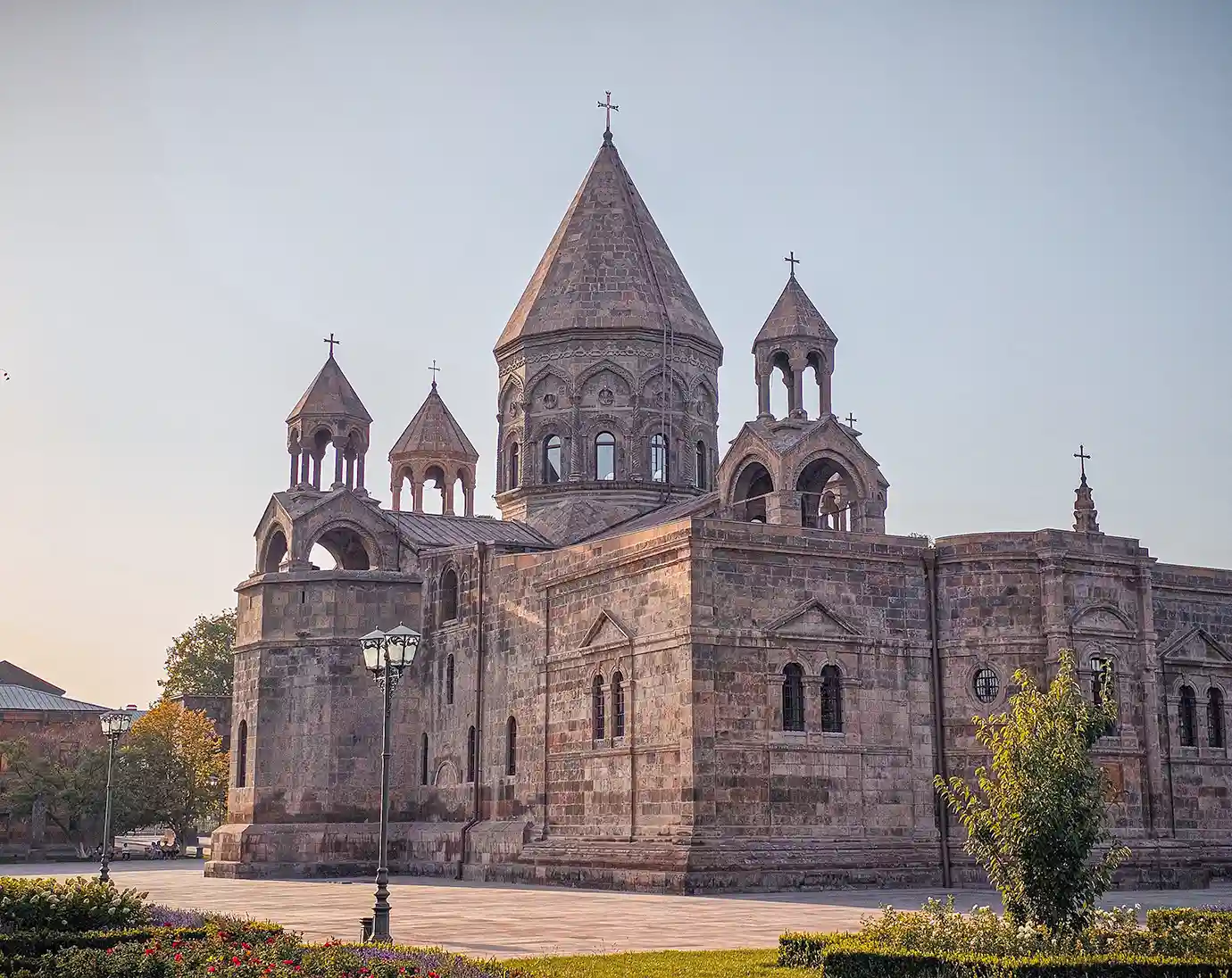
Echmiadzin Cathedral is the Vatican of the Armenian Apostolic Church. King Tiridates III and Saint Gregory the Illuminator built it between 301 and 303 AD. It is among the oldest state-built Christian churches in the world. Armenia adopted Christianity as its state religion in 301 AD — the first nation on earth to do so.
What Makes Echmiadzin Cathedral Significant?
Echmiadzin Cathedral sits in the city of Vagharshapat, 20 km west of Yerevan. The name Echmiadzin means “Descent of the Only Begotten” in Armenian. It refers to a vision Saint Gregory the Illuminator had of Christ descending to mark the building site. The UNESCO World Heritage inscription covers the cathedral and three nearby 7th-century churches: Saint Hripsime, Saint Gayane, and Saint Shoghakat. All four are within walking distance of each other.
The interior holds a Treasury that you must not skip. Three extraordinary relics are kept here: the Lance of Longinus, a fragment of Noah’s Ark, and the right hand of Gregory the Illuminator. The Lance is said to have pierced Christ at the Crucifixion. The Treasury requires a separate ticket.
Practical Information for Visiting Echmiadzin
The cathedral is an active house of worship, not a museum. Sunday morning liturgy runs from approximately 10:00. Visiting during a service is permitted, but move quietly and dress modestly: shoulders and knees covered; women, cover your hair.
Beneath the main cathedral floor, excavated ruins of a pre-Christian temple survive. Look through a floor panel at the original pagan foundations. Photography is permitted throughout, with no flash inside.
Vagharshapat is 20 to 25 minutes by car from central Yerevan.
2. Geghard Monastery: Carved Into the Mountain Itself
Geghard Monastery is a UNESCO World Heritage Site. Medieval builders ran out of ground-level space and carved two of their main halls directly into the surrounding cliff face. Stand inside the Kathoghike (built 1215) and hear your voice echo off stone that has never been touched by weather. No photograph quite captures it.
What to Expect Inside Geghard
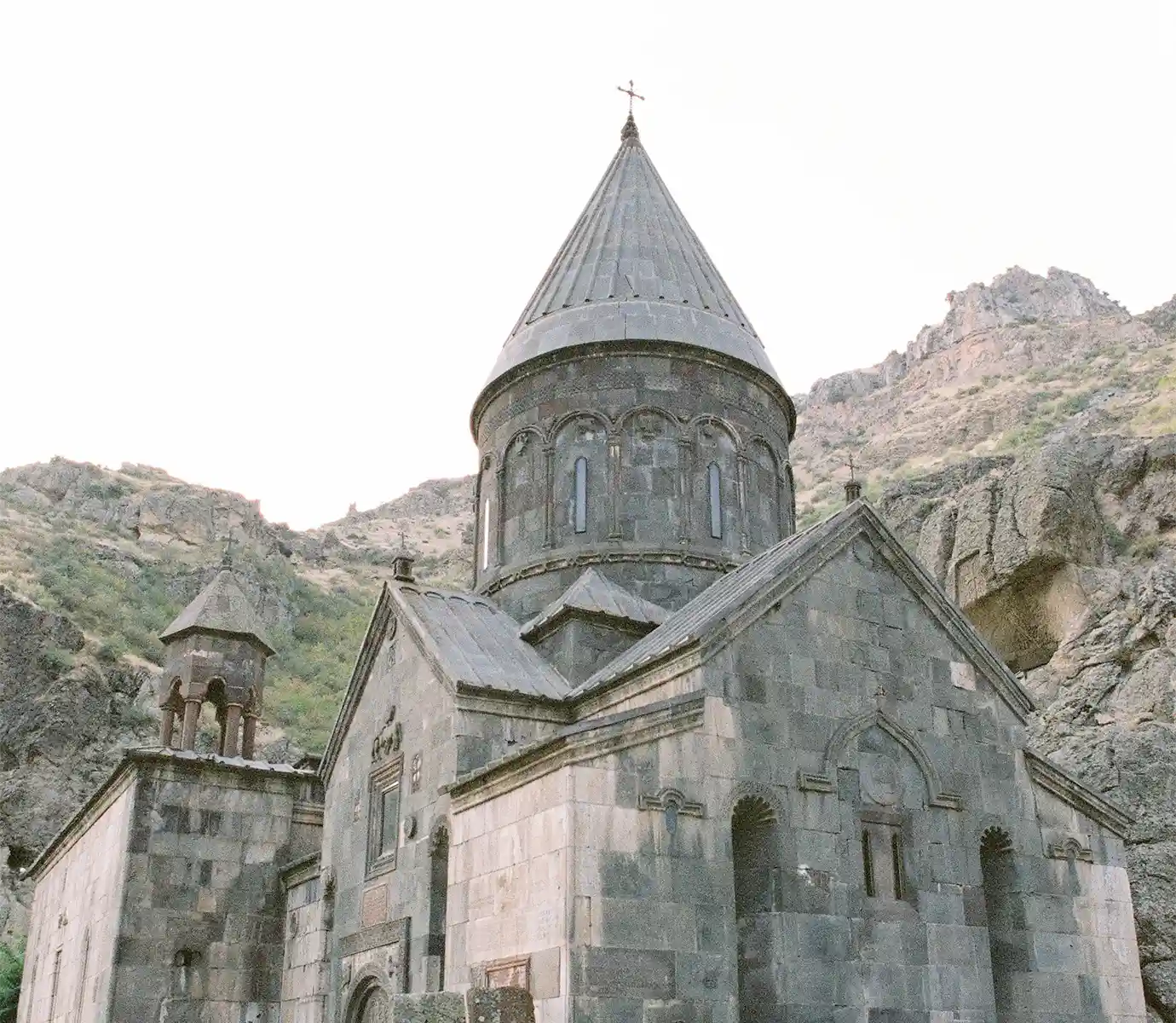
The monastery complex sits in the Azat River gorge, 40 km east of Yerevan. Founded in the 4th century and expanded through the 13th century, the complex earned its name from the relic it once held. Geghard means “spear” in Armenian. The lance said to have pierced Christ at the Crucifixion was kept here before being moved to Echmiadzin.
The main cathedral is a 13th-century stone structure with a precisely carved gavit (anteroom) covered in decorative stone-lattice ceiling work. Walk through the gavit into the main church, then continue into the first cave hall. The second, deeper cave hall is darker and more atmospheric — allow your eyes 30 seconds to adjust before moving through the low doorway.
Listen for Armenian polyphonic chanting. Local choirs sometimes perform inside the cave chambers on weekends and religious holidays. The acoustics concentrate and amplify sound in ways that feel architectural rather than incidental.
Practical Tips for Geghard
Geghard is at the end of a dead-end valley with no through road. If you are not on a private travel, arrange a return taxi in advance or risk a long wait. Head scarves are available at the gate for women at no charge.
Combine Geghard with Garni Temple on the same day. Garni sits 10 km west of Geghard and 30 km from Yerevan. Visiting both in sequence is the standard day trip from the capital. The full circuit, including the Symphony of Stones gorge below Garni, takes about six hours comfortably.
3. Khor Virap: The Dungeon Where Armenian Christianity Began
Khor Virap is the site where King Tiridates III imprisoned Saint Gregory the Illuminator in an underground pit for 13 years. Gregory’s survival and his conversion of the king in 301 AD led to Armenia becoming the first nation in the world to adopt Christianity as a state religion. The dungeon still exists, and you can climb down into it.
In the late 3rd century, King Tiridates III threw Saint Gregory the Illuminator into a deep pit at this site and left him to die. Khor Virap is the monastery built over that dungeon. The name Khor Virap means “deep pit” in Armenian.
The Pit Beneath the Altar
The dungeon entrance is through a narrow opening to the right of the chapel altar. A 27-rung metal ladder leads down into the original stone chamber — approximately 6 meters deep and 4 meters wide. The ceiling is low. Bring a light.
Armenian pilgrims descend year-round, often barefoot, touching the stone walls as an act of devotion. If you plan to go down, wear shoes with a good grip. The ladder is narrow enough that only one person can move up or down at a time.
Khor Virap and Mount Ararat
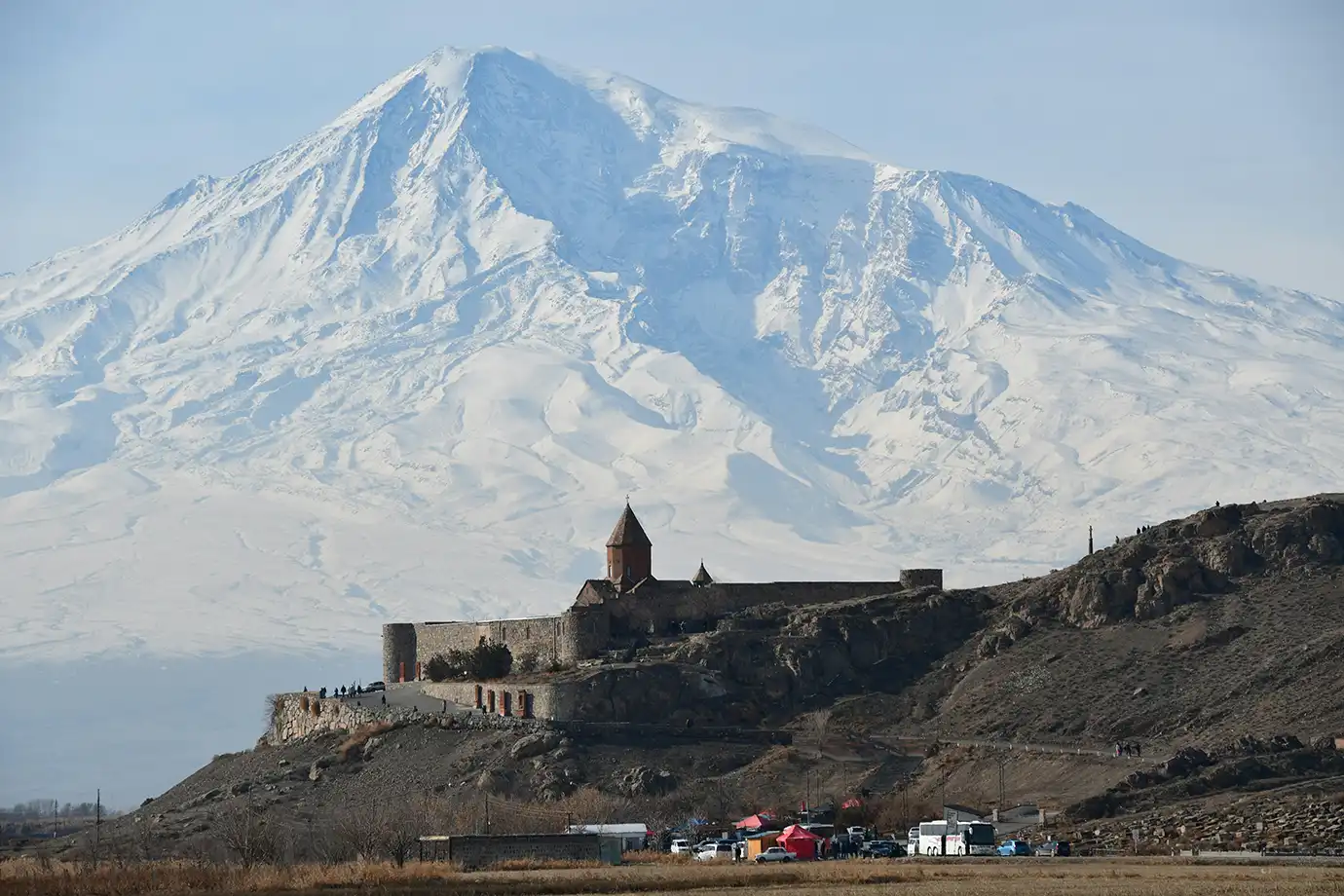
Khor Virap sits on a hilltop in the Ararat plain, approximately 40 km south of Yerevan. Mount Ararat appears on Armenia’s coat of arms and is the country’s most potent national symbol. It rises directly behind the monastery walls, less than 30 km away in a straight line.
Ararat is not always visible. Afternoon haze, summer dust, and occasional cloud cover obscure it. Early morning gives the clearest sightlines, particularly in spring (April to June) and autumn (September to October). If the mountain is out when you arrive, stop. Do not rush.
The monastery complex was originally established in 642 AD. The current buildings date primarily to the 17th century.
4. Tatev Monastery: Cliff’s Edge in the Deep South
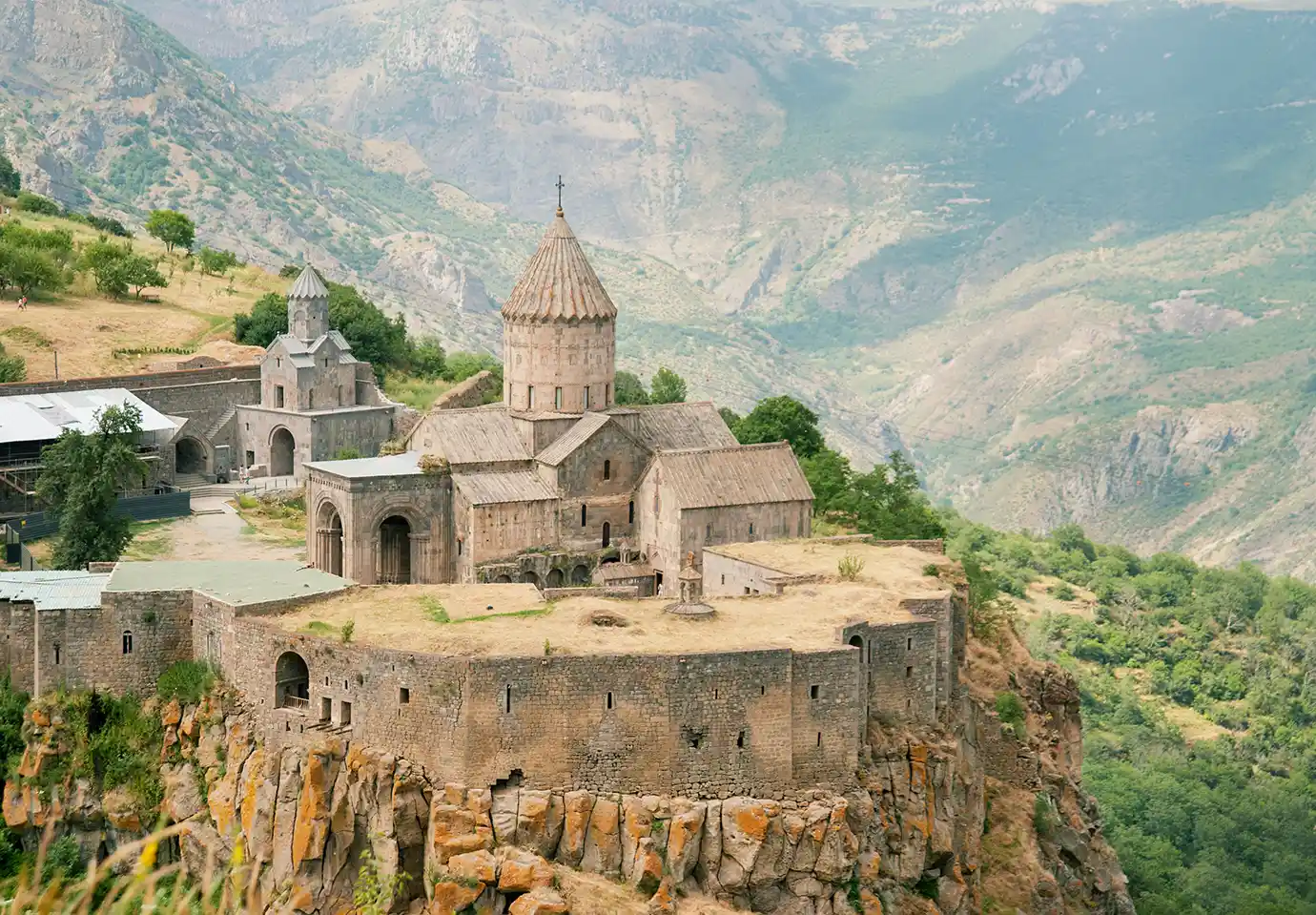
Tatev Monastery is a 9th-century fortress-monastery perched on a basalt plateau above the Vorotan Gorge. The Wings of Tatev aerial tramway carries you across the gorge in 12 minutes, floating 320 meters above the Vorotan River. At 5.752 km, it holds the Guinness World Record for the longest non-stop reversible aerial tramway.
Tatev sits roughly 250 km from Yerevan, a five-hour drive through some of the most dramatic terrain in the South Caucasus. Plan it as an overnight or two.
The Wings of Tatev Tramway
The tramway runs from the village of Halidzor to the monastery. Opened in October 2010, it was built by the Austrian-Swiss engineering firm Doppelmayr/Garaventa and completed in just ten months. The two cabins carry 25 passengers each and operate at 37 km/h.
The cabin crosses three support towers. Between the second and third towers, the gorge drops away beneath you. No ground is visible — just cliff, forest, and the white thread of the river far below. The monastery appears ahead in the last two minutes of the ride.
Tip: book the morning departure. The gorge fills with haze later in the day, and early light on the canyon walls is significantly better for photography.
What to See at Tatev Monastery
Tatev was founded in the 9th century and grew into the most powerful monastic center in medieval Armenia. At its peak, the complex housed a university and a scriptorium — a room for copying manuscripts.
The main cathedral, the Church of Saints Paul and Peter (895 AD), anchors the complex. One free-standing khachkar inside the complex sits on a movable base. It sways during earthquakes and returns to vertical on its own. Local tradition holds that this was an early seismic warning device.
Walk to the western cliff edge. The gorge drops hundreds of meters directly below your feet. The view north into the canyon is one of the starkest in Armenia.
Getting to Tatev from Yerevan
The drive south from Yerevan passes through Goris (approximately 5 hours, 250 km), a pleasant mountain town and a logical overnight base. Goris has good guesthouses and is within 20 km of the village of Tatev.
The Wings of Tatev starts from Halidzor, 15 km west of Goris. Reach Halidzor by taxi or car from Goris. An alternative mountain road also connects Halidzor to Tatev directly — drivable in summer, impassable in winter snow. The tramway runs year-round, weather permitting.
5. Sevanavank: The Monastery That Used to Be an Island
Sevanavank Monastery stands on a rocky peninsula above Lake Sevan — the largest lake in the Caucasus, sitting at 1,900 meters above sea level. When Princess Mariam commissioned the two surviving churches in 874 AD, the monastery stood on an island. Soviet-era water diversion schemes lowered the lake by roughly 20 meters over the 20th century, gradually connecting the island to the shore.
You now walk up a paved path to reach it. The panorama from the monastery forecourt has not changed. The water runs every shade of blue depending on season and cloud cover.
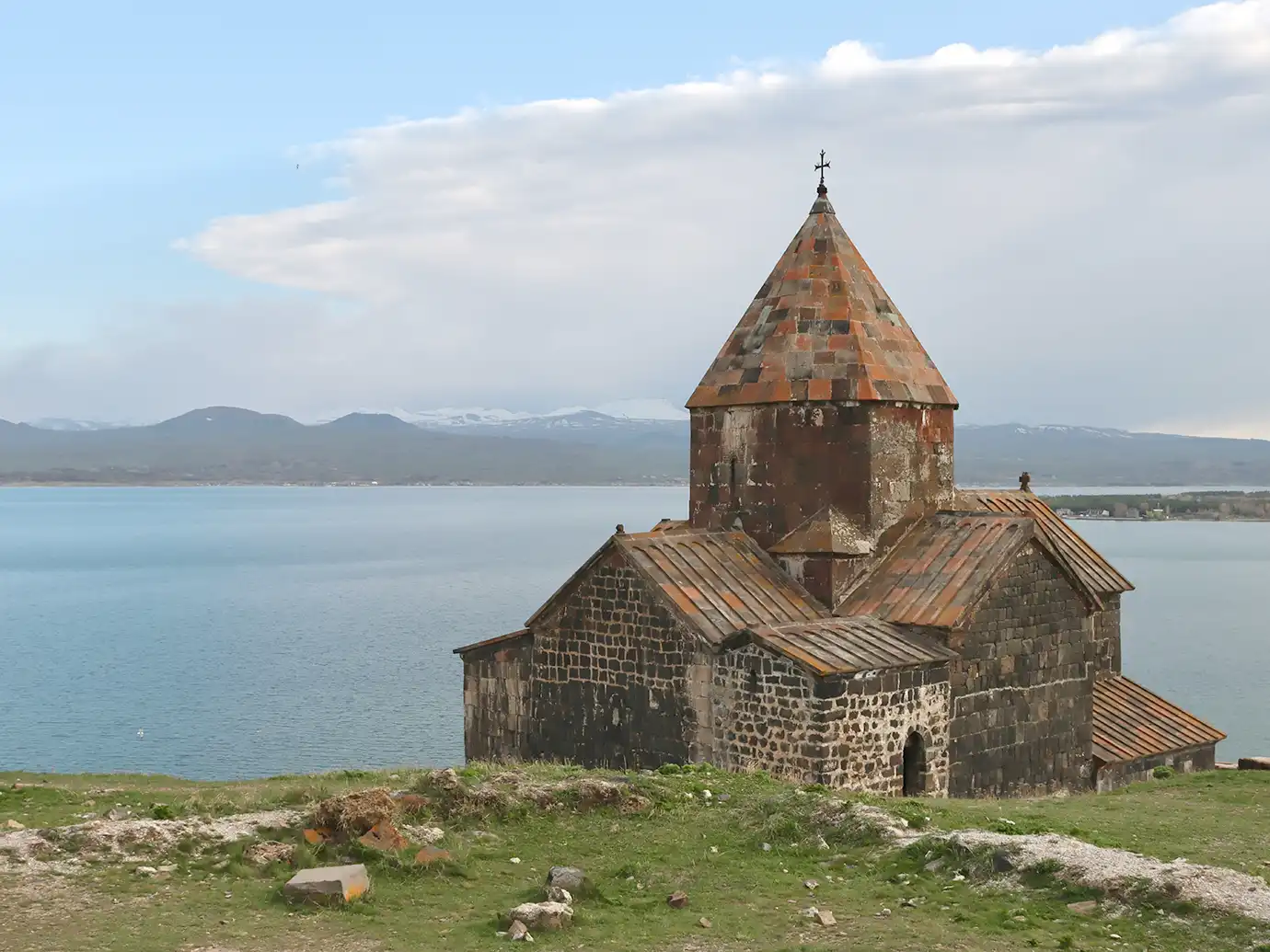
The Two Churches of Sevanavank
The Church of Saint Arakelots (Holy Apostles) and the Church of Saint Astvatsatsin (Holy Mother of God) both date to 874 AD. Both are built from black tuff, the volcanic stone that gives Armenian church architecture its distinctive dark and solid character. The interior of Saint Arakelots holds a large 17th-century khachkar depicting the Crucifixion. The 874 construction inscription is still visible on the outer eastern wall. Look for it at eye level, to the right of the doorway.
Sevanavank is still an active monastery. Monks live here and adhere to the same strict behavioral expectations as any active Armenian Apostolic site: modest dress, quiet movement, and no flash photography inside.
Sevanavank and Lake Sevan Together
Lake Sevan is 65 km northeast of Yerevan, about one hour by car. Combine Sevanavank with lunch at a fish restaurant on the shore. The lake produces iskhan (Sevan trout) and crayfish. It makes a full-day trip from the capital.
The best time to visit is late May through early October. The lake is swimmable from July to early September when water temperature climbs to 18°C to 22°C. The monastery can be visited in any season.
When to Visit Armenia’s Monasteries
The monasteries in Armenia are open year-round, but May, June, September, and October give the best conditions across all five sites. Temperatures in Yerevan stay between 18°C and 28°C. Ararat is clearest in spring and early autumn before summer haze builds.
| Monastery | From Yerevan | Difficulty | Best Combined With |
|---|---|---|---|
| Echmiadzin Cathedral | 20 km / 25 min | Easy walk | Zvartnots Cathedral ruins |
| Geghard Monastery | 40 km / 45 min | Easy walk, some steps | Garni Temple (10 km west) |
| Khor Virap | ~40 km / 50 min | Easy, ladder optional | Wine route at Areni village |
| Tatev Monastery | ~250 km / 5 hrs | Moderate (tramway) | Overnight in Goris |
| Sevanavank | 65 km / 1 hr | Easy walk | Swim at Lake Sevan |
All five sites require modest dress. Women bring a scarf to cover their hair. Both men and women cover their knees and shoulders. Active liturgy takes place regularly at Echmiadzin, Sevanavank, and Khor Virap — time your visits accordingly if you want quiet.
Frequently Asked Questions
Is Geghard Monastery a UNESCO World Heritage Site?
Yes. Geghard Monastery and the Upper Azat Valley were inscribed as a UNESCO World Heritage Site in 2000. The inscription recognizes the monastery’s rock-cut architecture as an outstanding example of medieval Armenian church design. Echmiadzin Cathedral and the three adjacent churches, along with the Zvartnots Cathedral archaeological site, are listed separately as a single UNESCO inscription from the same year.
How long does it take to visit Khor Virap?
Plan one to two hours at Khor Virap. Thirty minutes covers the exterior, the main chapel, and the view of Mount Ararat from the perimeter walls. Add another 20 minutes if you descend into the pit dungeon, which involves a 27-rung metal ladder and a narrow chamber. The monastery is approximately 40 km from Yerevan. Combine it with the Areni wine region and Noravank Gorge for a full southern day trip.
Do you need a guide for the Wings of Tatev tramway?
No. The Wings of Tatev tramway is independently accessible. Buy your ticket at the Halidzor terminal. The 12-minute ride drops you off directly at the Tatev Monastery gate, and the monastery grounds are accessible on foot without assistance. A local guide adds historical depth — particularly for the manuscript room and the earthquake-warning khachkar — but is not required. Bring water and a light jacket regardless of the season. The plateau at Tatev is exposed.
Can you combine Echmiadzin and Khor Virap in one day?
Yes, but plan carefully. Echmiadzin is 20 km west of Yerevan, and Khor Virap is approximately 40 km south — they sit in opposite directions from the capital. A full loop covering both, with the Zvartnots Cathedral ruins between them (12 km east of Echmiadzin), makes a long but achievable day trip. Leave Yerevan by 09:00 and return by 17:00. A private car is strongly recommended. Public transport does not connect the sites directly.
What is the best monastery in Armenia for photography?
Khor Virap offers the most dramatic subject for photography: the monastery silhouetted against the mass of Mount Ararat. The best light and clearest view of Ararat occur at sunrise from April to early June. Geghard’s cave churches offer strong interior light through the oculus (ceiling openings) in the carved chambers. Tatev provides aerial perspectives from the gorge-edge platform. Sevanavank photographs best mid-morning before the afternoon glare rises off the lake.
Email: sales@peregrinetreks.com
WhatsApp: +977 985 105 2413
Web: peregrinetreks.com