

Based on 13 reviews

Luxury Everest Three Passes Trek
The Complete 20-Day Khumbu Circuit

Duration
20 Days

Meals
- 18 Breakfast
- 15 Lunch
- 17 Dinner

Accommodation
- 5-Star Hotel
- Yeti Mountain Home
- The Himalayan Luxury Lodge

Activities
- Trekking
- Sightseeing
SAVE
US$ 1100Price Starts From
US$ 5500
Overview of Luxury Everest Three Passes Trek
The Luxury Everest Three Passes Trek is the most complete circuit of the Khumbu region in Nepal. In 20 days, you cross Renjo La (5,360m), Cho La (5,368m), and Kongma La (5,535m), visit the Five Gokyo Lakes, reach Everest Base Camp, and summit Kala Patthar at 5,545m. The Luxury Three Passes Trek Nepal includes Hotel Everest View overnight, YMH lodges, The Himalayan Tyangboche onsen spa, Khangri Resort Chukhung, and Bhojan Griha farewell dinner.
Few Khumbu trekking routes combine all three high passes, the Gokyo Lakes, Everest Base Camp, Kala Patthar, and the Chukhung Valley in one complete circuit. Peregrine Treks & Tours designs and runs this route from Kathmandu with a licensed senior Sirdar (Guide), verified safety equipment, and a daily altitude log from Day 5 onward.
Scroll left or right to view the full quick facts table.
The 19-Night Accommodation Spectrum
Luxury on the Khumbu operates on a spectrum. No luxury-branded property operates above Gokyo until Khangri Resort at Chukhung (4,730m). At extreme altitude, the premium is expert guide care, quality food, and verified safety equipment. Every night is listed honestly below.
Scroll left or right to view the full accommodation table.
Accommodation Note: Premium lodges in the Everest region have limited rooms and remain subject to availability. In remote, high-altitude places such as Lungden, Thangnak, Dzongla, Lobuche, and Gorak Shep, there are no full-service hotels. We use the best available lodges and focus on safety, warmth, meals, guide care, and route management.
Who Should Book This Trek
The Luxury Everest Three Passes Trek suits trekkers who have completed a major Himalayan route and want the most complete Khumbu experience in one 20-day circuit.
Best fit: You have trekked to EBC or Gokyo and want all three passes. You accept that lodges above Gokyo are basic and that the real premium at extreme altitude is expert guide care, daily SpO2 monitoring, and verified safety gear.
Consider Luxury EBC + Gokyo instead: You prefer an 18-day option with lower difficulty. You skip the Chukhung Valley and Kongma La crossing. The EBC + Gokyo route starts from USD 4,200.
Not recommended for: First-time high-altitude trekkers. Anyone without prior experience above 4,000m. Anyone who cannot complete 7–9 hours of walking on consecutive days at an altitude.
Guests aged 50–75 complete this route regularly with a private guide. Strong fitness and honest preparation matter more than age.
Detail Itinerary of Luxury Everest Three Passes Trek
Day 1 — Kathmandu Arrival — 1,400m
Elevation: 1,400m / 4,593ft
Accommodation: Radisson Hotel Kathmandu
Meals: Welcome dinner
Activity Level: Easy
Main Activity: Airport pickup, hotel transfer, trek briefing
Arrive at Tribhuvan International Airport in Kathmandu. A Peregrine Treks and Tours representative welcomes you outside the arrival terminal and transfers you to the Radisson Hotel Kathmandu in a private vehicle.
After hotel check-in, take time to rest and recover from your flight. In the evening, meet your trekking guide for a detailed briefing about the Luxury Everest Three Passes Trek. Your guide explains the route, daily walking plan, high-pass safety rules, Lukla flight process, accommodation plan, packing needs, and emergency support.
Enjoy a welcome dinner with the Peregrine team. This gives you time to ask final questions before the trek begins.
Route Highlights:
- Private airport pickup
- Premium hotel stay in Kathmandu
- Trek briefing with a guide
- Welcome dinner
- Final preparation for the Everest region
Preparation Note: Keep your passport, travel insurance copy, and trekking documents ready for permit checks and flight arrangements.
Comfort Note: Radisson Hotel Kathmandu offers a comfortable city stay before you travel to the high-altitude Everest region.
Guide Tip: Sleep early tonight. The next day includes sightseeing, gear checks, and final preparation for the Lukla flight.
Elevation: 1400m
Accommodation: Radisson Hotel Kathmandu (5-star)
Meal: Welcome dinner
Day 2 — Kathmandu Valley Sightseeing — 1,400m
Elevation: 1,400m / 4,593ft
Accommodation: Radisson Hotel Kathmandu
Meals: Breakfast
Activity Level: Easy
Main Activity: Cultural sightseeing, gear check, permit confirmation
After breakfast, start a guided sightseeing tour in Kathmandu. Visit the selected cultural and religious sites according to the final schedule. This day helps you understand Nepal’s heritage before heading into the Sherpa homeland of the Everest region.
After sightseeing, return to the hotel to prepare for the trek. Your guide checks your clothing, boots, daypack, sleeping bag, gloves, jacket, water bottle, medicine, and other key gear. If anything is missing, you can buy or rent it in Kathmandu.
The team also confirms permits, Lukla flight details, porter arrangements, luggage weight, and the next morning’s departure time.
Route Highlights:
- Guided Kathmandu sightseeing
- Cultural introduction to Nepal
- Final trekking gear check
- Permit and flight confirmation
- Briefing for Lukla and Phakding
Preparation Note: Pack your main trekking gear in a duffel bag. Keep your passport, valuables, medicine, warm layer, water bottle, and camera in your daypack.
Comfort Note: This day keeps the pace relaxed, so you can prepare well before the mountain section starts.
Guide Tip: Do not pack too much. Bring the right gear, but keep your luggage within the porter’s weight limit.
Elevation: 1400m
Accommodation: Radisson Hotel Kathmandu
Meal: None
Day 3 — Fly to Lukla — Trek to Phakding — 2,652m
Elevation: Kathmandu 1,400m / Lukla 2,860m / Phakding 2,610m
Walking Time: 3–4 hours
Distance: Around 7–8 km
Accommodation: Yeti Mountain Home Phakding or similar
Meals: Breakfast, lunch, and dinner
Difficulty: Easy to moderate
Main Activity: Kathmandu to Lukla flight and first trekking day
Start early and transfer to the airport for the flight to Lukla. We always recommend a direct flight from Kathmandu to Lukla for this luxury trek because it saves time, reduces stress, and avoids the long drive to Ramechhap Airport.
During peak trekking seasons, some Lukla flights may operate from Ramechhap Airport in Manthali instead of Kathmandu. This can require a 5 to 6-hour drive, often starting around 1:00 AM. Even after reaching Ramechhap, flights can still face delays due to weather, air traffic, or mountain visibility.
To protect your comfort and time, Peregrine Treks and Tours offers a fair helicopter upgrade policy. If a direct Kathmandu to Lukla fixed-wing flight is not available, we recommend upgrading to a helicopter flight when weather and aviation conditions allow.
The additional helicopter upgrade costs USD 350 per person, in addition to the regular flight cost. Peregrine covers 50% of this extra cost, and the trekker covers the remaining 50%. This means the trekker pays only USD 175 per person as the helicopter upgrade supplement.
After landing in Lukla, meet the porter team and begin the trek. The trail descends gradually from Lukla and follows the Dudh Koshi Valley through Sherpa villages, prayer walls, forest sections, and suspension bridges.
Reach Phakding and check in at the lodge. This first trekking day stays short, which helps your body adjust before the climb to Namche Bazaar.
Route Highlights:
- Direct Kathmandu to Lukla flight preferred
- Helicopter upgrade option if a direct fixed-wing flight is not available
- Fair 50/50 helicopter upgrade cost-sharing policy
- First walk in the Everest region
- Sherpa villages and prayer walls
- Dudh Koshi River valley
- Comfortable overnight stay in Phakding
Flight Note: Lukla flights depend on weather, visibility, air traffic, and aviation rules. A helicopter upgrade also depends on safe flying conditions and aircraft availability.
Helicopter Upgrade Note: If the extra helicopter cost is USD 350 per person, Peregrine pays USD 175, and the trekker pays USD 175. This policy helps avoid the long Ramechhap drive when a direct Kathmandu-Lukla fixed-wing flight is unavailable.
Terrain Note: The trail includes gentle descents, stone paths, village trails, and short uphill sections.
Altitude Note: Lukla sits higher than Kathmandu, but you sleep lower in Phakding. Walk slowly and drink enough water from the first trekking day.
Comfort Note: Phakding offers one of the better lodge experiences on the lower Everest trail. Premium lodge rooms depend on availability.
Guide Tip: Keep a light jacket, water, sunglasses, sunscreen, and rain cover in your daypack. Mountain weather can change quickly.
Elevation: 2652m
Accommodation: YMH Phakding
Meal: Breakfast, Lunch, and Dinner
Day 4 — Phakding to Namche Bazaar — 3,440m
Elevation: Phakding 2,610m / Namche Bazaar 3,440m
Walking Time: 5–6 hours
Distance: Around 10–11 km
Accommodation: Yeti Mountain Home Namche or similar
Meals: Breakfast, lunch, and dinner
Difficulty: Moderate
Main Activity: Trek from Phakding to Namche Bazaar
After breakfast in Phakding, start trekking along the Dudh Koshi River. The trail passes pine forests, small Sherpa villages, prayer wheels, mani walls, and suspension bridges.
You enter Sagarmatha National Park and continue toward Namche Bazaar. The final section includes a long uphill climb. On a clear day, you may get your first distant view of Mount Everest before reaching Namche.
Namche Bazaar is the main trading center of the Khumbu region. It has lodges, bakeries, gear shops, cafés, and mountain views. After check-in, rest and let your body adjust to the higher altitude.
Route Highlights:
- Dudh Koshi River valley
- Suspension bridges
- Sagarmatha National Park entry
- First possible Everest view
- Arrival at Namche Bazaar
Terrain Note: The trail includes river crossings, forest paths, stone steps, and a steady uphill climb before Namche.
Altitude Note: This day features a significant elevation gain. Walk slowly, drink enough water, and tell your guide if you feel a headache, nausea, dizziness, or unusual tiredness.
Comfort Note: Namche offers one of the better lodge experiences in the Everest region. Premium lodge accommodation depends on availability.
Guide Tip: Do not rush the final uphill section. A slow pace helps your body adjust better before the high-altitude days ahead.
Elevation: 3440m
Accommodation: YMH Namche
Meal: Breakfast, Lunch, and Dinner
Day 5 — Acclimatization — Hotel Everest View — 3,880m
Elevation: Namche Bazaar 3,440m / Hotel Everest View area around 3,880m
Walking Time: 3–4 hours
Distance: Around 4–6 km, depending on the acclimatization route
Accommodation: Hotel Everest View or similar
Meals: Breakfast, lunch, and dinner
Difficulty: Moderate
Main Activity: Acclimatization hike and mountain-view stay
Today supports acclimatization before you continue toward the higher valleys. After breakfast, hike from Namche toward the Hotel Everest View area. The trail climbs gradually above Namche and opens to wide views of the mountains.
On a clear day, you can see Everest, Lhotse, Ama Dablam, Thamserku, Kangtega, and other Khumbu peaks. This hike follows the “climb high, sleep lower or steady” acclimatization principle and helps your body adjust to altitude.
After reaching the Hotel Everest View area, enjoy the mountain setting and rest. This day gives you time to slow down, take photos, and prepare for the quieter route toward Thame and Renjo La.
Route Highlights:
- Acclimatization hike above Namche
- Everest, Lhotse, and Ama Dablam views
- Hotel Everest View experience
- Sherpa village scenery
- Better preparation for higher altitude
Terrain Note: The route includes uphill walking, open ridgeline sections, and gradual trails above Namche.
Altitude Note: You sleep higher than Namche tonight, so move slowly and avoid overexertion. Tell your guide early if you feel any altitude symptoms.
Comfort Note: Hotel Everest View offers one of the most special mountain hotel experiences in the Everest region. Rooms are limited and subject to confirmation.
Guide Tip: Keep warm layers, sunglasses, sunscreen, water, and a windproof jacket in your daypack. The weather can change quickly above Namche.
Elevation: 3880m
Accommodation: Hotel Everest View, Syangboche
Meal: Breakfast, Lunch, and Dinner
Day 6 — Namche to Thame — 3,820m
Elevation: Hotel Everest View area around 3,880m / Thame around 3,800m
Walking Time: 4–5 hours
Distance: Around 8–10 km
Accommodation: Yeti Mountain Home, Thame, or the best available lodge
Meals: Breakfast, lunch, and dinner
Difficulty: Moderate
Main Activity: Trek from the Namche/Syangboche area to Thame
After breakfast, leave the busy main Everest Base Camp trail and head toward the quieter western Khumbu valley. The trail descends toward Namche and then continues to Thame, a peaceful Sherpa village with a strong cultural and mountaineering history.
This section feels calmer than the main EBC trail. You walk through traditional settlements, stone-walled fields, prayer flags, and open mountain landscapes. Thame also works as an important staging point before the route continues toward Lungden and Renjo La Pass.
After reaching Thame, check in at the lodge and rest. The day gives your body more time to adapt before the trek climbs above 4,000 meters.
Route Highlights:
- Quieter western Khumbu trail
- Traditional Sherpa villages
- Mountain valley scenery
- Thame village
- Preparation for Lungden and Renjo La Pass
Terrain Note: The trail includes gentle descents, gradual climbs, village paths, and open valley sections.
Altitude Note: This day helps with gradual acclimatization. Even if the walking feels easier, keep a slow pace and stay hydrated.
Comfort Note: Yeti Mountain Home Thame is subject to availability. If unavailable, we use the best available lodge in Thame.
Guide Tip: Use this evening to organize your gear for the next stage. The route becomes more remote after Thame, and lodge facilities become more basic toward Lungden and Gokyo.
Elevation: 3820m
Accommodation: YMH Thame (subject to confirmation) or best premium lodge
Meal: Breakfast, Lunch, and Dinner
Day 7 — Thame to Lungden — 4,380m
Elevation: Thame around 3,800m / Lungden 4,380m
Walking Time: 5–6 hours
Distance: Around 8–10 km
Accommodation: Renjo Pass Lodge or the best available lodge
Meals: Breakfast, lunch, and dinner
Difficulty: Challenging
Main Activity: Trek from Thame to Lungden
After breakfast, leave Thame and continue deeper into the quiet western Khumbu Valley. The trail follows a remote route with fewer trekkers, wide mountain landscapes, and traditional Sherpa settlements.
As you gain altitude, the vegetation becomes thinner, and the air feels colder. The route passes small villages, yak grazing areas, stone walls, and open alpine terrain before reaching Lungden. This village works as the main overnight stop before crossing Renjo La Pass.
After arrival, rest at the lodge and prepare for the next day’s pass crossing. Your guide checks the weather, trail condition, group pace, and your physical condition before confirming the Renjo La plan.
Route Highlights:
- Quiet trail beyond Thame
- Remote western Khumbu scenery
- Yak pastures and alpine terrain
- Gradual climb toward Lungden
- Preparation for Renjo La Pass
Terrain Note: The trail includes gradual climbs, rocky sections, open valley paths, and colder high-altitude terrain.
Altitude Note: Lungden sits above 4,000 meters. Walk slowly, drink enough water, and report any headache, nausea, dizziness, or unusual tiredness to your guide.
Comfort Note: Accommodation in Lungden is more basic than in Namche or Hotel Everest View. We use the best available lodge, subject to confirmed availability.
Guide Tip: Pack your daypack before dinner. Keep warm gloves, sunglasses, snacks, water, a headlamp, and a windproof jacket ready for the early Renjo La crossing.
Elevation: 43799m
Accommodation: Renjo Pass Lodge or similar
Meal: Breakfast, Lunch, and Dinner
Day 8 — Lungden — Renjo La (5,360m) — Gokyo — 4,790m
Elevation: Lungden 4,380m / Renjo La Pass around 5,360m / Gokyo 4,790m
Walking Time: 7–8 hours
Distance: Around 11–12 km
Accommodation: Himalayan Chain Lodge or the best available lodge
Meals: Breakfast, lunch, and dinner
Difficulty: Strenuous
Main Activity: Cross Renjo La Pass and descend to Gokyo
Start early from Lungden and climb toward Renjo La Pass, the first major high pass of the trek. The trail rises through remote alpine terrain, becoming steeper as you approach the pass.
From the top of Renjo La, enjoy one of the finest viewpoints in the Everest region. On a clear day, you can see Everest, Lhotse, Makalu, Cho Oyu, Gokyo Lakes, and the surrounding Himalayan range.
After crossing the pass, descend toward Gokyo. The descent can feel steep and tiring, especially when snow, ice, or strong wind affects the trail. Your guide manages the pace and chooses the safest route based on conditions.
Reach Gokyo and check in at the lodge near the lake.
Route Highlights:
- First major pass crossing
- Renjo La Pass views
- Everest, Cho Oyu, and Makalu scenery
- Gokyo Lakes panorama
- Descent to Gokyo village
Terrain Note: The route includes steep climbs, rocky trails, exposed high-altitude sections, and a long descent toward Gokyo.
Altitude Note: This is a long day above 5,000 meters. Move slowly, avoid rushing, and tell your guide if you feel any altitude symptoms.
Comfort Note: Gokyo has basic mountain lodges. We use the best available lodge based on season and room availability.
Guide Tip: Wear layered clothing from the start. Keep your down jacket, gloves, hat, sunglasses, sunscreen, water, and energy snacks in your daypack.
Elevation: 5360m
Accommodation: Himalayan Chain Lodge or similar
Meal: Breakfast, Lunch, and Dinner
Day 9 — Gokyo to Thangnak — 4,700m
Elevation: Gokyo 4,790m / Gokyo Ri around 5,357m / Thangnak around 4,700m
Walking Time: 5–6 hours
Distance: Around 7–9 km, including Gokyo Ri hike and trek to Thangnak
Accommodation: Hotel Khumbila or the best available lodge
Meals: Breakfast, lunch, and dinner
Difficulty: Challenging
Main Activity: Gokyo Ri viewpoint hike and trek toward Cho La Pass route
Start early for the hike to Gokyo Ri, one of the best viewpoints in the Everest region. The climb is steep, but the summit rewards you with wide views of Everest, Lhotse, Makalu, Cho Oyu, the Gokyo Lakes, and the Ngozumpa Glacier.
After enjoying the view, descend to Gokyo for breakfast and rest. Later, continue toward Thangnak. The route crosses the rough glacial landscape near the Ngozumpa Glacier and leads toward the base area for the next major pass, Cho La Pass.
Reach Thangnak and rest at the lodge. Your guide checks the weather, trail condition, and group readiness for the Cho La crossing the next day.
Route Highlights:
- Gokyo Ri sunrise hike
- Everest and Cho Oyu views
- Gokyo Lakes scenery
- Ngozumpa Glacier area
- Preparation for Cho La Pass
Terrain Note: The climb to Gokyo Ri is steep. The route to Thangnak includes rocky paths, glacier-side terrain, and uneven sections.
Altitude Note: This day includes a viewpoint above 5,000 meters. Walk slowly and descend if your guide advises it.
Comfort Note: Thangnak is a remote high-altitude stop. Lodge facilities are simple, but we choose the best available accommodation for the night.
Guide Tip: Keep your pass-crossing gear ready tonight. Cho La can involve cold wind, rocky trails, snow, or ice, depending on the season.
Elevation: 4700m
Accommodation: Hotel Khumbila or similar
Meal: Breakfast, Lunch, and Dinner
Day 10 — Thangnak — Cho La (5,368m) — Dzongla — 4,830m
Elevation: Thangnak around 4,700m / Cho La Pass around 5,420m / Dzongla around 4,830m
Walking Time: 7–8 hours
Distance: Around 8–10 km
Accommodation: Hotel Dzongla Inn or best available lodge
Meals: Breakfast, lunch, and dinner
Difficulty: Strenuous
Main Activity: Cross Cho La Pass and descend to Dzongla
Start before sunrise and leave Thangnak for Cho La Pass, the second major pass of the Luxury Everest Three Passes Trek. The trail climbs through rocky terrain and can include snow, ice, and loose sections, depending on the season.
The climb to Cho La demands focus and steady pacing. Your guide checks trail conditions and helps guide the group through steep, exposed sections. From the pass area, enjoy dramatic views of surrounding peaks, glaciers, and high Himalayan terrain.
After crossing Cho La, descend carefully toward Dzongla. The descent can feel tiring due to rough terrain, cold wind, and long hours at altitude. Reach Dzongla and rest at the lodge.
Route Highlights:
- Cho La Pass crossing
- High-altitude glacier terrain
- Rocky and remote trail sections
- Views of Cholatse, Lobuche peaks, and surrounding mountains
- Descent to Dzongla
Terrain Note: The route includes steep climbs, rocky sections, possible snow or ice, and a careful descent. Trail conditions change with the seasons and the weather.
Altitude Note: Cho La Pass sits above 5,000 meters. Walk slowly, follow your guide, and report headache, nausea, dizziness, or unusual tiredness early.
Comfort Note: Dzongla has basic mountain lodges. We use the best available accommodation, subject to confirmed availability.
Guide Tip: Use trekking poles and keep both hands free on rough sections. Carry warm gloves, sunglasses, water, snacks, and a windproof jacket in your daypack.
Elevation: 5368m
Accommodation: Hotel Dzongla Inn or similar
Meal: Breakfast, Lunch, and Dinner
Day 11 — Dzongla to Lobuche — 4,940m
Elevation: Dzongla around 4,830m / Lobuche around 4,940m
Walking Time: 3–4 hours
Distance: Around 6–7 km
Accommodation: New EBC Hotel or best available lodge
Meals: Breakfast, lunch, and dinner
Difficulty: Moderate
Main Activity: Trek from Dzongla to Lobuche
After the demanding Cho La crossing, today gives you a shorter walking day. Leave Dzongla and follow the trail toward Lobuche. The route offers clear views of high peaks, open valleys, and rugged Khumbu landscapes.
You gradually rejoin the main Everest Base Camp trail near Lobuche. This section helps your body recover before the long day to Everest Base Camp. After reaching Lobuche, check in at the lodge and rest.
Use the afternoon to hydrate, eat well, and prepare your daypack for the next day’s trek to Everest Base Camp and Gorak Shep.
Route Highlights:
- Shorter recovery trekking day
- Views of Lobuche East and surrounding peaks
- Return to the main Everest Base Camp trail
- High-altitude valley scenery
- Preparation for Everest Base Camp
Terrain Note: The trail features rocky sections, gradual climbs, and open, high-altitude terrain. It feels easier than the pass-crossing days but still requires steady pacing.
Altitude Note: Lobuche sits close to 5,000 meters. Rest well and avoid unnecessary walking after arrival.
Comfort Note: Lodges in Lobuche are more basic than those in lower Khumbu. Rooms may feel cold, and heating usually stays limited to the dining area.
Guide Tip: Prepare warm layers, water, snacks, sunglasses, sunscreen, and a headlamp for the day at Everest Base Camp.
Elevation: 4940m
Accommodation: New EBC Hotel or similar
Meal: Breakfast, Lunch, and Dinner
Day 12 — Lobuche — Gorakshep (5,170m) — EBC (5,364m) — Gorakshep
Elevation: Lobuche around 4,940m / Gorak Shep around 5,185m / Everest Base Camp 5,364m
Walking Time: 7–8 hours
Distance: Around 11–12 km
Accommodation: Himalayan Lodge or the best available lodge in Gorak Shep
Meals: Breakfast, lunch, and dinner
Difficulty: Strenuous
Main Activity: Trek to Everest Base Camp and return to Gorak Shep
Start early from Lobuche and follow the trail toward Gorak Shep. The route crosses rocky moraine terrain with views of Pumori, Nuptse, and the surrounding Khumbu peaks. After reaching Gorak Shep, take a short break before continuing toward Everest Base Camp.
The trail to Everest Base Camp follows the edge of the Khumbu Glacier. This section feels rugged and slow due to rocks, moraine, and the altitude. Reach Everest Base Camp at 5,364 meters and enjoy one of the most important moments of the trek.
From Base Camp, you can see the Khumbu Icefall and the expedition area during climbing season. Mount Everest itself stays partly hidden from Base Camp, but the setting remains powerful and memorable.
After spending time at Base Camp, return to Gorak Shep for the night.
Route Highlights:
- Trek to Gorak Shep
- Khumbu Glacier and moraine trail
- Everest Base Camp at 5,364m
- Khumbu Icefall view
- High Himalayan expedition atmosphere
Terrain Note: The trail includes rocky moraine, glacier-side paths, uneven ground, and slow high-altitude walking.
Altitude Note: This is one of the highest sleeping nights of the trek. Walk slowly, stay warm, and tell your guide immediately if you feel unwell.
Comfort Note: Gorak Shep has very basic lodges due to its remote location and high altitude. Rooms are simple, and nights can feel very cold.
Guide Tip: Keep your camera, warm jacket, gloves, hat, sunglasses, sunscreen, water, and snacks in your daypack. Do not stay too long at Base Camp if the weather turns cold or windy.
Elevation: 5364m
Accommodation: Himalayan Lodge or similar
Meal: Breakfast, Lunch, and Dinner
Day 13 — Kala Patthar (5,545m) — Lobuche — 4,940m
Elevation: Gorak Shep around 5,185m / Kala Patthar 5,545m / Lobuche around 4,940m
Walking Time: 6–7 hours
Distance: Around 8–10 km
Accommodation: New EBC Hotel or the best available lodge in Lobuche
Meals: Breakfast, lunch, and dinner
Difficulty: Strenuous
Main Activity: Kala Patthar viewpoint hike and descent to Lobuche
Start before sunrise for the hike to Kala Patthar, one of the best viewpoints in the Everest region. The trail climbs steeply above Gorak Shep, and the cold morning air makes this section challenging.
From the top of Kala Patthar, enjoy close views of Mount Everest, Nuptse, Lhotse, Pumori, and the surrounding Khumbu peaks. This viewpoint offers a much better view of Everest than the Everest Base Camp.
After the viewpoint hike, descend to Gorak Shep for breakfast. Then continue back toward Lobuche. The descent helps your body recover after sleeping at high altitude.
Route Highlights:
- Early morning hike to Kala Patthar
- Best close-up view of Mount Everest
- Sunrise views over the Khumbu region
- Pumori, Nuptse, Lhotse, and Everest panorama
- Descent from Gorak Shep to Lobuche
Terrain Note: The Kala Patthar trail is steep, cold, and rocky. The descent to Lobuche follows moraine and high-altitude trails.
Altitude Note: Kala Patthar reaches 5,545 meters. Move slowly, wear warm layers, and keep up with your guide’s pace.
Comfort Note: Lobuche has simple mountain lodges. We use the best available lodge, subject to confirmed availability.
Guide Tip: Keep your down jacket, warm gloves, hat, headlamp, sunglasses, water, and camera ready before going to bed. The morning start is very early and cold.
Elevation: 5545m
Accommodation: New EBC Hotel or similar
Meal: Breakfast, Lunch, and Dinner
Day 14 — Lobuche — Kongma La (5,535m) — Chukhung — 4,730m
Elevation: Lobuche around 4,940m / Kongma La Pass around 5,535m / Chukhung around 4,730m
Walking Time: 7–9 hours
Distance: Around 10–12 km
Accommodation: Khangri Resort or the best available lodge in Chukhung
Meals: Breakfast, lunch, and dinner
Difficulty: Very strenuous
Main Activity: Cross Kongma La Pass, the final high pass of the trek
Start early from Lobuche and head toward Kongma La Pass, the third and final major pass of the Luxury Everest Three Passes Trek. This is one of the toughest days on the route because of the altitude, rocky terrain, and long walking hours.
The trail crosses remote high-altitude landscapes with wide views of the Khumbu region. Your guide checks the weather, trail conditions, and group pace before and during the crossing.
After reaching Kongma La Pass, descend carefully toward Chukhung. The descent can feel long and tiring, especially after several days at high altitude. Reach Chukhung and rest at the lodge.
Route Highlights:
- Final pass crossing of the Three Passes route
- Kongma La Pass at around 5,535m
- Remote high-altitude scenery
- Wide views of the Khumbu mountains
- Descent to Chukhung Valley
Terrain Note: The route includes rocky trails, steep sections, exposed terrain, and a long descent. Snow or ice may affect the pass depending on the weather and season.
Altitude Note: This is a very demanding high-altitude day. Walk slowly, stay hydrated, and tell your guide if you feel weak, dizzy, nauseous, or unusually tired.
Comfort Note: Chukhung has better lodge options than some remote pass villages. Khangri Resort or the best available lodge will be used, subject to confirmation.
Guide Tip: Pack carefully the night before. Carry warm layers, windproof clothing, sunglasses, gloves, snacks, water, and trekking poles. Follow your guide’s instructions at every steep or exposed section.
Elevation: 5535m
Accommodation: Khangri Resort
Meal: Breakfast, Lunch, and Dinner
Day 15 — Chukhung to Tengboche — 3,867m
Elevation: Chukhung around 4,730m / Tengboche around 3,860m
Walking Time: 5–6 hours
Distance: Around 12–14 km
Accommodation: The Himalayan Tyangboche, or the best available lodge
Meals: Breakfast, lunch, and dinner
Difficulty: Moderate
Main Activity: Descend through the Imja Valley to Tengboche
After breakfast in Chukhung, begin descending through the Imja Valley. The trail passes alpine landscapes, stone-walled fields, Sherpa settlements, and open views of Ama Dablam and nearby peaks.
As you lose altitude, the air feels warmer, and walking becomes easier. Continue through Pangboche and Deboche before reaching Tengboche, one of the most important spiritual centers in the Everest region.
In Tengboche, visit Tengboche Monastery if time allows. The monastery sits in a scenic location with views of Everest, Ama Dablam, Lhotse, Nuptse, and surrounding peaks.
Route Highlights:
- Descent through the Imja Valley
- Views of Ama Dablam and the Everest region peaks
- Pangboche and Deboche villages
- Tengboche Monastery
- Return to more comfortable lower-altitude conditions
Terrain Note: The route includes gradual descents, village trails, forest sections, and some short uphill parts before Tengboche.
Altitude Note: This day descends to a lower sleeping altitude, which helps recovery after the three high passes and the Everest Base Camp section.
Comfort Note: The Himalayan Tyangboche offers one of the better lodge experiences in this area, subject to room availability. If unavailable, we use the best available lodge in Tengboche.
Guide Tip: This is a good day to recover your pace. Drink enough water, eat well, and enjoy the lower-altitude comfort after the hardest section of the trek.
Elevation: 3867m
Accommodation: The Himalayan Tyangboche
Meal: Breakfast, Lunch, and Dinner
Day 16 — Tengboche to Namche Bazaar — 3,440m
Elevation: Tengboche around 3,860m / Namche Bazaar 3,440m
Walking Time: 5–6 hours
Distance: Around 10–12 km
Accommodation: Yeti Mountain Home Namche or similar
Meals: Breakfast, lunch, and dinner
Difficulty: Moderate
Main Activity: Trek from Tengboche to Namche Bazaar
After breakfast in Tengboche, begin the descent through forest trails and Sherpa settlements. The route passes Deboche and continues toward the river valley before climbing and descending through familiar parts of the Everest trail.
As you return toward Namche Bazaar, the air feels warmer, and the walking becomes easier than the high-pass days. You may see Ama Dablam, Thamserku, Kangtega, Everest, and Lhotse from different viewpoints along the trail.
Reach Namche Bazaar and check in at the lodge. This is a good place to rest, enjoy better lodge comfort, visit cafés, or walk through the local market.
Route Highlights:
- Descent from Tengboche
- Forest trails and river valley views
- Sherpa villages and suspension bridges
- Return to Namche Bazaar
- Warmer lower-altitude comfort
Terrain Note: The route includes downhill sections, forest paths, stone steps, river crossings, and some short uphill climbs.
Altitude Note: You sleep lower tonight, which helps your body recover after the high-altitude section.
Comfort Note: Namche offers one of the best lodge experiences in the Everest region. Yeti Mountain Home Namche is subject to availability.
Guide Tip: Use this evening to rest, recharge devices, and organize your duffel bag for the final trekking day to Lukla.
Elevation: 3440m
Accommodation: YMH Namche
Meal: Breakfast, Lunch, and Dinner
Day 17 — Namche to Lukla — 2,860m
Elevation: Namche Bazaar 3,440m / Lukla 2,860m
Walking Time: 6–7 hours
Distance: Around 18–19 km
Accommodation: Yeti Mountain Home, Lukla, or similar
Meals: Breakfast, lunch, and dinner
Difficulty: Moderate
Main Activity: Final trekking day from Namche Bazaar to Lukla
After breakfast, leave Namche Bazaar and descend toward the Dudh Koshi River. The trail passes familiar suspension bridges, pine forests, prayer walls, and Sherpa villages.
Continue through Monjo, Benkar, Phakding, and other small settlements before climbing gradually toward Lukla. This is the final walking day of the Luxury Everest Three Passes Trek.
After reaching Lukla, check in at the lodge and rest. In the evening, you can thank your guide and porter team for their support during the trek.
Route Highlights:
- Final trekking day in the Everest region
- Dudh Koshi River valley
- Sherpa villages and prayer walls
- Return to Lukla
- End of the trekking route
Terrain Note: The trail includes long descents, river crossings, village paths, and a final gradual climb to Lukla.
Altitude Note: You continue descending, so most trekkers feel stronger today. Still, the long distance can make the day tiring.
Comfort Note: Lukla has better lodge options than many high-altitude villages. Premium lodge rooms depend on availability.
Guide Tip: Keep your flight documents, passport, and essential items easily accessible. Lukla flights often start early the next morning.
Elevation: 2860m
Accommodation: YMH Lukla
Meal: Breakfast, Lunch, and Dinner
Day 18 — Fly to Kathmandu — 1,400m
Elevation: Lukla 2,860m / Kathmandu 1,400m
Flight Time: Around 30–35 minutes by fixed-wing flight, subject to weather
Accommodation: Radisson Hotel Kathmandu
Meals: Breakfast
Difficulty: Easy
Main Activity: Fly from Lukla to Kathmandu and transfer to the hotel
After breakfast, transfer to Lukla Airport for the flight back to Kathmandu. The flight offers one final view of the Everest region before returning to the city.
We recommend a direct Lukla-Kathmandu flight for this luxury trek to avoid the long drive from Ramechhap to Kathmandu. During peak seasons, some flights may operate through Ramechhap Airport in Manthali. This option can require a 5 to 6-hour road transfer after the flight.
If a direct fixed-wing flight from Lukla to Kathmandu is unavailable, Peregrine Treks and Tours may recommend a helicopter upgrade when weather, aviation regulations, and aircraft availability allow. The additional helicopter upgrade costs USD 350 per person, in addition to the regular flight cost. Peregrine covers 50% of this extra cost, and the trekker pays the remaining 50%. This means the trekker pays USD 175 per person for the helicopter upgrade supplement.
After landing in Kathmandu, transfer to the Radisson Hotel. The rest of the day stays free for rest, laundry, spa, shopping, or a relaxed meal.
Route Highlights:
- Flight from Lukla to Kathmandu
- Possible direct flight or helicopter upgrade option
- Return to city comfort
- Rest at Radisson Hotel Kathmandu
- Free afternoon in Kathmandu
Flight Note: Lukla flights depend on weather, visibility, airport traffic, and aviation rules. Flight delays or route changes can happen, so a buffer day in Kathmandu remains important.
Helicopter Upgrade Note: The helicopter upgrade applies only when safe flying conditions and aircraft availability allow. Peregrine and the trekker share the additional cost equally.
Comfort Note: Radisson Hotel Kathmandu offers a comfortable recovery stay after the long Everest region trek.
Guide Tip: Do not book your international flight on the same day as your Lukla return flight. Keep at least one buffer day in Kathmandu.
Elevation: 1400m
Accommodation: Radisson Hotel Kathmandu (5-star)
Meal: Breakfast
Day 19 — Spare Day — Bhojan Griha Farewell Dinner — 1,400m
Elevation: Kathmandu 1,400m
Accommodation: Radisson Hotel Kathmandu
Meals: Breakfast and farewell dinner
Difficulty: Easy
Main Activity: Buffer day, rest, shopping, spa, or optional sightseeing
Today works as a buffer day in Kathmandu. This day helps protect your international flight schedule in case of Lukla flight delays, bad weather, or route changes.
If your flight from Lukla arrives on time, you can use this day for rest and recovery after the trek. You may enjoy spa time, laundry service, souvenir shopping, or a relaxed walk through Thamel. You can also join an optional sightseeing if you want to explore more of Kathmandu.
In the evening, join a farewell dinner with the Peregrine team. This is a good time to celebrate the successful completion of the Luxury Everest Three Passes Trek and share feedback with your guide.
Route Highlights:
- Buffer day after Lukla flight
- Rest and recovery in Kathmandu
- Optional shopping or spa
- Optional sightseeing
- Farewell dinner with the team
Flight Buffer Note: Keep this day free. Lukla flights may be delayed due to weather, visibility, or airport traffic.
Comfort Note: Radisson Hotel Kathmandu offers a comfortable place to rest after a high-altitude trek.
Guide Tip: Use this day to repack your luggage, check your international flight details, and keep enough time for airport transfer the next day.
Elevation: 1400m
Accommodation: Radisson Hotel Kathmandu
Meal: Breakfast + Bhojan Griha farewell dinner
Day 20 — Departure from Kathmandu
Elevation: Kathmandu 1,400m
Accommodation: Not included
Meals: Breakfast
Difficulty: Easy
Main Activity: Airport transfer and final departure
After breakfast, prepare for your final departure from Kathmandu. Our representative meets you at the hotel and transfers you to Tribhuvan International Airport in a private vehicle.
Please keep your passport, flight ticket, and valuables ready before leaving the hotel. We recommend arriving at the airport at least 3 hours before your international flight.
Your Luxury Everest Three Passes Trek ends after airport drop-off. You leave Nepal with memories of Renjo La Pass, Cho La Pass, Kongma La Pass, Gokyo Lakes, Everest Base Camp, Kala Patthar, Sherpa villages, and the high Himalayan landscape.
Route Highlights:
- Breakfast at Radisson Hotel
- Private airport transfer
- Final departure from Kathmandu
- End of the Luxury Everest Three Passes Trek
Departure Note: Confirm your luggage, passport, and flight time before leaving the hotel.
Comfort Note: Private transfer ensures a smooth airport departure.
Guide Tip: Allow extra time for Kathmandu traffic, especially during office hours, festivals, or road construction.
Meal: Breakfast
Customize this trip with help from our local travel specialist that matches your interests.
Includes & Excludes
What is included?
- Accommodation: Radisson KTM (Days 1–2 and 18–19); YMH Phakding, Namche (x2), Thame, Lukla; Hotel Everest View (Day 5); Khangri Resort Chukhung (Day 14); The Himalayan Tyangboche (Day 15); best available at Lungden, Gokyo, Thangnak, Dzongla, Lobuche, Gorakshep.
- Meals: full board all trekking days (Days 3–17); hotel breakfast Days 18–19; Bhojan Griha five-course farewell dinner Day 19.
- Flights: Kathmandu–Lukla domestic return (both ways); helicopter safety net if fixed-wing delays exceed 90 minutes.
- Transfers: all private vehicle transfers in Kathmandu; Ramechhap transfer arranged if flights operate from Manthali Airport.
- Sightseeing: private vehicle and art-historian guide for Day 2 UNESCO World Heritage Sites.
- Guide: licensed senior English-speaking Sirdar for all 20 days.
- Porter: 1 per 1 guests; maximum 15 kg personal gear; porter insurance and IPPG welfare compliance.
- Permits: Sagarmatha National Park Entry Permit; Khumbu Pasang Lhamu Rural Municipality permit; any TIMS/agency registration required under current Nepal Tourism Board rules. All arranged by Peregrine before the trek.
- Farewell dinner: Bhojan Griha five-course Newari set menu with live cultural dance performance from seven ethnic groups.
- Support: 24/7 WhatsApp concierge; all government taxes; altitude medication under guide advisement; completion certificate.
- Farewell archive: framed altitude graph; digital photo archive; Kongma La mani stone rubbing in lokta paper envelope.
What is excluded?
- International flights.
- Nepal visa fee.
- Travel insurance — mandatory (see Travel Insurance Requirements below).
- Meals on Days 1–2 and Day 18 beyond the listed breakfasts.
- Personal trekking gear.
- Hot showers at basic lodges above Namche — charged separately at each lodge.
- Alcoholic beverages and specialty drinks.
- Helicopter upgrade for non-emergency use — available as a paid addition.
- Entrance fees at Bhaktapur, Pashupatinath, and monastery sites.
- Tips — suggested: USD 450 (Guide) — 200 total (Porter).
- Weather delay costs beyond the Day 19 Kathmandu buffer.
We also operate Private Trips.
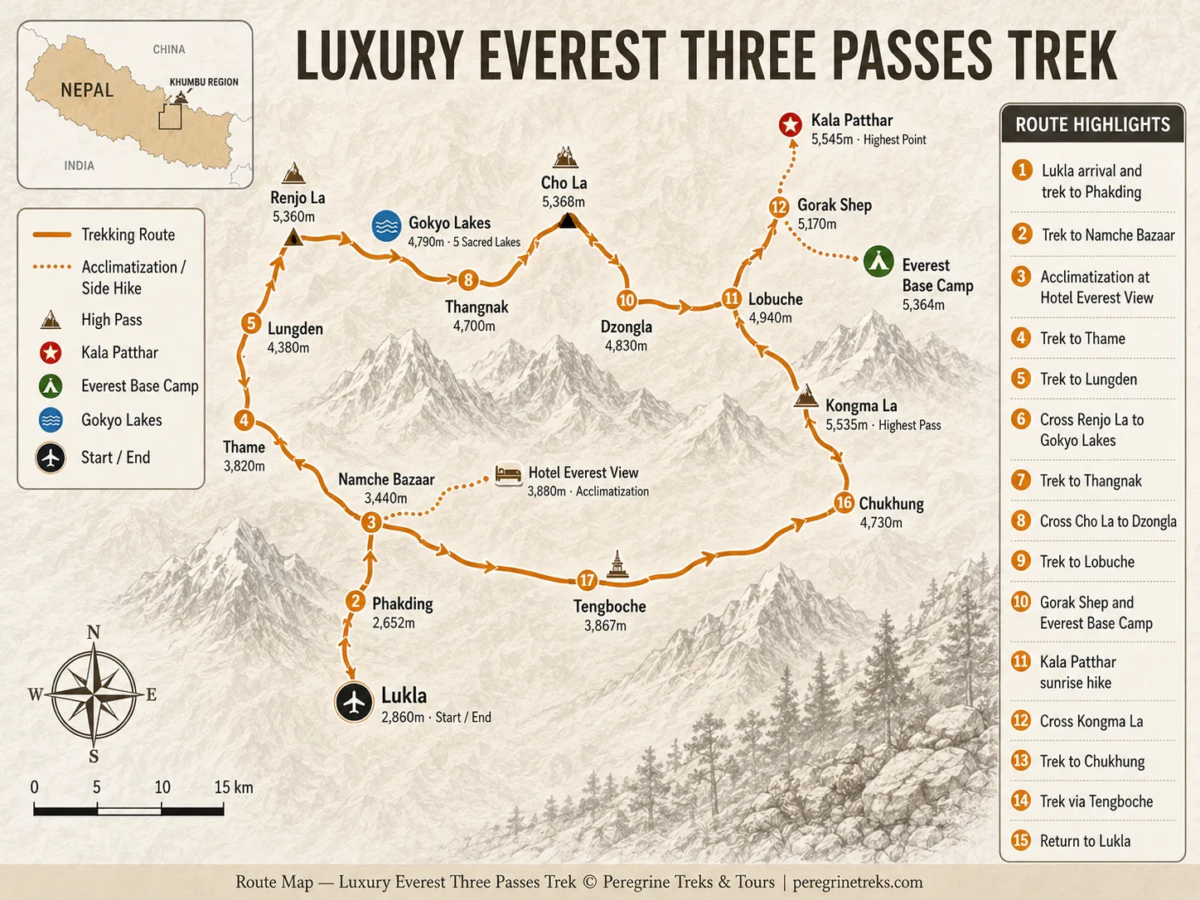
Route Map
Good To Know
Hotel Everest View, The Himalayan Tyangboche, and YMH lodges have limited rooms. Premium lodge availability depends on confirmed allocation at the time of booking.
If Hotel Everest View cannot confirm rooms for your dates, Peregrine offers the closest comparable option at Khumjung Village or adjusts the itinerary to maintain the acclimatization benefit of that altitude stop. If the Himalayan Tyangboche is unavailable, the best available lodge at Tengboche is confirmed, and the package value is adjusted accordingly.
All lodge confirmations are written into your booking contract before the deposit is paid. No lodge substitution occurs without your written agreement.
Before confirming your place on the Luxury Everest Three Passes Trek, Peregrine asks each guest for a short written account of prior high-altitude trekking experience, their current weekly fitness routine, relevant medical history, and comfort with consecutive 7–9-hour walking days.
Guests with no prior experience above 4,000m or no recent multi-day trekking background are redirected toward the Luxury Everest Base Camp Trek or Luxury EBC + Gokyo Trek — both equally well supported but better matched to the fitness level.
A doctor’s consultation before departure is strongly recommended. Discuss altitude medication, existing heart or respiratory conditions, and hydration planning with your physician before confirming the booking.
During the peak spring and autumn seasons, Lukla flights sometimes operate from Ramechhap (Manthali) Airport rather than Kathmandu due to air traffic management by Nepal’s Civil Aviation Authority. When this applies, Peregrine arranges the required private vehicle transfer from Kathmandu to Ramechhap — approximately a 4-hour drive — and adjusts the departure timing accordingly. No extra cost applies when this change is made before the trek starts.
The AS350 B3e helicopter safety net applies regardless of whether flights originate from Kathmandu or Ramechhap. If fixed-wing delays exceed ninety minutes, the helicopter lifts you to Lukla at no extra cost.
| Month | All 3 Passes Open? | Cho La Glacier | Views | Verdict |
|---|---|---|---|---|
| April | Yes | Mixed; crampons required | Good | Strong spring option. Full rhododendron bloom. |
| Early May | Yes | Softening; still passable | Good; haze late May | Book departures before May 15. |
| June–August | Not recommended | Wet and unstable | Poor visibility | Rain, cloud, snow instability, and poor visibility. Not recommended. |
| Late September | Variable | Firming up | Improving rapidly | Experienced guests only. |
| October | All three — optimal | Firm; crampons required | Post-monsoon clarity | Best month. Book at least 4 months ahead. |
| November | Good to mid-November | Cold and firm | Excellent | Fewer crowds. Kongma La requires extra caution post mid-November. |
| December–February | Often blocked | Deep snow; dangerous | Clear but extremely cold | Not recommended. |
October is the optimal month: post-monsoon clarity, firm Cho La glacier, and stable weather on all three passes. Hotel Everest View and The Himalayan Tyangboche fill up completely for October — book at least 4 months in advance.
April offers a genuine spring alternative. Rhododendron blooms peak between Phakding and Namche in early April. Spring light on Ama Dablam from Tengboche often exceeds autumn clarity.
| Cancellation Timing | Amount Retained |
| More than 60 days before departure | Deposit refunded minus bank and processing charges |
| 30–60 days before departure | 50% of the total package value is retained |
| Fewer than 30 days before departure | 100% of total package value retained |
- Date changes made more than 60 days before departure: subject to lodge availability; a date-change administration fee applies.
- Date changes within 60 days: treated as a new booking at current rates.
- Force majeure (earthquake, government closure, pandemic travel restriction): Peregrine offers a full credit note valid for 24 months. Cash refunds are not issued for force majeure cancellations.
- Weather delays beyond the Day 19 buffer: accommodation and logistics managed at cost; not covered by Peregrine’s cancellation policy; the guest’s responsibility under their travel insurance.
- Premium lodge unavailability (force majeure): Peregrine offers the closest available alternative and adjusts the package value before reconfirming.
All bookings are confirmed by a written contract. Verbal or email agreements are not binding until the deposit is received and a confirmation number is issued.
Trip Information
Why Choose the Luxury Everest Three Passes Trek
Five verified facts separate the Luxury Everest Three Passes Trek from every other Khumbu package. Each one is a specific property or experience that standard Three Passes routes skip entirely.
Hotel Everest View — Overnight at the World’s Highest Hotel
Takashi Miyahara conceived Hotel Everest View in 1968 while surveying the Syangboche ridge. Architect Yoshinobu Kumagawa designed the building. Workers carried all the materials on a two-week walk from Lamusangu or lifted them by helicopter. The hotel opened in 1971.
In 2004, the Guinness Book of World Records certified Hotel Everest View as the world’s highest-placed hotel at 3,880m. Twelve rooms each face Everest through floor-to-ceiling sliding glass doors. Oxygen wall outlets with disposable nasal cannulas sit in every room. The dining room centers on an ancient boulder carved with the Buddhist inscription ‘Om Mani Padme Hum.’
The menu includes continental breakfast, Japanese oyakodon, and fillet mignon. The hotel runs on solar power and is located within the UNESCO Sagarmatha National Park. Most standard Three Passes trek itineraries stop here for lunch, while Peregrine Treks Tours arranges an overnight stay for you.
The Himalayan Tyangboche — The Only Onsen Spa on the Everest Trail
The Himalayan Tyangboche sits adjacent to Tengboche Monastery at 3,867m. A purpose-built luxury lodge — part of the Himalayan Luxury Lodges of Everest chain — it serves Day 15 of this route, after you cross all three passes, reach EBC, and summit Kala Patthar.
The lodge features an indoor heated onsen pool and spa, massages, a steam room, and underfloor heating in select areas—Ensuite, les chambres ouvrent sur un panorama de Kangtega, de Thamserku et d’Ama Dablam. A gourmet fireplace restaurant serves organic Nepali thali and Western three-course meals.
The spa window faces southwest. Ama Dablam (6,812m) fills that window directly. You soak in heated water at 3,867m while monks chant 200 meters away at the monastery. No standard Three Passes package offers this.
Note: Facilities at The Himalayan Tyangboche may vary by room category, season, and operating conditions. Peregrine confirms the final room and facility availability before departure.
Khangri Resort — The Best Lodge After the Highest Pass
Owner Lopsang Sherpa runs Khangri Resort in Chukhung at 4,730m. The lodge sits at the head of the Imja Valley with Island Peak (6,189m) directly visible from the dining room window. Alpine Ascents International uses Khangri Resort as its Chukhung base lodge.
Khangri Resort is known among trekkers for reliable gas-heated showers and a warm dining room at 4,730m. Staff starts at 5 AM. The lodge prepares packed lunches for the day of the Kongma La crossing. Equipment rental covers La Sportiva Nepal Evo boots, Black Diamond crampons, and helmets. After crossing Kongma La at 5,535m, you arrive at a gas-heated shower, a warm dining room, and an owner who remembers your name.
The Complete Three-Pass Khumbu Circuit
The Luxury Everest Three Passes Trek crosses all three high passes of the Khumbu in one complete circuit: Renjo La, Cho La, and Kongma La.
Renjo La (5,360m) offers one of the rarest and most spectacular viewpoints in the Everest region, as far fewer trekkers cross it compared to the busy Everest Base Camp trail. Cho La (5,368m) adds a more technical challenge, requiring crampons on its glaciated eastern slope. Kongma La (5,535m), the highest of the three passes, is crossed last on Day 14, when your body has reached its best altitude adaptation.
Along the way, the journey includes the Gokyo Lakes, Gokyo Ri, Everest Base Camp, Kala Patthar, and the Chukhung Valley with views of Island Peak. It is the most complete trekking circuit in the Khumbu, leaving nothing out.
Bhojan Griha — Cultural Closure on Day 19
Bhojan Griha sits in Naxal, Kathmandu — 2.8 km from Thamel—the 150-year-old building, formerly the palace of Nepal’s Royal Priest. Bharat Basnet restored and reopened it in 1998, following Chi philosophy principles: organic ingredients and no chemical farming.
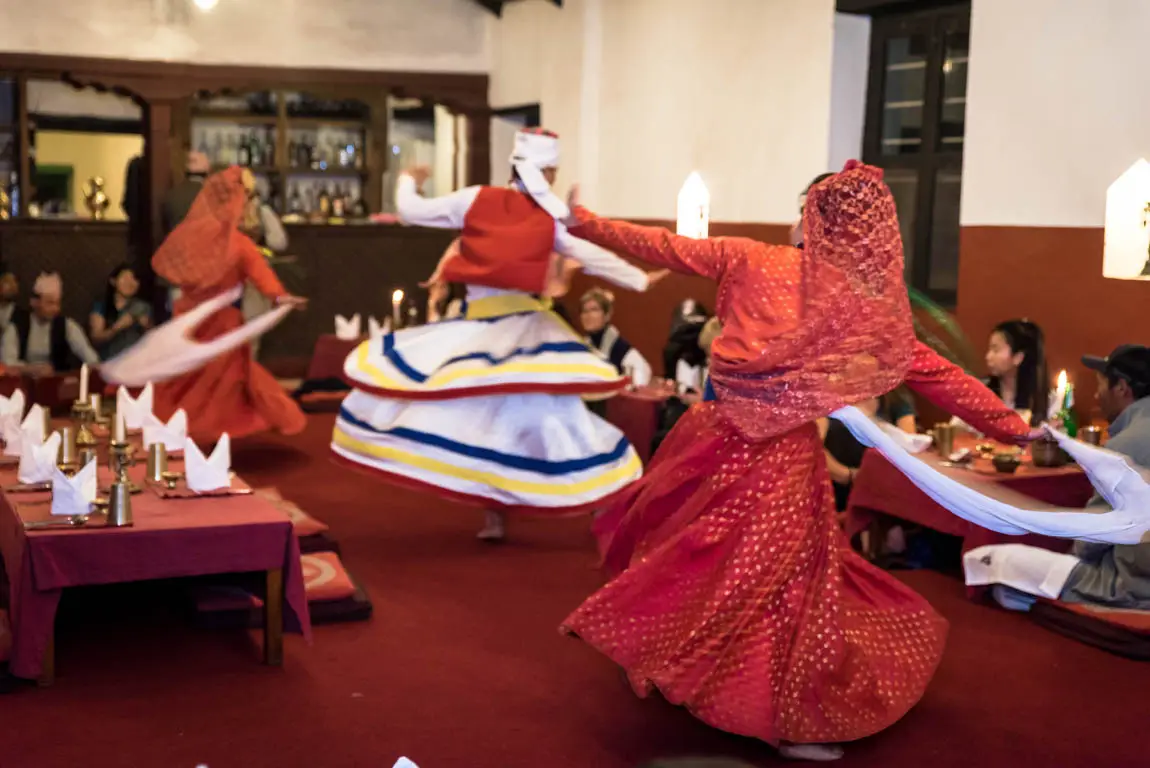
The five-course Newari set menu includes aila (local rice wine), momos, a Nepali thali, and a sikarni dessert. Seven Nepali ethnic groups — Sherpa, Newar, Limbu, Gurung, Chhetri, Brahmin, and Tharu — perform live cultural dances. You visited Boudhanath Stupa on Day 2 and attended the Tengboche puja on Day 15. Day 19 at Bhojan Griha closes the cultural circle of your 20-day Nepal experience.
The Three Passes — A Technical Guide
The three passes differ in terrain, technical requirements, and panoramic reward. Crossing them in the order Renjo La, Cho La, Kongma La is deliberate — each crossing builds on the acclimatization of the one before.
| Pass | Terrain | Technical Requirement | Best For |
|---|---|---|---|
| Renjo La | Rocky trail with steep sections on both sides. | No technical climbing. No glacier crossing in normal conditions. | Everest and Gokyo Lakes panorama. |
| Cho La | Rocky western side with glaciated terrain on the eastern section. | Crampons may be required based on snow and ice conditions. The guide assesses the route. | Glacier crossing and high-pass challenge. |
| Kongma La | Moraine, rocky trail, and remote high-altitude terrain. | Crampons may help in snow or ice. No technical glacier crossing in normal conditions. | Highest pass and wide Khumbu panorama. |
Scroll left or right to view the full comparison table.
Safety Note: Trail conditions on Renjo La, Cho La, and Kongma La can change due to snow, ice, wind, and temperature. Your guide checks the weather, trail conditions, and group fitness before each pass crossing. Crampons or other safety support may be used when conditions require.
Why This Pass Order Works
Renjo La is first. Guests arrive having slept at 3,880m (Hotel Everest View), 3,820m (Thame), and 4,380m (Lungden) — a controlled altitude profile with a dedicated acclimatization day before the approach.
Cho La is second. After two nights at Gokyo (4,790m) and an optional ascent of Gokyo Ri (5,357m), guests are thoroughly acclimatized for the glaciated crossing.
Kongma La is the last and highest at 5,535m. After EBC, Kala Patthar (5,545m), and 14 days at altitude, guests cross the highest pass at the point of maximum physiological adaptation. No other pass order achieves this.
Ama Dablam — The Mountain Above the Khumbu Trail
Ama Dablam (6,812m) appears on more Khumbu trail photographs than Everest. It stands directly above the main trail from Namche to Tengboche, its twin-horned summit and hanging glacier immediately recognizable — a tall, three-sided peak with a permanent wedge of ice on the upper southwest ridge.
The name means ‘Mother’s Necklace.’ Ama means mother. Dablam refers to the traditional Sherpa jewelry box worn around the neck on a cord. The hanging glacier on the southwest face is the necklace. The first ascent came on March 13, 1961 — Mike Ward, Barry Bishop, Wally Romanes, and two Sherpas via the Southwest Ridge.
Altitude: 6,812m. Classification: technical mountain.
| Day | Location | Distance to Ama Dablam | The View |
|---|---|---|---|
| Day 4 | Namche Bazaar — 3,440m | Approx. 15 km south | First clear appearance above the Khumbu Valley horizon on suitable weather days. |
| Day 11 | Thukla Pass and Lobuche | Approx. 10 km south | Wide mountain view from the memorial area, with Ama Dablam visible behind the Khumbu landscape. |
| Day 14–15 | Chukhung and Dingboche descent | Approx. 6 km south | Classic Imja Valley view with Ama Dablam rising sharply above the trail. |
| Day 15 | Pangboche to Tengboche | Approx. 4–5 km west | One of the closest and most impressive trail views. Ama Dablam dominates the skyline above the route. |
| Day 15 Evening | The Himalayan Tyangboche area | Approx. 5 km west | Weather permitting, the lodge area offers a dramatic view toward Ama Dablam and nearby Everest region peaks. |
| Day 16 | Tengboche to Namche descent | Approx. 8–10 km west | Final clear views of Ama Dablam before the lower ridges and forests reduce the line of sight. |
View Note: Mountain visibility depends on weather, cloud cover, season, and daily timing. Morning hours usually offer clearer views of Ama Dablam and the surrounding peaks in the Everest region.
The defining conjunction: Heated onsen pool at 3,867m. Monastery bells through the spa window. Ama Dablam’s southwest face is directly in the glass. No standard Three Passes package on the market places you in this specific frame.
Altitude Progression — All 17 Overnight Stops
The first two trekking days involve necessary altitude gain to reach the Khumbu trailhead — Kathmandu to Phakding (+1,252m) and Phakding to Namche (+788m). From Namche onward, the itinerary follows a controlled acclimatization profile. No overnight stop gains more than 560m over the previous night, and the Hotel Everest View acclimatization day, Thame rest night, and Lungden staging ensure the body builds tolerance before each pass.
| Day | Overnight Stop | Sleeping Altitude | Altitude Change | Acclimatization Note |
|---|---|---|---|---|
| 1–2 | Kathmandu | 1,400m | Baseline | Arrival, briefing, gear check, and baseline health review before the trek. |
| 3 | Phakding | 2,652m | +1,252m | First major altitude gain after the Lukla flight. A short walking day helps with adjustment. |
| 4 | Namche Bazaar | 3,440m | +788m | The body starts to notice altitude above 3,000m. Slow pacing matters. |
| 5 | Hotel Everest View Area | 3,880m | +440m | Dedicated acclimatization day with mountain views above Namche. |
| 6 | Thame | 3,820m | -60m | Slight descent supports recovery before the Renjo La approach. |
| 7 | Lungden | 4,380m | +560m | Pre-pass staging the night before Renjo La. Rest and hydration are important. |
| 8 | Gokyo | 4,790m | Cross Renjo La 5,360m, then descend | High pass crossing with sleep lower than the pass summit. |
| 9 | Thangnak | 4,700m | -90m | Slight descent before Cho La. Early rest helps prepare for the next pass. |
| 10 | Dzongla | 4,830m | Cross Cho La 5,368m, then descend | Cho La is a demanding high-pass day. Conditions may include snow or ice. |
| 11 | Lobuche | 4,940m | +110m | Shorter recovery day after Cho La before the Everest Base Camp section. |
| 12 | Gorak Shep | 5,170m | +230m | The highest sleeping altitude of the trek and the Everest Base Camp day. |
| 13 | Lobuche | 4,940m | Return from Kala Patthar 5,545m | Early viewpoint hike, then descent to a lower sleeping altitude. |
| 14 | Chukhung | 4,730m | Cross Kongma La 5,535m, then descend | Final high pass, crossed after the strongest acclimatization stage. |
| 15 | Tengboche | 3,867m | -863m net | Major descent to lower altitude and better recovery conditions. |
| 16 | Namche Bazaar | 3,440m | -427m | Continued descent helps the body recover after the high-altitude section. |
| 17 | Lukla | 2,860m | -580m | Final trail day before the return flight to Kathmandu. |
Altitude Note: Altitude gain and sleeping elevation matter on the Luxury Everest Three Passes Trek. Your guide monitors pace, rest, hydration, and symptoms throughout the route. Trekkers should report early if they have headaches, nausea, dizziness, poor sleep, or unusual tiredness.
Route Flexibility and Safety Decision Protocol
Your guide has full authority to delay, reroute, or cancel any pass crossing if weather, snow, ice, visibility, altitude, symptoms, or group fatigue pose a risk. Guest safety takes priority over completing all three passes.
When a pass day requires adjustment, the options, in order, are: wait one day at the current lodge if the forecast allows; take a lower route where terrain permits; return to the previous night’s lodge; and, in a medical or approved emergency only, arrange a helicopter evacuation to Kathmandu or Lukla.
Day 19 in Kathmandu absorbs one weather delay without affecting international connections. If a delay extends beyond what Day 19 covers, Peregrine manages the logistics and accommodation at cost price with no markup.
Luxury Everest Three Passes Trek Cost
Three pricing tiers serve different levels of private support and upgrade requirements. All prices are per person, twin share.
| Package Tier | Price Per Person | What Makes It Different |
|---|---|---|
| Standard Luxury | From USD 5,500 | Includes Hotel Everest View overnight, Yeti Mountain Home lodges where available, The Himalayan Tyangboche, Khangri Resort, Radisson Hotel Kathmandu, private guide, porter support, required permits, full-board trek meals, Bhojan Griha farewell dinner, and farewell archive. |
| Heritage Premium | From USD 7,500 | Adds suite upgrades at Radisson Hotel Kathmandu and The Himalayan Tyangboche, senior IFMGA guide support where available, two porters per guest, Garmin GPS tracking support, and enhanced private service. |
| Ultra-Premium Private | From USD 9,500 | Includes a private Sherpa support team, premium lodge, and room upgrades where available, enhanced emergency coordination, private helicopter emergency protocol subject to weather and aviation conditions, and the highest service level in the package. |
Price Note: Prices are listed per person, twin-sharing. Final cost may vary by travel date, lodge availability, room category, guide level, helicopter conditions, and confirmed service upgrades. Premium lodges and suite rooms remain subject to availability.
Single supplement: USD 800 per person.
Group savings: 4–6 guests save 10%. Groups of 7 or more save 15%.
Travel Insurance Requirements
Travel insurance is mandatory for this package. Your policy must cover all five of the following:
- Trekking activity up to 6,000m altitude
- Emergency helicopter evacuation to Kathmandu or Lukla
- Medical treatment and hospitalization in Nepal
- Trip interruption and cancellation
- Personal liability
Submit your policy details and emergency contact numbers to Peregrine before arrival. Rescue coordination costs remain the guest’s responsibility until insurer approval is confirmed. Peregrine’s 24/7 WhatsApp concierge assists with all rescue and insurance coordination on the ground.
Which Peregrine Treks Everest Package Is Right for You?
| Package | Best For | Duration | Difficulty | Luxury Level | Price From |
|---|---|---|---|---|---|
| Luxury Everest View Trek | First luxury Himalayan trek experience | Short circuit | Easy–Moderate | Highest comfort throughout the route | From USD 2,800 |
| Luxury Everest Base Camp Trek | Classic Everest Base Camp goal with added comfort | 16 days | Moderate–Hard | Strong comfort on most nights | From USD 3,840 |
| Luxury EBC + Gokyo Trek | More scenery with one high pass | 18 days | Hard | Mixed comfort, with luxury in lower Khumbu | From USD 4,200 |
| Luxury Everest Three Passes Trek | Experienced trekkers who want the complete Khumbu circuit | 20 days | Very strenuous | Premium support, with basic lodges above 4,700m | From USD 5,500 |
Package Note: Prices are starting rates per person and may vary by travel date, room category, lodge availability, group size, guide level, and confirmed upgrades. Luxury lodge standards are strongest in lower Khumbu, while high-altitude sections use the best available lodges.
Book Your Luxury Everest Three Passes Trek
The Luxury Everest Three Passes Trek runs in October–November and April–May. Peregrine Treks & Tours limits departures to 8 guests per group to maintain a 1:2 guide-to-guest ratio and pto secure private lodge reservations at Hotel Everest View and The Himalayan Tyangboche.
October departures book out 4–6 months in advance. Send your name, preferred travel dates, group size, and fitness background. Your Everest specialist responds within 24 hours.
Contact Peregrine Treks & Tours
- Email: sales@peregrinetrekstours.com
- Location: Kathmandu, Nepal
Frequently Asked Questions
A: A premium 20-day Khumbu circuit crossing Renjo La (5,360m), Cho La (5,368m), and Kongma La (5,535m). The route visits the Gokyo wetland system, Everest Base Camp, Kala Patthar (5,545m), and the Chukhung Valley. Key properties include Hotel Everest View overnight, YMH lodges, The Himalayan Tyangboche onsen spa, Khangri Resort, and Bhojan Griha farewell dinner.
A: Renjo La: 5,360m — no glacier; steep and rocky. Cho La: 5,368m — glaciated east side; crampons and fixed ropes provided; conditions assessed before each crossing. Kongma La: 5,535m — highest of the three; rocky moraine; crampons recommended.
A: Yes. Cho La has a glaciated section on the east side. Crampons are mandatory and provided by Peregrine. A dedicated Sherpa team pre-places fixed ropes on the glacier before your group departs Thangnak, subject to conditions assessment. The guide holds the group at Thangnak if weather or conditions fall outside the safety threshold. Renjo La and Kongma La do not require crampons under standard autumn and spring conditions.
A: The package price includes Hotel Everest View overnight (Guinness World Records, 3,880m), The Himalayan Tyangboche onsen spa at Tengboche, Khangri Resort in Chukhung, all YMH premium lodges, a licensed Sirdar with Everest summit credentials, comprehensive safety equipment, and the Bhojan Griha farewell dinner. These are verified facilities and services that standard Three Passes packages do not include at lower price points.
A: Yes. The Luxury EBC Trek crosses one pass and does not reach Chukhung. The Three Passes Trek crosses three passes above 5,300m over 20 days. Cho La requires crampons on a glaciated glacier. Kongma La gains 595m from Lobuche on loose moraine. Six days require 7 or more hours of walking. Prior high-altitude trekking experience is required for the Three Passes route.
A: Your guide holds full authority to delay or cancel any pass crossing if conditions are unsafe. Day 19 in Kathmandu absorbs one weather delay. If conditions prevent a pass crossing entirely, Peregrine offers a modified route, a rescheduled departure, or a credit toward a future trek. The specific terms are set out in your booking contract.
A: No — and this is stated honestly throughout the package. Luxury lodges operate at Kathmandu, Hotel Everest View, YMH lodges (Phakding, Namche, Thame, Lukla), Khangri Resort (Chukhung), and The Himalayan Tyangboche (Tengboche). Between Days 9 and 13, above Gokyo, the best available basic lodges at Thangnak, Dzongla, Lobuche, and Gorakshep are used. At extreme altitude, the premium is expert guide care, verified safety equipment, and daily health monitoring.
A: Yes. Prior multi-day trekking at or above 4,000m is required. First-time high-altitude trekkers are redirected toward the Luxury EBC Trek or Luxury EBC + Gokyo Trek before the Three Passes route is confirmed. A pre-booking fitness screening and doctor consultation are part of Peregrine’s confirmation process.
A: No — and setting this expectation matters. Nuptse (7,861m) blocks Everest completely from EBC. The Khumbu Icefall rises directly above instead. For the complete south face of Everest, Kala Patthar on Day 13 gives the definitive view: West Ridge, South Col, Hillary Step, and the summit pyramid.
A: Kongma La at 5,535m is the highest of the three passes. Crossing it on Day 14 places guests at peak physiological altitude adaptation — after 14 days at altitude, two prior passes, EBC, and Kala Patthar. No other pass order achieves this.
A: Not always. During the peak spring and autumn seasons, Lukla flights sometimes operate from Ramechhap (Manthali) Airport rather than Kathmandu. When this applies, Peregrine arranges a private transfer from Kathmandu to Ramechhap and adjusts the departure time at no extra cost. The helicopter safety net applies regardless of departure airport.
A: Yes, with your guide’s assessment. The guide monitors SpO2, heart rate, and fatigue daily. If a guest is not in condition for a specific pass, the guide redirects to a lower route or alternate itinerary. Skipping a pass does not disqualify you from the rest of the circuit. The terms for itinerary adjustment are set out in your booking contract.
A: All lodge confirmations are written into your booking contract before the deposit is paid. If Hotel Everest View cannot confirm rooms for your dates, Peregrine offers the closest comparable option at Syangboche and adjusts the package value accordingly. No substitution occurs without your written agreement.
A: Required documentation includes the Sagarmatha National Park Entry Permit, the Khumbu Pasang Lhamu Rural Municipality permit, and any TIMS or agency registration required under current Nepal Tourism Board rules. Peregrine Treks & Tours arranges all required permits before the trek. Permit fees are subject to change — current fees are confirmed at the time of booking.
A: October: post-monsoon clarity, firm Cho La glacier, and reliable weather on all three passes. April is the best spring option — Cho La is passable, and rhododendron blooms line the lower Khumbu trail. Book at least 4 months ahead for October and November departures.
A: From USD 5,500 per person (twin share) for Standard Luxury. Heritage Premium from USD 7,500. Ultra-Premium Private from USD 9,500. Single supplement: USD 800. Group savings apply for 4 or more guests.
A: A 150-year-old heritage building in Naxal, Kathmandu — formerly the palace of Nepal’s Royal Priest. Bharat Basnet restored it in 1998, following Chi philosophy principles: organic ingredients and no chemical farming. Five-course Newari set menu and live cultural dances from seven ethnic groups: Sherpa, Newar, Limbu, Gurung, Chhetri, Brahmin, and Tharu.
Reviews on Luxury Everest Three Passes Trek
5.0
Worth It for the Views, Route, and Care
I chose the Luxury Everest Three Passes Trek because I wanted the most complete Everest route with extra comfort where possible. It was worth it. The route covered Renjo La, Gokyo Lakes, Cho La, Everest Base Camp, Kala Patthar, and Kongma La in one well-planned itinerary. The trek was physically demanding, so training before arrival helped a lot. Peregrine’s team took care of airport transfers, hotels, permits, lodges, meals, and daily planning. That made a big difference. I loved the contrast between the premium lodges and the wild high-pass sections. This package suits active travellers who want comfort, safety, and a proper Himalayan challenge.

Rebecca Martin
Sydney, New South Wales, AustraliaA Perfect Balance of Challenge and Comfort
The Luxury Everest Three Passes Trek gave me the exact mix I wanted: serious mountain challenge and high comfort where possible. Renjo La, Cho La, and Kongma La each tested my legs, but our guide paced the trek with great care. I liked the honest approach to accommodation. In Namche, Phakding, and Lukla, the premium lodges made a huge difference. In remote places like Lungden and Gorak Shep, the team chose the best available lodge and managed everything well. The views from Gokyo Ri and Kala Patthar were unforgettable. I felt safe, supported, and well cared for from Kathmandu to Lukla and back.
Michael Anderson
Denver, Colorado, USABest Trek for Strong Hikers Who Want Better Service
I booked the Luxury Everest Three Passes Trek because I wanted a tougher route than the classic Everest Base Camp Trek, but I did not want a basic backpacker-style trip. Peregrine delivered exactly that. The itinerary gave us time to acclimatize, especially with the night at Hotel Everest View. Our guide checked our oxygen levels, meals, water intake, and pace every day. Cho La felt the hardest for me, but the team handled the icy section with care. The premium lodges in lower Khumbu added real value. This trek suits fit travelers who want adventure, strong safety support, and better comfort in the Everest region.
Sarah Mitchell
Seattle, Washington, USAWell Organised and Professionally Guided
The Luxury Everest Three Passes Trek was well organised from the first email to the final hotel transfer in Kathmandu. The office team answered every question clearly before arrival. Once the trek started, our guide managed the route, weather, lodge bookings, and altitude checks with great skill. Renjo La offered my favourite view of the trek, with Everest, Lhotse, Makalu, and the Gokyo Lakes all visible on a clear morning. The lodges varied in comfort, but Peregrine explained this honestly before we booked. That transparency mattered. This trek requires strong fitness, yet the support team made the experience smooth, safe, and deeply rewarding.
James Whitfield
Bristol, England, UKA True High-Pass Trek with Luxury Where It Matters
I chose this package because I wanted the full Everest Three Passes route without giving up comfort in Kathmandu and lower Khumbu. The Luxury Everest Three Passes Trek exceeded my expectations. Radisson Hotel Kathmandu gave us a soft start and finish, while Yeti Mountain Home lodges helped us rest well after long walking days. The remote sections felt basic, as expected, but our guide and porter made them manageable. Kongma La was the toughest day for me, yet also one of the most beautiful. The route felt wild, quiet, and far more complete than the standard Everest Base Camp route. I would recommend it to experienced trekkers.
Emma Richardson
Bath, England, UKExcellent Route Design and Acclimatisation
The Luxury Everest Three Passes Trek gave us a complete view of the Everest region. I liked the route because it did not rush into high altitude. The extra nights in Namche and Hotel Everest View helped our bodies adjust before we crossed the first pass. Renjo La was beautiful and peaceful. Cho La felt more demanding because of the terrain, while Kongma La felt remote and powerful. Our guide explained every day in advance, so we always knew what to expect. The service stayed professional throughout the trek. The package combines comfort, safety, and a real Himalayan challenge in a very good way.
Sophie Laurent
Lyon, FranceA Strong Trek with Superb Mountain Views
This trek is not easy, but it gives amazing rewards to prepared trekkers. I joined the Luxury Everest Three Passes Trek to see more than Everest Base Camp, and the route delivered much more. Gokyo Lakes, Renjo La, Cho La, Kala Patthar, Everest Base Camp, and Kongma La all felt different. The guide knew the trail very well and made smart decisions when the weather changed. The luxury part felt strongest in Kathmandu, Namche, Phakding, Lukla, and Hotel Everest View. In the higher villages, comfort was limited, but the support and food planning stayed excellent. I returned home tired, proud, and very satisfied.
Lukas Schneider
Munich, GermanyGreat Choice for Canadian Hikers Seeking a Big Challenge
The Luxury Everest Three Passes Trek was one of the best outdoor experiences I have had. As someone used to hiking in the Canadian Rockies, I still found the altitude and long days very demanding. Peregrine handled the logistics with care, which allowed us to focus on walking, eating well, and resting. The guide set a steady pace and watched everyone closely for altitude issues. I loved the Gokyo section and the view from Kala Patthar. The comfort level changed from village to village, but that is part of trekking in the high Himalaya. The package offers excellent value for fit travellers who want a premium Everest route.
Daniel Thompson
Calgary, Alberta, CanadaSafe, Comfortable, and Beautifully Planned
I wanted a trek that felt adventurous but not careless, and this package matched that perfectly. The Luxury Everest Three Passes Trek takes you into remote parts of the Everest region, so safety matters. Our guide stayed calm, practical, and very attentive. He adjusted our pace when needed and gave clear advice each evening. The accommodation plan was also helpful. We enjoyed real comfort in Kathmandu and the lower Khumbu, then accepted simpler lodges higher up. The scenery changed every day, from Sherpa villages to glaciers, lakes, passes, and wide mountain views. I finished the trek with a strong sense of achievement and trust in the team.
Olivia Bennett
Vancouver, British Columbia, CanadaThe Best Way to See the Everest Region in Depth
The Luxury Everest Three Passes Trek gave me a much deeper view of the Everest region than a simple in-and-out trek to base camp. The route crossed quiet valleys, busy Sherpa villages, frozen terrain, and wide high passes. I found Cho La the most exciting day, while Renjo La gave the finest view. The team planned the trek with proper care and never pushed us too fast. I also appreciated the better lodges before and after the remote sections. A hot shower and warm dining room felt like a real treat after long days. This trek suits people who want a serious route with thoughtful comfort.
William Clarke
Edinburgh, ScotlandPremium Service on a Demanding Himalayan Route
This trek demands effort, but Peregrine made it feel well managed from start to finish. The Luxury Everest Three Passes Trek covered everything I hoped for: high passes, Gokyo Lakes, Everest Base Camp, Kala Patthar, and beautiful Sherpa villages. Our guide was patient, skilled, and honest about the trail each day. He never made the route sound easier than it was. I liked that approach. The premium accommodation in lower areas gave us better rest, and the team chose the best possible lodges in remote places. The farewell dinner in Kathmandu was a lovely way to end the trip. I would book with them again.
Charlotte Evans
Cardiff, WalesA Brilliant Trek with Strong Support
The Luxury Everest Three Passes Trek was a brilliant choice for our group. We wanted something harder than the usual Everest Base Camp Trek, but we also wanted reliable support and decent comfort where available. Peregrine handled that balance very well. Our guide kept the pace steady, gave clear advice, and checked how we felt each day. The passes were tough, especially Kongma La, but the views made every hard step worthwhile. Hotel Everest View was a real highlight during acclimatisation. The high villages were basic, but we expected that. The service, planning, and guide support made the trek feel safe and rewarding.
Andrew Collins
Melbourne, Victoria, Australia