


The best **things to do in Petra** include walking through its dramatic gorges, discovering monuments carved into rose-red sandstone, and taking time to explore the ancient city’s vast landscape. Built by the Nabataeans around 2,000 years ago, Petra is a UNESCO World Heritage Site and one of the New Seven Wonders of the World. The site covers 264 km² at roughly 900 meters above sea level, and most visitors spend one or two full days exploring.
Petra saw 200,000 foreign visitors in the first half of 2025 alone — a 17 percent year-on-year increase. Most of those visitors arrived expecting a single famous photograph and left understanding they had barely scratched the surface.
Things to Do in Petra: Quick Visitor Overview
| Site Area | 264 km² |
| Elevation | Approximately 900 m above sea level |
| Siq Length | 1.2 km (main entrance gorge) |
| Treasury Height | ~39.5 m tall, 25 m wide |
| Monastery | 48 m wide × 47 m tall |
| Roman Theatre | ~8,500 capacity |
| Opening Hours | Summer (Apr–Sep): 06:00–18:00 | Winter (Oct–Mar): 06:00–16:00 |
| Petra by Night | Sun–Thu, 20:30–22:30 | 30 JOD per person (confirm schedule before travel) |
| Little Petra | Free entry | 9 km north of main gate |
| Getting There | Amman → Petra: ~3 hrs (Desert Hwy) | ~4–5 hrs (King’s Highway) |
What Is Petra?
Petra was the capital of the Nabataean Kingdom from around the 4th century BCE to 106 CE, when Rome annexed the region. The Nabataeans were Arab traders who grew wealthy controlling the spice and incense routes connecting Arabia, Egypt, and the Mediterranean. They did not build Petra — they carved it. Every major structure at the site was cut directly from the sandstone rock face by hand.
The city once housed an estimated 30,000 people. Its water system, carved channels, and cisterns fed the population through years of near-zero rainfall. When Rome arrived, Petra slowly declined. By the Byzantine period, it was nearly abandoned. The outside world largely forgot it existed until Swiss explorer Johann Ludwig Burckhardt rediscovered it in 1812.
Today, Petra is Jordan’s most-visited archaeological site and the primary reason international travelers come to Jordan. The site is managed by the Petra Development and Tourism Region Authority (PDTRA) and is open year-round.
How Much Time Do You Need in Petra?
Two days is the appropriate amount of time for a first visit to Petra. One day gets you the Siq, the Treasury, the Roman Theatre, and the main colonnaded street — roughly 20 to 25 percent of the site. Two days add the Monastery (Ad Deir), the Royal Tombs, the High Place of Sacrifice, and enough time to walk without rushing. If Petra is part of a longer trip, read our Jordan itinerary guide to compare 4-, 5-, 7-, and 10-day routes and decide how much time to spend in each destination.
The single most common regret from Petra visitors is not allocating a second day. The Monastery alone requires 40 to 60 minutes of uphill walking from the Basin Restaurant area, plus time at the top. Combining that climb with the Treasury and the Street of Facades in one day leaves most people exhausted before they reach the best views.
One day in Petra:
Siq → Treasury → Street of Facades → Roman Theatre → Colonnaded Street → Qasr al-Bint. Total walking distance: 8 to 10 km. Suitable only for visitors who cannot extend their stay.
Two days in Petra:
Day 1 covers the main valley floor. Day 2 starts early and heads directly to the Monastery before the heat builds, then works back through the High Place of Sacrifice and the Royal Tombs on the descent.
The Siq — The Walk to the Treasury
What the Siq Looks Like
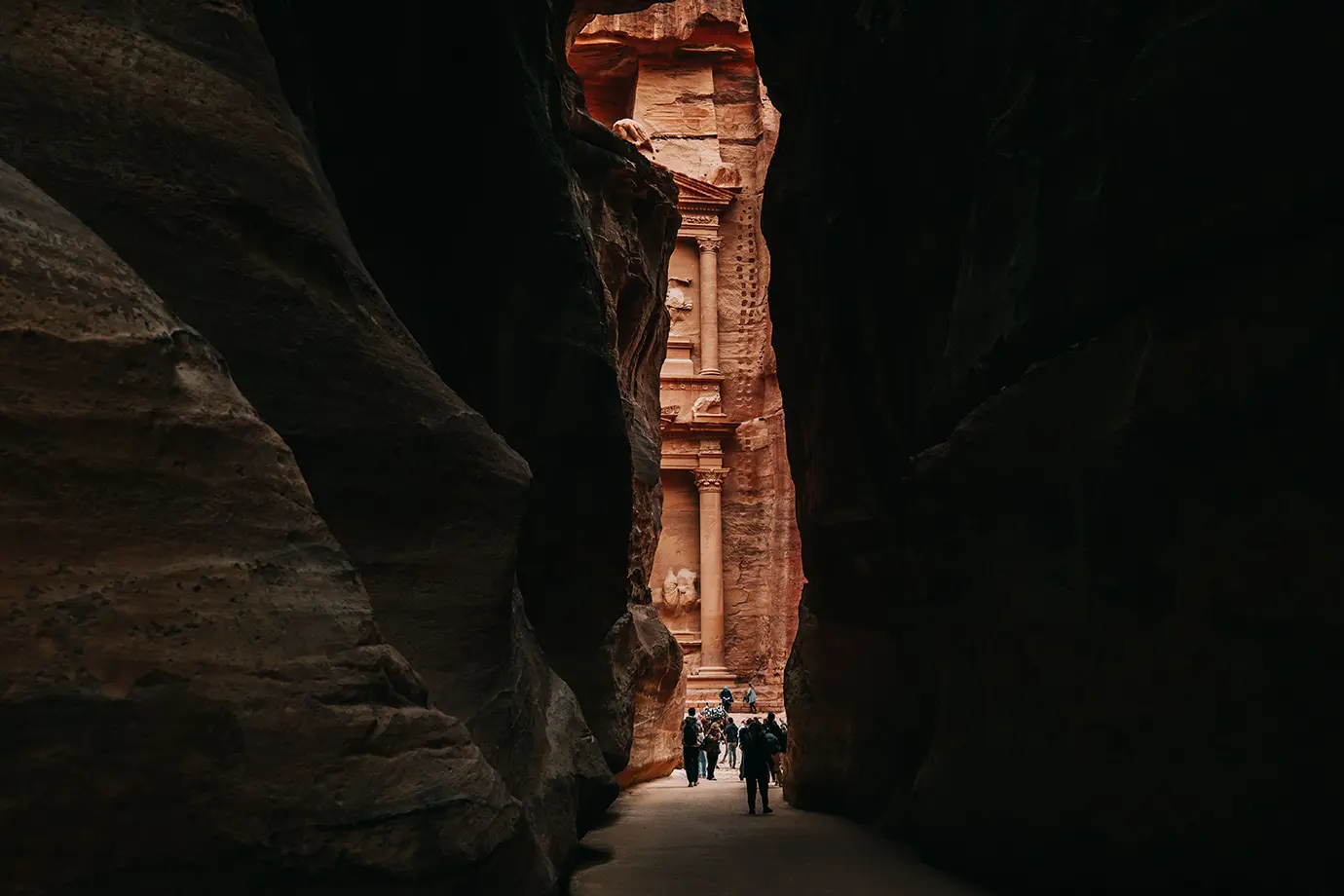
The Siq is a 1.2 km natural gorge that forms the main entrance to Petra. The walls on either side reach 80 meters in height at the narrowest points, and the passage narrows to as little as 3 meters wide in places. The light inside the Siq changes throughout the day. In the early morning, shafts of direct sunlight cut across the pale stone floor. By midday, the gorge is mostly in shadow. Late afternoon sends warm orange light onto the upper walls.
The floor is uneven sandstone — not paved, not flat. You will navigate loose stone, carved channels, and occasional wet patches from seepage. The colors shift as you walk: cream, ochre, deep red, purple. Nabataean carvings appear in niches cut into the walls — gods, incense burners, water channels that once fed the city. The entire walk feels like a deliberate reveal.
How Long Does the Siq Walk Take?
At a normal walking pace, the Siq takes 20 to 30 minutes. During peak hours between 10:00 and 14:00, the gorge fills with visitors walking in both directions, slowing progress. Walking in at 06:00 when the site opens, the Siq is empty and quiet.
The horse-drawn carriages that operate along the Siq move at speed and have the right of way — stay to the side when you hear them approaching.
The Treasury appears at the end of the Siq without warning. The gorge makes a final bend, the walls pull back slightly, and the carved facade fills the frame. No photograph prepares you for the scale of it.
Al-Khazneh (The Treasury) — What to Expect When You Arrive
The Treasury Dimensions
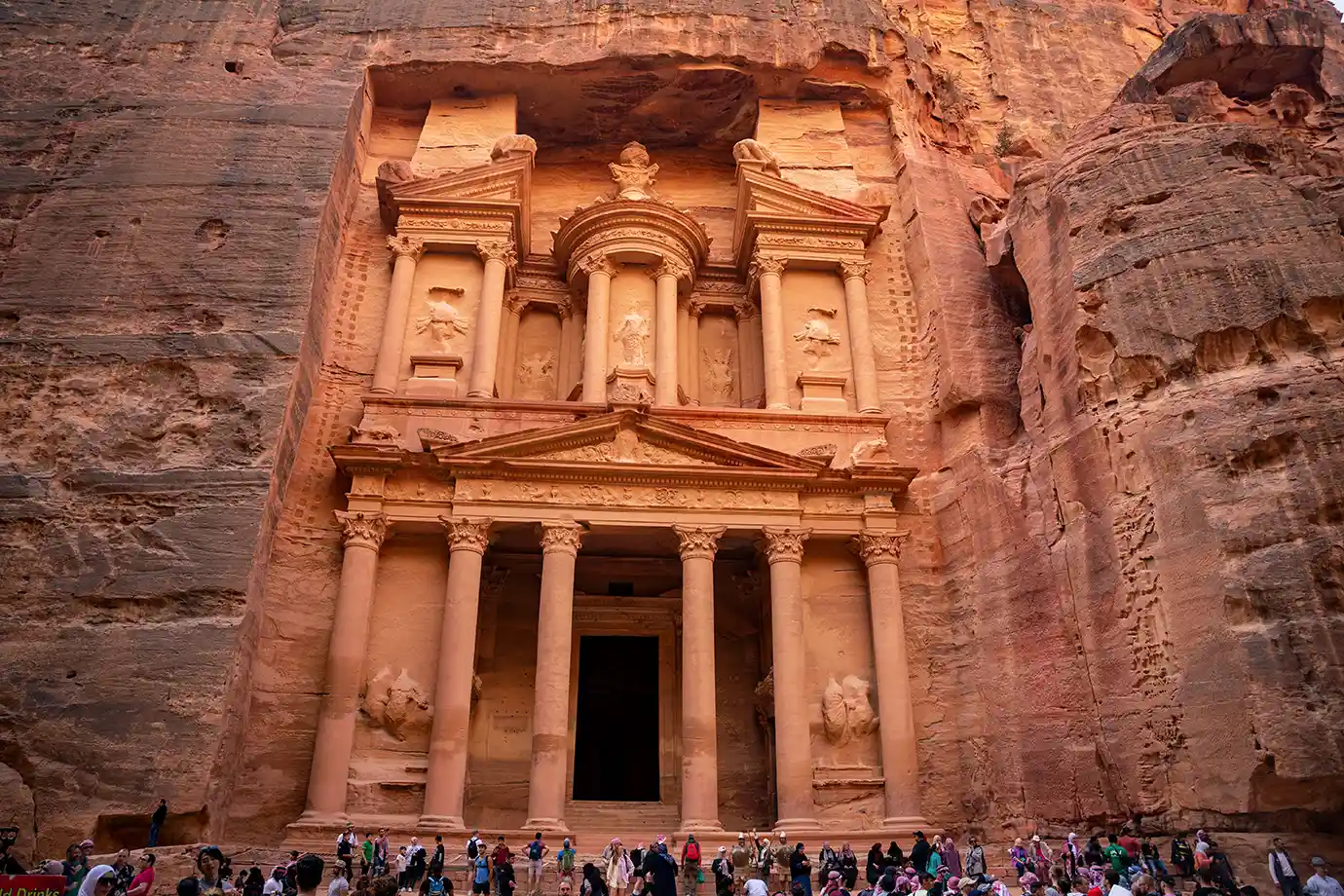
Al-Khazneh stands approximately 39.5 meters tall and 25 meters wide, carved entirely from a single sandstone cliff face. The facade divides into two main tiers. The lower tier features a classical portico with six Corinthian columns. The upper tier rises into a broken pediment with a central tholos — a circular domed element — topped by a funerary urn. Every column, every capital, and every carved figure was cut from the living rock.
The scale only becomes apparent when you see people standing at the base. The doorway itself is 8 meters tall.
Why Is It Called the Treasury?
The name comes from a Bedouin legend, not from history. Local tribes believed that an ancient pharaoh had hidden treasure inside the stone urn at the top of the facade. The urn is pocked with bullet holes from generations of attempts to shatter it and release the gold. No treasure was ever found, because none existed. Archaeological evidence confirms the Treasury was a Nabataean royal tomb, most likely built for King Aretas IV, who ruled from 9 BCE to 40 CE.
The Best Time to Photograph the Treasury
The Treasury faces east. Direct sunlight hits the facade in the early morning, roughly from 06:30 to 09:00 depending on the season. During those hours, the rose-red stone glows. By mid-morning, the facade moves into partial shadow, and by afternoon it is largely unlit.
Arriving at site opening (06:00) and walking briskly through the Siq puts you at the Treasury by 06:30 with no crowd and the best light. By 09:00, tour groups fill the plaza and the light has already softened.
Beyond the Treasury — The Full Petra Route
Street of Facades and Royal Tombs
Past the Treasury, the gorge opens into a wider valley. The Street of Facades runs along the left (eastern) wall — a row of rock-cut tomb facades stacked above each other, most dating to the 1st century CE.
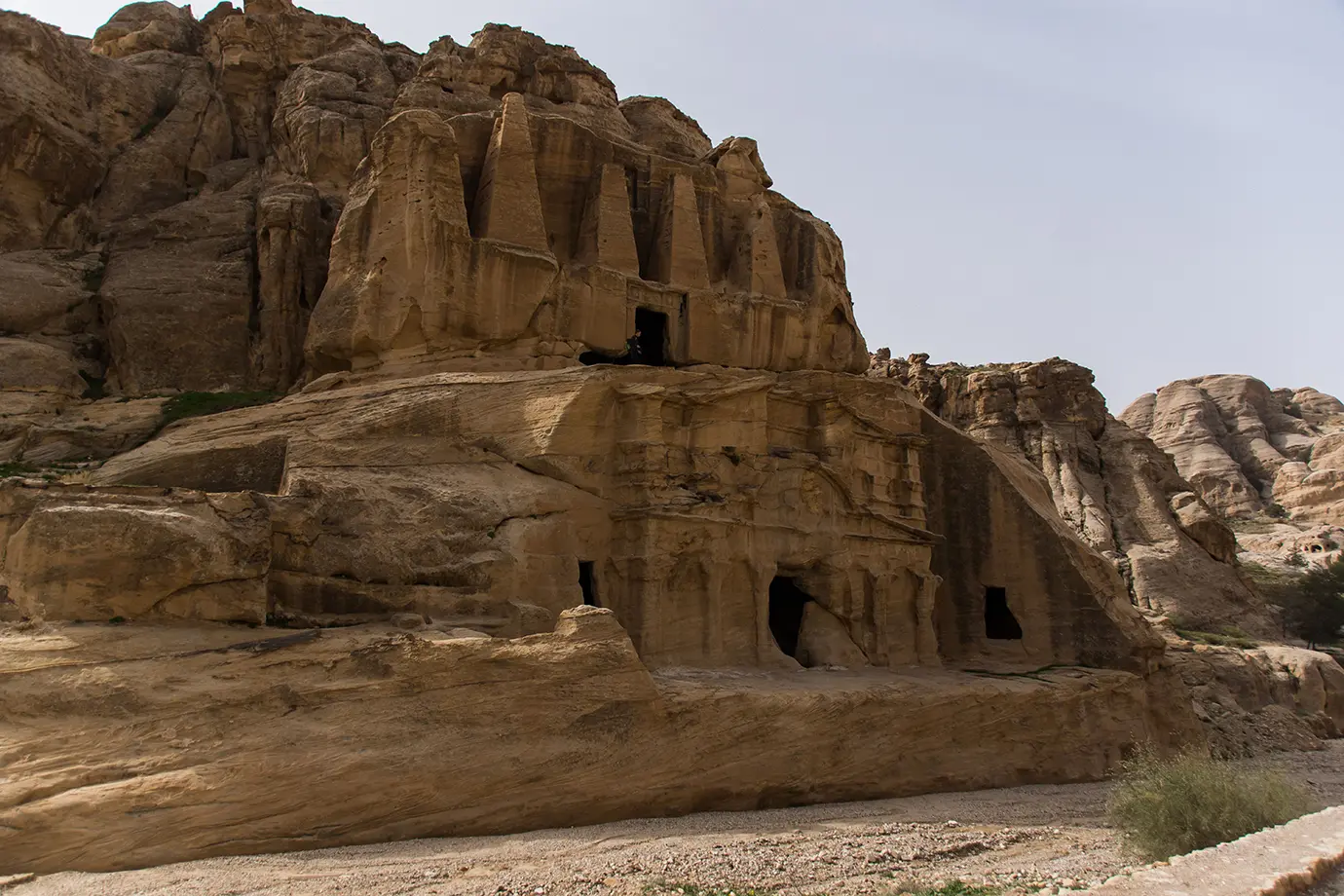
The Royal Tombs sit higher up the same cliff face, accessible by a stone staircase. The four main tombs — the Urn Tomb, the Silk Tomb, the Corinthian Tomb, and the Palace Tomb — are visible from the valley floor. The Urn Tomb is the largest and most accessible. The Byzantines converted it into a church in 446 CE, and crosses carved into the interior walls are still visible. Walking up to the Royal Tombs takes 10 to 15 minutes from the valley floor and gives the best elevated view of Petra’s central basin.
The Roman Theatre
The Roman Theatre sits midway along the main valley, carved directly into the hillside. It holds approximately 8,500 spectators and dates to the 1st century CE. The stage area is open to walk through. The seating tiers are intact and climbable.
From the upper rows of the Theatre, you have a clear view across the colonnaded street and back toward the Treasury. It takes about 10 minutes to climb and walk to the Theatre, and the view from there justifies the stop.
Colonnaded Street and Qasr al-Bint
The Colonnaded Street follows the line of Petra’s ancient main avenue, lined with the bases of the columns that once supported a covered market. At the far end stands Qasr al-Bint — the only major free-standing structure in Petra that was actually built rather than carved from rock. The name translates roughly as ‘Palace of the Pharaoh’s Daughter,’ a Bedouin name with no historical accuracy. The structure was a Nabataean temple, likely dedicated to the god Dushara. The walls still stand to a height of 23 meters.
The Byzantine Church and Its 6th-Century Mosaics
The Byzantine Church sits northeast of the Colonnaded Street and is easy to miss without a guide pointing it out. Excavated in the 1990s, the church contains floor mosaics dating to the 6th century CE — one of the most significant Byzantine mosaic floors found in Jordan. The mosaics depict animals, birds, and allegorical human figures. A protective structure covers the mosaic floor. Entry is included with the main Petra ticket.
The Monastery (Ad Deir) Trail — Petra’s Most Rewarding Climb
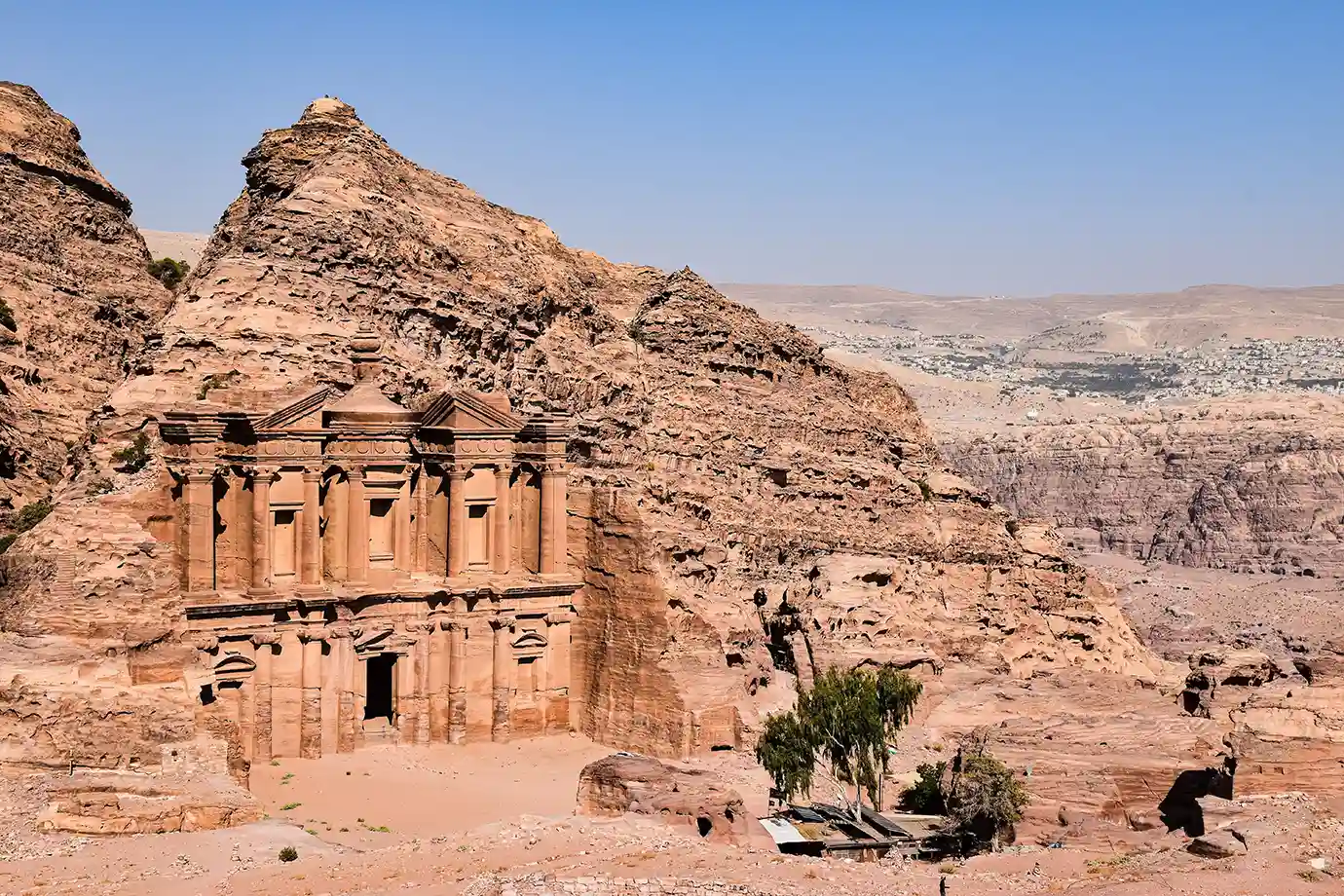
The Monastery is the largest monument in Petra. Its facade measures 48 meters wide and 47 meters tall — both wider and taller than the Treasury. Most visitors who make the climb rate it as the highlight of their Petra experience.
How Many Steps to the Monastery?
The trail from the Basin Restaurant area to the Monastery climbs approximately 800 rock-cut steps over roughly 1.5 km. The climb takes 40 to 60 minutes depending on pace and fitness level. The path is well-maintained and shaded in sections by overhanging rock. Donkey rides are available for those who cannot manage the steps on foot and are arranged at the trail base.
Do not start the Monastery climb after 14:00 in summer. Start by 08:00 to reach the top before 09:30 — morning light and a fraction of the midday crowd.
What the Monastery Looks Like vs the Treasury
The Monastery is deliberately plainer than the Treasury. The upper tier has a simplified broken pediment and a central tholos with a conical roof. No sculpted figures decorate the facade — the Nabataean builders achieved scale through proportion rather than ornament. The central doorway stands 8 meters tall and is the sole source of light for the interior chamber, which measures 11.5 meters by 10 meters.
Byzantine-era Christian crosses are carved into the interior back wall. Two Greek monks reportedly lived in the building in 1217 CE — which is where the name ‘Monastery’ originates. The structure was almost certainly built as a temple or royal tomb.
The End of the World Viewpoint
A narrow path to the left of the Monastery plateau leads to a clifftop viewpoint overlooking Wadi Araba, the rift valley that drops roughly 1,000 meters to the desert floor below. The view extends west toward Israel and the Negev Desert. The walk from the Monastery takes 5 to 10 minutes. No fence or barrier marks the edge — stay well back from the cliff.
The High Place of Sacrifice — The Best Panoramic View
The High Place of Sacrifice sits atop Jebel Madbah, reached by a staircase that branches right from the main valley floor, just past the Theatre. The Theatre takes 45 to 60 minutes to reach and offers significant elevation. At the top: a large flat-cut altar platform, two carved obelisks, and a 360-degree view across the entire Petra basin.
The descent on the far side passes the Lion Fountain, the Garden Tomb, and the Renaissance Tomb before rejoining the colonnaded street. Allow 2 to 2.5 hours total for the High Place circuit. The descent route is easier than the ascent and passes monuments most visitors never see.
Petra by Night — Is It Worth It?
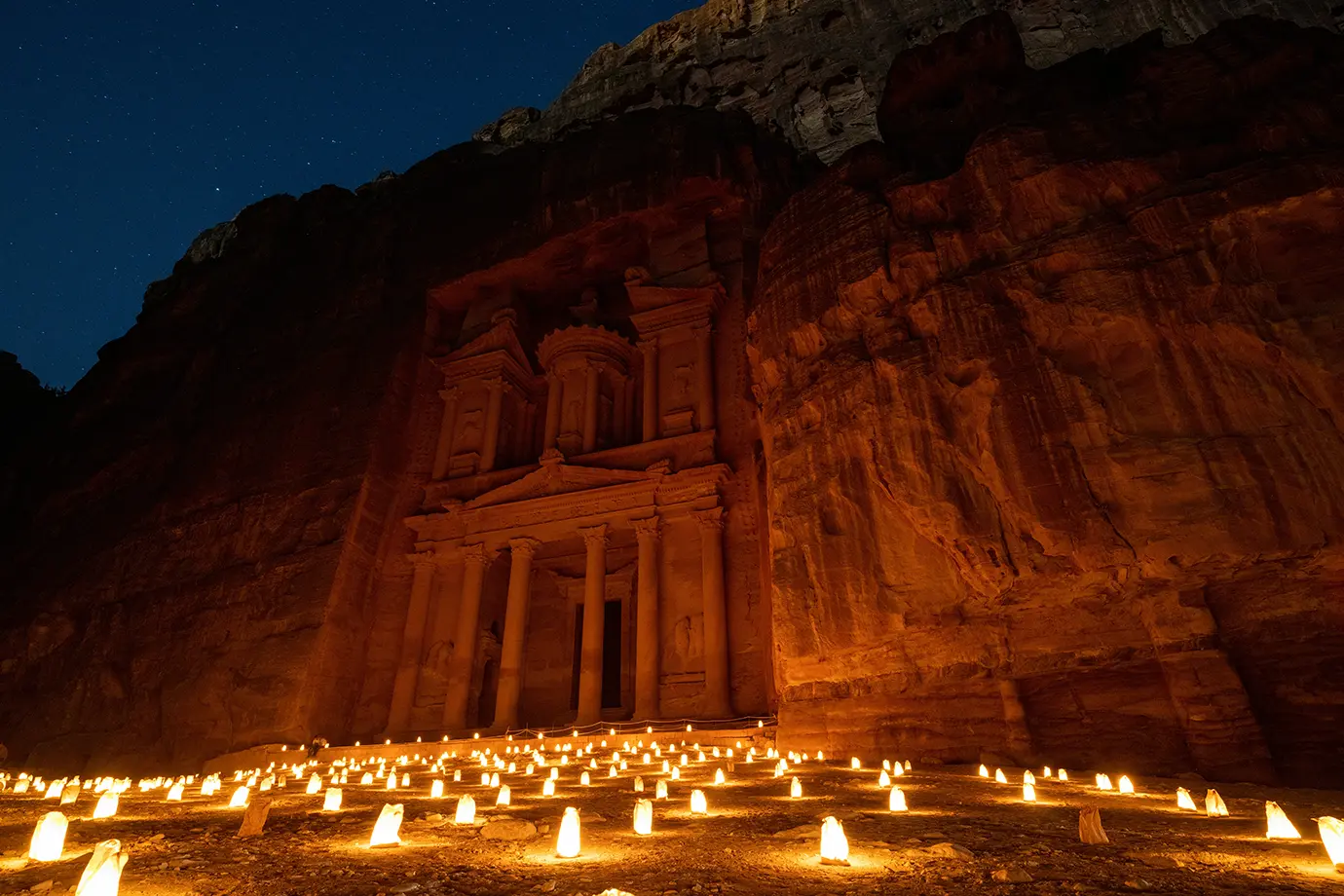
Petra by Night is an atmospheric evening experience that takes visitors through the candlelit Siq to the Treasury, where a projection-mapping show is projected onto the facade. It runs separately from the daytime visit and requires its own ticket.
Current Schedule and Ticket Price
Petra by Night currently runs from Sunday to Thursday, from 8:30 PM to 10:30 PM. The ticket costs 30 JOD per person, and children under 10 enter free of charge. Tickets are sold at the Petra Visitor Center on the day of the event. Check the official Petra by Night website before your visit for schedule updates and ticket details.
The listed program runs Sunday through Thursday, 20:30 to 22:30, at 30 JOD per person. Children under 10 enter free. The Jordan Pass does not cover Petra by Night. You need a valid daytime Petra ticket as a prerequisite, plus the separate 30 JOD evening ticket.
What the Experience Is
Candles placed in paper bags line the Siq from the gate to the Treasury — roughly 1,500 candles over the 1.2 km walk. The effect in darkness is genuinely striking. The Treasury is then lit by projection mapping, which runs a narrated show about Nabataean history and culture onto the carved facade using large-scale visuals.
The experience is atmospheric and worth adding to a two-day Petra visit. It does not replace the daytime visit. Bring a small flashlight for the walk back — the unlit return through the Siq after the show is dark and uneven.
Little Petra (Siq al-Barid) — The Free Alternative
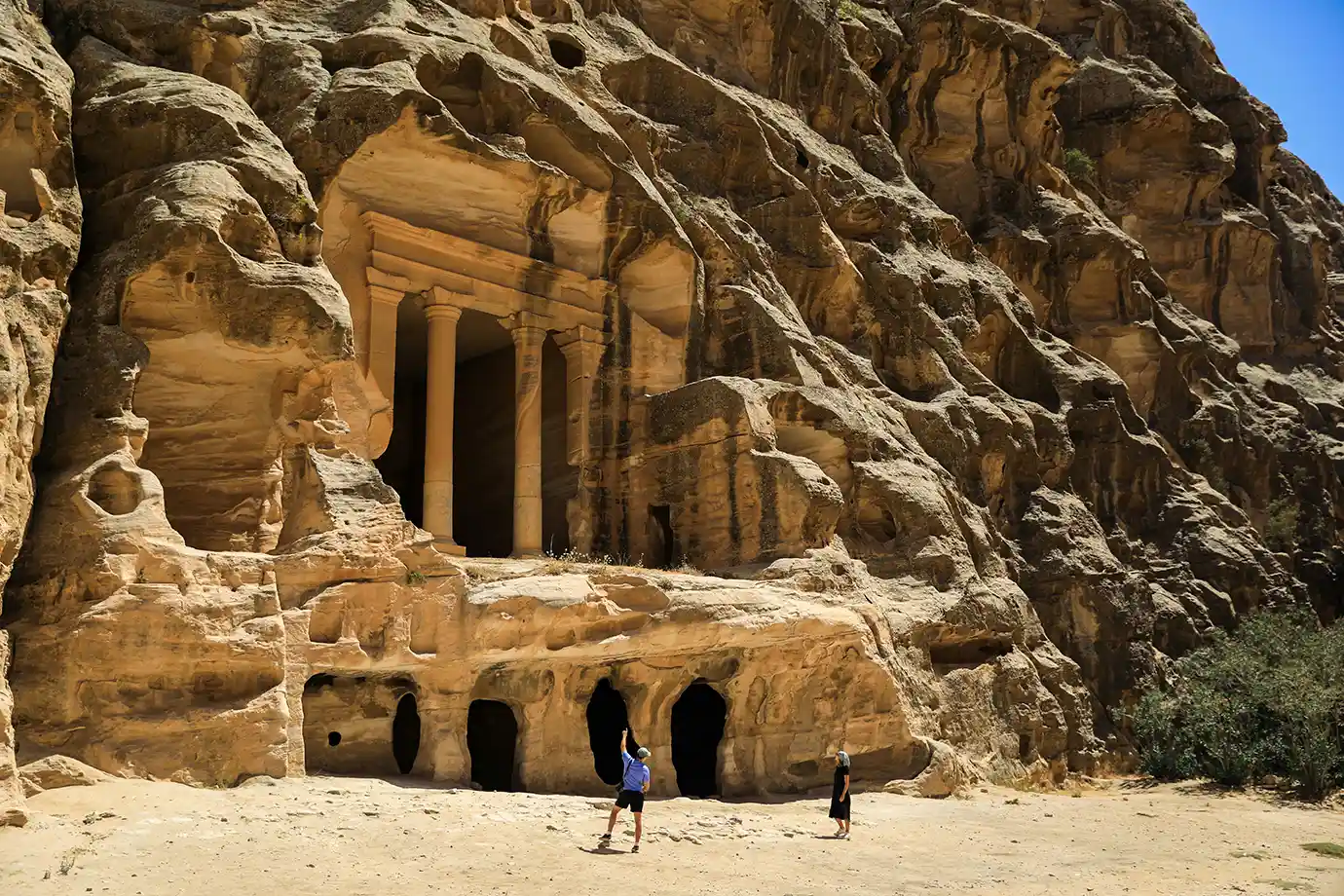
Little Petra — officially Siq al-Barid, meaning ‘the Cold Canyon’ in Arabic — sits 9 km north of the main Petra gate and has no entry fee. The site was a Nabataean suburb built to receive trading caravans arriving from the north before they entered the main city.
The canyon runs approximately 350 meters and opens into four main chambers. The Painted House, a carved dining room (biclinium) inside the gorge, contains the only surviving painted Nabataean frescoes in the region: grapevines, Eros figures, and botanical motifs still visible on the ceiling after 2,000 years of exposure.
Allow one to two hours for Little Petra. Combine it with the nearby Neolithic village of Beidha — one of the oldest human settlements in the Middle East, dating to 7000 BCE — which sits a short walk from the car park.
Practical Tips for Visiting Petra
What to Wear and Bring
Wear closed-toe shoes with ankle support. The Siq floor, the Royal Tombs staircase, and the Monastery trail are all uneven rock — sandals and flip-flops cause falls. A full day can cover 10 to 15 km of walking, depending on your route.
Carry at least 2 liters of water per person from the start. A wide-brim hat and sunscreen are not optional in spring and summer. Pack light — leave large bags at your hotel.
When to Arrive
Petra’s opening hours vary by season. The official schedule lists different closing times for winter and summer, and authorities may adjust hours during special events or unusual conditions. Check the official Jordan site opening hours before setting out.
Is the Jordan Pass Worth It?
Yes. The Jordan Pass covers your Petra entry ticket and waives the 40 JOD tourist visa fee for stays of 3+ nights in Jordan. For most international visitors, the Jordan Pass saves money compared to the Petra entry alone, before accounting for the other 40+ sites it covers, including Jerash and Wadi Rum.
The Jordan Pass covers entry to more than 40 attractions, but it does not include every activity in Petra. Review the official Jordan Pass FAQs to check the visa waiver, pass validity, and attraction conditions.
The Jordan Pass can cover daytime entry to Petra and other attractions across the country. It may also waive the single-entry tourist visa fee for eligible travelers who meet the minimum stay requirement. Read our Jordan Visa and Jordan Pass Guide for details about pass options, visa conditions, and entry rules.
Petra Accessibility
Petra is not wheelchair accessible. The Siq, the Monastery trail, the High Place of Sacrifice, and most internal routes involve steep, uneven rock terrain. Horses are available at the site entrance for the flat section leading up to the Siq. Donkeys are available for the Monastery climb.
Visitors with limited mobility can still experience the Siq and the Treasury on foot — the gorge floor is the most walkable section of the site.
What to Eat Inside Petra
The Basin Restaurant sits at the far end of the main valley, near the start of the Monastery trail. It serves a buffet lunch from late morning — practical rather than exceptional — but it’s the only sit-down option inside the site.
Tea stalls operated by Bedouin vendors appear throughout the site — along the Monastery trail, near the Royal Tombs, and at the High Place viewpoint. Sage tea for a couple of JOD, served in small glasses. Accept it.
The Cave Bar sits at the Petra visitor center end, inside a 2,000-year-old Nabataean tomb. It opens in the evening and is the only licensed bar in the Petra area — a beer in a rock-cut tomb after a long day on the trails. Want to try more local dishes during your Jordan trip? Read our Jordan Food Guide for traditional meals, regional specialties, and places to eat across the country.
Getting to Petra from Amman
The Desert Highway — Faster, Straighter
The Desert Highway runs directly south from Amman to Wadi Musa, covering approximately 240 km. By private car or taxi, the drive takes around 3 hours. JETT buses run daily from Amman’s 7th Circle terminal to Wadi Musa. Journey time is approximately 3.5 hours. Book ahead in peak season as seats sell out.
The King’s Highway — Slower, More Rewarding
The King’s Highway follows an ancient trade route south, winding through Madaba, the Arnon Canyon, Karak Castle, and the Dana Biosphere Reserve before reaching Petra. The drive takes 4 to 5 hours with stops. The scenery is significantly more varied — canyon edges, Byzantine mosaics at Madaba, and the Crusader fortress at Karak.
Taking the King’s Highway south and the Desert Highway north on return is the most efficient use of both routes on a multi-day Jordan itinerary. You can also combine Petra with a visit to the Dead Sea. Our Dead Sea Jordan Guide explains where to float, how to plan a visit, and what to expect at the resorts.
Frequently Asked Questions
How long should I spend in Petra?
Two full days give you the complete Petra experience — including the Monastery, the High Place of Sacrifice, the Royal Tombs, and the Byzantine Church, in addition to the Siq and Treasury. One day is enough to cover the main valley floor and the Treasury at a moderate pace. If you only have half a day, focus on the Siq, Treasury, and Roman Theatre and accept that you are seeing a fraction of the site.
What is the best time to visit Petra?
March to May and September to November are the best months. Temperatures at Petra’s 900-meter elevation range from 18°C to 28°C during those windows, and the light on the sandstone is excellent. June through August is hot — the Monastery climb in 35°C+ heat is genuinely demanding. December through February is cold at Night,t far less crowded, and the low winter sun creates extraordinary light in the Siq.
Is Petra safe to visit?
Petra is safe for international tourists. The site is managed and supervised by the PDTRA. The main hazards are the terrain itself — falls on uneven rock, heat exhaustion, and dehydration. Bring water, wear appropriate footwear, and do not underestimate the walking distances.
Can I visit Petra without a guide?
You can enter and navigate Petra independently. The main route from the Siq to the Treasury to the Colonnaded Street is signposted. For the Monastery trail and the High Place of Sacrifice, the paths are clear. A licensed guide adds significant historical and archaeological context — particularly at the Treasury, the Byzantine Church, and the Royal Tombs — that fundamentally deepens the visit.
Is the Jordan Pass included in a Peregrine Jordan tour?
Yes. All Peregrine Jordan tour packages include the Jordan Pass as a standard component. The pass covers your Petra entry and the tourist visa fee waiver. Peregrine purchases and activates the pass as part of pre-departure coordination, so you arrive with it already confirmed.
| Book a Petra Tour with Peregrine Private tours, licensed guides, Jordan Pass included.
WhatsApp: +977 985 105 2413 Email: sales@peregrinetreks.com Web: www.peregrinetreks.com Response within 24 hours. All itineraries are customizable. |