


Wadi Rum is a UNESCO World Heritage Site in southern Jordan, covering 720 km² of desert valley cut from sandstone and granite. The protected area sits around 290 km south of Amman and 60 km northeast of Aqaba. Known locally as the Valley of the Moon, the site holds 12,000 years of human history — and has doubled as Mars, Arrakis, and a galaxy far, far away for more than a dozen major films.
Wadi Rum Guide: Essential Visitor Information
| UNESCO Status | Mixed Heritage Site (inscribed 2011) |
| Area | 720 km² protected desert valley |
| Location | 290 km south of Amman; 60 km northeast of Aqaba |
| Entry Fee | 5 JOD (covered by Jordan Pass) |
| Nearest Town | Rum Village (no ATM); nearest ATMs in Aqaba |
| Getting There | From Petra: ~1.5 hrs | From Aqaba: ~45 min | From Amman: ~3.5 hrs |
| Best Season | March–May and October–November |
| Inside the Desert | All movement by licensed Bedouin 4×4 only |
What Is Wadi Rum?
Wadi Rum is a protected desert landscape in Jordan’s Aqaba Governorate. UNESCO inscribed it as a Mixed World Heritage Site in 2011 for its natural landforms and cultural record, including thousands of rock carvings, inscriptions, and archaeological remains. The valley combines towering sandstone cliffs, red sand plains, narrow canyons, and natural rock arches, all formed over millions of years by wind and erosion. Over 25,000 rock carvings and 20,000 ancient inscriptions are found across the site, tracing human presence dating back to at least 10,000 BCE.
The name “Valley of the Moon” accurately describes the landscape. The terrain is otherworldly — red and amber dunes between sheer rock walls, with almost no vegetation and almost no sound. The Bedouin tribes of the Zalabia and Zwaideh have lived in this desert for centuries and remain the licensed operators of all tourism within the protected area today. Wadi Rum’s protected landscape also requires careful visitor management. Read the UNEP-WCMC World Heritage site profile for background on the area’s conservation history, protected-area management, and natural features.
How to Get to Wadi Rum
From Petra:
The drive from Wadi Musa (Petra’s main town) to Wadi Rum Visitor Center takes approximately 1.5 hours via the Desert Highway south. Most Jordan itineraries route Petra first, then Wadi Rum, then Aqaba — this direction flows naturally. Petra and Wadi Rum work well together in a Jordan itinerary. Before you travel south, read our Petra travel guide for advice on the main trails, monuments, tickets, and how long to spend at the archaeological site.
From Aqaba:
Wadi Rum sits 60 km northeast of Aqaba. The drive takes approximately 45 minutes on a good road. Day trips from Aqaba are practical — many travelers base themselves in Aqaba and do Wadi Rum as a full-day trip or an overnight.
From Amman:
The Desert Highway south from Amman to Wadi Rum covers approximately 290 km. Driving time is 3 to 3.5 hours. Most travelers reach Wadi Rum as part of a multi-stop itinerary in Jordan. Planning a longer trip? Our Jordan itinerary guide compares 4-, 5-, 7-, and 10-day routes, including time in Petra, Wadi Rum, Amman, and the Dead Sea.
All vehicles enter through the Wadi Rum Visitor Center. All movement inside the protected area requires a licensed Bedouin guide in a 4×4. Private cars cannot drive inside the desert.
What to Do in Wadi Rum
The 4×4 Jeep Safari
The 4×4 Jeep safari is the primary way to see Wadi Rum. All licensed vehicles are driven by Bedouin guides who know the terrain, the stops, and the light. A half-day safari (3 to 4 hours) covers 5 to 8 key formations: typically Lawrence Spring, Khazali Canyon, a red dune, Um Fruth Rock Bridge, and a sunset viewpoint.
A full-day safari extends to further areas — Burdah Rock Bridge, Barrah Canyon, and more distant dunes — and allows time to get out and walk at each stop rather than just photograph from the vehicle.
The Jeep itself is a pickup truck with bench seating in the open bed. You sit in the back, open to the wind and the desert. The sensation of traveling between 300-meter sandstone walls at low speed, with sand drifting across the track, is something no photograph conveys accurately.
Lawrence’s Spring
Lawrence’s Spring sits on the western flank of Jebel Rum, where a natural freshwater spring still seeps from the rock face, supporting a small cluster of palm trees in an otherwise dry valley.
T.E. Lawrence — the British officer whose role in the 1916–1918 Arab Revolt became the subject of the 1962 film — used Wadi Rum as a military base during that campaign. He described the area extensively in his memoir ‘Seven Pillars of Wisdom.’ The spring is one of the most visited stops on the standard Jeep route, partly for the shade and partly for the historical context that a good guide brings.
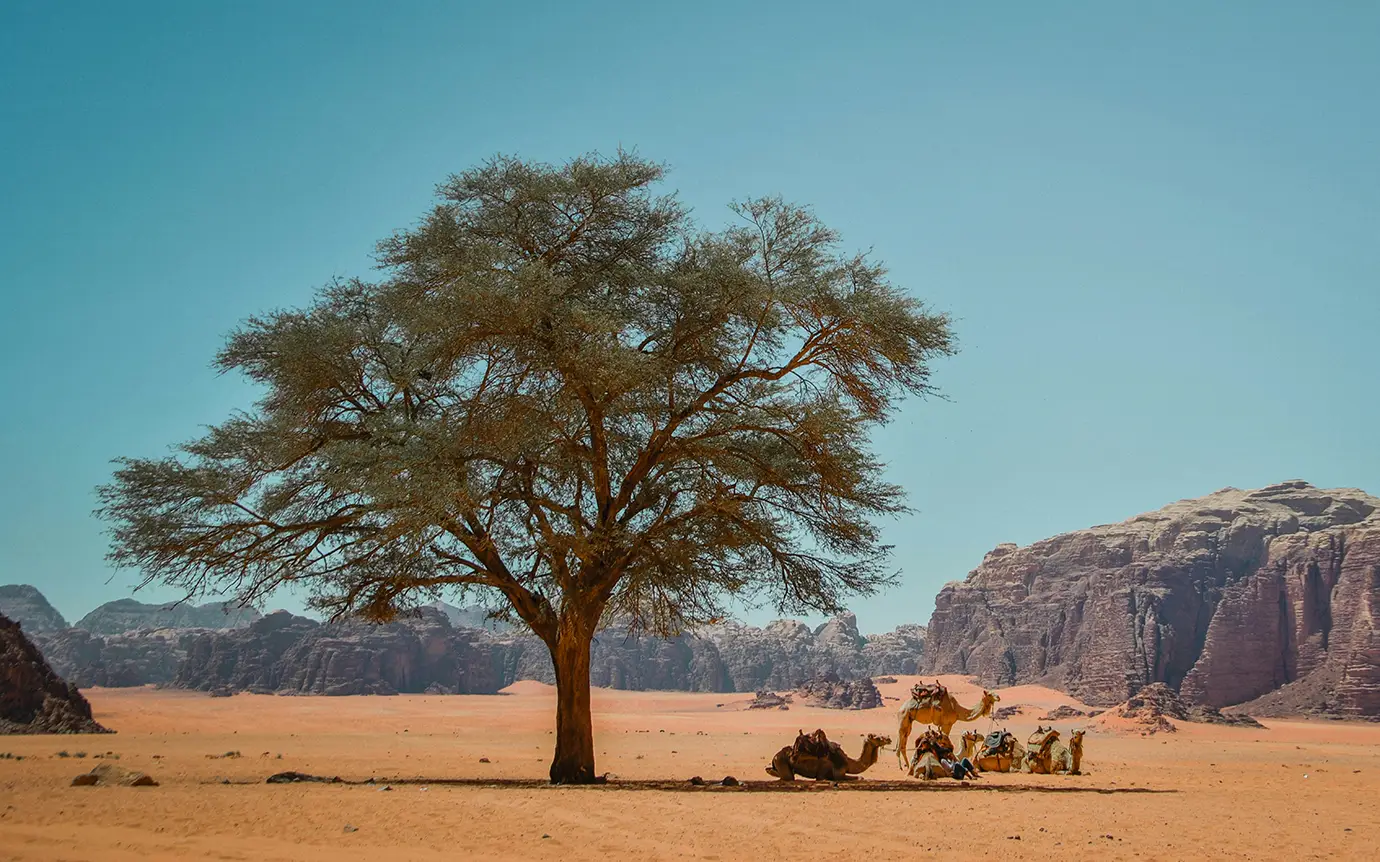
Khazali Canyon
Khazali Canyon is a narrow fissure that cuts deep into Jebel Khazali and is accessible on foot via the Jeep track. The canyon walls carry ancient Nabataean and Thamudic inscriptions — carved figures of humans, animals, and geometric symbols dating back more than 2,000 years. You can walk approximately 150 meters into the canyon before the passage becomes too narrow. The shade inside noticeably lowers the temperature, and the inscriptions are close enough to the path to examine without climbing.
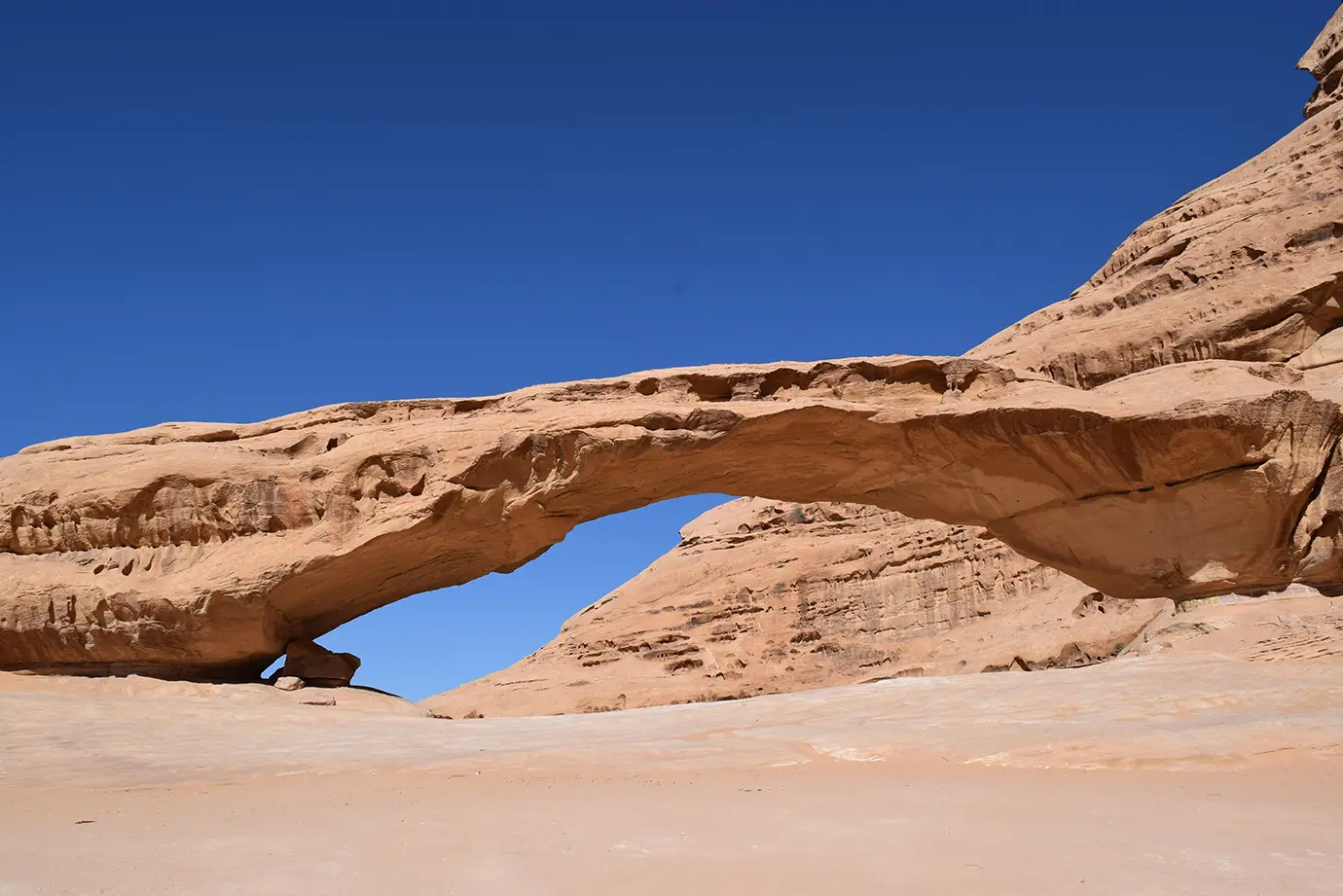
The Natural Rock Bridges
Wadi Rum has several natural rock arches formed by wind erosion through softer sandstone layers.
Um Fruth Rock Bridge is the most accessible — a short scramble of 5 to 10 minutes from the desert floor puts you on top of the arch, with a panoramic view across the red sand plains. Most guides help visitors across it. The crossing requires no special skills, just confidence with heights.
Burdah Rock Bridge is a different category. The bridge sits 80 meters above the surrounding rock on the northern ridge of Jebel Burdah. Reaching it requires a 2- to 3-hour scramble involving rocky terrain, open rock slabs, and a short section where you use your hands to climb. A guide with a rope assists through the most exposed section. The hike is not suitable for those with a strong fear of heights, but for experienced walkers it is one of the finest viewpoints in all of Jordan.
Red Sand Dunes
Several dune fields sit within the protected area, the most striking being those banked against Jebel Umm Ulaydiyya in the central valley. The sand is a deep red-orange color, formed by iron oxide in the eroded sandstone. Climbing to the crest of a major dune takes 10 to 20 minutes and delivers a wide-angle view across the valley floor.
Sandboarding — sliding down the dune face on a simple board — is available at most dune stops through your Bedouin guide. The descent is fast on a board; the walk back up is slower.
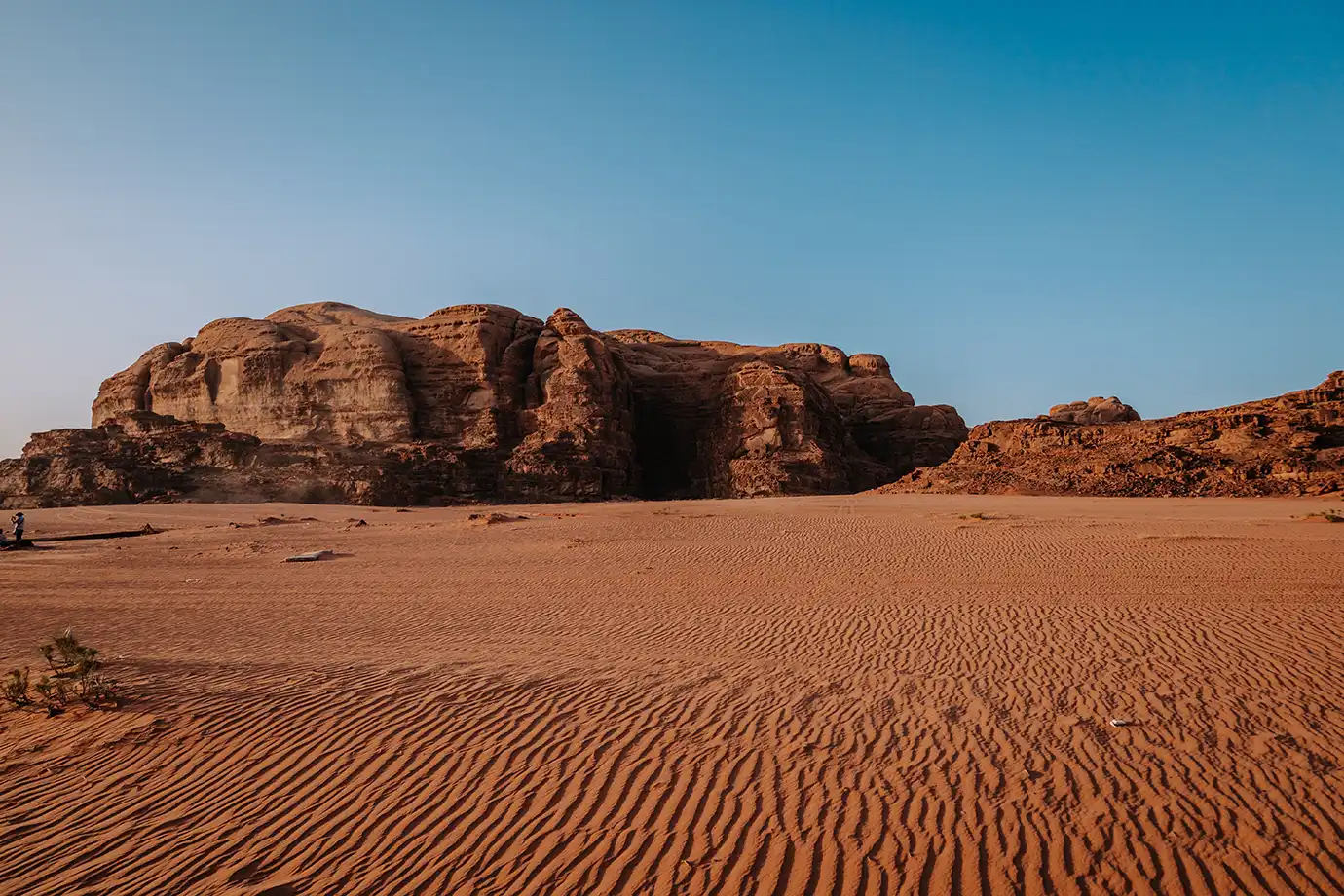
Rock Climbing in Wadi Rum
Wadi Rum has a strong rock-climbing community. The sandstone towers offer routes from beginner scrambles to technically demanding multi-pitch climbs on near-vertical faces. Jebel Rum (1,754m) is the highest point in the area and a popular climbing destination for experienced climbers.
Beginners and intermediates can access guided half-day climbing experiences through Bedouin operators. All climbing requires a licensed local guide inside the protected area.
Camel Rides
Camel rides are offered on a short circuit (30 to 60 minutes) or as a longer sunrise trek before the Jeep tour begins. The pace is slow — camels walk at about 4 km per hour — and the elevated position offers a different perspective on the desert floor and rock walls than a Jeep does.
The sunrise camel trek is one of the most practical ways to experience the desert: you are up before the heat, the light is excellent, and the desert is entirely quiet.
Hot Air Balloon Flights
Hot air balloon flights over Wadi Rum operate seasonally from October through May. Flights launch before sunrise and last approximately one hour, drifting over the valley floor and dune fields at low altitude.
Flights require calm wind conditions and can be canceled on short notice due to weather. Book through your camp or a licensed operator in advance. Peak-season dates fill quickly.
Wadi Rum Camps — How to Choose
Basic Camp vs Luxury Camp vs Martian Dome
Three clear tiers of accommodation exist in Wadi Rum, and the differences are real rather than cosmetic.
Basic tented camps use shared bathroom facilities, no air conditioning, standard bedding, and a communal dining area. The experience is authentic and close to the desert. The trade-off is comfort on cold winter nights and noise from neighboring tents.
Luxury tented camps offer private tents with attached bathrooms, hot water, heating and cooling, and quality bedding. Wadi Rum Night Luxury Camp and Memories Aiwan sit in good locations within the protected area, away from the main visitor clusters. A private luxury tent in Wadi Rum is not the same as a hotel room — the structure is a tent, the floor is desert, and the sky is overhead — but the amenities are genuinely comfortable.
Martian dome camps use geodesic bubble tents or igloo-shaped domes with transparent or semi-transparent panels, providing views of the night sky from inside your bed. Sun City Camp is the most recognized operator running dome tents in Wadi Rum. The dome experience became popular after The Martian’s release.
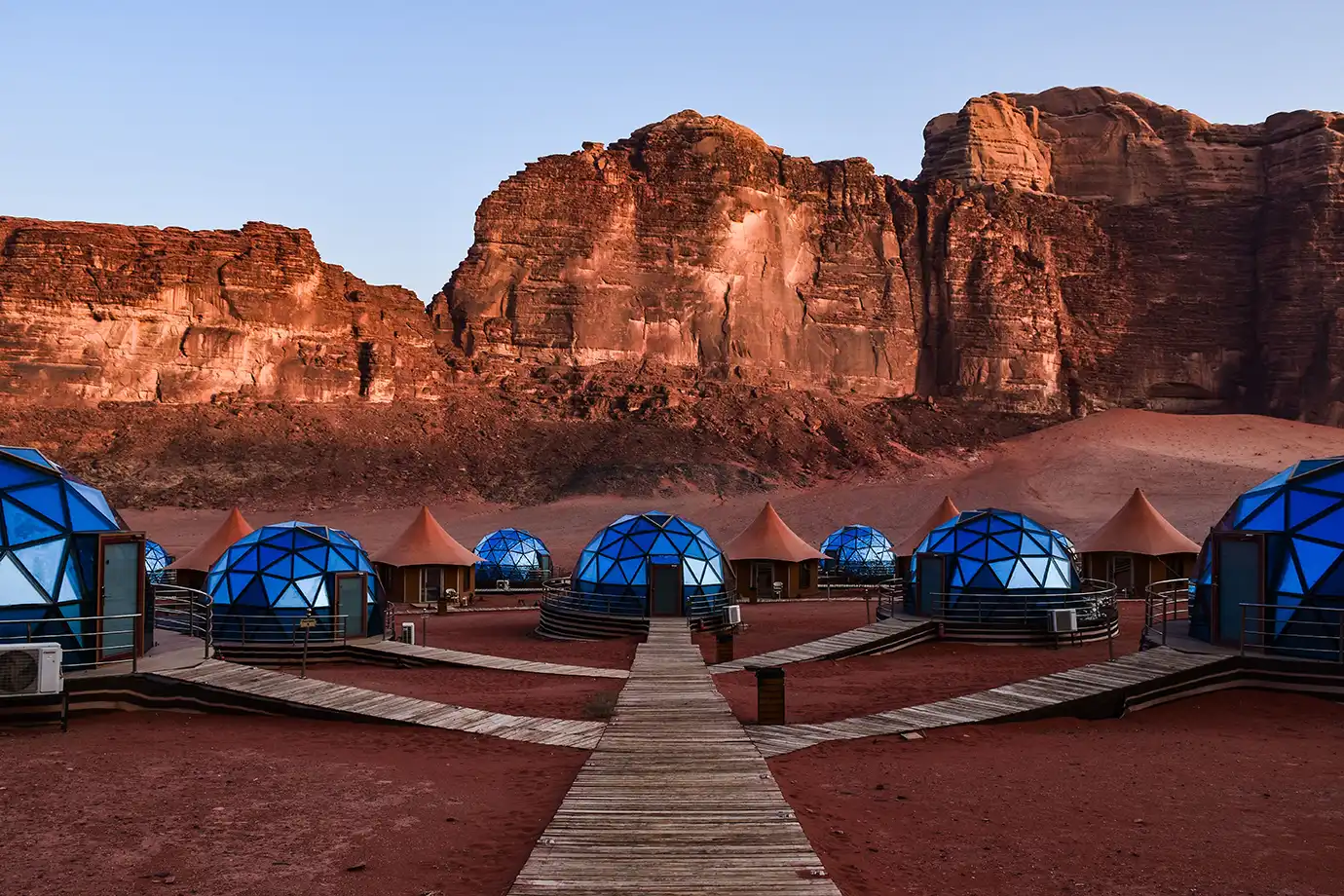
What “En-Suite” Means in Wadi Rum
En-suite in Wadi Rum means a private bathroom attached directly to your tent or dome — your own toilet, shower, and hot water — rather than a shared block some distance from your sleeping area. At reputable luxury camps, the hot water is reliable. At basic camps, it varies. Confirm with your specific camp before booking if this matters to you.
The Overnight Experience — Why It Matters
What Sunset Looks Like from the Desert
Wadi Rum’s sunset lasts about 40 minutes, from the first color change to full dark. The sandstone walls shift through orange, deep red, purple, and eventually near-black as the light falls. The change is gradual enough to watch as a continuous event.
Most camps sit in the valley, facing a dune or a cliff. Guides take overnight guests to a high viewpoint — usually a dune crest or a flat rock ledge — for the actual sunset. The walk takes 5 to 20 minutes, depending on the camp’s location. Go. Do not watch from the camp.
Zarb Dinner — What It Is and How It Works
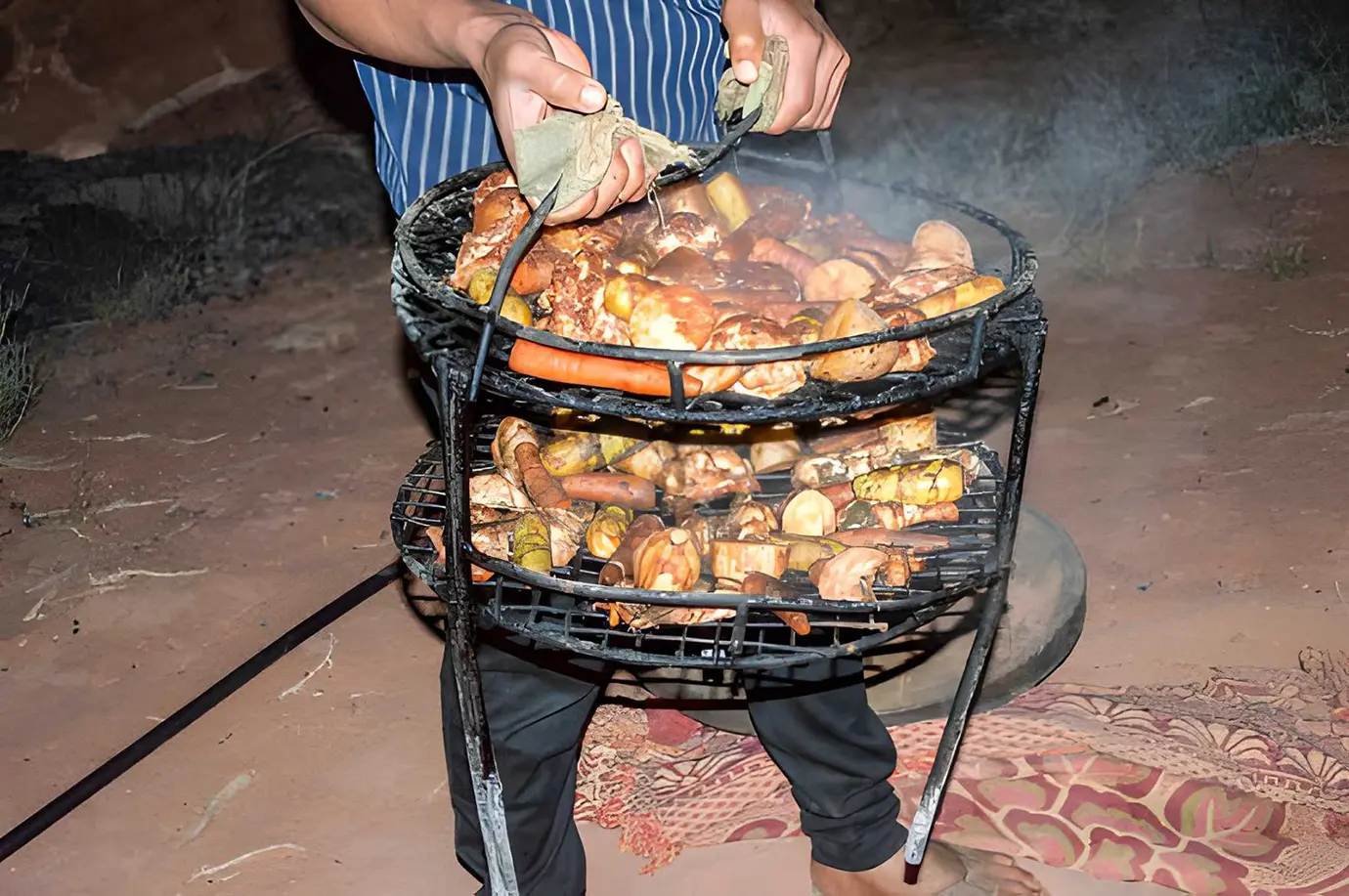
Zarb is the traditional Bedouin underground oven, and every overnight camp in Wadi Rum serves it. A metal rack holding marinated lamb, chicken, and vegetables is lowered into a pit lined with hot coals. A metal lid seals the pit, sand covers the lid, and the food slow-cooks underground for 2 to 3 hours. Zarb offers a taste of Bedouin cooking, but Jordan has many other traditional dishes to try. Read our Jordan Food Guide to discover local meals, regional specialties, and dining experiences across the country.
When the pit is uncovered, steam and the smell of spiced meat rise from the sand. The rack is lifted out, and the food is served communally alongside rice, flatbread, and salads. The meat falls apart. The setting — open sky, fire, total silence beyond the camp — turns dinner into something that is genuinely difficult to replicate anywhere else.
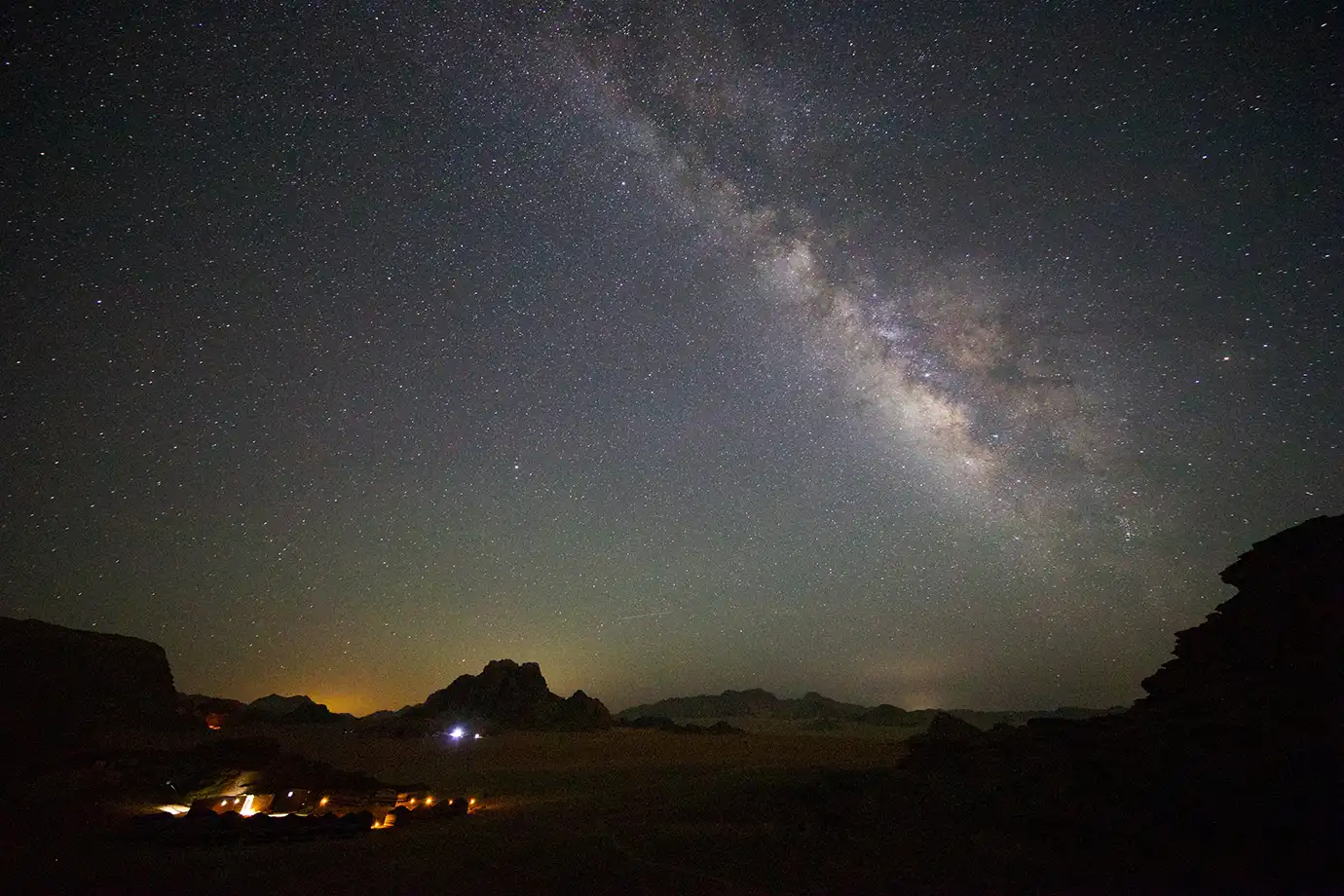
Stargazing at Wadi Rum
Wadi Rum sits in one of the lowest light-pollution zones in the Middle East. On a clear night from October through May, the Milky Way is visible to the naked eye as a dense band across the sky. Familiar constellations appear brighter than most urban observers have ever seen them.
The best stargazing happens away from camp lights. Many guides walk guests 10 to 15 minutes into the desert after dinner, then stand in the darkness. No equipment is needed. The sky does the work.
Sunrise in the Desert
Sunrise at Wadi Rum moves fast. The sky goes from deep blue-black to pink to gold in about 20 minutes, and the rock walls catch the first light on their upper faces before the valley floor brightens. Most camps have a dune crest within a 10-minute walk that faces east.
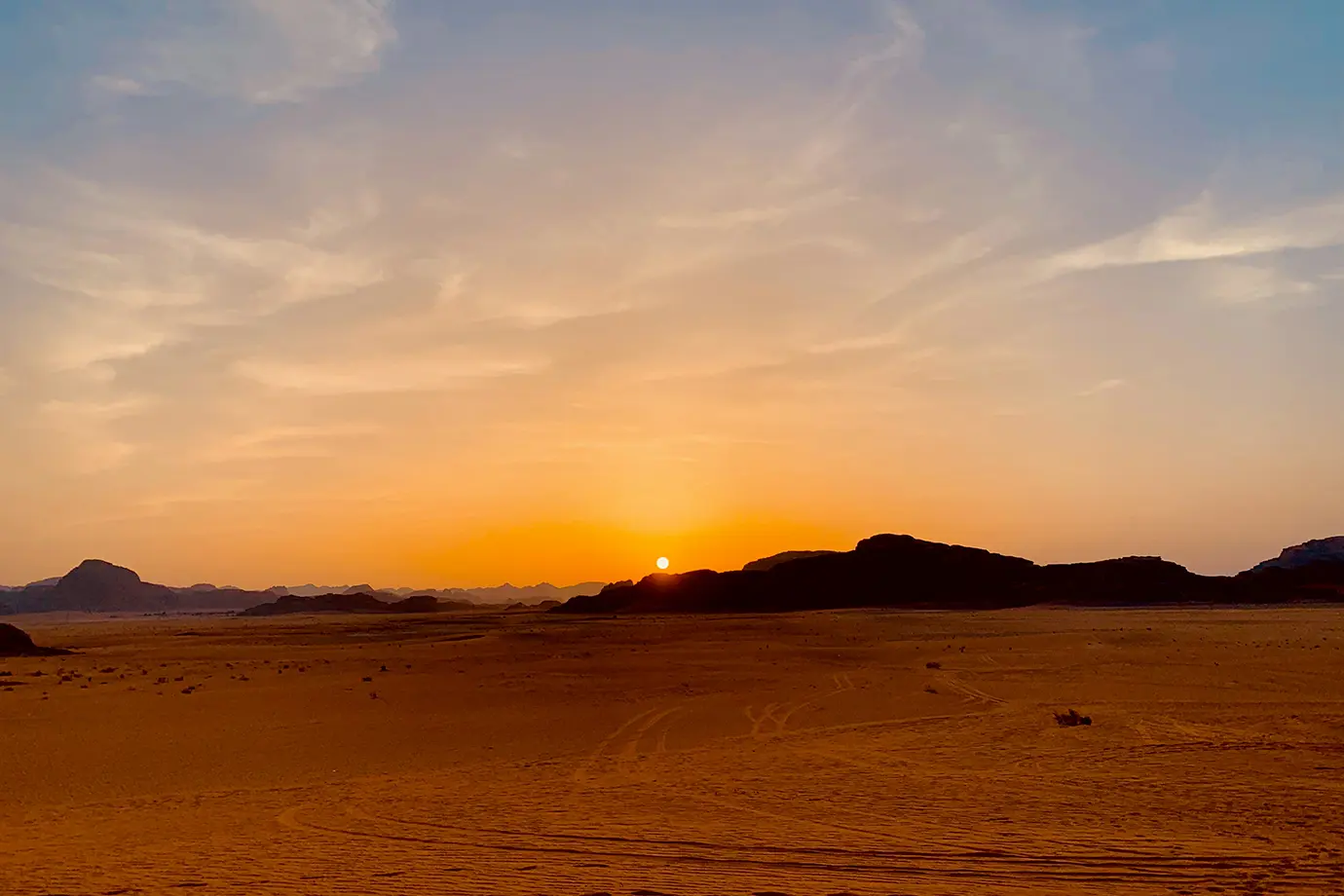
Ask your guide to walk you to the sunrise viewpoint the night before first light. The view from the dune crest in the first 10 minutes of daylight is worth the early start.
Wadi Rum Films — Where Were the Famous Scenes Shot?
Lawrence of Arabia (1962)
Lawrence of Arabia was the film that introduced Wadi Rum to the world. Directed by David Lean and starring Peter O’Toole as T.E. Lawrence, the production used Wadi Rum for the scenes set around Prince Feisal’s desert camp and the early sequences of the Arab Revolt. The Seven Pillars of Wisdom rock formation, directly behind the Wadi Rum Visitor Center, was named after Lawrence’s memoir. Lawrence’s Spring — a stop on every standard Jeep tour — marks the area where he camped during the 1917–1918 campaign.
When you visit these stops with a guide who knows the film, you are standing on locations that appear in footage shot over 60 years ago. The terrain has changed very little.
The Martian (2015)
Ridley Scott chose Wadi Rum to represent the surface of Mars in The Martian. The red sand plains and isolated rock buttes photographically match NASA’s images of the Martian surface closely enough that the production required minimal digital alteration. The wide shots of astronaut Mark Watney crossing the open desert and the rover-journey sequences all used Wadi Rum’s central valley.
The Mars associations stuck commercially. Several Wadi Rum camps use Martian-themed branding, and the geodesic dome tent style became popular partly because the domes resemble the habitat structures depicted in the film.
Dune: Part One and Part Two (2021/2024)
Denis Villeneuve’s Dune adaptation used Wadi Rum to represent the desert planet Arrakis. The production returned for the sequel, filming across the wide valley floors and the canyon walls that create Arrakis in the films. The broad sandy basins framed by sheer cliffs — visible in the Fremen camp sequences and the open-desert riding scenes — are Wadi Rum’s actual terrain.
A local guide familiar with the film locations can show you the specific formations used. However, many are several kilometers into the protected area and not accessible on a standard half-day tour.
Rogue One: A Star Wars Story (2016)
Rogue One used Wadi Rum to depict Jedha, a small desert moon that served as a pilgrimage site and Imperial-occupied territory in the film. The production used the Sunset Point area several kilometers north of the main Wadi Rum road, and a rock bridge structure in the Kharez region of the valley.
The cliff-lined canyon approach to Jedha City, visible in the film, maps directly onto the narrow passages between sandstone towers that you travel through on every Jeep tour. If you have seen the film, you will recognize the terrain immediately.
When Is the Best Time to Visit Wadi Rum?
Spring (March to May) and autumn (October to November) are the two optimal windows. Temperatures are comfortable for Jeep tours, dune climbing, and long outdoor hours. Nights are cool but not cold.
| Season | Temperatures | Conditions | Notes |
|---|---|---|---|
| Spring (Mar–May) | 20°C–32°C day / 10°C–18°C night | Ideal | Peak season; book camps ahead |
| Summer (Jun–Sep) | 35°C–42°C+ day / 22°C–28°C night | Very hot | Start all outdoor activity before 09:00 |
| Autumn (Oct–Nov) | 22°C–30°C day / 12°C–18°C night | Ideal | Best stargazing window begins |
| Winter (Dec–Feb) | 10°C–18°C day / 0°C–8°C night | Cold nights | Clearest skies; cold requires layers |
Summer is the hardest season. Temperatures above 40°C are dangerous for extended outdoor activity. Summer visits require strict heat management — early starts and shade by 11:00.
Winter brings the coldest nights, dropping near or below freezing between December and February. The advantage is exceptional sky clarity for stargazing, fewer visitors, and dramatic cold-light photography. A genuine down layer is required for desert nights.
What to Pack for Wadi Rum
Wadi Rum does not require specialized desert gear. The Jeep tour puts you in a vehicle for most of the visit, and the camps handle shelter and food. What you actually need:
- Layers for the night: a fleece or light insulated jacket for spring and autumn; a proper down layer for winter
- Closed-toe shoes with grip — for dune climbing and rock scrambling at Um Fruth
- SPF 50+ sunscreen — the desert reflects UV; apply before the first Jeep stop
- Sunglasses with full UV coverage — reflected glare off sand is intense
- 2+ liters of water per person for the Jeep tour
- Portable phone charger — power sockets in the desert are limited
- Headlamp or small flashlight — camp paths are unlit after dark
- Cash in JOD — no ATMs in Wadi Rum village; nearest ATMs are in Aqaba
- Scarf or buff — the open Jeep kicks up dust on sand tracks
Wadi Rum Practical Information
Entry fee:
5 JOD per person for foreign visitors, paid at the Wadi Rum Visitor Center. The Jordan Pass covers standard Wadi Rum entry — present it at the gate. All Peregrine Jordan packages include the Jordan Pass. Before buying the pass, review the official Jordan Pass FAQs for details about included attractions, eligibility, validity, and visa-fee exemptions.
RSCN registration:
All tourism activities within the protected area require operators to be licensed by the RSCN and registered with ASEZA. Peregrine handles this registration as part of every Wadi Rum package — no paperwork required from you.
Inside the protected area:
Private cars cannot drive inside the desert. All movement from the Visitor Center inward uses licensed Bedouin Jeeps. Your camp or guide will collect you at the Visitor Center.
Nearest services:
Aqaba, 60 km away, has full services — ATMs, pharmacies, hospitals, fuel, and an airport. Carry what you need before entering the protected area. Mobile signal inside Wadi Rum is intermittent; download offline maps before you go.
Frequently Asked Questions
Is Wadi Rum worth an overnight stay?
Yes — an overnight stay is what separates the full Wadi Rum experience from a Jeep ride. Day-trip visitors see the formations and leave. Overnight visitors experience the sunset light change, the zarb dinner, the Milky Way sky after dark, and the silence that settles over the desert once all other visitors have gone. A single night is the minimum; two nights allow a fuller range of activities.
How far is Wadi Rum from Petra?
Wadi Rum is approximately 1.5 hours by car from Wadi Musa (Petra’s main town) via the Desert Highway south. The route is direct and well-paved. Most Jordan itineraries pair Petra and Wadi Rum consecutively — two nights at Petra, then one or two nights at Wadi Rum, then Aqaba.
Is the Jordan Pass worth it for Wadi Rum?
Yes. Wadi Rum entry is included in the Jordan Pass alongside Petra, Jerash, and over 40 other sites. Buy the pass through the official Jordan Pass website before arriving in Jordan if you want to use its eligible visa-fee exemption. Check the current conditions and included attractions before purchase.
What is the difference between a basic camp and a luxury camp in Wadi Rum?
A basic camp uses shared or simple private bathrooms, basic bedding, and no climate control. A luxury camp provides a private tent with an attached en-suite bathroom, hot water, heating and cooling, and quality bedding. The Martian dome option adds a transparent ceiling with direct views of the night sky from bed. For most international visitors, a luxury camp or dome is the practical choice — the desert itself is wild enough.
Can I visit Wadi Rum without an overnight stay?
Yes. A half-day or full-day Jeep tour is practical for those who cannot stay overnight. Day visitors experience the main geological formations, the inscriptions at Khazali Canyon, the dunes, and the rock bridges. The sunset and night sky are only available to overnight guests. If your itinerary allows even one night, the overnight stay is the better choice.
| Book a Wadi Rum Tour with Peregrine Jordan Pass included and licensed Bedouin camps—no RSCN paperwork required.
WhatsApp: +977 985 105 2413 Email: sales@peregrinetreks.com Web: www.peregrinetreks.com Response within 24 hours. All itineraries are customizable. |