


Baku earns its reputation. The Flame Towers catch the light at dusk in a way that stops you mid-step. The winding lanes of the UNESCO Old City hold a thousand years of stone and silence. The Absheron fire temples sit in the semi-desert east of the city, burning on gas seeps that have been alight since antiquity. Spend three days in Baku, and you will not run out of things to see.
But the places to visit in Azerbaijan outside Baku are where the country’s real geographic range reveals itself. Within a few hours of the capital, the terrain shifts from Caspian shoreline to high alpine ridge, from semi-desert steppe to temperate rainforest. A mountain village sits at 2,200 meters, where residents speak a language unrelated to Azerbaijani. A lake formed when an earthquake collapsed a mountainside in 1139. A national park holds between 7,000 and 8,000 gazelles on a plain that sits below sea level. A medieval fortress resisted Timur’s armies for fourteen years from a peak you can climb on foot in under two hours.
None of these requires an internal flight. Most are reachable from Baku in a single day by road. Each adds a dimension to Azerbaijan that the capital, for all its energy, cannot provide on its own. This guide covers five destinations — Quba and Khinaliq, Lankaran and Hirkan Forest, Ganja and Lake Göygöl, Shirvan National Park, and the Nakhchivan exclave — with the practical information you need to plan each stop.
Here are the five best places to visit in Azerbaijan outside Baku, with distances, logistics, and the details that make each one worth the drive.
1. Quba: Hiking Country and the UNESCO Village of Khinaliq
Quba is the primary gateway to hiking in the Greater Caucasus. The city sits roughly 170 kilometers north of Baku and is accessible by road in about 3 hours. From Quba, you can reach the Tenghi Canyon by 4×4, as well as the UNESCO village of Khinaliq. Khinaliq sits at approximately 2,200 meters — Azerbaijan’s highest continuously inhabited settlement.
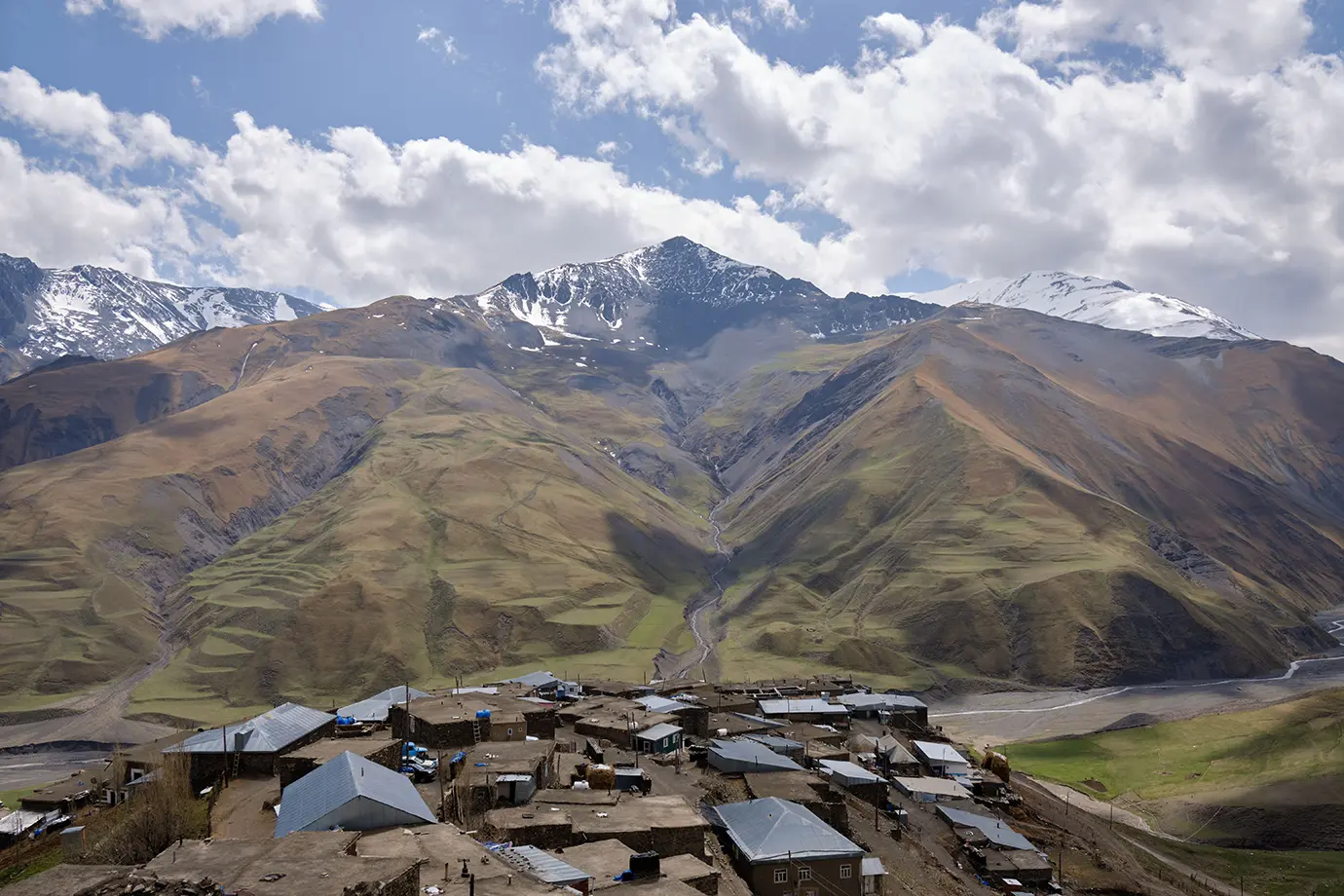
Quba city itself is pleasant but compact — most travelers treat it as an overnight base rather than a destination. The real draw is 50 kilometers southwest on a winding mountain road. Khinaliq sits at approximately 2,200 meters on the Greater Caucasus ridge. The village has around 2,000 residents who speak a distinct language unrelated to Azerbaijani. UNESCO inscribed the Cultural Landscape of Khinalig People and the Köç Yolu Transhumance Route as a World Heritage Site in 2023.
The houses are ancient stone constructions, stacked up the hillside with almost no flat ground between them. Sheep and cattle wander the lanes between buildings. On clear days, the ridge above the village gives an unobstructed view north toward Russian territory. On bad days, the cloud sits in the valley below, and the village floats above it.
How to Reach Khinaliq
Quba is a mandatory transit point. Marshrutkas (minibusses) leave frequently from the Baku International Bus Terminal, with the trip taking around 3 hours and 20 minutes. From Quba, the 50-kilometer road to Khinaliq takes 1.5 to 2 hours. The final stretch requires a capable 4×4 or, at a minimum, a high-clearance vehicle. The road includes narrow sections where one car must reverse to allow another to pass.
No ATMs exist in Khinaliq. Withdraw cash in Quba.
Local taxis run from Quba market to Khinaliq and back. Agree on the Azerbaijan Travel Cost before departure. Your accommodation in Quba can also arrange a driver for you. Homestays operate in the village — book one to avoid the round-trip same-day drive.
Hiking Above Khinaliq
Several trails leave the village directly for the surrounding ridges. The traditional Köç Yolu route — the transhumance path that the Khinalig people used for centuries to move livestock to summer pastures — is the most historically significant. Experienced trekkers with a local guide can complete multi-day routes across the ridge into the neighboring valleys.
Even without a guide, a 2-hour walk above the village to the first ridge gives panoramic views across the Greater Caucasus without technical difficulty. Afternoon thunderstorms build quickly at this altitude. Start before 09:00 and aim to return to a lower elevation by 14:00.
Tenghi Canyon is a separate half-day excursion from Quba town.—the gorge cuts between sheer limestone walls, with a river path running along the canyon floor. The trail is wet and rocky in places — wear trail shoes.
When to Visit Quba and Khinaliq
Late May through September offers the best conditions. Snow closes the Khinaliq road from November through April in most years. Summer temperatures at the village level run cool even when Baku is hot — bring a fleece for evenings regardless of the month.
2. Lankaran: Tea Plantations, Subtropical Coast, and Hirkan Forest
Lankaran is the main city of Azerbaijan’s southern region. It sits on the Caspian coast about 260 kilometers south of Baku, a roughly 3.5-hour drive. The surrounding region runs a humid subtropical climate that produces Azerbaijan’s tea crop and supports a forest ecosystem unlike anything else in the Caucasus.
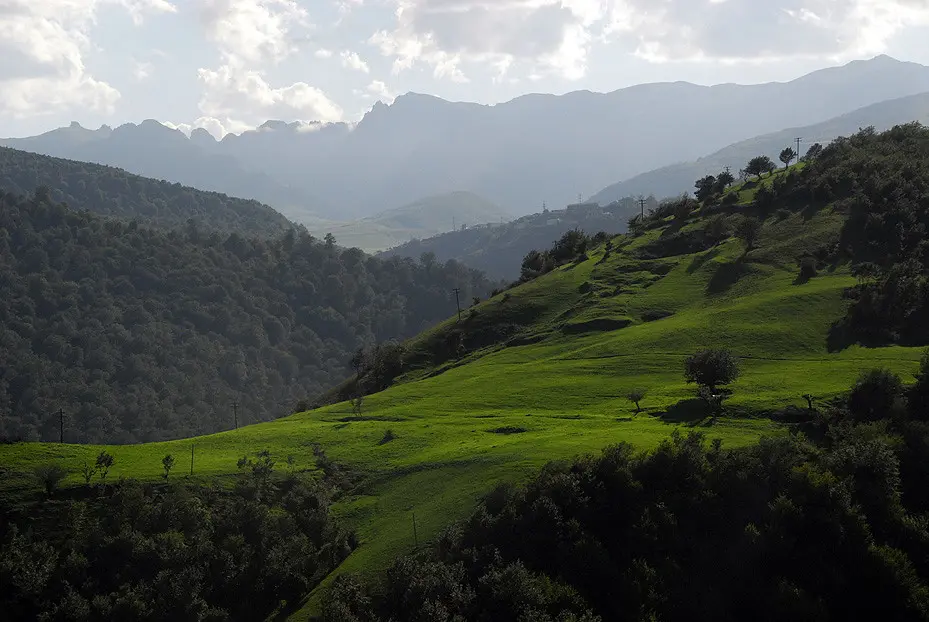
The appeal here is entirely natural. Rolling tea plantations cover the lower Talysh Mountain slopes. The coastline sits at sea level with a beach strip and a small fishing harbor. Inland, 30 to 40 kilometers from the coast, Hirkan National Park holds one of the last surviving Hyrcanian forest fragments. A temperate rainforest type that once covered much of Eurasia before the Ice Ages survived in this narrow coastal strip.
Hirkan National Park
Hirkan National Park covers 40,358 hectares across the Lankaran and Astara districts. UNESCO inscribed the Hyrcanian Forests — a joint Iranian and Azerbaijani site — on the World Heritage List in 2019.
The park’s most distinctive tree is the ironwood (Parrotia persica), a relict species that predates the Ice Age. Ironwood is so dense that it sinks in water. Some specimens in Hirkan are estimated to be over a thousand years old.
The forest also holds 150 endemic tree and plant species found nowhere else on earth. Wildlife includes the Persian leopard (critically endangered and rarely sighted), brown bear, lynx, European roe deer, wild boar, and red fox. Birdlife is strong throughout, with black stork, golden eagle, and Caucasian woodpecker among the notable species.
A visitor center at the park entrance provides guided trail maps. The main walking trails are well-maintained and run through dense lowland forest. The best times for wildlife observation are early morning and dusk.
Lankaran Town
Lankaran itself is a small, relaxed city with a pleasant waterfront. The old fortress (most of the walls are 19th century) and the local market are worth a morning. The city’s Talysh cuisine differs from northern Azerbaijani food — fish dominates, with pomegranate sauces and aromatic herb dishes served alongside.
When to Visit Lankaran
Lankaran receives the highest annual rainfall in Azerbaijan — the humid subtropical climate that sustains the forest also brings heavy rain. The forest is green and atmospheric in almost any season. Spring (April to June) and autumn (September to November) are the most comfortable for hiking. Summer is warm and humid.
Read More: Best Time to Visit Azerbaijan: Season-by-Season Guide
3. Ganja: Azerbaijan’s Second City and the Earthquake Lake
Ganja is Azerbaijan’s second-largest city, 355 kilometers west of Baku. Reach it by train in roughly 5 to 6 hours or by car in around 4 hours. The city was founded in the 5th century and served briefly as the first capital of the Azerbaijan Democratic Republic in 1918. Its old quarter holds Safavid-era monuments alongside the mausoleum of the 12th-century poet Nizami Ganjavi.
What to See in Ganja
The Chokak Hamam (built in 1606, commissioned by the Safavid ruler Shah Abbas I) is Ganja’s most interesting historic building. The structure is built from brick and clay with a central dome flanked by two smaller domes. The hamam still functions as a bath and cultural center. You can book a session. The steam room is original.
The Mausoleum of Nizami Ganjavi stands just outside the city. It honors the 12th-century poet whose five epic poems — the Khamsa — remain central texts in Persian and Azerbaijani literature. The current mausoleum was completed in 1991, replacing earlier structures. The surrounding garden complex includes sculptures depicting scenes from the Khamsa.
Also worth seeing: the Shah Abbas Mosque (1606, twin-minaret, red-brick) and the Alexander Nevsky Church (19th-century Russian Orthodox, still active). The eccentric Bottle House is a private home whose exterior walls hold 48,000 embedded bottles in decorative patterns.
Ganja is an easy overnight. The city center is walkable. Stay two nights,s and you have time for the city sites and the lake.
Lake Göygöl
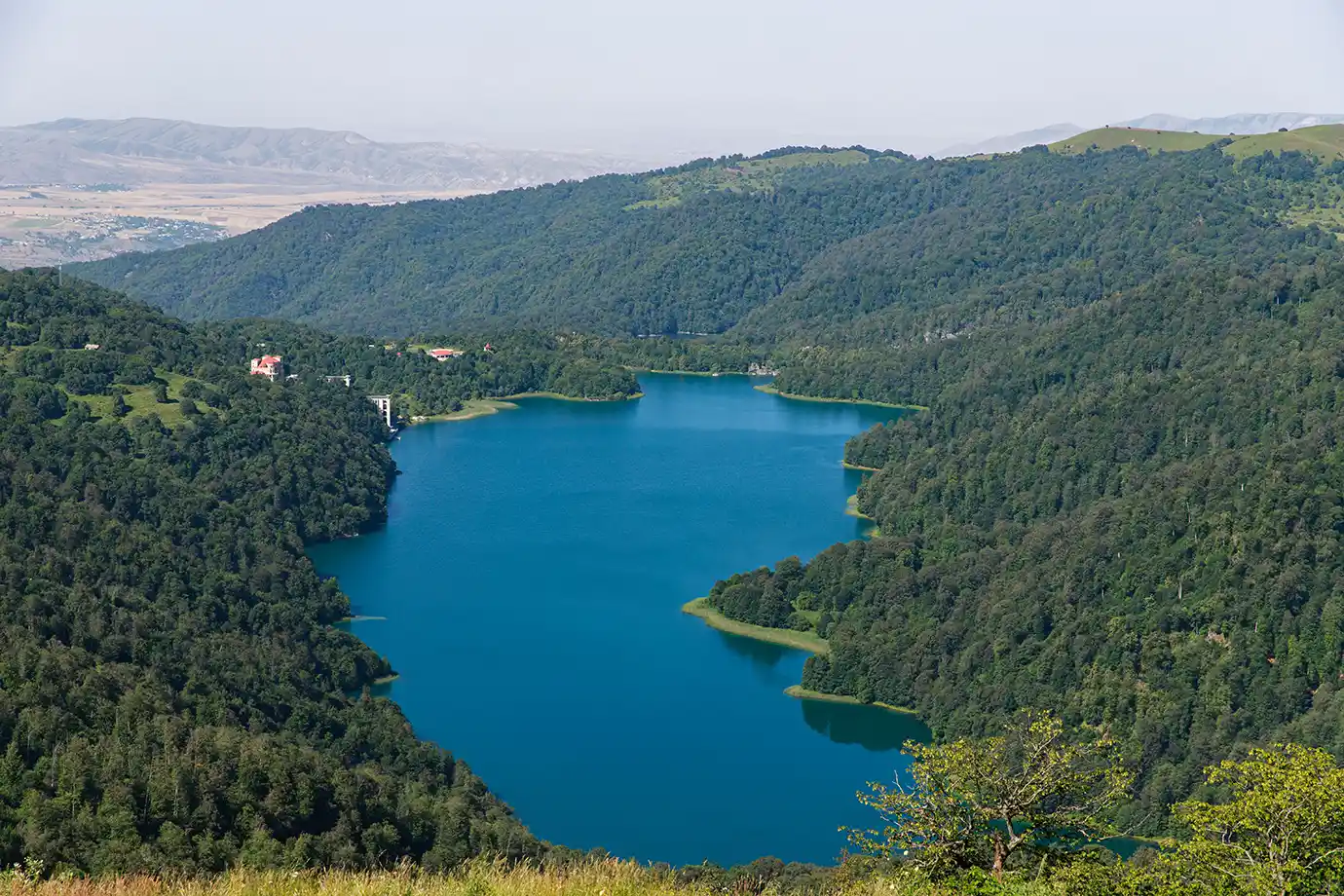
Lake Göygöl (meaning “Blue Lake”) sits about 45 to 50 kilometers south of Ganja at an elevation of 1,553 meters. The lake formed on September 30, 1139. A catastrophic earthquake caused part of Mount Kapato to collapse into the Akhsu River gorge, creating a natural dam. The same earthquake created seven smaller lakes in the surrounding valley.
The lake covers 0.78 square kilometers and reaches a maximum depth of 96 meters. The water is cold and exceptionally clear — the only fish species present is trout, and all fishing is prohibited. The surrounding Göygöl National Park (12,755 hectares, established in 2008) features oak and beech forests and is home to wild boar, brown bear, lynx, and roe deer.
A paved road runs from Ganja to the national park. From the park entrance, take a shared taxi or drive the final 20 kilometers to the lake itself. Designated walking paths run along the lakeside.
When to Visit Ganja and Göygöl
May through October offers the best conditions. The lake road can be closed by snow from December to March. September and October give the best forest color and cooler temperatures for the uphill drive.
4. Shirvan National Park: Gazelles and Bird Migration on the Caspian Steppe
Shirvan National Park sits about 100 kilometers south of Baku on the Baku-Astara main road. It is the most accessible major wildlife destination in Azerbaijan — roughly a 1.5-hour drive from the capital. The park covers 54,373 hectares of semi-desert steppe and shallow Caspian wetlands, lying 20 to 25 meters below sea level.
The land here was once part of the Caspian seabed. The flat, semi-arid plain with scattered water reservoirs looks and functions like the East African savannah, just transplanted to a Caspian context.
What You Can See
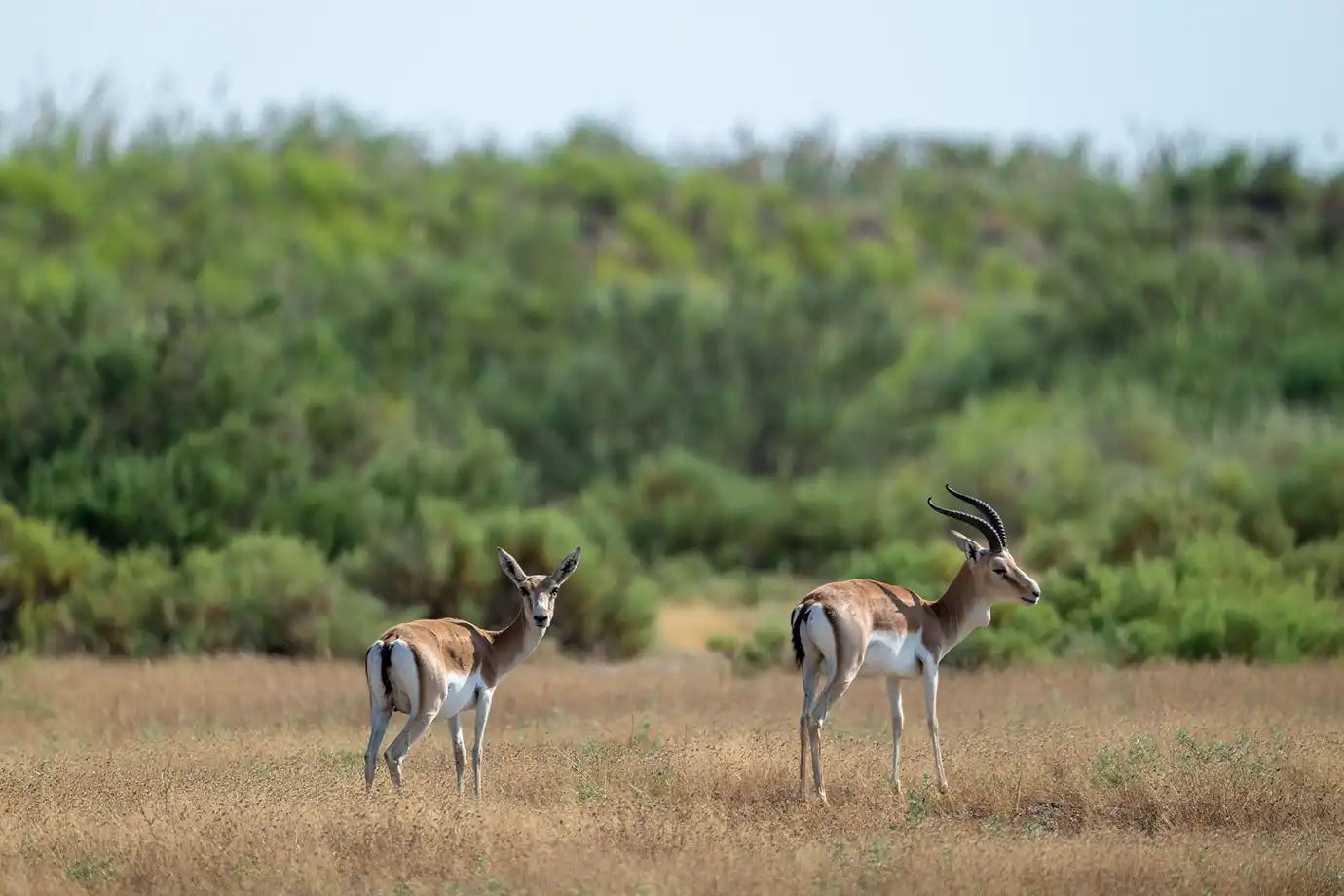
The park’s signature animal is the goitered gazelle (jeyran in Azerbaijani — named for the pouch in the male’s throat). Numbers had fallen to just a few hundred animals in the 1960s following Soviet-era hunting. A protected reserve was established in 1969. Conservation work since then has brought the population back to between 7,000 and 8,000 animals within the park. Sightings are near-guaranteed.
You will also find jackals, jungle cats, red foxes, grey wolves, and wild boar within the park. Reptiles include the Greek tortoise and various snake species. The wetland zones attract flamingos, pelicans, swans, cranes, and steppe eagles among the over 270 recorded bird species. The park sits directly on the Caspian coast bird migration corridor.
Little bustard flocks in winter sometimes exceed 25,000 birds in the steppe zones. For serious birdwatchers, December through February can be more productive than summer at Shirvan.
Logistics for Visiting
The park entrance is on the main Baku-Astara road. Private vehicles can enter with a fee. A ranger-guided jeep tour within the park gives the best gazelle sightings, as the animals are accustomed to vehicles and allow close approach. Walking is restricted to designated zones.
Morning visits produce the most wildlife activity. Bring binoculars and a telephoto lens — the steppe is flat, and animals are visible at a distance before you get close.
When to Visit
The park is open year-round. Spring (April to June) is excellent for breeding gazelles and the full range of water birds. Winter (December to February) brings the largest concentrations of migrant birds. Summer heat is intense on the exposed steppe — early morning departures are essential in July and August.
5. Nakhchivan: The Exclave, Alinja Castle, and the Edge of Azerbaijan
Nakhchivan is a detached piece of Azerbaijani territory surrounded by Armenia, Iran, and Turkey, with no land connection to the rest of Azerbaijan. Reaching it requires a flight from Baku (around 1 hour on AZAL) or a road entry from Turkey or Iran. The exclave has its own parliament, administration, and distinct character.
Soviet-era architecture and an ultra-dry continental climate define Nakhchivan’s atmosphere. Sharp mountains rising from semi-desert plains complete a visual identity found nowhere else in Azerbaijan.
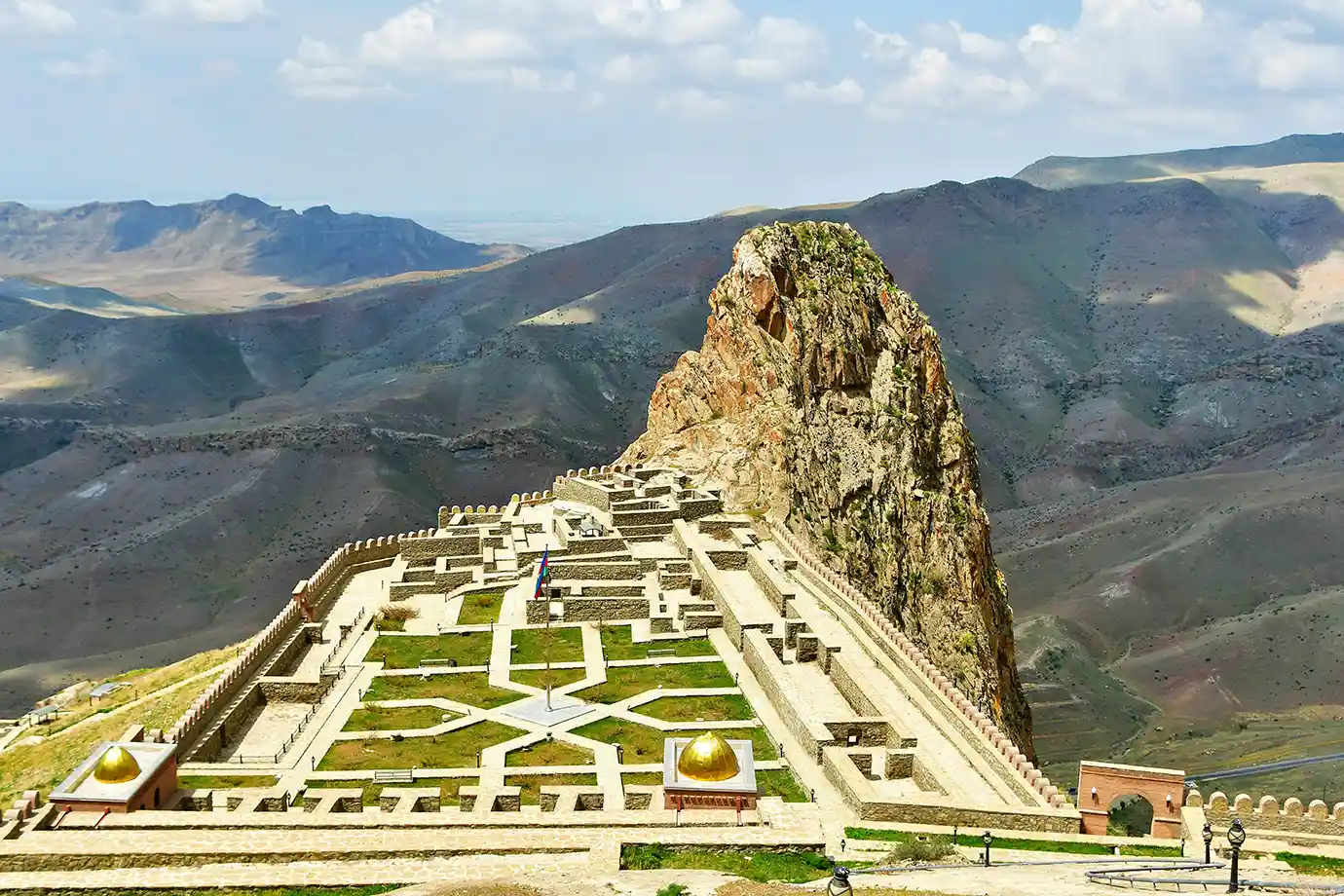
Alinja Castle
Alinja Castle is the main reason hikers and history travelers come to Nakhchivan. The medieval fortress sits at approximately 1,800 meters on the peak of Alinja Mountain, about 30 kilometers east of Nakhchivan city.
Timur’s armies besieged the castle between 1387 and 140, for 14 years, but never took it. The structure still communicates that fact from a distance. The approach from the road is entirely on foot, up approximately 1,500 stone steps cut into the mountainside. The climb takes 45 minutes to 2 hours, depending on fitness level and conditions. The restored fortress walls and towers at the top give a panoramic view across the surrounding mountain range.
Start the climb no later than 08:30 in summer. The exposed southern face bakes in full sun by mid-morning, and the heat on the pale stone steps is severe with no shade. Bring a minimum of 2 liters of water per person. No facilities exist on the mountain.
A local taxi or minibus from Nakhchivan city center covers the 30-kilometer road to the base of Alinja Mountain. Minibusses heading toward Khanagah village pass within 1 kilometer of the steps.
Other Sites in Nakhchivan
The Momine Khatun Mausoleum in the city center dates from 1186 and is one of the finest surviving examples of medieval Azerbaijani brick architecture. The distinctive octagonal tower rises to 2 meters,s with intricate geometric tilework in original Seljuk style.
The Duzdag salt mine near Nakhchivan city operates as a therapeutic wellness facility — visitors can sleep in a sanitized underground salt chamber for respiratory treatments.
Getting to Nakhchivan
AZAL operates multiple daily flights between Baku (Heydar Aliyev Airport) and Nakhchivan International Airport. The flight takes approximately 1 hour. Book in advance during summer — capacity is limited, and routes fill quickly with local travelers.
An overland route into Nakhchivan is possible via Turkey (from Igdir, crossing at Sadarak) or via Iran (from Jolfa or Parsabad). These routes require a valid Iranian or Turkish visa,s where applicable.
When to Visit
Spring (April to June) and autumn (September to October) are the best windows. Nakhchivan summers are hot and dry. Daytime temperatures in July and August frequently exceed 35°C, though nights at an elevation of t 873 meters run cooler than n Baku. The castle climb becomes grueling in peak heat. Winters are cold and can be snowy.
Frequently Asked Questions
What are the best places to visit in Azerbaijan outside Baku for hiking?
Quba and the surrounding Khinaliq area offer the most accessible high-altitude hiking in Azerbaijan. Khinaliq village, at an elevation of approximately 2,200 meters, is the starting point for routes along the Köç Yolu transhumance trail. UNESCO inscribed it as a World Heritage Site in 2023. The Tenghi Canyon near Quba is a separate half-day gorge walk. For more remote hiking, Nakhchivan’s Alinja Castle climb is the most dramatic single-day ascent in the country.
How far is Ganja from Baku, and is it worth visiting?
Ganja is approximately 355 kilometers west of Baku, reachable by car in about 4 hours or by train in 5 to 6 hours. Two sites make it worth a detour: the Chokak Hamam (built in 1606, still functioning) and the mausoleum of the poet Nizami Ganjavi. A day trip to Lake Göygöl adds an alpine counterpoint to the city’s historic sites. Formed by an earthquake in 1139, the lake sits at an elevation of 1,553 meters.
Can you see the goitered gazelle at Shirvan National Park?
Yes. Shirvan National Park is home to between 7,000 and 8,000 goitered gazelles across its 54,373 hectares of semi-desert steppe. Sightings during a guided jeep tour are near-guaranteed. The park also records over 270 bird species, with particularly large concentrations of migratory waterbirds from December through February. Shirvan sits approximately 100 kilometers south of Baku — about 1.5 hours by road.
Is Nakhchivan accessible to foreign tourists?
Yes. AZAL operates direct flights from Baku to Nakhchivan International Airport in about 1 hour. No special permits are required beyond the standard Azerbaijan e-visa for most nationalities. The exclave borders Armenia, Iran, and Turkey but has no land connection to the rest of Azerbaijan. Most visitors arrive by air from Baku. Entry via Turkey or Iran is possible but requires valid visas for those countries.
What makes Hirkan National Park unique?
Hirkan National Park protects one of the world’s last surviving Hyrcanian temperate rainforests. Before the Ice Ages, this forest type covered much of Eurasia. It survived only in the narrow coastal strip between the Talysh Mountains and the Caspian Sea. The park covers 40,358 hectares and was inscribed on the UNESCO World Heritage List as part of the Hyrcanian Forests in 2019. Its most iconic species is the ironwood tree (Parrotia persica), a relict species so dense it sinks in water.
Email: sales@peregrinetreks.com
WhatsApp: +977 985 105 2413
Web: peregrinetreks.com. To build a private Azerbaijan tour package covering the best places to visit in Azerbaijan outside Baku, contact the Peregrine team directly.